
Greetings to our subscribers and supporters,
Over the past month, the Institute has been active on several fronts, primarily working on the Transport Regulation and the Dogs and Cats Welfare Regulation. We also continued our collaborative advocacy by co-signing a series of joint letters with partner organizations.
On May 21st, we joined the Aquatic Animal Alliance in urging the New Zealand government to reject any new funding for projects aimed at developing octopus factory farming. On June 5th, we joined Brussels-based organizations in calling on Commissioner for Climate Wopke Hoesktra to implement meaningful measures in the agriculture sector to help achieve the EU’s 2040 climate target. Additionally, we helped promote WeMove Europe’s #ThisIsNotAFarm campaign, launched in advance of the CAP negotiations expected by the end of this year.
As we approach the summer break, we will be monitoring several critical areas:
Outbreaks of animal diseases such as African swine fever and avian influenza continue to spread across the EU, prompting regulatory updates. These ongoing crises underscore the vulnerability of animals, particularly when farmed in high concentration, as well as the potentially catastrophic public health risks posed by factory farming.
Meanwhile, pressure on large carnivores is intensifying. The proposed amendment to the Habitats Directive, together with increasingly permissive national rules for wolf hunting, reflects a growing political willingness to manage these species primarily via lethal means. These developments, along with other signs, have fueled concern that bears might be the next species targeted for removal by similar methods.
Updates from the Institute
Tribute to Paula Sparks
The Parliament’s AGRI Committee vote on the proposed Dogs and Cats Regulation
Animal Law News
EU
Member States
International Law
Events
Job Postings
Publications
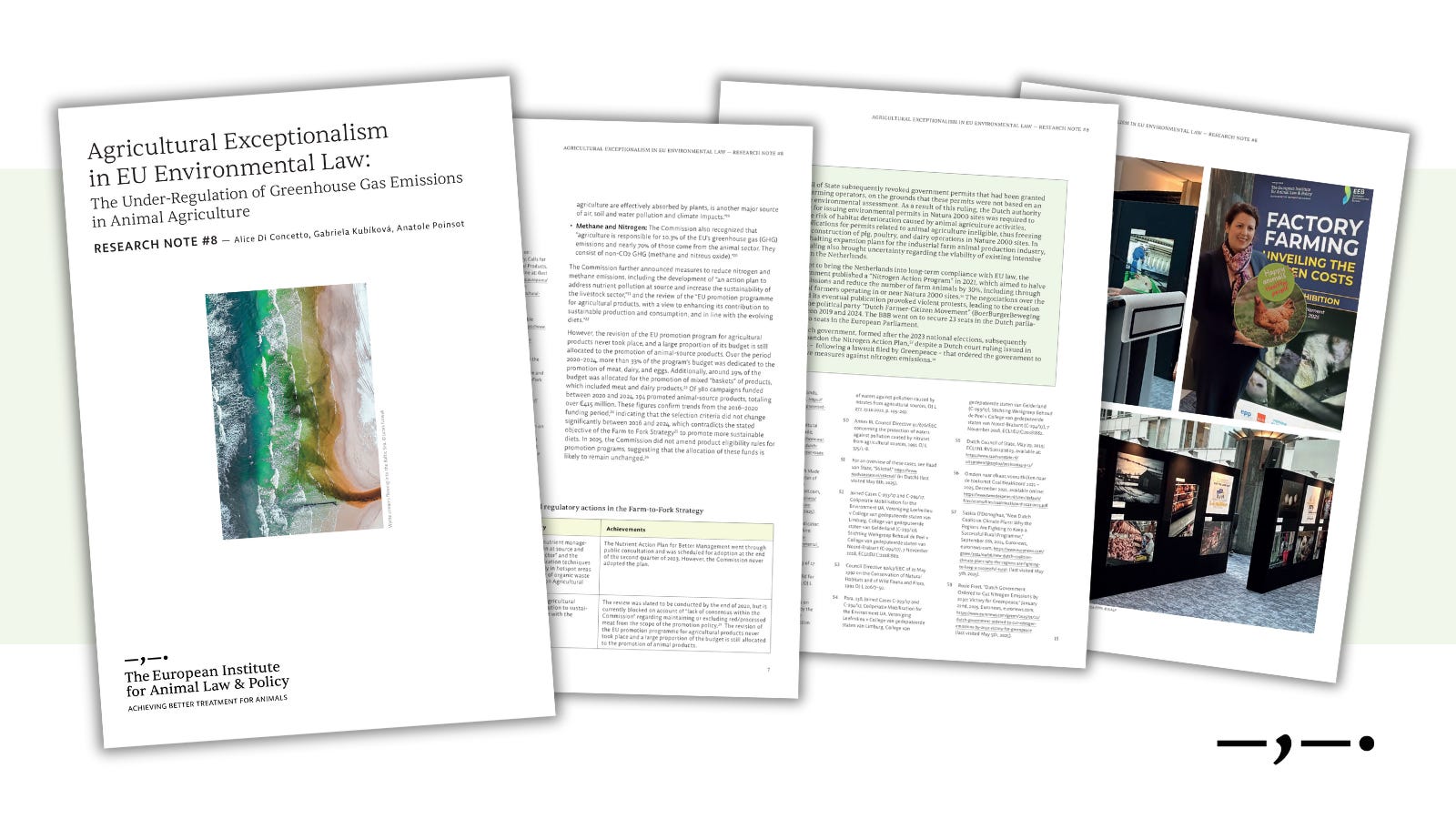
This quarter’s Research Note is titled “Agricultural Exceptionalism in EU Environmental Law.” It examines the policy and regulatory instruments currently in place to limit and regulate greenhouse gas emissions from animal agriculture in the EU. It further provides a detailed account of the nitrogen crisis in the Netherlands and explores the political context surrounding the 2024 revision of the Industrial Emissions Directive. With this Research Note, we also hope to help bridge the gap between environmental and animal advocacy movements, building on the momentum of the exhibition on factory farming we co-organized with EEB in the European Parliament.
This Research Note was co-authored by Gabriela Kubíková (Policy Advisor) and Anatole Poinsot (Lawyer). The Institute thanks Sandra Beuving (Dierencoalitie) and Roberto Talenti (PhD Candidate in Agri-Environmental Law at Scuola Superiore Sant’Anna, Pisa, Italy) for their feedback on an early draft of the Note.
Alice Di Concetto (Chief Legal Advisor) authored two law review articles:
The Gradual Development of the EU’s Competence in Animal Welfare Law and Policy, published in a special issue “New Perspectives on Animal Treatment” in the Revista Catalana de Dret Públic (Catalan Public Law Review), edited by Professor Carolina C. Leiva Ilabaca (Autonomous University of Barcelona).
Animals in the Law: Questioning the Property / Other-Than-Property Duality, with Hugo Marro-Menotti, in the Sorbonne Doctoral Law review, edited by Marina Lovichi.
Alice will speak at the conference “Access to Justice for Animals in Europe: Towards an ‘Aarhus Convention’ for Animals?,” on July 1st in Hamburg, Germany. This conference is organized by the research group AJA (Access to Justice for Animals) and hosted by the Max Planck Institute for Comparative and International Private Law.
Alice will speak at the Oxford Centre for Animal Ethics’ Summer School, Animal Captivity and the Law: Progress and Limitations, on August 6th.
We were deeply saddened to learn that Paula Sparks, the founder and chairperson of the UK Centre for Animal Law (A-Law), passed away on May 30th. Paula was such a kind and dedicated person, elegant, a true trailblazer in the field of animal law in the UK and beyond. Through her passionate advocacy and insightful knowledge, she inspired and helped train the next generation of animal lawyers. Her legacy will, without a doubt, contribute to the education of future generations committed to advancing animal welfare.
We will miss her dearly and remember her with great affection.
You can read A-Law’s obituary in honor of Paula here.
On June 3rd, the European Parliament’s Committee on Agriculture and Rural Development (AGRI Committee) adopted its amendments to the proposal for a new Regulation on the Welfare of Dogs and Cats and their Traceability. Although initially seen as a consensus-based piece of legislation, rules about the scope of the regulation had become a point of contention, stalling in the limbo of inter-party negotiations. The June vote was thus a welcome step towards the adoption of this new regulation, which would be the first to set companion animal welfare standards in EU law.
Key Advances and Persisting Gaps
Key amendments to the Regulation include storing the microchip numbers of cats and dogs in a single EU database. MEPs also voted to extend the rules to cover not only imports for commercial purposes but also non-commercial movements, meaning that the Regulation would cover dogs and cats that enter the EU as non-commercial companion animals but which may later be sold in the EU. Lastly, MEPs also voted to prohibit close family breeding, the separation of puppies and kittens from their mothers until at least eight weeks, and the breeding of dogs or cats that have excessive conformational traits – such as brachiocephalic breeds.
However, the amendments by the MEPs fall short of mandatory identification and registration of all cats and dogs before they’re sold, and they continue to allow numerous exemptions from these rules, such as for owners of farm dogs for instance.
Next Steps
The AGRI Committee’s amendments will be tabled for a vote in the Parliament’s plenary, which is expected to take place the second week of July. Because the Council of the EU published its set of amendments back in June 2024, the next step in the legislative process will be negotiations between the European Commission, the Council of the EU, and the European Parliament, which will likely take place in the second half of 2025.
📝 New Laws
Animal Health (HPAI): On May 12th, the Commission adopted Implementing Decision 2025/896 updating emergency measures in response to new outbreaks of highly pathogenic avian influenza (HPAI) in Hungary and Poland.
Fish (fishing quotas): On May 15th, the Commission adopted Implementing Regulation 2025/916 to update Italy’s allocated fishing quotas due to overfishing occurring in 2024.
Animal Health (sheep and goat pox): On May 15th, the Commission adopted Implementing Regulations 2025/909 and 2025/948 on emergency measures related to sheep pox and goat pox.
Horses: On May 19th, the Commission adopted Implementing Regulation 2025/899 pertaining to the inclusion of Thailand on the list of third countries or territories or zones thereof authorised for the entry into the Union of consignments of equine animals.
Wild Animals (nature restoration): On May 19th, the Commission adopted Implementing Regulation 2025/912 establishing the format for national restoration plans. The Regulation aims to standardize the format of national restoration plans that the Member States must adopt and implement as part of the 2024 EU Nature Restoration Law.
Animal Health (African Swine Fever): On May 22nd, the Commission adopted Implementing Regulation 2025/1072 amending Implementing Regulation 2023/594 on special disease control measures for African Swine Fever. The new rules update the zoning status of regions in Germany, Latvia, Poland, and Slovakia.
Trade (Farmed animals) and Animal Health (HPAI): On May 22nd, the Commission adopted Implementing Regulation 2025/900 and 2025/1085 restricting the territories, or zones authorized to export poultry and poultry products into the EU, following outbreaks of HPAI in Canada and the US.
Animal Welfare (all animals): On June 5th, the Commission adopted Decision 2017/C 31/12 establishing the Commission Expert Group “Platform on Animal Welfare,” limiting the number of observers to a maximum of 20 and extending the platform’s mandate until June 30th, 2030 (instead of 2025, as initially planned).
🌐 Trade Agreements
EU/Ivory Coast – Aquatic Animals (fishing quotas): The EU and the Ivory Coast have signed a 4-year protocol renewing a fisheries partnership agreement allowing EU vessels to fish tuna and migratory species in Ivorian waters.
✍️ Public Consultations
Farmed Animals (climate): The Commission is seeking feedback on an implementing regulation related to harmonized third-party verification under Regulation 2024/3012 to set up an EU certification framework for permanent carbon removals, carbon farming, and carbon storage in products.
Deadline: July 1st, 2025.Farmed Animals (Common Agricultural Policy): The Commission is seeking feedback on its proposal for a regulation amending Regulation 2021/2115 on the simplification of the Common Agricultural Policy regulations, including conditionality and inspection rules.
Deadline: August 1st, 2025.The Commission further announced the following upcoming calls:
a call for evidence followed by a public consultation on the “modernization of EU legislation on on-farm animal welfare for certain animals” in the next few months.
a call for evidence in response to the “Fur Free Europe” European Citizens’ Initiative, which urged the EU to ban fur farms and the sale of fur products in the EU.
Other News
Farmed Animals (Common Agricultural Policy): On May 14th, the Commission published a proposal for an omnibus regulation amending Regulation 2021/2115 on the simplification of Common Agricultural Policy regulations, including conditionality and inspection rules.
Wild Animals (wolves): On June 5th, the Council of the EU adopted the Directive as regards the Protection Status of the Wolf, which would amend the Habitats Directive to change the level of protection of wolves from “strictly protected” to “protected.”
Aquatic Animals: On June 5th, the Commission published The European Ocean Pact, including a Vision 2024 for fisheries and aquaculture. The document mainly contains aspirational objectives that aim to bring consistency between existing laws, such as the Common Fisheries Policy Regulation and the Marine Strategy Framework Directive.
📝 New Laws
🇩🇰 Denmark – Companion Animals (extreme breeding): On May 26th, the Danish Veterinary and Food Administration adopted a rule prohibiting the breeding of dogs with serious hereditary health issues, such as hip dysplasia, respiratory problems, spinal disorders, and heart defects. The decree will enter into force on July 1st, 2025.
🇫🇷 France – Farmed animals (chicks): On May 2nd, the French government adopted a new rule establishing a tax to be paid by retailers and wholesalers to help cover costs associated with in ovo sexing in the egg industry.
🇪🇸 Spain – Food Transition: On April 15th, the Spanish executive authorities adopted a rule requiring more fruits and vegetables to be served in school cafeterias.
⚖️ Rulings
🇨🇿 Czechia – Farmed Animals: In a ruling handed down on April 7th, the Supreme Administrative Court (Nejvyšší správní soud) rejected the legal action by the environmental protection organization Dobře zapsaný spolek, wherein the group claimed that the use of inhumane mass killing methods of laying hens using CO2 asphyxiation following an outbreak of avian flu violated their constitutional right to a favorable environment. The Court rejected the complaint on the grounds that animal welfare legislation does not primarily pursue environmental protection goals, and as a result, slaughter method rules cannot interfere with the constitutional right to a favorable environment.
Other News
🇧🇪 Belgium – Wild Animals (kangaroos): On May 12th, the socialist party introduced a bill to the Flemish Parliament to ban the manufacturing and sale of kangaroo products in Flanders. Belgium is currently the top importer of kangaroo products worldwide.
🇫🇮 Finland – Farmed Animals (pigs): The Finnish administration announced it was reconsidering the 2035 ban on piglet surgical castration provided in the Finnish Animal Welfare Act. The Agriculture Ministry cites the absence of similar requirements in EU law, which causes distorsions in competition for Finnish producers.
🇫🇷 France – Farmed Animals: On May 28th, a bill proposing to lower the environmental requirements for industrial animal farms (and to align such standards with those provided in the EU Industrial Emissions Directive) moved one step further towards its adoption in the French House of Representatives.
🇫🇷 France – Wild Animals (wolves): On May 20th, the French government proposed a new rule allowing farmers to pre-emptively shoot wolves to protect their herds. The rule was submitted to public consultation until June 10th.
🇮🇹 Italy – Wild Animals (hunting): At the end of May, the Italian government announced it would soon publish a proposal for a bill relaxing hunting regulations. According to a leaked version, the bill would restrict the scope of hunting bans in certain areas, and for certain species of animals, allow live bait hunting, and expand the scope of allowed weapons.
🇮🇹 Italy – Wild Animals and Companion Animals (criminal law): On May 29th, the Italian senate approved a law stiffening criminal penalties for cruelty to animals. The law further recognizes the sentience of animals and provides that animals can be direct victims of human misconduct. The law must be approved by the House of Representatives and the executive branch before it is officially adopted.
🇸🇰 Slovakia – Wild Animals (bears): On May 28th, the Slovakian government announced it would soon authorize bear meat for retail sale. This new rule follows the government’s recent announcements that it would loosen hunting rules to allow the killing of around 350 brown bears, even though these bears are protected under the EU’s Habitats Directive.
📝 New Laws
🇨🇭 Switzerland – Fur and Farmed Animals (trade restrictions): On May 30th, the Swiss government (Federal Council) adopted new rules requiring the labeling of animal-source food originating from mutilated and force-fed animals. The rules also prohibit the import and sale of fur products originating from inhumane production methods. These new rules will enter into force on July 1, 2025, with a two-year transition period.
⚖️ Rulings
🇨🇭 Switzerland – Fundamental Rights: On April 16th, the Swiss Federal Supreme Court rejected a case arguing that wild bees should be granted voting rights, ruling that wild bees are not holders of basic rights and therefore cannot claim political rights.
Other News
🇺🇳 UN – Wild Animals: Ninety-five countries have signed a joint declaration calling for the adoption of a legally binding treaty to reduce plastic pollution. Notably, Brazil, China, Saudi Arabia, Russia, and the United States did not sign the declaration.
Conference – Access to Justice for Animals in Europe: Towards an “Aarhus Convention” for Animals?, The Access to Justice for Animals Research Group, July 1st, Max Planck Institute for Comparative and International Private Law in Hamburg (Germany). Learn more.
Conference – The Legal Distinction Between Persons and Things: Changing Perspectives, University of Antwerp, July 7th – 8th 2025, Antwerp (Belgium). Learn more.
Summer School – The Ethics of Captivity, The Oxford Centre for Animal Ethics Annual Summer School, August 4th – 7th, Oxford (UK). Learn more.
Conference – European Animal Rights Law Conference, Cambridge Centre for Animal Rights Law, September 4th – 5th, Cambridge (UK). Learn more.
Summit – The European Vegan Summit, September 9th – 11th, online. Learn more.
Conference – Animal Law & Advocacy Conference, Animal Justice, September 26th – 28th, Toronto (Canada). Learn more.
Conference – Animal Law Conference, Animal Legal Defense Fund and the Center for Animal Legal Studies at Lewis & Clark Law School, October 17th–19th, Chicago (USA). Learn more.
Conference – Conference on Animal Rights in Europe (CARE Conference), September 11th – 14th, Warsaw, Poland. Learn more.
Job Offer – ProVeg is looking for an EU Project Manager. Learn more.
Job Offer – The Animal Law Foundation in the UK is looking for a lawyer. Learn more.
European Commission’s Joint Research Centre and the European Environment Agency, Assessing Progress in Monitoring and Implementing the EU Biodiversity Strategy for 2030 (2025).
European Parliamentary Research Services, Transforming Animal Farming Through Artificial Intelligence (2025).
Eva Bernet Kempers, Animal Rights and Animal Liberation, Oxford Bibliographies (2025).
Alice Di Concetto and Hugo Marro-Menotti, Animals in the Law: Questioning the Property / Other-Than-Property Duality, Sorbonne Doctoral Law Review.
Carolina C. Leiva Ilabaca (ed.), Special issue New Perspectives on Animal Treatment, Revista Catalana de Dret Públic (Catalan Public Law Review) (2025).
Matthew Liebman, Representing Animals, Maryland Law Review (2025).
Macarena Montes Franceschini and Kristen Stilt, Naturalized Rights of Animals, Animalized Rights of Nature, Stanford Environmental Law Journal 44 Stan. Envtl. L. J. 1 (2025).
Francesco Tedioli, Parmigiano Reggiano PDO: Approved Amendments to the Product Specification Concerning the Origin of Animals, European Food and Feed Law (2025).
Angela Tzikas, Recognition of Insects as Animals in EU Law: A Legal and Ethical Analysis, Global Journal of Animal Law (2025).
Jasmin Zöllmer, Race to the Top of Farm Animal Welfare Policies in the US States: What Can Explain the New Development? A Qualitative Comparative Analysis, Journal of Comparative Policy Analysis: Research and Practice (2025).
BEUC, The Common Agricultural Policy (CAP): What Consumers Want, 2025.
FAIRR, De-risking Salmon Feed: The Wild-Caught Fish Dilemma Sustainable Aquaculture Engagement Phase 3 Progress Report (2025).
The Animal Law Review at Lewis & Clark Law School is seeking submissions for its fall 2025 issue from academics, professionals, and students. Deadline: June 13th.
Comments
Nothing yet. Say the first thing.
Sign in to join the conversation.