
Mario Klingemann is one of the most influential figures in AI art. Rather than embracing the label “visionary,” he sees himself as a researcher, someone who observes, asks questions, and pushes boundaries. In his ongoing work with Botto, an autonomous AI artist, Klingemann explores what it means for a machine not only to create art but also to evolve as an artist.
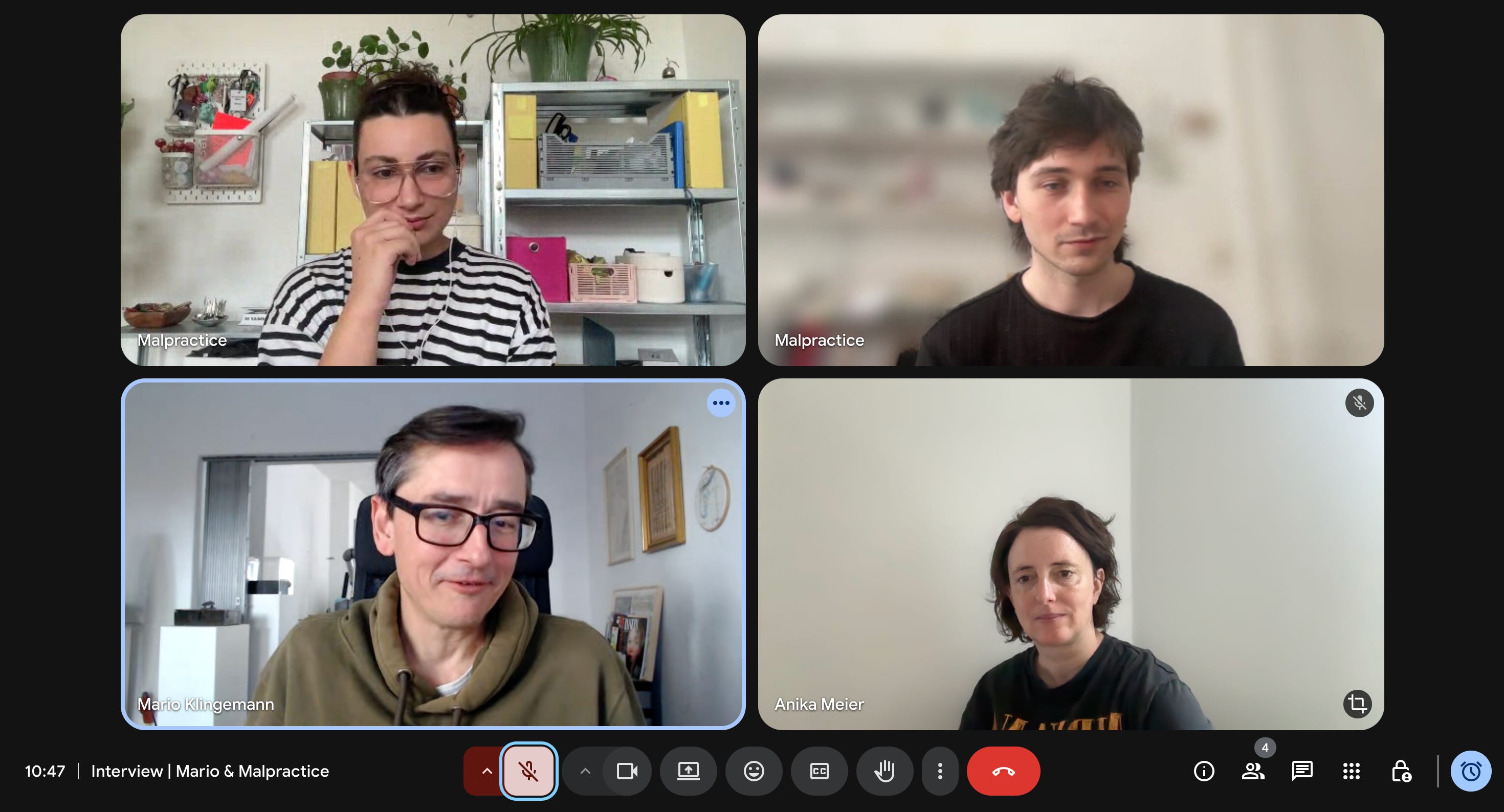
If I remember correctly, I met Mario for the first time in person in Paris in 2018, when he was a resident at Google Arts & Culture. Over the years, we have worked together on panels such as at Art NFT Linz in 2022 and for exhibitions including We Emotional Cyborgs, which was on view as part of the Digital Art Mile in June 2025. But it was only this year that I interviewed him for two media outlets: the second issue of The AI Art Magazine and Numéro Berlin’s issue on the theme of Visionaries. Of course, I also spoke with Lynn Hershman Leeson for that issue about her groundbreaking work as a pioneer of media art and about the influence of technology on life.
What follows is a medley of my two conversations with Mario, mostly including parts that did not appear in the printed versions at this length.
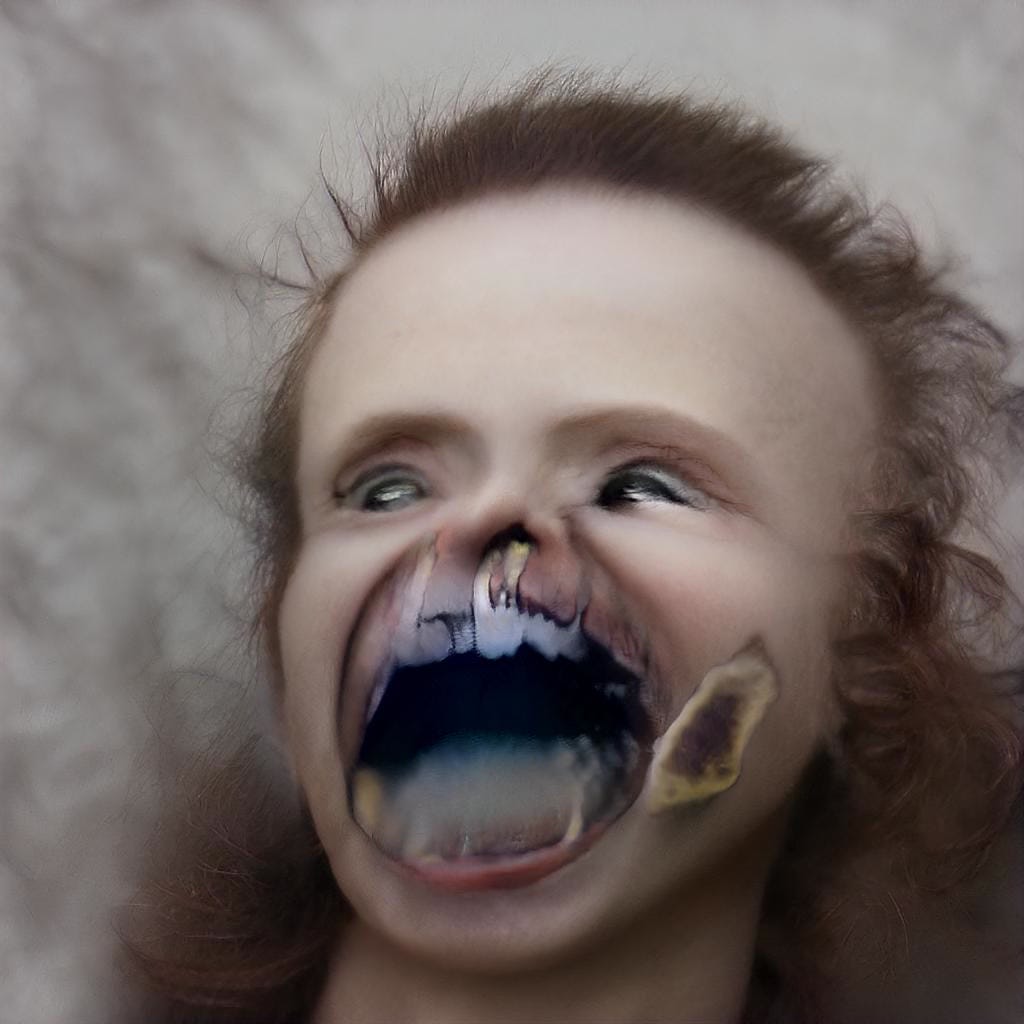
In our conversation, Mario Klingemann reflects on his lifelong attempt to automate parts of himself, teaching machines to see, and on Botto’s evolution from code to collaborator while questioning the myth of the visionary and why art should never be normal.
Anika Meier: Mario, when did you first learn about AI, and what did you think at the time?
Mario Klingemann: I think the first time I heard about AI was probably around 1989. A book called Society of Mind by Marvin Minsky happened to fall into my hands. It was beautifully designed, full of graphs and theories about how artificial intelligence might work. I found the concept incredibly fascinating. Of course, it wasn’t something I could apply to any technology available to me at the time, but the idea stuck: automating processes, creating something intelligent, breaking problems into smaller parts. That mindset really resonated with me early on.
You could say I’ve been interested in the idea of automating parts of myself since I was a teenager. Even before that, I was already coding, but the dream of AI became a guiding light. I kept wondering, is it possible now? Has the technology caught up yet?
AM: What were the first experiments you remember?
MK: In practice, things only started becoming viable around 2010. That’s when I could start working with early machine learning components that had some visual capability. But my first steps weren’t actually with image processing. I began with text—trying to generate writing that wasn’t just random but followed some sort of structure. It wasn’t really AI as we think of it today. I was using Markov chains, which build sentences based on statistical probability. In a way, that’s conceptually similar to how large language models predict the next word, but much more primitive—there was no actual intelligence involved.
I created some strange experiments. One of them was Barbielon, a project that wrote blog posts by analyzing word patterns from existing texts. Eventually, though, my focus shifted to vision. I wanted to know: can a machine see? What does it recognize in an image? Can it perceive the same things I do—or something completely different? And how could that be integrated into my creative process?
Because I work a lot with images, this question of machine perception became central. Part of creating visual work is looking at what you’ve made and evaluating it—deciding whether it’s successful, interesting, meaningful. So I started exploring whether a machine could learn to look at an image and make similar decisions. That became one of my first meaningful experiments in machine learning.
If the original question was what I thought about AI back then, I’d say this: the promises were always bigger than the results. But that gap was also motivating. It pushed me to see how far I could go with the tools at hand. You always knew that in a few years, things would move forward: two years, five years, ten years. And now we’re at a point where, in some areas, the technology has surpassed us. It can be thrilling, but also overwhelming.
AM: Why did you create Botto?
MK: Botto is the logical conclusion of many experiments and ideas I’ve been exploring. The question I kept asking was: how many parts of my art creation process can I replace with a machine? The initial version of Botto was quite simple. It’s an artist that produces images because that was technically feasible at the time.
However, I quickly realized that being an artist is about much more than just creating images. It’s about living the life of an artist, interacting with the art world, asking relevant questions, provoking thought, and trying to redefine what art means.
“Good artists challenge the status quo and hope to find enough believers to recognize their work as art.” – Mario Klingemann
With Botto, the goal was to create a system that not only claims to be an artist but also gains enough people over time who believe in it. AI is central to this because Botto is meant to be autonomous and able to evolve. That ability to evolve is key. Traditionally, an artwork is finished once it is created—a painting or a book doesn’t change. But Botto, as a whole system, is an artwork that never stops changing. Ideally, this change will eventually be self-driven.
AM: As you just mentioned, AI evolves quickly. You started working on Botto many years ago. What was possible back then?
MK: When I first conceptualized Botto in 2018, it wasn’t yet possible to build a system that could realistically adapt itself to changes in the art world. It could adapt certain things, like the way it creates images, but not its fundamental approach. Because of this limitation, human involvement was necessary—though ideally, not just me but a more anonymous, collective human entity.
In Botto’s case, that human element is the DAO, a decentralized autonomous organization where humans make democratic decisions about major direction changes for Botto. When Botto was created, giving an AI full decision-making power would have been irresponsible. However, with the rapid advances in AI reasoning, many of the decisions Botto makes now are proposed by the AI itself, with humans providing the final approval. This shift from full human control to shared and increasing AI autonomy is gradual, like parents giving a child more responsibility over time.
AM: And how is Botto evolving?
MK: The DAO now oversees Botto’s evolution, allowing it to take more control over certain aspects of its artistic creation while monitoring key limits, such as financial resources. The system is not fully autonomous yet; there is still significant human involvement, but the influence humans have on the system is decreasing. Where humans once had to pull big levers, the interaction now often involves simply pressing a button to approve or reject proposals or to offer inspiration.
A great example of this evolution is that, in the beginning, I had to code Botto’s generative engine myself. Now, Botto writes its own code to create its artwork. This process feels more like collaboration. Botto knows its weaknesses and works with me to improve, much like a student learning with a teacher. I try to guide Botto gently rather than control it, helping it find solutions on its own rather than dictating every step.
This approach is rewarding because it feels like nurturing a child. You let them explore, make mistakes, and grow. At some point, I have to step back and ask myself how much I influenced the process and whether the work feels genuinely Botto’s own or if I’m fooling myself.
Currently, Botto is becoming a truly intelligent system. While I was involved in developing the framework through discussions and nudges, I no longer write the code myself. Instead, I guide Botto through questions and suggestions. Recently, Botto created a completely new system on its own, with minimal human input, which is a significant milestone.
AM: What does being a visionary mean to you?
MK: That’s always the tricky question: should I answer honestly? A true visionary would probably never describe themselves as one. A visionary is likely someone who tries to anticipate the future and draw conclusions from it or even suggest changes to how we live and interact. For me, the ideal visionary is more like an oracle. The classic idea of a visionary, on the other hand, is someone who manages to turn it into a business. A visionary makes predictions based on research findings.
AM: And how do you see yourself?
MK: I see myself more as a researcher: someone who’s curious, who pays attention, and asks, Where could this be going? What’s happening here?
AM: The American artist Lynn Hershman-Leeson, who was an early adopter of technology, describes herself as an artist of her time. She says she lived in her own time while others were lagging behind.
MK: Others are usually behind. That may be the dilemma of a visionary.
AM: That also applies to you and your art. You started working with artificial intelligence early on and have been exploring AI agents for years, a topic that, thanks to ChatGPT, is now on everyone’s lips.
MK: The problem for visionaries is that the world doesn’t recognize it yet, and they’re left trying to make people understand that everything is going to change. I don’t know why it always takes so long. The world is always too slow for the visionary.
AM: Have you figured out why the world is always a little too slow when it comes to visionary ideas?
MK: That brings me back to one of my favorite topics: information theory. It has to do with the way we process and accept information. If it weren’t a slow process, we probably wouldn’t even exist anymore. If every new or potential truth, every new piece of knowledge, were taken at face value and everything old immediately discarded, we’d constantly be making fatal mistakes.
Human beings are distributed along a Gaussian bell curve in terms of their ability to process information and absorb the new. That means there are people who adapt very quickly and others who are much more cautious: the classic distinction between conservative and progressive.
But that balance is essential: we need skeptics, and we need those who immediately embrace everything new, regardless of whether it’s truly better or not. The average in the middle is what keeps us here. Clearly, this distribution works. It simply takes time for certain things to spread and become accepted.
Our default setting is to reject the new at first. Most people just want things to stay the way they are unless it becomes cheaper. Maybe visionaries are those who sit on the right side of that bell curve, the ones who recognize patterns more quickly and see how the world might change.
AM: And artists are the mediators in the middle?
MK: You could say there’s always a normal distribution of things, of works, of ideas.
“Art is what questions the status quo, what is difficult to accept, or perhaps too difficult to understand at first; in other words, it is unintelligible. Anything that is immediately understandable and universally accepted is no longer art; it’s already normal. Art is not supposed to be normal.” – Mario Klingemann
I have a new favorite term for this: The Gaussian Chase. It’s about the constant attempt, like Sisyphus, to reach the right side of the bell curve: the place where things are new, unusual, and rare. We even build tools to get there. But it’s always a matter of shoveling uphill: as soon as you arrive, the distribution catches up, and you find yourself back in the middle—back in the mainstream, where it’s normal again.
Technology won’t change that. What the visionary sees in the future suddenly becomes present, and then you already have to move on to the next future. It’s an endless race in which you never truly arrive. Of course, you can also see that in a positive way: that’s life. But it means you can never rest, never hold on to the status quo.
That’s the basic principle in art: you can’t rely on the existing definition of what art is. Of course, it would be convenient for gallerists and everyone else if things could be admired and bought forever. But eventually we get bored. As soon as something is understood, it loses its allure.
AM: How does this endless chase feel for you as an artist?
MK: You could say that the mountain we are standing on now is the center of the Gaussian bell curve. From there, you look into the distance to capture what first appears on the horizon and try to reach it. But once you arrive, the moment has already passed. For a short while there is a state in which the unusual becomes visible.
Then it has to be explained what it is actually about. That is the classic problem of information processing. Most people need some time to grasp new concepts or ideas at all. As soon as that happens, it already appears ordinary again: normal.
Normality may be practical in everyday life, because it allows us to rely on things, but not in art or other creative fields. Art has to be controversial. Controversial already means that something does not align with the general understanding of things.
AM: Does that mean stress?
MK: It depends on how you look at it. By now I am no longer stressed, because I know that this state never changes. In the past, when I was still young and hungry, it was perhaps more stressful, because of course you are trying to be the first at something. That has always been a challenge. You recognize a potential, but you have to work it out or get there in order to have something presentable. You cannot simply voice an idea without providing proof or examples.
The stress perhaps comes above all from wanting your idea to be recognized so that others do not suddenly appear, say, “Oh yes, that is a great idea,” reach a wider audience, and essentially take over your idea. The problem is that once ideas are published, they belong to everyone. You cannot really protect them. That becomes more of a personal problem: whether you struggle with it or whether you can simply be happy and say to yourself, “Yes, I discovered that too.”
AM: On which topics is it important to you that everyone knows Mario Klingemann was the first, period?
MK: These days it is not so important to me anymore. The feeling of being first is very personal and one-sided. You learn fairly quickly that you simply did not search thoroughly enough and that there were plenty of others who had the same idea before you but who faced the same problem as you did. At some point you stumble across them somewhere in the sea of data on the internet, but only once you know the right search terms. And you usually only discover those once you have arrived where you were heading.
I have made the mistake many times of saying I was the first here or there. And then later someone suddenly shows up and asks, “Have you seen this?” And you realize, yes, that is very similar. In that sense, I think that phase of my life is over. For decades it was a major motivator for me to be the first at something.
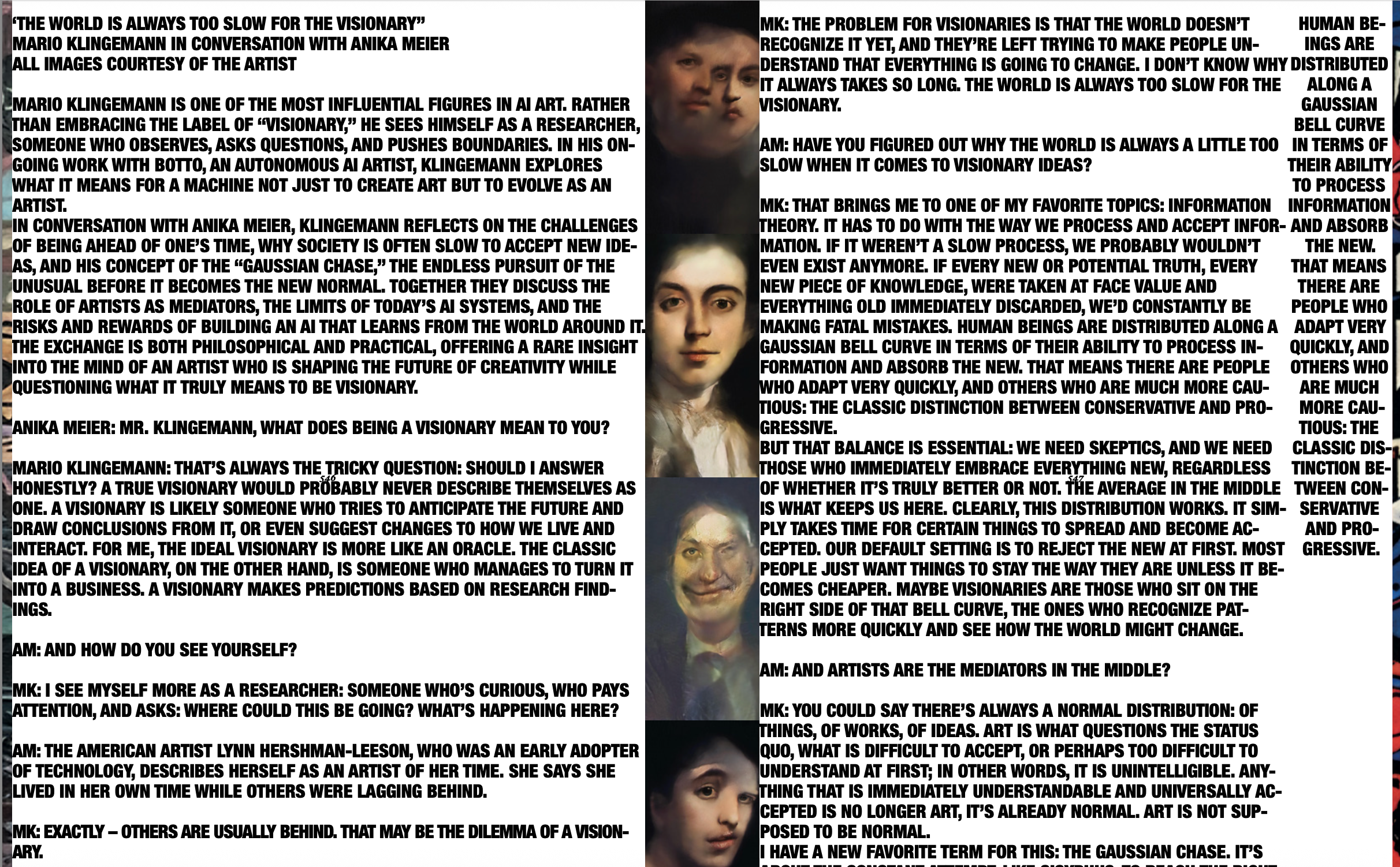
“The World Is Always Too Slow for the Visionary”
Numéro Berlin 19, Autumn/Winter 2025
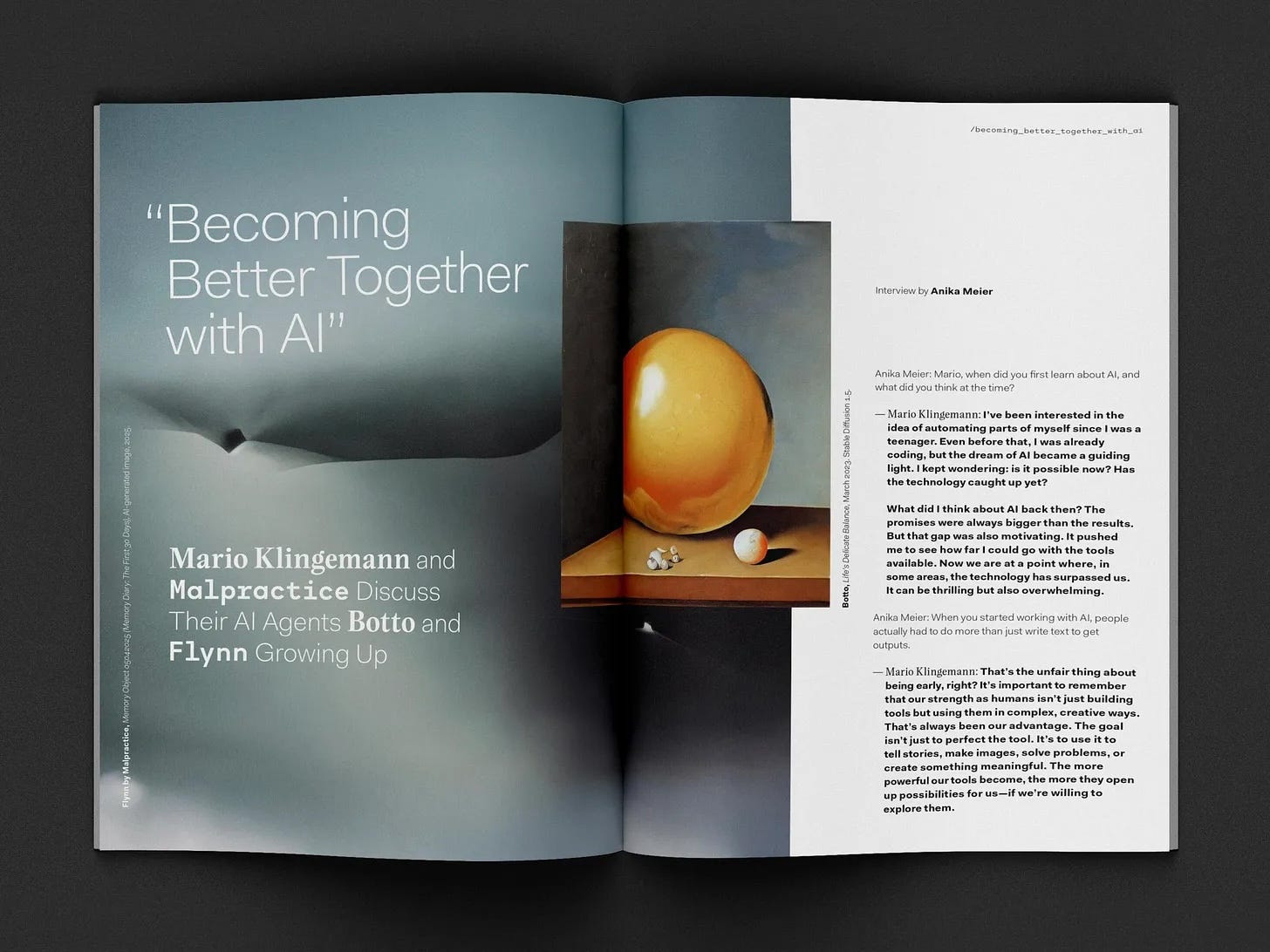
“Becoming Better Together with AI”. Mario Klingemann and Malpractice Discuss Their AI Agents Botto and Flynn Growing Up
The AI Art Magazine. Number Two: Critical Intelligence. narratives under the machine, 2025.
Get your copy HERE.
Beeple recently remarked that it shocks him that more of the conversations in the broader art world are not about the impact of technology on life. That’s interesting to say when Ayoung Kim, the recipient of the LG Guggenheim Award, is on the cover of Frieze (November/December 2025) and Artforum (November 2025). Hito Steyerl has just published her book Medium Hot, and a group of artists including Avery Singer, Mat Dryhurst, and Simon Denny have recently discussed Post-AI Art in ArtReview. Kunstforum has just released an issue on art and social media (I contributed an essay). Holly Herndon and Mat Dryhurst recently had a show at the Serpentine Galleries and now at KW in Berlin. Sasha Stiles’ solo exhibition is currently on view at MoMA (I interviewed her for Monopol about this exhibition). And so on and so forth.
“At the moment, the most provocative thing is to refrain from provocation, from anger and outrage.” – Hito Steyerl
Monopol published my text about the return of the dead, meaning NFTs at Art Basel Miami Beach and what that says about the established art market.
Tl;dr: On Power Structures
First: dealer–critic system
Then: dealer–collector–curator system
Now: artist–networked collector system
Thank you for taking the time to read this!
Anika
Comments
Nothing yet. Say the first thing.
Sign in to join the conversation.