
This article completes a three part series:
Why the UK Cannot Afford to Internationalise The Question of Scotland
And completes the annexation arc that began with Annexation I — The UK exists because the Scottish people were denied their lawful rights

Since October 2025 we’ve published a series of articles that have traced two linked arguments:
First, that what occurred in 1707 wasn’t a mutual constitutional merger but the annexation of Scotland into a continuing English state.
Second, that this outcome was later normalised and is still defended through domestic patterns that prevent the annexation question from ever being treated as admissible in law, or treated seriously at all.
Almost unavoidably the following question therefore has to be asked:
If the annexation question can’t be resolved within the UK’s own constitutional frame, why don’t they allow it to be tested outside it?
This article looks at why the UK state has a structural interest in keeping Scotland’s constitutional status confined to domestic law and politics, and why any move toward internationalisation is resisted, quietly but consistently, regardless of party or government.
The bottom line for the UK, and the issue is ultimately existential for them, is that this is about their being exposed to international standards of lawful state formation. Standards they clearly fear they can’t fulfill.
Why internationalisation matters
It’s important to realise that International law treats the formation and extinction of states very differently from UK domestic constitutional law, and that difference is crucial here.
Where domestic law asks whether a legislature had competence to enact a measure, international law asks whether a people possessed the capacity to alienate sovereignty at all, and whether the process by which this occurred met the standards of lawful state transformation.
Those standards include, among other things:
the existence of a competent constituent authority
(constituent authority being the ultimate power to create or fundamentally alter a constitution, originating from the people as the source of sovereignty);the free expression of the will of the people
(historically through a sovereign body, however imperfect that might have been as representative of ‘the people’);the absence of coercion;
and continuity or discontinuity of state institutions.
These are precisely the questions that any open analysis of the events surrounding 1707 raise, and precisely the questions we encountered in our analysis here, and precisely the questions UK constitutional discourse avoids assiduously — and that’s telling.
As we found in our analysis, once the question is examined on primary evidence, rather than two centuries of assertion, and framed internationally rather than domestically, the presumption that parliamentary ratification in 1707 resolves the question of constituent authority collapses.
Devolution as containment
Devolution is often presented as a recognition of Scotland’s distinct status within the UK. In reality, it is a statutory construct, created and limited by UK law itself. In practice, it functions as a containment strategy.
As former Conservative and Ulster Unionist MP, Enoch Powell tellingly stated: “power devolved is power retained”. He argued that because the UK Parliament is sovereign, any powers it “devolves” to regional bodies (like the Scottish Parliament) aren’t fully surrendered. The Legal Reality is that Westminster retains the ultimate authority to amend or even revoke those powers at any time. Powell of course supported Westminster control but viewed devolution as a sometimes-necessary tactical concession which placated and diverted pressure for full self-determination from Scotland, Wales, and the part of Ireland still controlled by the UK.
Therefore by relocating Scottish political identity into a sub-state legislature defined entirely by UK statute, Scotland’s constitutional question has been reframed as a matter of delegated competence rather than one of original sovereignty.
For the British state this achieves two things simultaneously:
It allows Scottish self-government to be acknowledged without conceding any right of external self-determination.
It ensures that all Scottish constitutional claims remain justiciable only within UK courts applying UK constitutional principles.
Devolution therefore absorbs constitutional tension rather than resolving it, and domesticates what would otherwise be an international question.
Referendums as permission, not recognition
The same logic applies to independence referendums.
In international law, self-determination isn’t a discretionary gift of the state that exercises de facto control. It is a right that, once triggered, exists independently of domestic permission.
In the UK, by contrast, referendums on Scotland’s status are treated as exceptional events, authorised by Westminster and defined entirely within UK constitutional terms. They are framed as exercises in parliamentary sovereignty, not expressions of an underlying right.
This framing is crucial. It ensures that even when Scotland votes on its future within a UK framework, it does so only as a temporary licensee of UK constitutional authority, not as a sovereign entity in its own right.
Recognition of an underlying right would imply that the UK lacks ultimate control over whether such a vote can take place. Westminster permission therefore preserves Westminster control.
Why courts avoid the constituent authority question
Courts within the UK have consistently declined to engage with Scotland’s constituent status in any direct way.
They will rule on the scope of devolved competence, on the legality of statutes, and on the interpretation of the Acts of Union. But they will not ask whether the Union itself was lawfully constituted in terms of constituent authority.
This is often presented as judicial restraint. In reality, it reflects a structural limitation: UK courts derive their authority from the very constitutional settlement whose legality would be placed in question.
A court cannot easily adjudicate the lawful origin of the system from which its own jurisdiction flows.
The avoidance isn’t therefore incidental, it’s inherent to the jurisdiction these courts represent.
Why the UK cannot afford any escalation into an international forum
If the question of Scotland’s situation within the UK were escalated to an international forum the above protections, that domestic constitutional framing quietly provides, would be immediately removed.
It would:
treat Scotland, and Scots, as a people rather than a region of a larger sovereign entity;
examine historical coercion rather than legislative competence;
assess continuity of statehood rather than continuity of statute;
and apply principles of self-determination rather than parliamentary sovereignty.
Under those conditions, the UK would be required to justify Scotland’s status by reference to international standards of lawful state formation and territorial incorporation and would immediately be unable to reference what its own institutions say.
That’s a radically different burden for the UK and shifts the goal posts significantly in Scotland’s favour.
The pattern across time
This resistance to internationalisation isn’t new or an episodic concidence. From the absence of any international recognition process in 1707, through the consistent framing of Scottish constitutional claims as domestic matters, to the modern insistence that Scotland has no status beyond that of a devolved territory, the pattern is consistent: Scotland’s status is to be resolved, if at all, only within UK constitutional space.
This resistance is clearly because the international dimension is decisive, and existential for the UK.
What this reveals
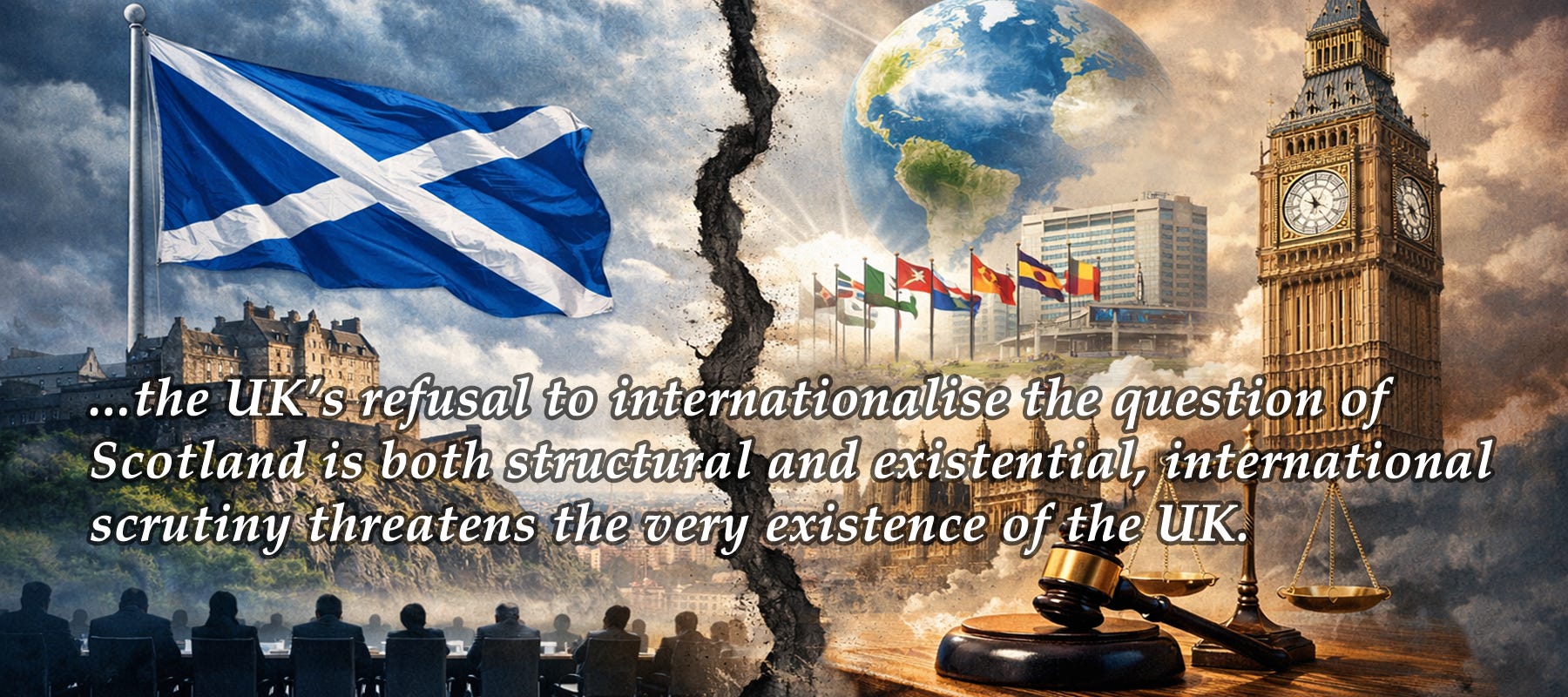
Taken together, these features show that the UK’s refusal to internationalise the question of Scotland is both structural, and existential; because international scrutiny threatens the very existence of the UK. It therefore isn’t a tactical or a political choice, it’s baked in.
Once any analysis that suggests annexation, and continuity (of England), is given space and credence internationalisation becomes the only reasonable route for the foundational legality of Scotland’s incorporation to be examined.
That’s precisely why the issue is avoided, diverted from, mocked, and shouted down.
It’s not because the UK fears debate per se, but because it cannot control the forum in which that debate would occur.
And that, ultimately, is what marks the question of Scotland as unresolved.
This ends our analysis of annexation, for now…

Coming up we take a two-part deep dive back to the 1600s, and examine the conditions and context that made the 1707 annexation possible in the first place:
William, Darien, and the Neutralisation of Scottish Sovereignty
There Was No Union of Crowns — How Scotland Lost its Constitutional Monarchy

If you’d like to support my research into Scotland’s true history, you can chip in for running costs (and the coffees that keep me going) here: https://ko-fi.com/angrypict
Comments
Nothing yet. Say the first thing.
Sign in to join the conversation.