
Part two of a two-part deep dive, where we examine the conditions and context that made the 1707 annexation possible in the first place:
There Was No Union of Crowns — How Scotland Lost its Constitutional Monarchy
Scotland Wasn’t Bankrupt: The Real Fiscal History of 1707

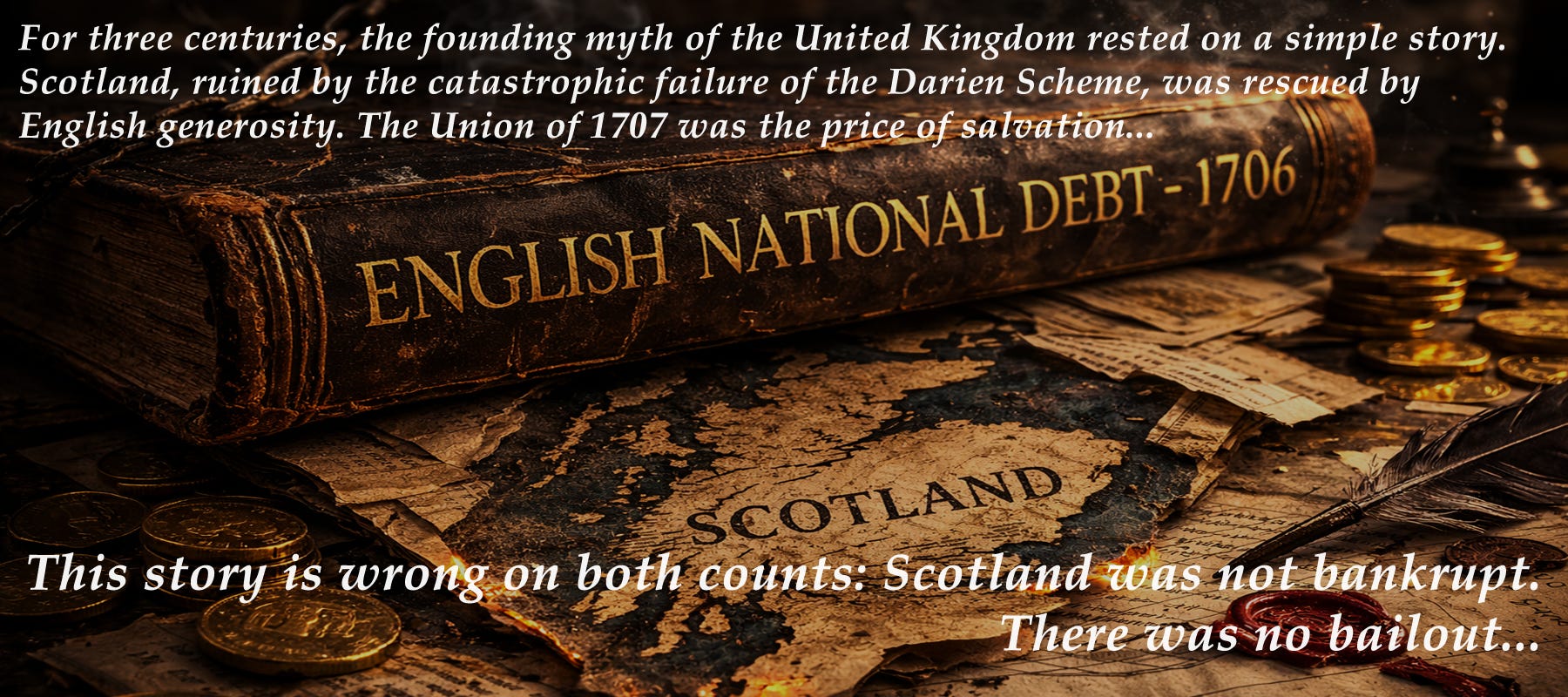
For three centuries, the founding myth of the United Kingdom has rested on a simple story. Scotland, ruined by the catastrophic failure of the Darien Scheme, was rescued by English generosity. The Union of 1707 was the price of salvation, a pragmatic settlement between a solvent neighbour and a bankrupt state that had run out of options.
This story is wrong on both counts. Scotland was not bankrupt. There was no bailout.
These are conclusions that follow directly from the primary fiscal record. The settlement of 1707 wasn’t an act of mercy. It was an act of incorporation, an annexation, achieved through strategic abandonment, economic coercion, and a financial instrument carefully designed to serve the incorporating state rather than the nation it purported to compensate.
To understand how that incorporation was achieved, and why the myth of rescue has proved so durable, it helps to understand first how the myth was created.
The Creation of the Bankruptcy Myth
The “Darien bankruptcy” narrative didn’t emerge spontaneously from the historical record. It was constructed, consolidated, and institutionalised over successive generations by those with an interest in the survival of the Anglo-British state, and blurring it’s origins.
In the immediate aftermath of the Union, English and pro-Union Scottish propagandists framed the settlement as rescue from ruin. Daniel Defoe, employed by Robert Harley as a Union propagandist in Edinburgh in 1706 and 1707, wrote extensively to present the Treaty as Scotland’s rational escape from economic collapse.
The narrative served a precise political function: it transformed an act of annexation into an act of generosity, and transformed Scottish resistance into ingratitude.
Eighteenth century Whig historiography consolidated the frame. Historians writing within the British state’s intellectual orbit had little incentive to examine the fiscal mechanics of the settlement critically. The story of failure, generosity, and grateful union was rhetorically clean, politically convenient, and aligned with the legitimating narrative of British state formation. It entered the standard constitutional and historical account and remained there.
By the Victorian period the myth had been absorbed into popular and educational history as settled fact. Scottish schoolchildren learned that Darien had bankrupted their nation and that England had offered a lifeline. The fiscal record that would have complicated that account; the Treasury papers, the Equivalent Commission documents, the debt architecture of the English state in 1706 remained in archives, unread by the audiences who had been given the simplified version.
The myth persists because it is structurally useful. A Union founded on rescue is legitimate. A Union founded on coercion, elite capture, and fiscal incorporation is something else entirely.
The audit that follows is an attempt to read what the archives actually say.
Part One: Darien Was Not a Bankruptcy
To understand why there was no bailout, you first have to understand what Darien actually was, and what destroyed it.
The Company of Scotland Trading to Africa and the Indies, founded in 1695, was a sovereign commercial strategy born from economic necessity. Scotland in the 1690s operated under sustained economic pressure from English trade policy. The Navigation Acts treated Scottish merchants as foreign traders, effectively barring them from legal participation in English plantation commerce and colonial markets. Scottish goods faced tariff barriers in English markets. Scottish maritime expansion was treated as a competitive threat to be suppressed rather than a legitimate commercial activity to be accommodated.
The Wool Act and related measures compounded the exclusion. Scotland was being systematically squeezed by a neighbouring state that controlled the dominant Atlantic trade routes and had the political will to use that control against Scottish economic development.
Darien was Scotland’s structural response. A trading colony on the Isthmus of Panama would give Scotland its own entrepôt (trading post), a crossing point between Atlantic and Pacific trade that bypassed English commercial dominance entirely. The strategic logic was sound. The location had genuine geographic merit. The scheme attracted investment from across Scottish society, representing a genuine national economic mobilisation rather than just elite speculation. However, a significant proportion of the Scottish elite sank fortunes into the venture, particularly after English interventions to block investment from outside Scotland.
What destroyed Darien was a sequence of English strategic decisions whose cumulative effect was the isolation and abandonment of the settlement.
When the Company of Scotland sought investment from English and Dutch merchant capital in 1695 and 1696, English parliamentary intervention forced English investors to withdraw under pressure from the East India Company lobby and the Crown. Scottish envoys seeking continental backing in Hamburg found English diplomatic pressure waiting, formal protests threatening foreign investors with royal displeasure. The Company was deliberately isolated, forced to rely entirely on Scottish domestic capital for a venture that required international financial backing to succeed.
When the first expedition reached Darien in 1698, the strategic context had shifted decisively. England was managing increasingly dangerous pre-war diplomatic tensions over the Spanish succession. Spain claimed sovereignty over the Darien isthmus. Maintaining Spanish neutrality was an English strategic priority of the first order. A Scottish settlement on territory Spain considered its own was an unwanted complication in a delicate diplomatic situation England could not afford to destabilise.
William of Orange, acting as King of England, issued orders to the governors of English colonial territories in the Caribbean and North America forbidding them from supplying the Scottish settlement with provisions, trade, or assistance. English ships were legally barred from relieving Scottish colonists in distress. The proclamations were the predictable consequence of English strategic priorities in which Scottish settler welfare didn’t register, despite the fact that William was also the monarch of Scotland.
England therefore didn’t need to destroy Darien actively. It only needed to ensure that no help arrived and that Spanish concerns about the settlement went unaddressed. The Spanish assault that finally ended the colony in 1700 came against a settlement that English policy had already isolated, starved of resupply, and stripped of diplomatic protection.
The result was the loss of approximately £400,000 of Scottish private capital, a devastating blow concentrated among the Scottish political and merchant class. Landed families, Edinburgh merchants, and members of the Scottish Parliament had invested heavily. Those losses were real, politically significant, and represented around 20-25% of Scottish liquid private capital.
But they didn’t bankrupt the Scottish state.
Scotland had no funded national debt, no comparable public credit obligations to service, and continued to generate tax revenues and pass legislation through a functioning parliament. What Darien destroyed was the liquid capital and political confidence of a specific segment of the elite. That is a categorically different thing from state bankruptcy, and the distinction is the foundation of everything that follows.
A political class that has suffered catastrophic personal investment losses, whose commercial strategy has been strangled by a more powerful neighbour, and which has no credible path to independent economic recovery is receptive to external offers that promise to make those losses whole. That receptiveness was the entry point for what came next.
The Coercive Context: The Alien Act of 1705
Before Union negotiations England applied a further lever that removed any remaining ambiguity about the terms of engagement.
The Alien Act of 1705 gave Scotland an ultimatum. If the Scottish Parliament didn’t open negotiations toward Union, accepting the Hanoverian succession, by Christmas Day 1705, Scots would be treated as aliens in England, losing property rights and legal protections in English courts. Scottish-owned property in England faced potential seizure. Scottish exports of linen, coal, and cattle to England would face embargo. The economic consequences for Scotland’s already constrained trade position would have been severe, probably disastrous.
The Alien Act made explicit what had previously been structurally implied, Scotland’s weakened economy was threatened directly. The Union negotiations that followed therefore didn’t take place between equal sovereign partners engaged in voluntary deliberations. They took place between a state that had already demonstrated its willingness to isolate Scotland economically and diplomatically, and a political class whose private capital had been destroyed by the consequences of that isolation.
This is the context in which the Equivalent, the so-called bailout, must be understood.
Part Two: The Equivalent Was Not a Bailout
The £398,085 10s paid to Scotland under Article XV of the Treaty of Union is the material foundation of the bailout myth. The standard account presents it as compensation, England paying Scotland’s debts and reimbursing Darien losses as part of a generous settlement between willing partners.
However the primary fiscal record doesn’t support this reading.
To understand what the Equivalent actually was, you have to understand the English fiscal position in 1706 and 1707. England wasn’t a solvent state extending generosity to a bankrupt neighbour. It was a heavily indebted state whose funded debt obligations, accumulated through decades of expensive warfare, had reached the point where its existing customs and excise revenues were substantially committed to servicing prior debt obligations.
The critical distinction here is structural: Scotland had no funded national debt to assume because its fiscal system had never been converted into a permanent war-credit state.
England in contrast had undergone precisely that conversion: the Financial Revolution of the 1690s had transformed English public finance from short-term monarchical borrowing into a permanent funded debt system, in which specific taxes were earmarked by Parliament to service long-term obligations. The Bank of England, established in 1694, the Tonnage Act annuities, the excise-backed debt instruments of the early 1700s, these had mortgaged the major English revenue streams years into the future.
By 1706 the appropriated English debt structure tied up the bulk of customs and excise capacity. The English Treasury was managing an ongoing structural deficit while simultaneously financing its European military commitments. It wasn’t offering charity, it was in no position to do so. It was managing a crisis.
Scotland, by contrast, had no comparable funded debt structure. Its customs and excise revenues were unencumbered. In the fiscal architecture of the early eighteenth century, unencumbered taxable capacity was a valuable strategic asset, precisely because it could be brought into a debt-servicing structure that needed new revenue sources.
Article XV of the Treaty of Union reflects this reality in its technical design. The Equivalent wasn’t a rough political compromise or a simple reimbursement of Darien losses. It was a structured proportional instrument tied to specific revenue streams. The treaty text fixes the figure against present Scottish and English customs and excise yields, Scottish customs at £30,000 per annum against English customs at £1,341,559; Scottish excise at £33,500 against English excise at £947,602. That proportional calculation, applied to the relevant English debt obligations Scotland was assuming, produces the treaty figure. In literal terms numbers that end in shillings don’t emerge from political bargaining, they emerge from hard arithmetic and accounting.
Secondary analysis confirms that present-value discounting techniques were employed in the calculation, meaning the commissioners modelled future Scottish tax liability streams, not simply a static ratio applied to a nominal debt stock. The mathematics assumed Scotland’s fiscal integration before the political act had completed it.
The treaty then creates a second mechanism that the standard account ignores entirely:
A deferred adjustment was to be calculated after Union, once Scottish revenues had begun to rise under the new fiscal regime. Scotland would receive additional equivalents as its tax yield increased and as further English debt obligations attached to it. This two-stage structure clearly isn’t the architecture of a compensation payment, it’s the architecture of a managed fiscal integration. Namely a structured entry into an ongoing and expanding debt-servicing system.
For the Scottish elite, the mechanics of reimbursement revealed who the instrument was actually designed to serve. Of the total sum, approximately £100,000 arrived in Scotland as gold, borrowed and set against future Scottish debt liabilities. The remainder, roughly £298,000, came as Exchequer bills and debentures. These were short-term state paper instruments whose value depended on London financial markets. Scottish holders without London connections found themselves holding potentially valueless paper trading at a significant discount against face value, instruments worth substantially less in Edinburgh than in London.
The effect was a liquidity hierarchy. Senior political figures with London access converted their paper to gold at or near face value. Smaller creditors and ordinary Darien shareholders held discounted instruments. The Equivalent functioned as an upward transfer of liquid wealth to precisely the political class whose votes were needed in the Scottish Parliament to pass ‘Union’ legislation.
This public ‘carrot’, however, should be kept analytically separate from the private mechanism later exposed by George Lockhart of Carnwath in his 1714 Memoirs. Alongside the public Equivalent, a separate sum of £20,540 was distributed directly from English Treasury funds specifically to secure the Squadrone Volante, as well as key members of the Scottish Privy Council, the parliamentary swing bloc whose votes determined the Paliamentary outcome (We have already looked at the role Privy council role in the events of April 1707 here, so won’t examine that again in this article). These were individual payments to specific figures, recorded with a precision that confirms their purpose. Lord Banff received £11 2s. The exactness of that figure is itself evidence: this wasn’t generosity, it was procurement. Every vote had been priced.
The Equivalent and the Lockhart fund were doing different work. The Equivalent was the public fiscal instrument, the structured entry payment that incorporated Scotland into the English debt system while appearing to compensate for Darien losses. The Lockhart fund was the private political instrument, the targeted capture of individual votes. Together they formed a two-track system operating simultaneously at the level of fiscal architecture and individual betrayal.
Neither was a bailout.
What Happened to Scottish Revenues After Union
If the Equivalent was an entry payment into an English debt system rather than a rescue package, the post-Union fiscal record should show Scottish revenues being drawn into British debt-servicing structures. It does.
Following 1707, Scottish customs and excise entered the unified British fiscal system. The Salt Tax and Malt Tax were extended to Scotland, subjecting Scottish households to impositions that had no precedent in Scottish fiscal history. By 1713 the Malt Tax had generated a crisis serious enough that Scottish peers in the House of Lords moved to dissolve the Union, a motion that failed by four votes. The fiscal promises of 1707 were being tested against lived experience, and the experience was of extraction rather than partnership.
The broader fiscal integration moved quickly. Within four years of Union, the South Sea Company (1711), designed by Robert Harley, the same minister who had managed the Union negotiations, was established specifically to convert the floating government debt overhang into consolidated stock. The expanded British revenue base, which now included previously unencumbered Scottish customs and excise, provided the fiscal foundation that made that conversion credible to investors. Scotland’s unencumbered taxable capacity was the asset the Union had secured. Its post-Union revenues were part of the return on that investment.
The sequence is visible in the record: Union creates a unified British revenue base; that base provides the fiscal capacity for large-scale debt conversion operations; the first major such operation draws on North British duties. Scotland’s unencumbered taxable capacity was the asset. Its post-Union revenues were the return on that investment.
The Voice That Was Ignored
The settlement of 1707 wasn’t popular, the political class negotiated and ratified it. The Scottish public opposed it.
Petitions against the Union arrived at the Scottish Parliament from burghs, parishes, and presbyteries across the country. The Convention of Royal Burghs, representing Scotland’s merchant towns, petitioned against incorporation. There were riots in Edinburgh and Glasgow as ratification proceeded. Contemporary observers noted that popular opposition was widespread and vocal.
The Scottish Parliament pressed ahead regardless. A parliament whose decisive votes had been secured through the combination of public financial inducement and private payment was not in a position to claim it was acting on the mandate of the community it represented.
The Constitutional Consequence
Under the constitutional principles established by the Claim of Right in 1689, sovereignty in Scotland resided with the Community of the Realm, not unconditionally with Parliament. The Scottish Parliament was a delegated institution, deriving its authority from that community and exercising it on its behalf.
A delegated institution cannot permanently alienate the sovereign authority from which its own power derives. The Scottish Parliament of 1707, operating under economic coercion, with its decisive votes procured through financial inducement and private payment, and against the expressed opposition of the population it represented, lacked the legitimate authority to extinguish Scottish sovereignty.
What it produced therefore wasn’t a voluntary union of equal kingdoms. It was a constitutional usurpation, the transfer of sovereign authority by a compromised instrument acting beyond its competence.
That transfer has been dressed, for three centuries, in the language of rescue and generosity. The primary record strips that dressing away. Scotland wasn’t bankrupt. There was no bailout. The settlement of 1707 was an incorporation, structured, calculated, and paid for at a price the Sovereign Scottish Community of the Realm was given no voice in setting.
The overall audit isn’t yet complete. But the findings are now becoming harder to ignore.

The key facts at a glance:
Scotland was not bankrupt.
In 1707 Scotland had no national debt. The Scottish state was still functioning and raising taxes through its own parliament.
England was heavily indebted.
After decades of war, England had built a large funded national debt backed by customs and excise taxes.
The Treaty made Scotland assume part of that debt.
Under Article XV, Scotland joined the English debt system and became liable for a share of it.
The “Equivalent” was not a rescue payment.
The £398,085 paid to Scotland was calculated as compensation for entering that debt system and assuming liability.
Most of the money was not paid in gold.
Only about £100,000 arrived as cash. Much of the rest came as Exchequer bills and government paper, which often traded at a discount.
A separate fund was used to secure parliamentary votes.
George Lockhart of Carnwath later recorded £20,540 distributed to members of the Scottish Parliament whose votes were needed for ratification.
The public opposed the Union.
Petitions against it came from burghs, parishes and guilds across Scotland, and riots broke out in Edinburgh and Glasgow during the debates.
After Union, Scottish taxes fed the British debt system.
Within four years, Scottish duties were being directed into the South Sea debt-conversion scheme.
In short:
Scotland was not rescued from bankruptcy.
The Union integrated Scotland into England’s debt and fiscal system.
Technical Appendix
On the Equivalent calculation: Article XV of the Treaty of Union fixes the figure against present Scottish customs yields (£30,000 per annum) relative to English customs (£1,341,559 per annum), and present Scottish excise (£33,500 per annum) relative to English excise (£947,602 per annum). The resulting proportional calculation, applied to the relevant appropriated English debt obligations, produces the treaty figure. Analysis by William Deringer confirms that present-value discounting techniques were employed, suggesting the commissioners modelled future Scottish tax liability streams prospectively rather than applying a static ratio to a nominal debt stock. The calculation assumed fiscal integration before the political act completed it.
On the inadequacy of the Equivalent as settlement: J.G. Pittendreigh’s analysis of the Equivalent, in P.H. Scott, The Union of 1707: Why and How? (The Saltire Society, 2006), establishes several findings that sharpen the fiscal reinterpretation. The total liabilities the Equivalent was supposed to cover, Scottish contribution to the English national debt, Darien losses, public debts, recoinage costs, and arrears to public servants, came to at least £710,000 against a payment of £398,085 10s, leaving a shortfall of over £300,000. The calculation was carried out by a commission of six, three from each side, which included William Paterson. The Arising Equivalent, the mechanism promising future Scottish benefit from increased post-Union revenues, existed, in Pittendreigh’s assessment, only in the imaginations of those drafting the Article. Scottish revenues in fact decreased in the initial post-Union years and assistance to Scottish manufactures and fisheries was not forthcoming for decades. Most significantly, the English borrowed the money to finance the Equivalent payment and added it to the British national debt, a debt Scotland was then required to help service. In Pittendreigh’s formulation, the Scots were expected to subsidise their own takeover.
On English fiscal saturation: P.G.M. Dickson’s The Financial Revolution in England (1967) reconstructs the funded debt structure of the English fiscal-military state. By 1706 the major English revenue streams were substantially committed to servicing existing instruments including Bank of England lending, Tonnage Act annuities, and excise-backed annuities. Scotland’s unencumbered revenues represented genuine expansion of fiscal capacity at a moment of structural strain.
On post-Union fiscal integration: The South Sea Company (1711) was established to convert approximately £9.5 million of floating government debt, largely Navy bills and unfunded military obligations, into consolidated stock. The expanded British revenue base following Union, incorporating previously unencumbered Scottish customs and excise, formed part of the fiscal foundation that made that conversion credible to investors. The specific statutory routing of named North British duties into the South Sea fund requires further primary source verification before it can be cited as a closed evidentiary point. Also see Balen’s A Very English Deceit.
On the bribery evidence: The £20,540 Lockhart fund and the individual payments recorded therein are documented in George Lockhart of Carnwath, Memoirs Concerning the Affairs of Scotland (1714). The gold and paper distribution of the Equivalent, and the discount at which Exchequer bills traded in Scotland following 1707, are addressed in Christopher Whatley, Bought and Sold for English Gold (2001).
On the Darien blockade: The orders issued by William of Orange to the governors of English colonial territories forbidding assistance to the Scottish settlement are recorded in the Calendar of State Papers, Colonial Series (1699). The structural account of English diplomatic pressure on continental investors is drawn from the standard secondary literature on the Company of Scotland.
On the coercive context of the 1706 negotiations: The withdrawal of the Alien Act before serious negotiations concluded has sometimes been cited to argue that coercion was an opening threat rather than a continuous condition. The primary record does not support that reading. The Alien Act was one instrument within a broader coercive architecture that included active military preparation for invasion.
On 12 December 1704, James Johnstone, Lord Register and a figure in close contact with English official opinion, wrote from London to Baillie of Jerviswood: the spirit in England ran upon “conquest or union.” That framing, conquest as the explicit alternative, predates the Alien Act and establishes the strategic context within which it operated.
By November 1706, as negotiations concluded, English troops were massed on the Scottish border and in Ulster. Sir David Nairne wrote to the Earl of Mar on 26 November 1706 confirming three regiments of foot on the border and three of horse, one of foot and one of dragoons in Ulster, with the necessary orders in place, adding that “all relating to this affaire must be kept very private.” A further letter of 10 December confirmed an additional 800 horse had marched to the border on Marlborough’s direct instructions. These were operational deployments, not diplomatic signals. Historian Gordon Donaldson confirmed the military reality: the scanty, ill-trained Scottish regiments could not have resisted Marlborough’s veterans.
The Alien Act’s own propagandist acknowledged its character. Daniel Defoe, employed by Robert Harley to manage the Union narrative in Edinburgh, described the Act as having “in a manner declar’d open war with Scotland” — the most impolitic measure, he added, that had ever passed that assembly. That characterisation came from the man paid to present the Treaty as Scotland’s rational choice.
T.B. Smith’s assessment of the negotiating conditions follows directly: the Scottish commissioners of 1706 negotiated under the implied threat of invasion by one of the great captains of history at the head of a veteran army, backed by the military resources of one of the most powerful states in Europe.
The Alien Act established the coercive frame. The military deployments maintained it operationally throughout negotiations. The withdrawal of the Act did not withdraw the troops.
On the removal of Scottish military capacity: The structural defencelessness of Scotland in 1706-07 plausibly went considerably beyond the disparity of trained forces that Donaldson’s assessment implies. Scotland’s standing army wasn’t available to defend Scottish sovereignty because it was not under Scottish command. Scottish regiments — including the Royal Scots, Royal Scots Fusiliers, and Scots Greys — were serving under Marlborough on the continent, confirmed at Ramillies in May 1706, six months before the Nairne letters document English troop deployments on the Scottish border. The Scottish Parliament had itself acknowledged this reality in 1704 when it threatened to withdraw Scottish forces from the continental war as leverage against the Crown, a threat that confirmed those forces were serving under English-directed strategic command rather than Scottish institutional authority.
Scotland therefore faced the threat of invasion by Marlborough’s veterans while its own trained military forces were under Marlborough’s command fighting elsewhere. The defence of Scottish sovereignty mostly rested on militia assessed as incapable of resistance. This wasn’t just a military imbalance. It was plausibly structural entrapment. The progressive absorption of Scottish military capacity into English strategic command through the mechanics of the absentee monarchy, leaving Scotland institutionally defenceless at the moment of maximum coercive pressure.
This element requires further investigation, but the structural reality is already clear from the widely available evidence.
On the relevance of popular opposition to ‘Union’ (The Voice That Was Ignored): The issue and relevance of Scottish Constitutional popular sovereignty, and popular opposition to the 1707 settlement, within the pre-1707 Scottish constitution has been covered in a series of previous articles, most particularly in the following:
Scotland’s Constitution Was Never the Same as England’s — and That Changes Everything
Annexation I — The UK exists because the Scottish people were denied their lawful rights
Annexation III — The Week Scotland Was Silenced, and an Empire Was Born
Annexation IV - A Treaty Without Authority Is No Treaty at All
Furthermore, the issue of how that Constitutional reality has been obscured and hidden, most notably in the canon of Whig Historiography, is broached in the following article:
Primary sources: George Lockhart of Carnwath, Memoirs Concerning the Affairs of Scotland (1714); Calendar of State Papers, Colonial Series (1699); The Claim of Right (1689), Acts of the Scottish Parliament; Article XV, Treaty of Union (1707). Correspondence of George Baillie of Jerviswood (Bannantyne Club, 1842), p.42; Report of the Manuscripts of the Earl of Mar and Kellie (Historical Manuscripts Commission, London 1904), pp.336 and 353; Defoe, The History of the Union between England and Scotland (London, 1786), pp.54 and 86.
Secondary sources: P.G.M. Dickson, The Financial Revolution in England (1967); Christopher Whatley, Bought and Sold for English Gold (2001); William Deringer, Calculated Values (2018). P.H. Scott (ed.), The Union of 1707: Why and How? (Berlin, 2006), citing J.G. Pittendreigh’s analysis of the Equivalent. Gordon Donaldson, Scotland: the Shaping of a Nation (Newton Abbot and London, 1974), p.57; T.B. Smith, “The Union of 1707 as Fundamental Law” in Studies Critical and Comparative (Edinburgh, 1962), p.9.
If you’d like to support my research into Scotland’s true history, you can chip in for running costs (and the coffees that keep me going) here: https://ko-fi.com/angrypict
Comments
Nothing yet. Say the first thing.
Sign in to join the conversation.