
This follows an earlier piece, “Four Minutes and the Machinery of Colonial Closure,” on the reaction to a Holyrood ceremony and the historian’s column it produced. This piece picks up one line from that column and asks how old it actually is.
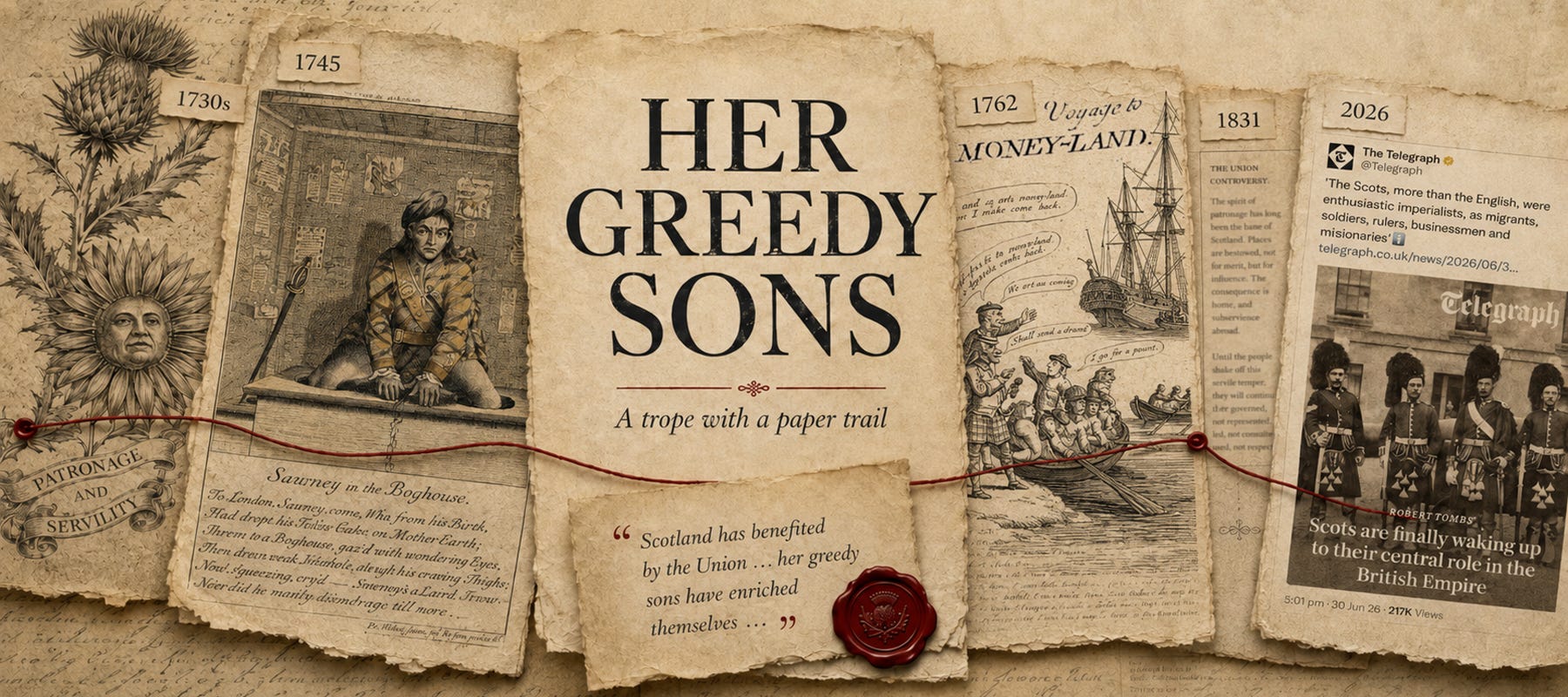
In 1831, a London radical writer named John Wade published a catalogue of state corruption called The Extraordinary Black Book. In its section on the colonies, it turned to Scotland and delivered this assessment of the Union:
“Scotland has benefited by the Union: her soil has been fertilised by our capital, and her greedy sons have enriched themselves by sinecures and pensions, the produce of English taxes; but what has England gained from the connexion?”
Set that next to a Telegraph column from June 2026, in which the historian Robert Tombs argued that Scots were imperialists “more than the English.” Different centuries, different registers, same accusation: Scotland didn’t participate in a shared British project. Scotland extracted from one.
The interesting question isn’t whether this charge is true. It’s how old it is, how many different costumes it has worn, and why it keeps being recurring.
The most rigorous account of this history is a peer-reviewed paper by the historian Gordon Pentland, published in the Scottish Historical Review in 2011, tracing English political prints about Scots from 1707 to 1832. Pentland’s evidence doesn’t describe one continuous slur. It describes four distinct accusations, arriving in different decades, doing different political work.
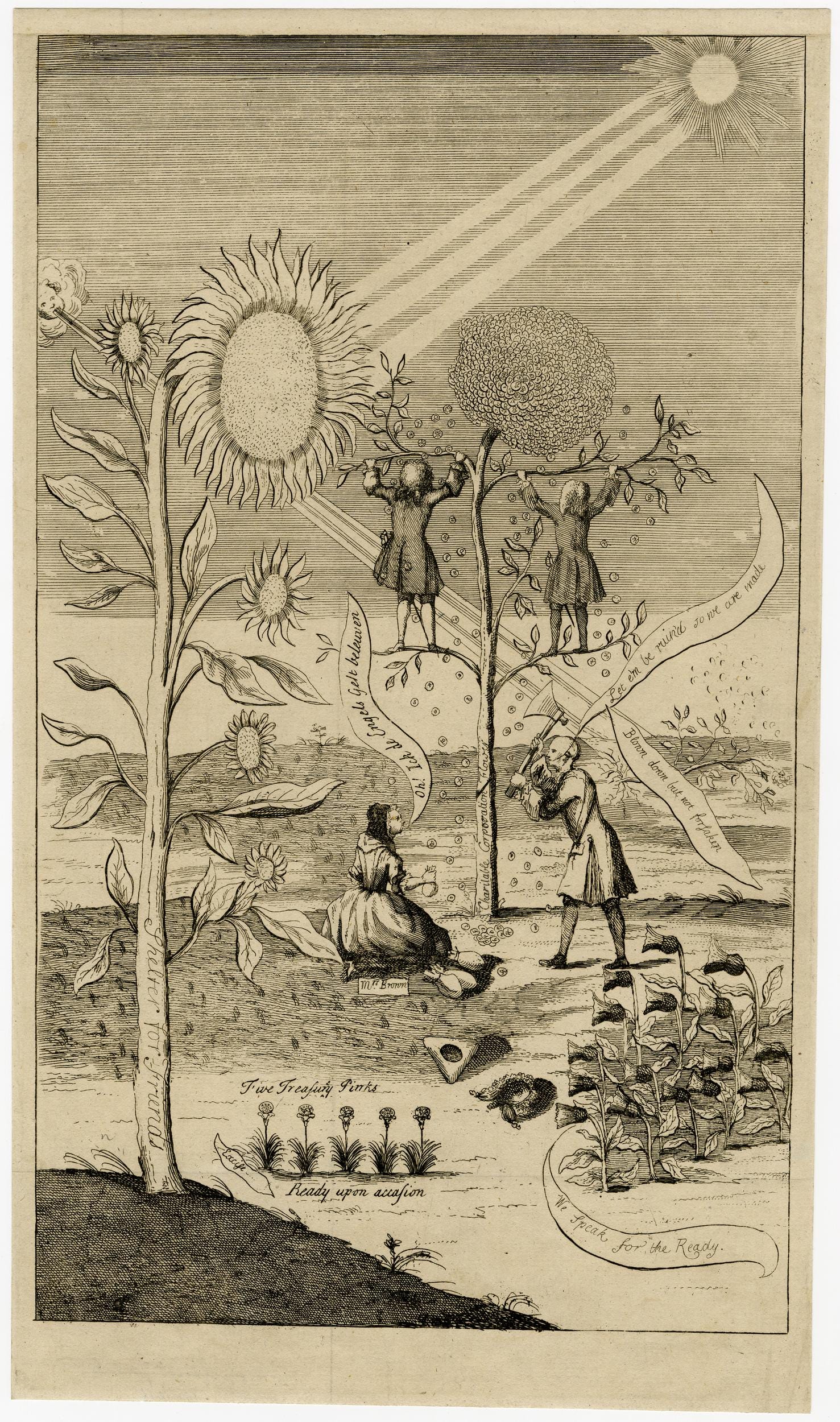
The earliest accusation was of servility. In 1734, an anti-Walpole satire showed sixteen thistles — representing Scotland’s newly created body of representative peers — bowing beneath a sunflower labelled Walpole. The caption: “We speak for the ready.” Ready meaning money. The accusation wasn’t exactly greed. It was sycophancy: Scots as a bloc of supplicants, trading loyalty for office.
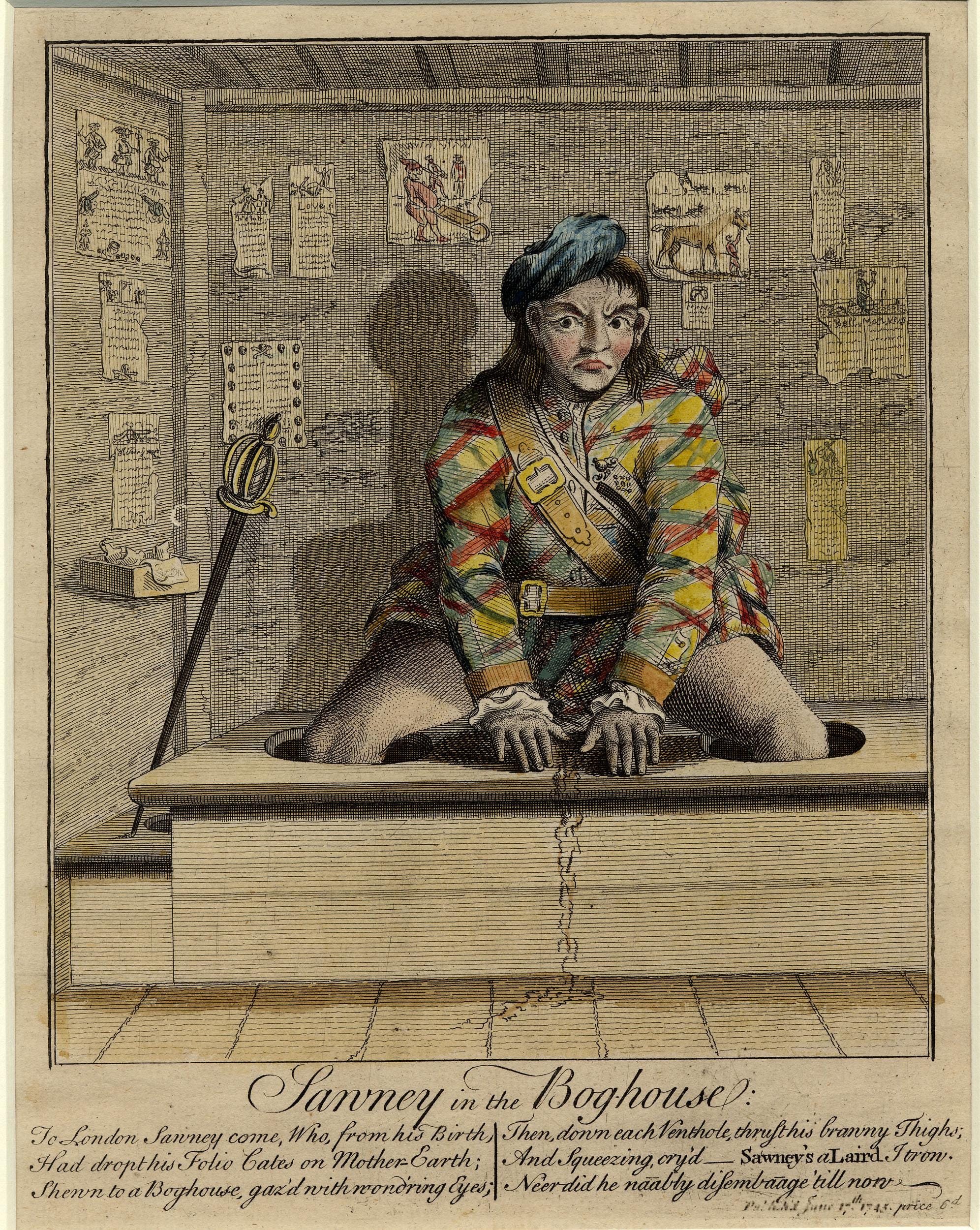
The second accusation was savagery. From 1745, with the Jacobite rising underway, English printmakers produced Sawney in the Bog-House and its imitators — Scots as filthy, primitive, barely continent, a national character built from disgust rather than argument. Sawney was a common pejorative name for Scots in this period, it invoked myths of Scottish cannibals.
The story of Sawney Bean is widely considered by modern historians to be a fictional myth rather than historical fact. While the legend claims that Alexander “Sawney” Bean and his incestuous clan murdered and cannibalised over 1,000 travellers during the 15th or 16th century along the Ayrshire coast, there is absolutely no contemporary Scottish record or evidence of his existence, his massive clan, or the royal hunt of 400 men allegedly led by King James VI.
The earliest recorded mention of Sawney Bean did not appear until the early 1700s in England. The story first surfaced in British broadsheets, cheap sensationalist booklets called “chapbooks,” and eventually compiled criminal biographies like The Newgate Calendar. These publications focused heavily on lurid crimes, gore, and scandals to sell copies to an eager public.
Anti-Scottish Political Propaganda
Historians Fiona Black and Dr Louise Yeoman have argued that the myth was weaponised as anti-Scottish propaganda in the years following the 1715 Rising.
The Slur: “Sawney” was a derogatory caricature name used by the English to mock a stereotypical Scottish person, much like “Paddy” for the Irish.
The Narrative: Presenting a story about a literal cave-dwelling Scottish monster who was completely uncivilised served to justify English dominance, painting Scots as savages who required English law and governance to civilise them.
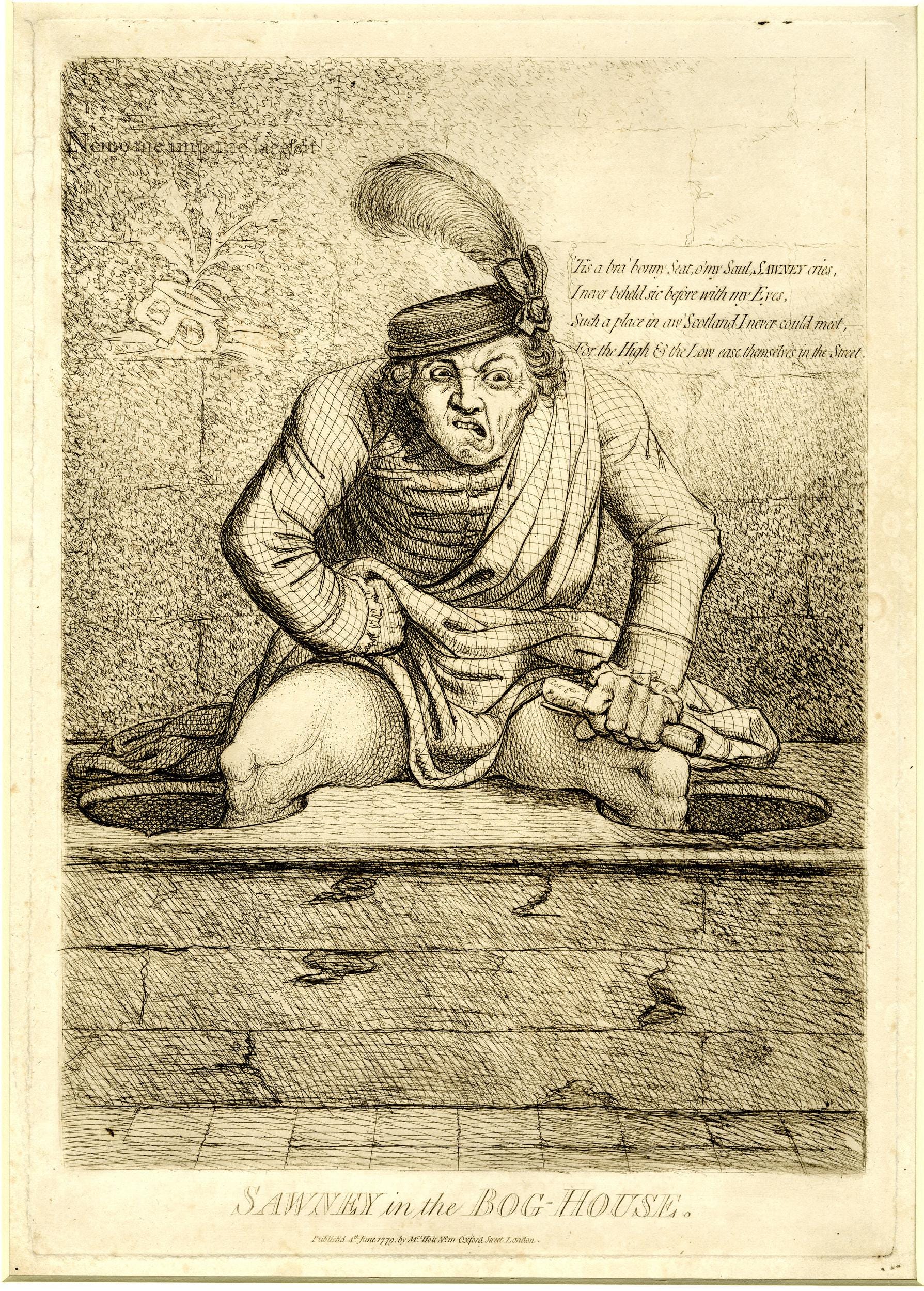
That image didn’t stay fixed in 1745 either. It was restaged twice more in similar form, under the same title, decades apart. A second version appeared around 1762. A third was published in June 1779 by a London print-seller, Mrs Holt of Oxford Street, sometimes attributed to the young James Gillray. Each is catalogued as an imitation rather than a copy of the one before — same pose, same crude joke, same setting, redrawn for a new moment. The 1779 version isn’t simply a reprint. Sawney now clutches a rolled document reading “Act for establishing Popery” — a reference to the Catholic Relief Act of 1778, the legislation that fed the anti-Catholic agitation which exploded into the Gordon Riots the following year. Behind him, a thistle grows from an inverted crown, captioned with Scotland's own royal motto, Nemo me impune lacessit — no one provokes me with impunity — borrowed for mockery. The image is similar. What it’s angry about has changed with the news.
The third accusation was sexual threat, specific to the same crisis: Scotswomen recast as poisoners and seducers, dangerous specifically because they could get close to the Stuart cause without leaving Scotland at all.
The fourth, and the one that matters most here, arrived later and separately: thrift and avarice. Charles Macklin’s comedy play, "The Man of the World", first performed in 1781, featured a Scot, Sir Pertinax MacSycophant, who was described by contemporaries as grasping and avaricious — a theatrical cousin, audiences noted at the time, of Macklin’s other famous role: Shylock. William Cobbett spent the 1820s attacking “Scotch metaphysics” and Scottish paper money. And then, in 1831, Wade’s Black Book gave the register its clearest early statement: Scotland’s “greedy sons,” enriched at English expense.
Pentland is explicit about the sequencing: thrift is a late arrival, not an original feature of anti-Scottish sentiment. It shows up once the older, cruder registers — the filth, the savagery — had become unfashionable, as English satire itself moved toward Victorian respectability. The anti-Scottish accusations didn’t fade, they simply changed clothes.
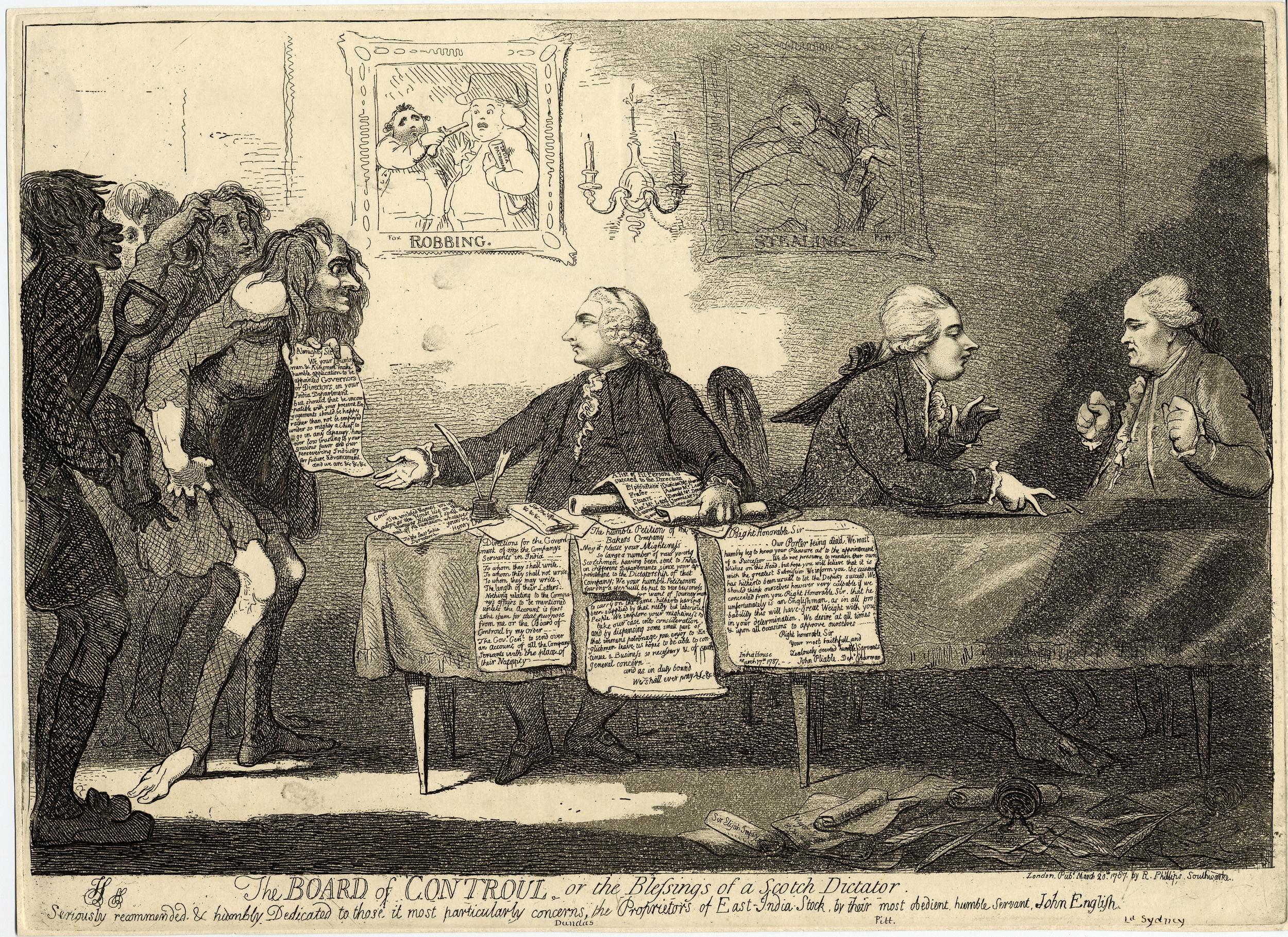
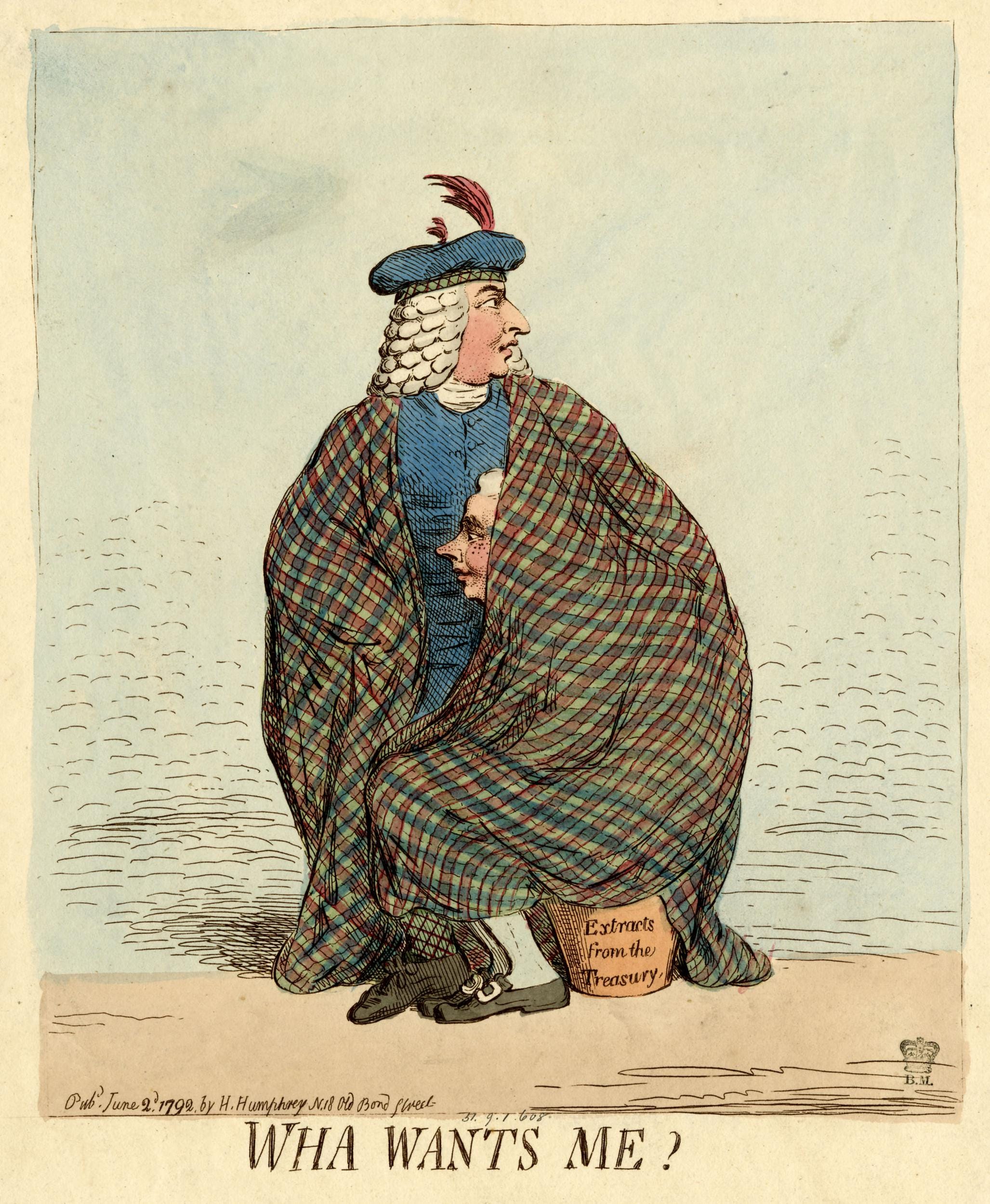
The servility register found its most pointed application when some Scots began administering the empire itself, which matters directly to what Tombs is arguing. In 1787, James Gillray’s The Board of Controul, or the Blessings of a Scotch Dictator showed Henry Dundas — the Scottish politician who controlled patronage for the East India Company for a generation — presiding over a table of scrawny, grotesque Scots seeking preferment in India — government functions, as Pentland describes the scene, seized “from their proper hands” by a tyrannous Scot besieged by legions of his needy countrymen. Five years later, Gillray’s Wha Wants Me? showed Dundas throwing a cloak around a diminutive Pitt, seated on a pail marked “extracts from the treasury.” The image eighteenth-century England actually produced of Scots running the empire wasn’t admiring partnership. It was infestation.
Pentland’s research also identifies who was making these images. Many of the most vicious anti-Scottish satirists — John Wilkes’s collaborator Charles Churchill chief among them, a penurious priest recovering from bankruptcy — were marginal, financially precarious literary figures attacking Scots who had out-competed them for patronage and prestige: the portraitist Allan Ramsay, the publisher William Strahan, the poet James Macpherson, the philosopher David Hume, the novelist Tobias Smollett, the architect Robert Mylne, who beat English rivals to design Blackfriars Bridge. The charge, in other words, was frequently provoked by Scottish success rather than Scottish failure. That’s worth noting because it’s the direct eighteenth-century ancestor of Tombs’s own move: success, once it belongs to a Scot, gets redescribed as a vice.
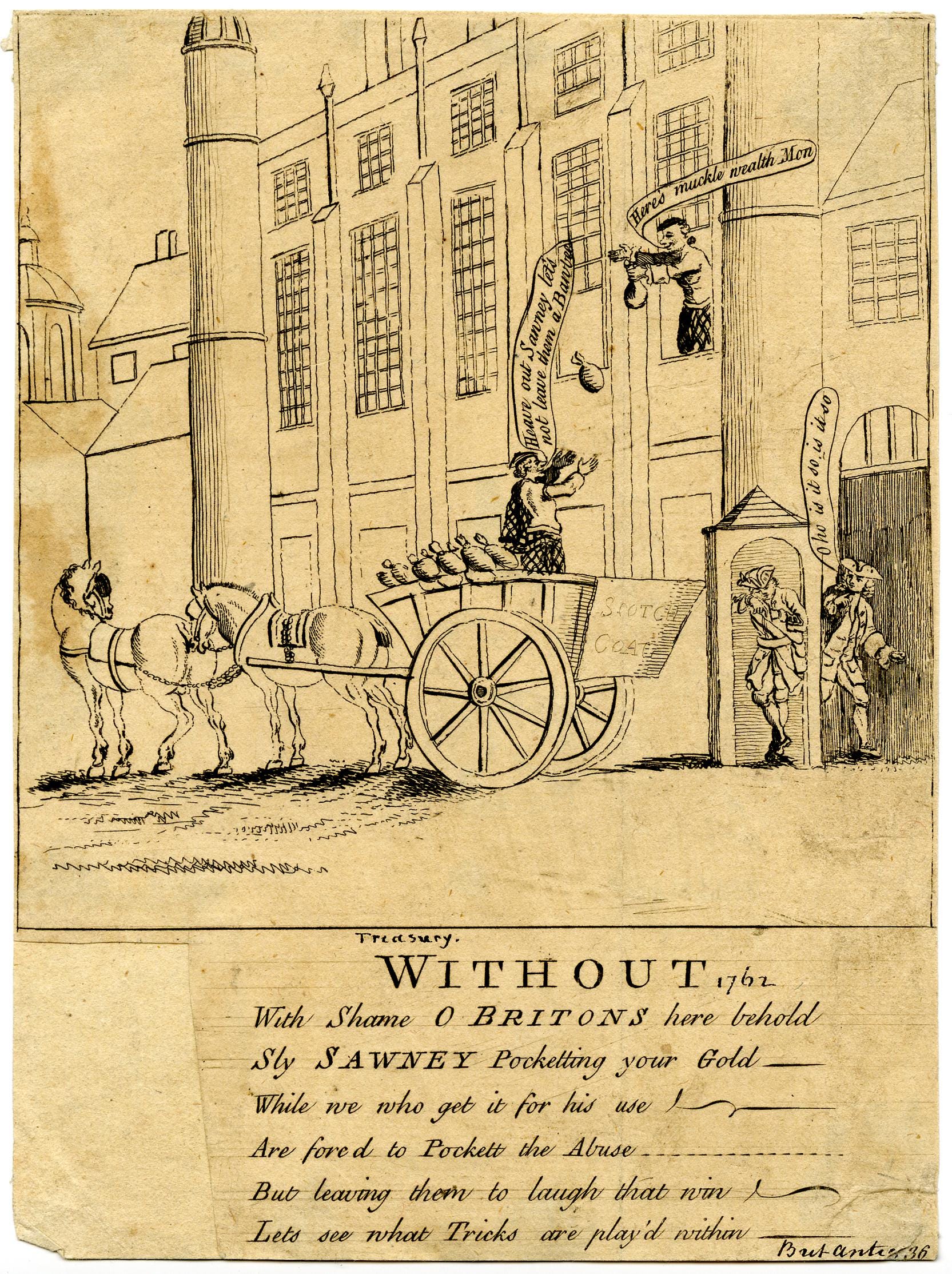
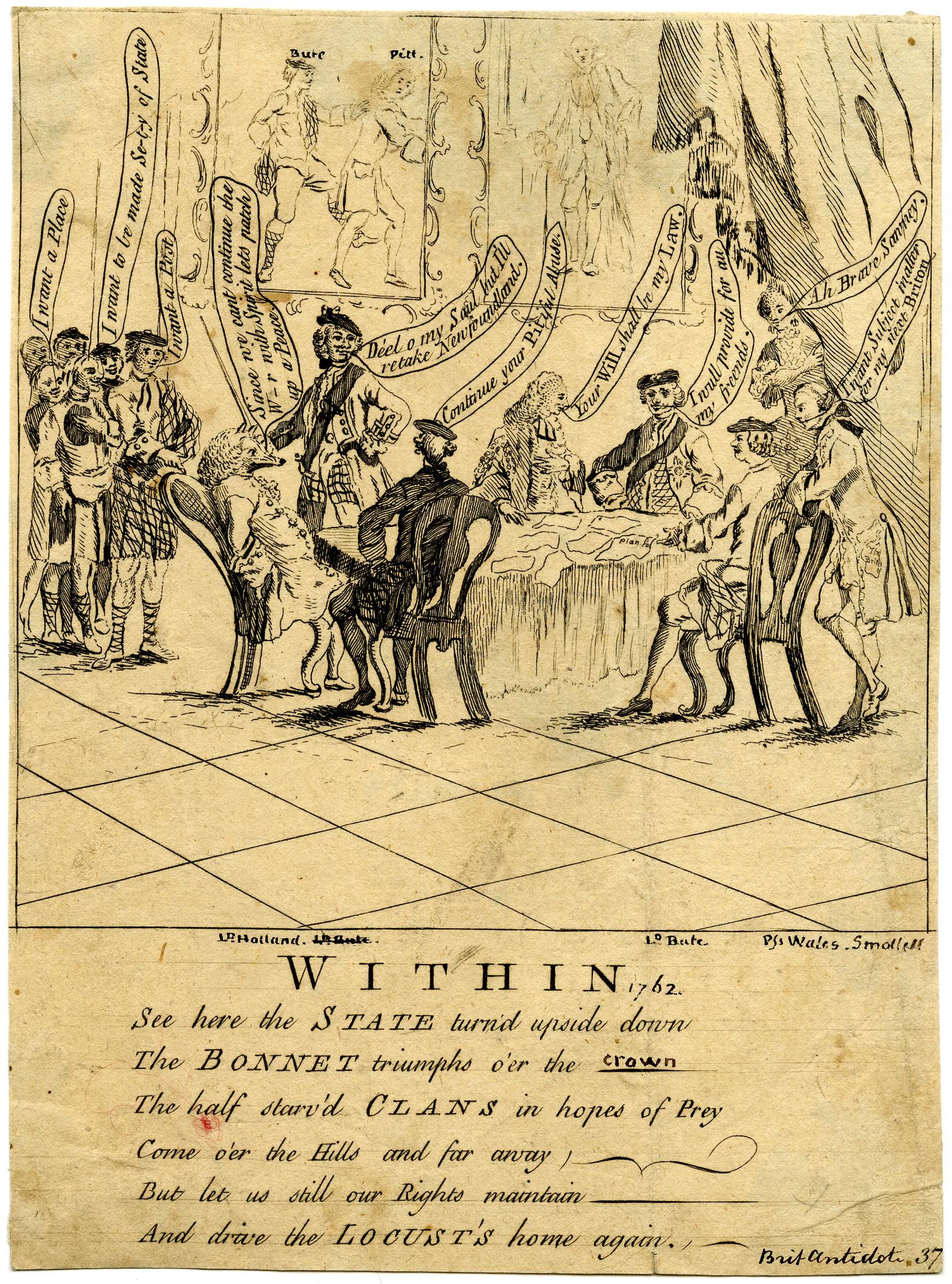
There is a fifth point worth adding to Pentland’s four. In 1762, a print called Without/Within — now held by the British Museum — attacked the prime minister Lord Bute, a Scottish elite Tory, for distributing Treasury patronage to his countrymen. Its verse has a Scot named “Sawney” catching bags of gold thrown from a window, hauling them away by cart, while English officials are described as “forc’d to Pockett the Abuse.” Here England isn’t generous. England is a victim, robbed by proxy through a corrupt minister. The accusation takes a different shape from Wade’s sixty years later — it asserts extraction under duress, rather than simple greed — and it is worth noting that even within the eighteenth century, the story of Scots and English money kept being narrated differently, depending on what the moment required.
This register didn’t stay in the eighteenth century, and didn’t need three hundred years of continuous transmission to resurface. Pentland opens his own 2011 paper with a modern instance: English press commentary on Gordon Brown’s path to the premiership in the mid-2000s, which coded him through what one commentator called “quintessentially Scottish values: in particular, thrift, humourlessness and a kind of autocratic clannishness” — almost the same charge sheet Wade levelled in 1831. A 2004 book on the same theme carried the title On the Make: How the Scots Took Over London. None of this required anyone involved to have read Wade, or Cobbett, or Macklin. The register simply resurfaces, on schedule, whenever Scottish political prominence becomes newly visible.
Which is where the modern version runs into a problem the historical record doesn’t obviously share. Contemporary “subsidy Scotland” rhetoric — the GERS arguments, the “parasite” language occasionally aimed at Scottish politicians — typically wants to run two accusations at once: that Scotland is a drain, actively extracting more than its share, and that Scotland is a dependency, incapable of surviving without transfer payments from England. Those cannot both be true in the way they are usually deployed. A nation cannot simultaneously be a cunning extractor of wealth it does not deserve and a passive dependent too poor to survive alone. One accusation requires agency. The other requires incapacity. Historically, as Pentland’s evidence shows, they arrived as separate charges, for separate purposes, in separate decades. Somewhere between 1831 and 2026, they got fused together, and the fusion doesn’t hold up to five minutes of scrutiny.
That incoherence is worth sitting with. It suggests the charge was never really an economic argument. It was a slot that needed filling, and English commentary reached for whatever was available: servility in the 1730s, savagery in the 1740s, avarice in the 1780s, dependency by the twentieth century, and now, in the Telegraph, enthusiasm — the accusation that Scots enjoyed empire too much to complain about it now.
The vocabulary keeps changing. The function doesn’t.

Next: No New State (Wednesday 22 July) In 1707 no new parliament was summoned, no new state was born, and the one condition the Union was built to protect was destroyed within a year. This is the documentary record — in the Anglo-British state’s own hand.

If you’d like to support my research into Scotland’s true history, you can chip in for running costs (and the coffees that keep me going) here: https://ko-fi.com/angrypict
Comments
Nothing yet. Say the first thing.
Sign in to join the conversation.