
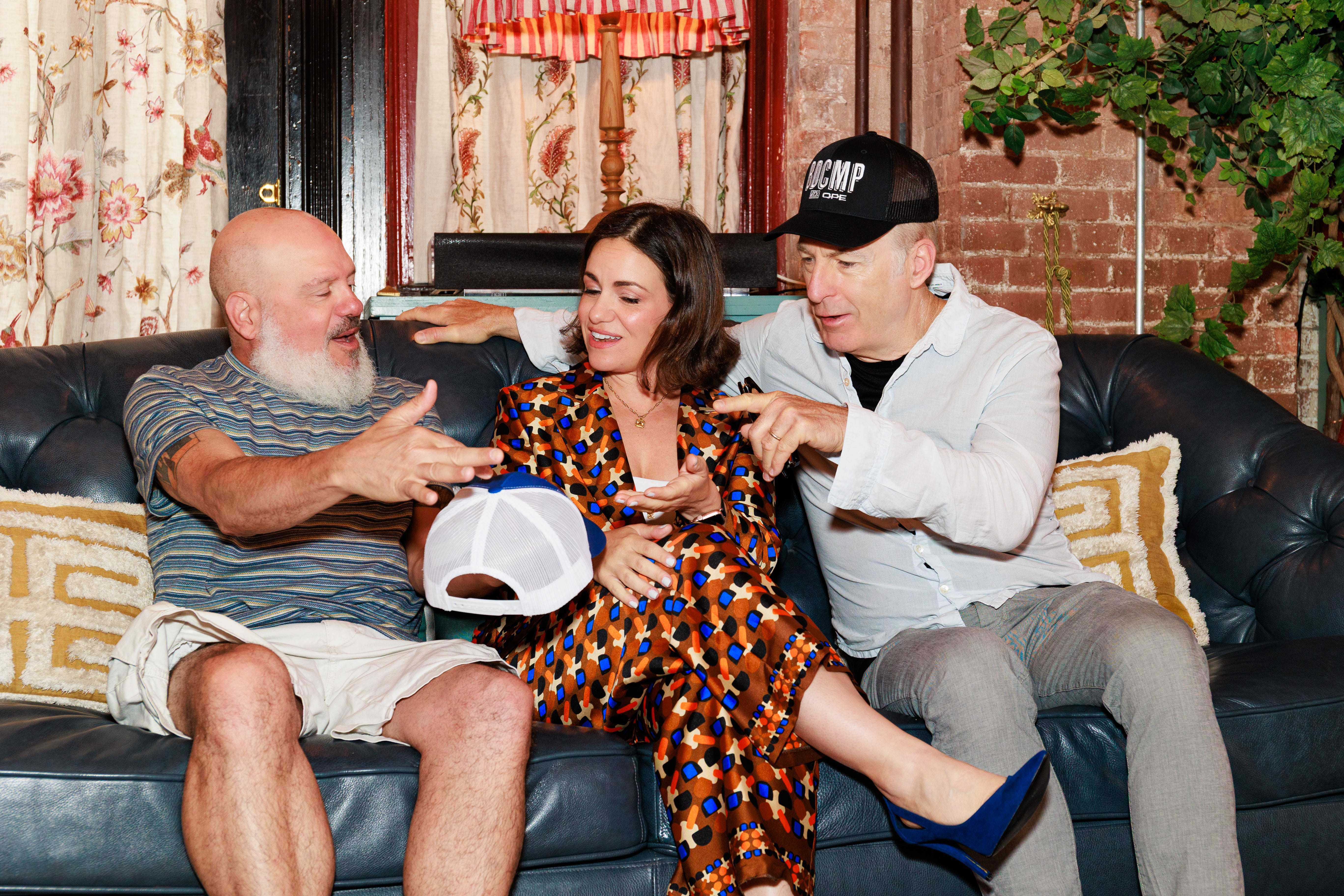
First things first: thank you to Greenslate, Theorem Media, and Portrait for making this panel happen! Greenslate has been a longtime partner of AOP and it never gets old talking about the ways they have revolutionized production payroll and accounting for independent film. They had 22 projects at Tribeca this year and Bob and David Climb Machu Picchu was the one we chose to spotlight, via their client Left/Right.
Not a shabby start to a Sunday morning in NYC! (Go Knicks!!!!)
Over 1.5 million people visit Machu Picchu every year, but of that number, only 25,000 hike in. That's roughly 1.6% — less than the crowd at a mid-sized music festival. Bob Odenkirk and David Cross are among them.
And so am I.
Three years ago, I hiked the Inca Trail on my honeymoon. It was an epic adventure where I often felt, well, bamboozled. (proof below) It rained the entire time. The upside, however, is that we basically had the whole trail to ourselves because protests in Lima had kept most hikers away — just me, my husband, and an Italian named Federico who became our accidental third wheel. Volllaarreee!
Yes, it was a very sexy honeymoon, thank you very much.
So, I knew I was uniquely positioned to have this chat.
And when I tell you that moderating a 45-minute conversation with Bob and David in front of 100+ people is its own kind of altitude sickness — I mean that affectionately. These two have been cracking each other up for thirty years. Keeping them on a clock is a fool’s errand.
Is there anything more a producer loves than delightful, chaotic, completely worth it fool’s errand?
The Wrap called the film “a warm and affectionate home movie” and compared it to The Trip series — high praise for a documentary shot on narrow mountain paths with a skeleton crew and two guys slowly losing oxygen. The Tribeca programmer’s note described it as a “coca-fueled meditation on friendship, mortality, and profoundly absurd comedy.” Both are accurate.
During our chat, we tackled the realities of the hike, why David felt compelled to invite Bob, how the trip cracked them both open, and how Bob’s heart attack during the final season of Better Call Saul quietly gave the whole journey a different kind of weight.
When my husband and I finally made it to the Sun Gate above Machu Picchu, the skies parted and revealed the most stunning marvel — one of the seven wonders of the world, and every bit worthy of the title. No video or photo does it justice. Not even in 4K.
One of my favorite moments in the documentary comes near the end when Bob and David share an honest conversation over dinner. Bob reflects:
“I always hated how Hollywood made me care about things I don’t care about.”
When I brought this up during our panel, he connected it directly to social media. We think we are meant to create with the same velocity we consume, and it just doesn’t work that way. If comparison is the thief of joy, then who in Hollywood isn’t entitled to file a formal complaint?
There’s clinical language for what Bob was describing. Psychologists call it extrinsic motivation — when your sense of worth becomes tethered to external reward. Prestige. Validation. The box office number. The billboard on Sunset. The follower count. The deal that closed or didn’t.
Dr. Ali Mattu, a clinical psychologist at Columbia University Medical Center who has consulted for HBO, Netflix, and PBS, writes and speaks extensively about how anxiety loops form when we outsource our self-assessment to things we can’t control. The entertainment industry is almost uniquely designed to trigger this and welcomes tortured souls from all walks of life. Success is invisible until it suddenly isn’t. The rules change, the goalposts move, and the device in your pocket gives you a real-time score that never stops refreshing.
Bob put it plainly:
“That was never a priority for me in my world and my life, but this thing, this device... made me have anxiety and neediness towards... what the fuck is that?”
Dr. Barbara Van Dahlen, a licensed clinical psychologist named to TIME’s 100 Most Influential People and a consultant on A Million Little Things, has built her career around the idea that talking about emotional pain honestly is the first step toward cultural change. She’d recognize what Bob was articulating: the entertainment ecosystem doesn’t just reward extrinsic motivation, it manufactures it.
Dr. Sherry Walling, a clinical psychologist and burnout expert, writes about how high-performing creatives are especially vulnerable to identity collapse when the work slows down or the industry shifts. Because when your career is the dream you had, it becomes almost impossible to keep it separate from who you are. The industry doesn’t take you aside and say, “hey, chill out, this is just a job.”
No, sir.
It says things like “we are family!” and “it’s all about relationships.” Until it’s no longer convenient — then it says, “hey, it’s showbiz, kid.”
A 2024 Deadline piece on Hollywood on-set therapists captured the growing crisis: with layoffs, strikes, and continued contraction reshaping everything, therapists in production noted that people are cracking in new ways. Deeper than career stress. The foreboding existential question of whether the life they built still makes sense.
Bob’s antidote used to be Europe — going somewhere between seasons where no one knew who he was, where he could exist completely outside the vortex. Then life changed. Kids. LA. The distance disappeared. He’s still working on getting it back.
One of my many survival jobs early in my career was working for Bob and his wife Naomi as their nanny. This was around 2009, aka season 2 of Breaking Bad, and the kids were 10 and 11 at the time — that’s how I know exactly how many years have passed. Bob was always around, and many evenings were spent cooking dinner together, particularly tilapia, which he taught me how to make. I still make it today.
During our exchanges about career and ambition, he would often remind me: You have to think about who you’re becoming in the meantime. Because you don’t want to get to the destination and be miserable.
The concept of the meantime has stuck with me ever since. How do we hold on to our internal values when extrinsic motivation is so tempting, so loud, so everywhere?
There was something poetic and surreal and quietly emotional about sitting across from Bob on that Sunday morning at Tribeca — as a producer, a mother, the creator and host of AOP. Still in my meantime, because when do any of us actually arrive? But different. Changed. Able to hold that early version of myself with some tenderness instead of just embarrassment.
It’s pretty cool.
While it follows two old friends hiking the Inca Trail, Bob and David Climb Machu Picchu (which is still looking for distribution) is actually about perspective. It examines what happens when you remove yourself completely from the noise and are forced to put one foot in front of the other to reach the other side.
They didn't set out to make a mental health film. They set out to do something hard together, to see if they still could. What they made is a meditation on friendship, aging, meaning, and the quiet terror and deep relief of discovering that the person you are on the mountain is the person you actually are.
Near the end of our conversation, David talked about his nine-year-old daughter — how fatherhood changed how he thinks about his choices and how he looks in the mirror differently now. It was quiet and honest and it landed.
If only we had more time together.
Keep creating, keep hustling. And as always, thanks for doing this life thing with me!


Resources:
Dr. Ali Mattu, PhD — Columbia University Medical Center: psychologytoday.com/us/contributors/ali-mattu-phd
Dr. Barbara Van Dahlen, PhD — Give an Hour / Inner Space Podcast: dcpofficial.com/barbara-van-dahlen
Dr. Sherry Walling, PhD — ZenFounder: sherrywalling.com
Hollywood’s Mental Health Crisis: On-Set Therapists Speak Out — Deadline, 2024: deadline.com
No posts
Comments
Nothing yet. Say the first thing.
Sign in to join the conversation.