
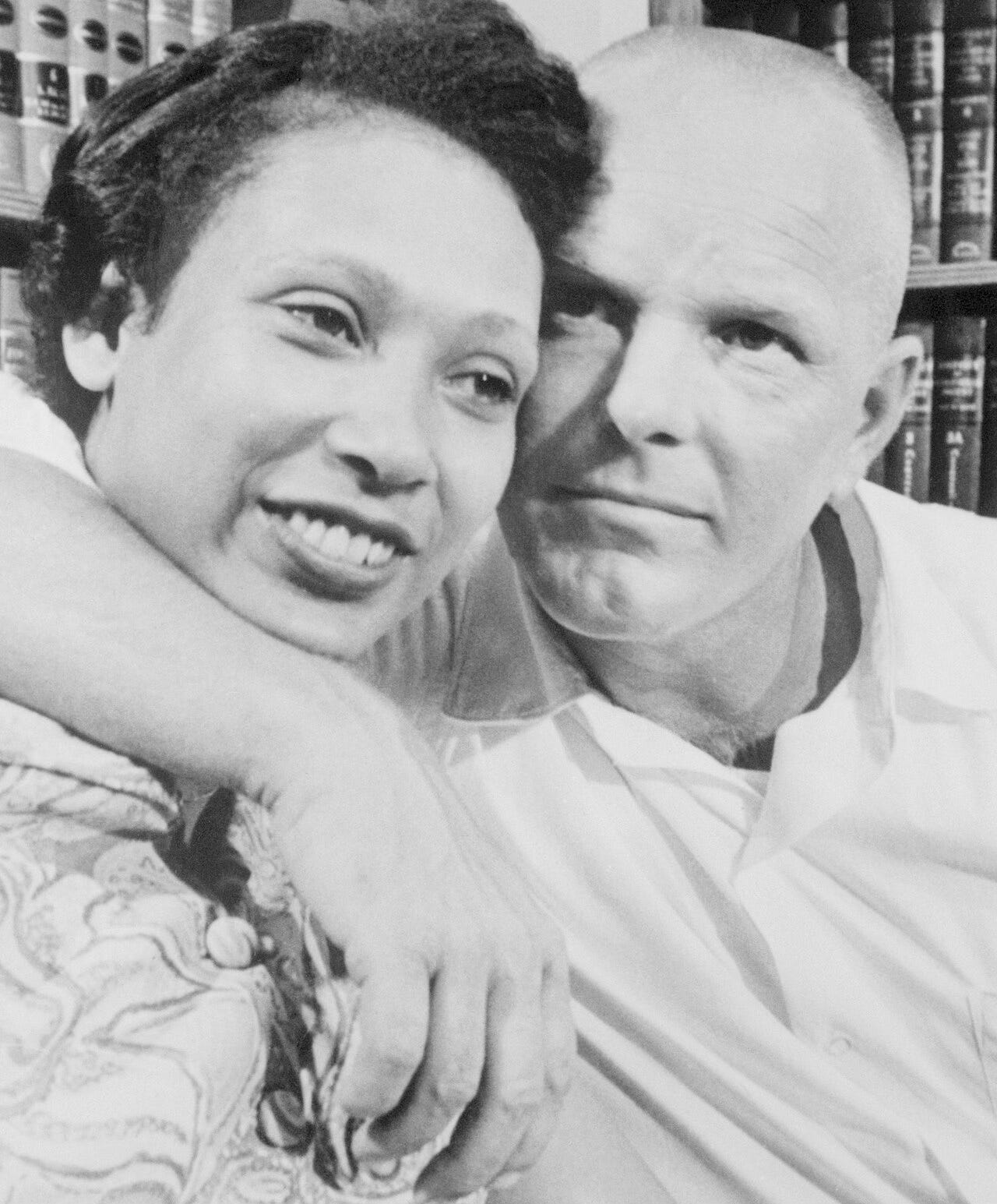
June 12 was Loving Day, which celebrates the 1967 Supreme Court decision striking down state bans on interracial marriage.
It’s so perfect, one of those coincidences that makes me (almost) believe in God, that in that case, the couple was named “Loving.” I was curious about them, so I was doing a little reading. It’s a really beautiful story, but I was struck by one detail in their life stories, or big thing that is treated like a detail, is a sad fact of American life that we have never fixed.
Richard and Mildred Loving were both from Central Point, Virginia, a small town that was diverse and where there was a lot of interracial socializing that took place. Richard grew up with Mildred’s brothers. His ancestors had fought for the confederacy in the Civil War. Mildred was part Native American part Black.
The couple started dating when Mildred was in high school. They got married after she became pregnant by another man. They traveled to Washington, D.C. in 1958 to get married because it was illegal in Virginia. Mildred reported she did not know it was illegal at the time.
They attempted to return home and were awoken to a police officer standing over their bed. In 1959 they were convicted of “cohabiting as man and wife, against the peace and dignity of the Commonwealth." They were sentenced to a year in prison. But the judge allowed them to leave the state rather than serve the time.
The couple returned to Washington, D.C. but Mildred didn’t like city life. In 1964, one of the couple’s sons was hit by a car playing in the street. They wanted to return to their hometown and their families, who they weren’t even allowed to visit. That year, they filed a suit to vacate their conviction.
Mildred wrote to Attorney General Robert F. Kennedy and he referred them to the ACLU, who agreed to take the case on. The case was brought before the Virginia Supreme Court, which upheld the guilty verdict that year on the grounds that it was “enforced equally” whether a white or black person violated the law.
ACLU appealed to the Supreme Court, which ruled unanimously that anti-miscegenation laws violated the 14th (equal protection) amendment of the constitution. Richard and Mildred did not appear at the proceedings but Richard did write the judge. His statement was “tell the court that I love my wife and it is just wrong that I can’t live with her.”
Richard was a construction worker and Mildred was a stay-at-home mom. They led quiet lives and did not make many public statements after the decision. They raised three children, including one who had a different father.
Official accounts of their life note, however, that in 1975, they were hit by a drunk driver. Richard was killed. Mildred lost one of her eyes.
What a sad ending to such an important American love story. I was struck how in the official accounts of the case and their lives, this fact is treated as kind of an aside. They fought all those years to live together, and then some dumb drunk driver stole it away, just like that. That is the convention with how traffic deaths are handled in American narratives. Even though, it happens to so many people and has such a profound impact on people’s lives and life stories.
The lack of emphasis is understandable of course, given the historic precedence of what Richard (and Mildred) did. Still, what a tragedy.
So many American families have stories like this. Just BAM one day, someone they loved a lot (the childhood friend turned husband) snatched away suddenly in a car crash. You can’t replace that kind of figure in your life.
A fatal car crash, the way it is treated in these narratives, is just something that happens, almost like an act of God. People are just expected to rise above and move on from. It’s so common for us. Joe Biden lost his wife and kid this way. In my state, my Governor, Mike DeWine, he lost one of his kids on the road. Fatal crash.
After fighting to be with her husband, Mildred ended up raising kids alone. And that is not treated as an injustice necessarily.
We have, of course, made progress on drunk driving since that time. But we’ve failed American families in many ways on this. We still have about 10,000 deaths a year in the U.S. that are the result of drunk driving. Over the last decade, we’ve made practically no progress on reducing traffic fatalities, while our peer nations have seen remarkable declines.
I was reading this article by a traffic safety expert written in 2014. The author Leonard Evans says in 1991, the “US traffic safety was nearly the best in the world.” Now we are the worst in the developed world. Americans die in car crashes about twice as much as Canadians. Our traffic death rates are six times (!!) higher than world leaders like Sweden.
If U.S. traffic safety had continued to improve at the same rate as our peer nations between 2004 and 2014, 20,000 lives a year would be saved, Leonard wrote. (Keep in mind this was written in 2014:
Since the terrorist attacks that killed 3000 Americans on September 11, 2001, deaths on US airlines have been rare events, averaging less than 20 per year. Since that date, more than 450 000 Americans have been killed in traffic crashes, including more than 8000 children aged seven years or younger. When 20 children of similar age were killed at Sandy Hook Elementary School, President Obama became prominently involved, as he did again on the one-year anniversary of the tragedy. Yet there is little governments can do to protect against deranged gunmen. They strike in many countries, the largest loss of life being a 2011 incident in Norway.
In sharp contrast, every aspect of traffic involves government. Governments design and build roads, regulate and inspect vehicles, pass and enforce traffic laws, and license and discipline drivers. It is government’s responsibility to take unremarkable steps that already apply in other countries to prevent the deaths of 20,000 Americans (including more than 300 children aged seven years or younger).
“US safety policy continues to be a public health catastrophe,” he wrote.
To make matters worse, looking back 2014 looks like a great moment in U.S. traffic safety. Since that time, our record has eroded even more compared with peer nations. My book about this was published in 2020, where again I was calling it a crisis, and again deaths jumped and got worse.
The kind of people we’re losing every day, their importance to their families, I think we forget that. What was it like for Mildred raising those kids without Richard? And with a disability to boot?
They deserved better. We deserve better. We keep treating this problem as a footnote in other more important stories instead of being something worth examining in itself.
No posts
Comments
Nothing yet. Say the first thing.
Sign in to join the conversation.