
I was reading Dr. Sasha Chaitow’s indepth and wonderful FAQ page below:
In the the FAQ, Sasha addresses many common questions and or misnomers concerning Greek culture. I wanted to bring attention to the following:
20. So are Greek magical practices just watered-down versions of ancient ones? Are they “real” survivals or just echoes?
Short answer:
Many are direct descendants with documented manuscript trails; some details changed, but core functions and structures remain.In depth:
In Greece, numerous rituals, healing charms, blessing formulas, and magical practices can be traced from ancient texts (inscriptions, papyri), through Byzantine manuscripts, into modern oral and family tradition.
Not every detail remains, and adaptation is constant, but the structure, purpose, and even many of the words persist.`
This is clearest in:
Incantations: Many Christian prayers retain phrases or patterns from the magical papyri or earlier hymnography.
Protective magic: The ritual of xematiasma (removing the evil eye), and incantations/amulets to protect infants use formulas directly paralleling ancient “apotropaic” practices, documented across centuries. Sometimes the wording is the same or derivative of that found in the PGM and similar sources.
Lament and blessing: Village funerary laments (moiroloi) and seasonal rituals show continuous lines of function and form from Homeric times onward.
It is not “just an echo.” Living tradition is not about frozen replicas, but about continuity of purpose and the ability to adapt. Greek magical and ritual practices are among the best-documented cases of cultural resilience—not as nationalist fantasy, but as historical fact.
This is called functional continuity—the same ritual or magical role, but updated for new times.
I want to draw attention to the laments. I figured it would be a nice time to share a Greek lament so you get a sense of what they are about. In Greek, laments are called μοιρολόι (moiroloi).
From μοίρα (moira) meaning “fate” or “destiny”
and λέω (leo) or λόγος meaning “speech” or “word”
So μοιρολόι literally means “speech about fate.”
The lament and exegesis below are from A Weft of Memory: A Greek Mother’s Recollection of Folksongs, Poems, and Proverbs by Vasiliki Scotes and Thomas J. Scotes.
This is a lament or kneeing song, known as a moiroloi. Such songs were sung at the wake before the dead person was taken to the church and at the graveside. Women usually sang them and some were specifically asked to come to the funeral because of their ability to compose and sing such songs.
Death is personified in Greek as Charos (Xápoç), a form of the ancient Charon, the ferryman of the dead in ancient Greek mythology. Despite being Christian for almost two thousand years, the Greeks in their folklore still see death as a bitter and comfortless occurrence imposing a reluctant departure from the beauty and pleasures of life on earth (as described in the song) for the gloom and bleakness of the grave.
A good account of the beliefs of the Homeric Greeks concerning death and fate can be found in Thomas Seton's book, "The Gods Remain"
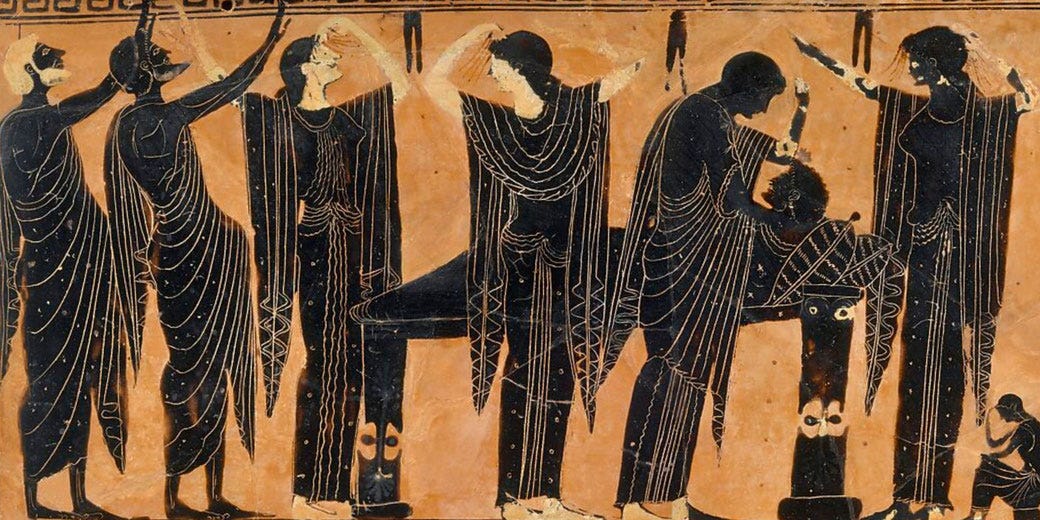
The Greek and English are below.
Με γέλασαν κάτι πουλιά
Με γέλασαν κάτι πουλιά, της άνοιξης τ’ αηδόνια.
Με γέλασαν και μου ’πανε ποτέ δεν θ’ αρρωστήσω,
ποτέ δεν θα πεθάνω.
Βάνω, φκιάνω τα σπίτια μου ψηλότερα από τ’ άλλα.
Φκιάνω και τα μπαλκόνια μου καλύτερα από τ’ άλλα.
Και στο μπαλκόνι κάθουμαι, τους κάμπους αγναντεύω.
Βλέπω τους κάμπους πράσινους και τα βουνά γαλάζια,
βλέπω κάποιον να ’ρχεται καβάλα στ’ άλογό του.
Μαύρος κι αυτός και τ’ άλογο, μαύρη και η φορεσιά του.
Καθούμουν και τον κοίταζα, πού θα ξεπεζέψει.
Κι αυτός ήρθε και ξεπέζεψε μέσα στην αυλή μου.
Κι εγώ τον καλωσόρισα, να φάμε και να πιούμε.
Κι αυτός μ’ απάντησε:
–Δεν ήρθα εδώ για φάι, για πιει, ούτε για τραγούδια,
εμένα μ’ έστειλε ο Θεός, μαζί μου να σε πάρω.
Εμένα με λένε Χάροντα και μαζί μου θα σε πάρω.
Ούτε πλουσίους ντρέπουμαι ούτε φτωχούς λυπάμαι.
Some Birds Deceived Me
Some birds deceived me, the nightingales of spring.
They deceived me and told me I would never fall ill,
I would never die.
I built my houses higher than all the others.
I made my balconies finer than all the others.
And I sat on my balcony, gazing out at the plains.
I saw the plains green and the mountains blue,
I saw someone approaching quietly on his horse.
He was black, and so was the horse, and black was his attire.
I sat and watched him, wondering where he would dismount.
And he came and dismounted in my yard.
I welcomed him, invited him to eat and drink.
And he replied to me:
— I haven’t come here to eat, or drink, or sing.
God has sent me, and I’ve come to take you.
They call me Charon, and I’ve come to take you with me.
I feel no shame before the rich, no pity for the poor.
No posts
Comments
Nothing yet. Say the first thing.
Sign in to join the conversation.