

Hi everyone,
It’s been a while. I’d like to get back to writing and I’ll try to make an effort to use this platform a little more. Even if it’s just to share what I’ve been watching/reading/listening to that week.
If you’ve been following me on other platforms, you’ll know it’s been a very busy year. I’ve been working hard on Canada’s presidency of the G7 this year as a Senior Policy Analyst on AI, quantum, and digital technologies for the G7 Sherpa team. (“Sherpa” is a funny word. In reality, Sherpas are the “Personal Representative” of their respective leaders — ie. Prime Minister Mark Carney — to the G7 ecosystem of Summits, Ministerial meetings, and so many working groups. The word comes from the “Sherpas” who helped guide mountain climbers to the “Summit” of Mount Everest!)
All of the hard work and overtime culminated in the publishing of the G7 Leaders’ Statement on AI for Prosperity and Kananaskis Common Vision for the Future of Quantum Technologies. While our presidency continues through to the end of the year, this has been the most challenging but fulfilling experience of my professional career. I joined the team exactly one year ago and it's been one of the best years of my life.
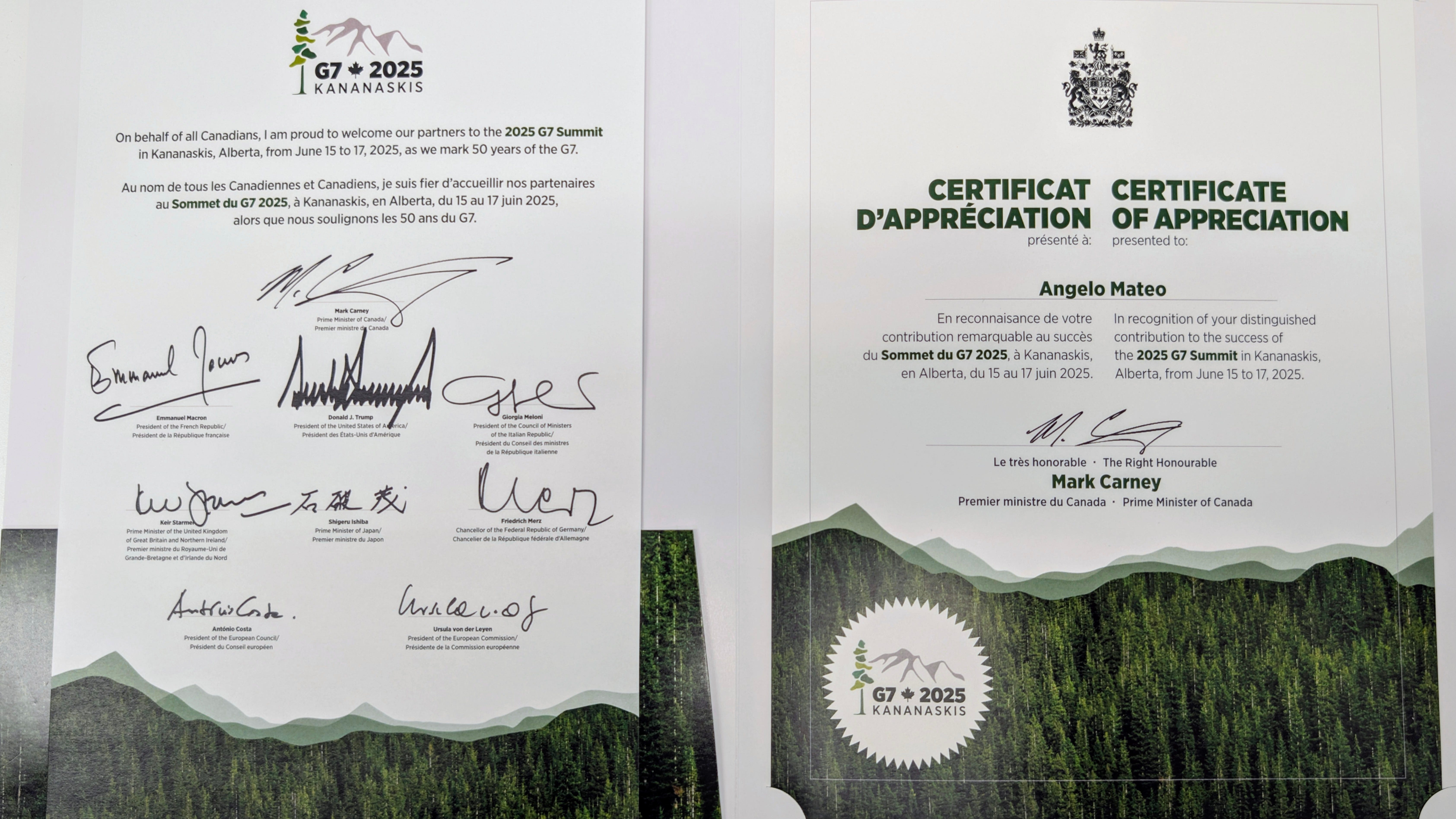
Last week, our senior leadership held an appreciation event for our team. We were presented with Certificates of Appreciation, signed by Prime Minister Carney "in recognition of your distinguished contribution to the success of the 2025 G7 Summit in Kananaskis, Alberta, from June 15 to 17, 2025." I very much appreciate the recognition of our hard work at the working level!
Today, I’d like to share a personal essay I wrote last week as a reflection to International Suicide Prevention Day.
Throughout my life, I’ve attempted suicide several times and have thought about it so often. I have lost friends and heroes to the darkness. Suicide is a part of my life and my story.
I’ve written about suicide before. It’s a very difficult topic because it brings up a lot of complicated emotions. I don’t know if I want to share too much – maybe it scares someone or makes you think less of me. I don’t know if it impacts my career. Or maybe I just want to keep some secrets to myself. But unless you’ve been in that darkness before and almost let it take you, you never know how it truly feels. The pain and fear and comfort in that moment when everything is overwhelming and all you want is rest. I write about suicide and my journey with bipolar disorder in the hopes that these words bring comfort to someone carrying these burdens alone.
cw: suicide
—
Since my first attempt, I have tried to wrestle with and understand the concept of suicide – both as an academic interest but also to try and resolve the emotional burden that comes with it. Kay Redfield Jamison, the most prominent scholar of bipolar disorder – and someone who intimately lives with the illness – wrote “Night Falls Fast: Understanding Suicide” in 1999 as her own way of trying to come to grips with the concept. Jamison drew upon her clinical expertise in psychology, psychiatric medicine, and psychopathology, while putting the concept in historical context and bringing in literary references to try and develop a better understanding of suicide.
Jamison wrote that: “In short, when people are suicidal, their thinking is paralyzed, their options appear spare or nonexistent, their mood is despairing, and hopelessness permeates their entire mental domain. The future cannot be separate from the present, and the present is painful beyond solace.” She quotes Japanese author Ryūnosuke Akutagawa:
“The world I am living in now is the icily transparent universe of sickly nerves… Of course, I do not want to die, but it is suffering to live.”
I know the feeling well. The hopelessness and despair. That the pain is so overwhelming that you feel there is no other choice. All you want is rest. It is a terrible thing to feel like there is nothing left to live for. And in those moments, no amount of reasoning or reassurance can ease the pain.
There is a poem called the The Suicide’s Soliloquy that was allegedly written by Abraham Lincoln. I’ve always found that this one verse truly encapsulates the feeling:
“To ease me of this power to think,
That through my bosom raves,
I’ll headlong leap from hell’s high brink,
And wallow in its waves.”
Living with bipolar means that I am particularly intimately connected with the concept of suicide. Research indicates that suicide attempts are disproportionately higher for people who live with a mood disorder like bipolar. Per Gergel et al. (2024):
“Globally, approximately 15–20% of people with bipolar disorder die by suicide, with 30–60% making at least one attempt, and these attempts use more lethal means than attempts among the general population… Suicide in people with bipolar disorder is associated with psychopathology and causes death, injury, and trauma, alongside wider socioeconomic costs.
The first time that bipolar disorder almost destroyed my life was absolutely crushing. It shatters your self-conceptualization. The world collapses into itself and becomes infinitely smaller. It is “a sense of being only a shadow or husk of one’s former self; an unshakable hopelessness; a feeling of failure and shame; and a terrible anxiety that the illness will return.” As Jamison writes:
“The awareness of the damage done by severe mental illness – to the individual himself and to others – and fears that it may return again play a decisive role in many suicides… Patients who do well socially and academically when young and who then are hit by devastating illnesses such as schizophrenia or manic-depression [note: an older, out-of-date terminology for what we now more commonly call bipolar disorder] seem particularly vulnerable to the spectre of their own mental disintegration and the terror of becoming a chronic patient. For them and many others there is a terrible loss of dreams and inescapable damage to friends, family, and self.”
When I was first diagnosed with bipolar disorder, I felt like it was a death sentence. That my dreams were forever out of reach and it was only a matter of time. Of course, I’ve achieved much in my life since then. But as I’ve written before, it is terrifying to feel like everything can fall apart at any moment.
Several of my suicide attempts have happened during the most dangerous of mood episodes known as “mixed states”. It is a mix of symptoms from depressive and (hypo)manic episodes. It is the worst of both worlds because it has the hopelessness and despair of depression with the frenetic and unstable energy of mania. Jamison describes it as:
“high-voltage, perturbed, yet morbid conditions… Behavior and moods during these periods tend to be volatile and erratic. Any combination of symptoms is possible, but the one most virulent for suicide is the mix of depressed mood, morbid thinking, and a “wired,” agitated level of energy… It is singularly and dangerously uncomfortable. Excess energy produces a kind of unhinging agitation.”
Poet Anne Sexton called it an “almost terrible energy”:
“I walk from room to room trying to think of something to do – for a while I will do something, make cookies or clean the bathroom – make beds – answer the telephone- but call along I have this almost terrible energy in me and nothing seems to help… I walk up and down the room – back and forth – and I feel like a caged tiger.”
I know these feelings all too well. I have sat in that darkness before and I have acted upon it. I wish I had never seen death so clearly and stared into his face. I have chosen to leave several times before – and yet I’m still here.
It is particularly devastating trying to understand the deaths by suicide of both loved ones and more prominent figures, when you yourself have lived through suicide. They don’t tell you about the feeling of immense feeling of guilt. Why Will and not me? Why am I still here and why isn’t he? Even hearing of Anthony Bourdain’s death, though I had never met him personally, was upsetting. I remember crying on the bathroom floor at work, trying to make sense of what happened. But what I’ve learnt is that you will never get answers and you will never rid yourself of the guilt and you have to learn to live with the uncertainty and commit yourself not to be another short story.
—
I never thought I’d live past thirty. Living with bipolar disorder, I know the intimacy of fragility and flirting with instability. I wrote once that “I grieve for all the times I’ve attempted suicide. I grieve for all the “me’s” that could have been. I grieve for all the endings that I’ve conceived in my mind.” But I have also felt the love and warmth of family, friends, and my lifelong partner.
Yes, I am always afraid that the darkness will return – and unfortunately, I’m sure it will. But I have also felt the magnificent light of loved ones. Almost ten years of living with bipolar disorder. Almost ten years since my first suicide attempt. And yet, I’ve lived, thrived, achieved so much.
I have lived with suicide and I have chosen to leave. But I have also chosen to stay. I chose winter nights, looking out into the Toronto back alleys, as snow gently danced in the rays of streetlights. I chose Tokyo Police Club and milkshakes with friends. I chose two kitties who bring joy and warmth everyday – even on the worst of workdays. I chose summer sunsets, driving with the windows down, singing along to “Dancing On My Own” with my love. It may feel impossible at times, but today, I choose to live.
“The woods are lovely, dark and deep,
But I have promises to keep,
And miles to go before I sleep,
And miles to go before I sleep.”
Thanks for reading The Revue & Review — Angelo Gio Mateo! Subscribe for free to receive new posts and support my work.
Comments
Nothing yet. Say the first thing.
Sign in to join the conversation.