
Welcome to August, friends.
July gave us four weeks of structural craft—letters, second scenes, the editor’s patience, the close-third lens. This week I want to back up and talk about something every writer makes a decision about on page one, often without realizing its importance:
Naming the people in your book.
It sounds like the easiest part of the work, but it isn’t. A name does more on the page than almost any other single word, because the reader hears it before they meet the person it belongs to.
From the Latin nomen (name) and calare (to call) — literally, “the calling of names.” A system of naming, especially within a particular field.
The nomen root family is one of the richest in English and full of surprises:
noun—the part of speech that names a thing
nominate—to put a name forward
denomination—a named category
misnomer—a wrong name
renown—re-nomen, named again and again; famous for something good
ignominy—in-nomen, the loss of one’s good name; similar to notorious, which is being famous for something bad.
That last pair is the one I keep coming back to. Renown and ignominy—fame and disgrace—share the same Latin root. A name is the thing you can build up or lose. Worth remembering when you sit down to name the people in your book.
If you’d like access to the full archive of Write Well—including paid issues on memoir structure, friendship in fiction, the epistolary novel, and close third-person POV—you can upgrade anytime. Seven dollars a month, less than a fancy coffee and a doughnut. Thank you to those of you who already make this work possible.
Question: How do I know if I’ve picked the right name for a character?
Answer: Say it out loud. Then say it inside a line of dialogue from another character: Pass the salt, Henry. Then say it in dialogue about the character: Henry would never do that.
If the name flattens out—if it sounds like any other name, if your mouth has no opinion about it—you don’t have it yet. A right name has texture in the mouth. It catches.
Also: check the decade. A 1934 farm girl named Madison broke the spell for the reader, and the reader can’t always tell you why. The Social Security Administration keeps the top thousand baby names by year and by decade, free, at ssa.gov/oact/babynames/decades. I use it every time I start a new book. More on that below.
“To know a thing’s true name is to have power over it.” — Ursula K. Le Guin, A Wizard of Earthsea
She wrote that in 1968 about a young wizard learning the old speech, and the concept was also familiar in biblical times. But every novelist knows the line is also about us.
I know that Russian writers have produced some truly great novels, but I don’t think I’ve ever finished one. Why? The Russian names. I can’t pronounce them, so I don’t hear them in my head, so I can’t keep the characters straight. (Well, I could sit and study them, sounding them all out, but I read novels for enjoyment, not to review phonics.) Names are important.
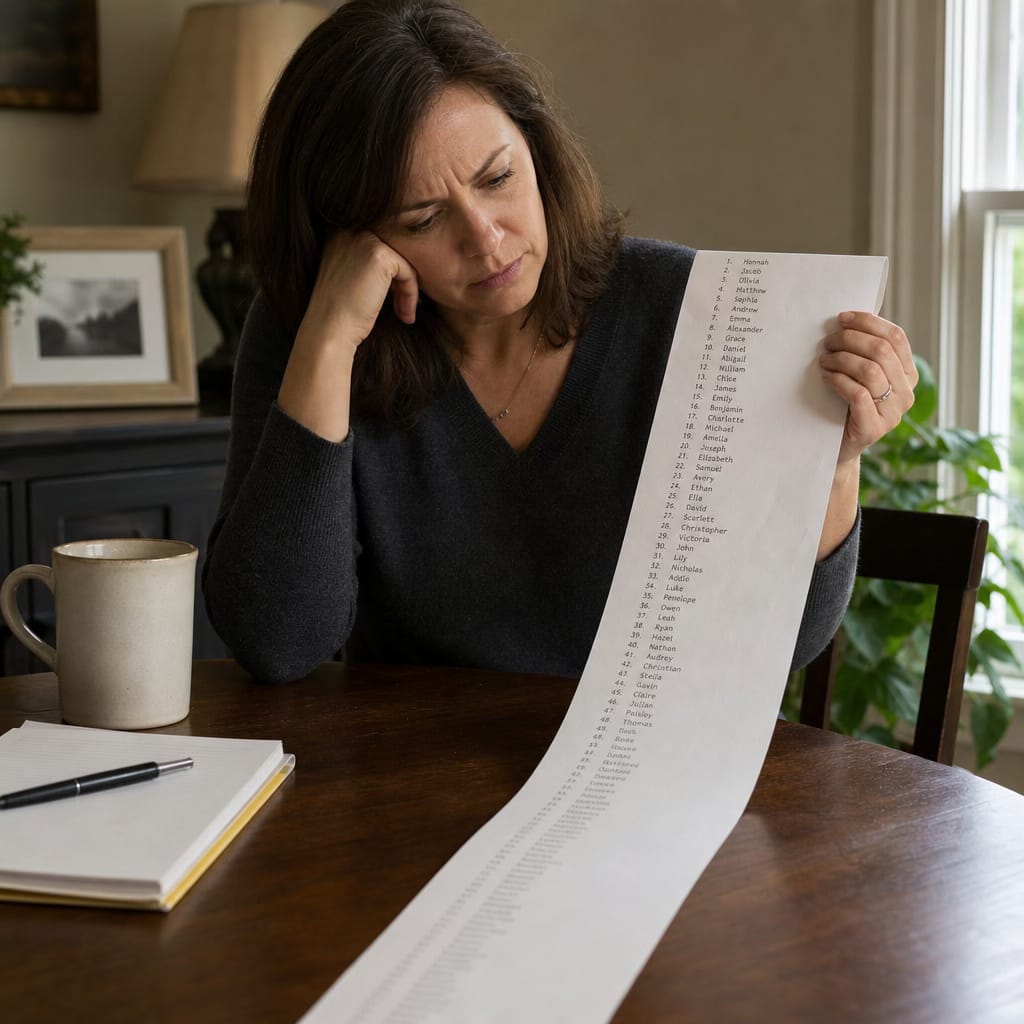
Pull the first chapter of any novel off your shelf. Count the named characters. Now ask yourself: do any two of them start with the same letter? Do they share a syllable count? Do they all end in the same soft sound—Sara, Anna, Emma, Mia—so the reader’s ear has to work to keep them separate?
This is the first test, and many manuscripts fail it.
I see it in workshop manuscripts and I see it in published novels. The writer fell in love with a vowel sound—usually a long a or a short i—and named four characters with it. The reader can’t track them. The reader doesn’t know why she can’t track them. She just sets the book down.
So that’s the technical floor. Vary the first letters. Vary the syllable counts. Vary the rhythms—a one-syllable last name with a three-syllable first name reads differently from two two-syllable beats. Sam Spade is not Harriet Vane. Atticus Finch is not Boo Radley. The mouth-feel does work the reader’s conscious mind never registers.
But the sound is just the beginning. The real work is what a name carries.
Dickens knew this and was shameless about it. Pip in Great Expectations is a name a boy can grow into and out of—short, soft, easy to write on a tombstone. Pumblechook is a buffoon you can hear coming. Magwitch carries the swamp he came from. Dickens stuffed meaning into his names because his audience read serially and needed handles. We tend to be subtler now, but the principle hasn’t changed: a name is the reader’s first piece of information about a person, and you don’t get a second first impression.
In one of my recent books, a rich family owns an island. Their surname? The Armstrongs. The father’s name? Victor. The name of his boat? Dominion. This is a man who wants to control everything he sees. The generational story begins in the mid 1950’s, so his wife’s name is Alexandra. In the next generation, the son marries an Elizabeth. And in the current generation, the husband marries a Katherine. All lofty names, appropriate for their decade and shared by queens and empresses. These women co-rule their husbands’ empires.
Flannery O’Connor took the opposite tack in “Good Country People.” Her character was christened Joy. At twenty-one, the character legally renamed herself Hulga—the ugliest name she could find—as a protest against the mother who insisted on calling her Joy. O’Connor doesn’t have to tell you what kind of woman this is. The renaming tells you. A character who chooses her own name is a character making a thesis statement.
Then there are the writers who refuse to name at all. Cormac McCarthy’s The Road gives us “the man” and “the boy.” For four hundred pages. The refusal to name is itself a craft choice—these are the last two people, archetypal rather than particular, and a name would shrink them. McCarthy is using the absence of a name as a tool. (Don’t try this in your first novel. McCarthy earned the right.)
Period matters, too—and this is where the SSA database earns its keep. If you’re writing a woman born in 1934 Mississippi, you can pull up the top thousand names for girls in that decade and see what was actually in the air. The name will be different from what your modern ear would invent. You’ll see Mary, Betty, Dorothy, Shirley, Helen, Margaret. You will not see Madison or Harper. A reader may not be able to tell you why your character named Madison feels off for a Depression-era farm girl, but she’ll feel it, and once she feels it she’s no longer inside your book.
One year I worked with a group of middle school girls, and most of their names ended in an ee sound: Julie, Holly, Susie, Nicki, Angie. I used one of their names for characters in one of my middle school books—Nicki—but threw in a Kim, a Meredith, a Christine, and a Laura to avoid all those ees. And yes, our youth group did have a Kim, Meredith, Christine, and Laura, so those names were right for the era.
You can also use the SSA database to break the rule on purpose. Maybe your 1934 girl was named Madison because her father was reading a Federalist Papers biography the week she was born and her mother was too exhausted to argue. That’s a story. But you need to know you’re breaking the pattern. (Plus, that gives your character a charming tale to tell at the right moment.)
The last thing I’ll say is about sound—the actual physical sound a name makes when a reader’s eyes pass over it. Atticus Finch is a name made of clipped consonants and a sharp final ch. It cuts. Boo Radley is two soft round sounds, the kind a child can hum. Holly Golightly is built to lift—three syllables in the last name, all of them open, ending in the long e of lee. Truman Capote knew exactly what he was doing. He named a woman who would float through the rest of American fiction.
When I was in the sixth grade, and beginning to formulate my identity, I decided I no longer wanted to be an Angela. That’s my legal name, of course, but to me, Angela sounded stuffy and a tad pretentious. I’d rather be an Angie any day, so Angie I became. There’s a woman at my synagogue named Angela, and she prefers Angela—clearly, it’s not stuffy to her; she likes it and dislikes Angie. What name does your protagonist want to be known by? Why?
A word about minor characters, because this is where I see the most waste. The walk-on at the bank, the neighbor across the hall, the cousin who shows up for one scene at Thanksgiving. A named minor character is a character the reader expects to come back. If you name her Aunt Mavis, you’ve promised the reader that Aunt Mavis means something. If she doesn’t come back, the promise breaks quietly, and quiet breakage is the worst kind, because the reader can’t point to what’s wrong.
So name them if they matter, or if you want the reader to wonder if they will. Otherwise let them be the cashier, the man on the porch, the woman with the dog. Anonymity is a tool. It tells the reader where to put her attention.
The other place writers waste names is on last names. Another common tendency is to give every character a memorable first name and a generic last name—Sarah Johnson, David Miller, Rachel Smith. The last names are wallpaper. But last names can carry weight: they tell the reader about family, place, ethnicity, period, class. Atticus Finch is named Finch because Harper Lee wanted the bird association—small, watchful, common. The Boo Radleys are Radleys because the name sounds like rattle and radish, rural and slightly off. Even a perfectly ordinary last name can be made to work if you choose it on purpose instead of grabbing the first one your eye lands on.
If you find yourself short on last names, the SSA database is one source. Census records are another. Old phone books, if you can find them, are gold—they fix names to specific cities at specific times. I keep a running list of last names I’ve heard and liked, the same way some writers keep notebooks of overheard dialogue. Most don’t get used. The ones that do, earn it.
Your characters’ names are the first sentence of who they are. Give them the same attention you give the first sentence of your book.
Bonus fact: If you use Scrivener, you have a built-in name generator. In the menu bar, Edit>Reference Tools>Name Generator. You’re welcome.
Open your current manuscript. List every named character in your first three chapters. Read the list aloud. Now ask:
Do any two names start with the same letter or share a dominant vowel sound?
Does anyone’s name fight the period or the place?
Is there a character who would be sharper if they renamed themselves?
Fix what the list shows you. You’ll feel your book tighten by the afternoon.
See you next Tuesday.
— Angie
Comments
Nothing yet. Say the first thing.
Sign in to join the conversation.