
Hi I'm Listening readers,
I’m so honored to share with you today a guest post from the Rev. TJ Johnson. Pastor Johnson is now a pastor in Oregon as part of the Evangelical Lutheran Church in America. But as he explains in the personal, deeply wrought story he shares below - he spent most of his ministry serving in the more conservative Lutheran Church - Missouri Synod, a denomination that does not ordain women or allow non-LCMS members to commune in its churches.
I have some very close family and friend relationships to the LCMS, and I’ve always felt deeply sad about the animosity between our church bodies. There have been LCMS pastors who have accepted me and appreciated my ministry. There is also at least one LCMS podcast episode devoted solely to ripping me and my work, haha.
I’ll let Pastor Johnson take it from here. And please do follow his Substack over at:
The story he is sharing here takes a great deal of courage. I’m grateful to call him a colleague.
When the Church Loses the Compassion of Christ
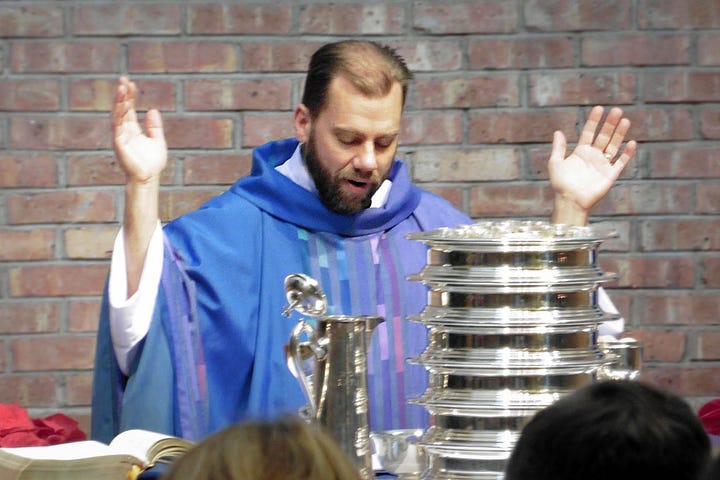
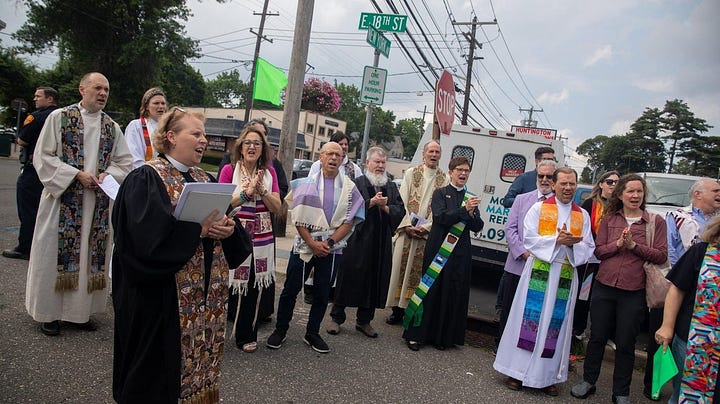
Photos provided by TJ Johnson. The first is of him ministering as an LCMS pastor; the second is a photo he says “got me into a lot of trouble with the LCMS.” He is wearing a multicolored stole at an interfaith vigil in protest of ICE’s assault on his community in Oregon.
By TJ Johnson
One Sunday in September of 2024, the deeper conflict that had been growing within and around me suddenly became impossible to ignore. A parishioner came through the receiving line, extended his hand, and then suddenly yanked mine toward him. He grabbed my wrist with his other hand, twisted my arm and shoulder, and drove his weight downward while shouting at me, “You can’t do this to us! You can’t do this to us!” just inches from my face. I stayed calm and tried to pull away, but I could not free myself safely. Several people witnessed it. Hours later, my wrist and shoulder were still throbbing.
I served for over two decades as a pastor in the Lutheran Church—Missouri Synod (LCMS). I was largely formed by it, raised my children in it, and gave much of my life to preaching the Gospel, caring for the suffering, and walking with people through the ordinary joys and sorrows of life. I did not come to my concerns about the LCMS as an outsider looking in. I came to them as someone who loved the church, served it faithfully, and hoped to remain in it, even as the denomination grew more rigid and my own conscience began to shift.
The confrontation did not come out of nowhere. That morning I had preached on the Letter of James: “the tongue is a fire.” I spoke about the mocking, bullying, and cruel rhetoric directed at trans people online, including by some LCMS pastors, and I said that whatever one’s disagreements or confusion may be, it is not the way of Christ to bully or mock another human being. That parishioner had made his condemnation of “trans” and “homosexuals” clear before, and those nearby could hear his anger during the sermon. I cannot explain exactly what drove him in that moment, but I believe that my refusal to bless such cruelty was part of it.
Though I was not seriously hurt, the psychological trauma of it helped me cross a threshold. By then, I had already been living with a growing sense that something in the culture around me was changing. It was not long after this incident that a whole group of parishioners contacted my bishop wanting to press charges and have me removed as pastor because I attended an immigration vigil where we heard stories and prayed for our immigrant neighbors. I was accused of being “woke” and “bringing politics into the church.” Yet I did not go as a partisan, nor had I turned the pulpit into a platform for that cause. I went as a pastor, to listen, to pray, and to stand with neighbors living in fear. Ironically, two of the complainants wore matching “Make America Great Again” red sweatshirts the Sunday before the 2024 election. What I was witnessing was not confined to official statements or those in authority; it was evident among ordinary laypeople as well. Across the church body, the spirit I encountered was becoming harder, more fearful, more grievance-driven, and less recognizable to me as the spirit of Christ. Just as troubling was the quiet indifference of so many who seemed unmoved by the suffering of others. I saw that spirit not only in personal encounters, but also in the denomination’s public voice.
I did not leave the LCMS because I wanted less faith, Scripture, or Jesus. I walked away because I could no longer reconcile what I was seeing in the church body with the compassion of Christ I had been called to preach.
I say that not as an outsider taking cheap shots, but as someone who served within the LCMS, loved many people in it, and did not leave lightly. This was not a casual change of affiliation. It was painful. It meant loss, grief, and the surrender of a church body that had shaped much of my life and ministry for 24 years. But there comes a point when staying begins to wound the conscience more deeply than leaving.
For me, that point did not come all at once. It came through years of watching the public spirit of the denomination grow harder, more fearful, and more political, especially toward immigrants, women, and the LGBTQIA+ community. The change I witnessed was not limited to those in authority; it was evident among ordinary laypeople as well. My concern was not merely that I disagreed with a conservative theological position. Christians have always had serious disagreements. My concern was that fear and scapegoating were beginning to crowd out the mercy, tenderness, and moral clarity of Jesus.
Another part of my awakening involved the silencing of women’s voices. As my support for women’s ordination deepened, I also saw congregations and pastors who would not allow women to vote, serve on church council, preside as congregational president, read Scripture, pray publicly, teach adult men, share children’s messages in worship, or even stand at the altar. These communities preached strict female submission, and in the circles I knew, I watched that rigid vision gain increasing influence, especially among some younger clergy.
What troubled me was not only what I was seeing in local church life, but how increasingly similar themes were showing up in the denomination’s public voice as well.
I think often of the contrast in the public words of LCMS President Matthew Harrison over the years. In 2017, during the first Trump administration, when the country was reckoning with the separation of immigrant children from their parents at the border and with the harsh conditions in which many families were being held, Harrison wrote about immigrants and refugees with a tone of compassion and pastoral concern. In a letter dated on January 6, 2017, he wrote, “We have and will continue to stand with Jesus’ mandate to ‘love your neighbor’ in the case of immigrants, documented or not, even as we provide assistance within the bounds of the law.” There was an acknowledgment of shared humanity, a sense that these were not abstractions or talking points, but neighbors. That sounded to me like the voice of the Gospel.
But in later letters, the tone and language changed. During the second Trump administration, when DOGE had become associated with sweeping cuts to the federal workforce and a broader politics of disruption, immigrants were increasingly described in political and dehumanizing categories such as “illegal.” In a letter dated February 6, 2025, Harrison’s said, “I’m personally pleased with DOGE” and “The LCMS is a law-abiding and patriotic church body. We don’t invite or support illegal immigration.” That language stood in painful contrast to his 2017 affirmation of Jesus’ mandate to love our neighbors, “documented or not.” I would argue that the most patriotic thing we can do is to hold our elected leaders accountable. The church has every right—even every duty—to speak about justice, mercy, and the dignity of human beings. Jesus measures faithfulness not by fear or judgment of the stranger, but by welcome: “I was a stranger and you welcomed me” (Matthew 25:35). But when it begins echoing partisan rhetoric as though it were Christian faithfulness, it loses its bearings and risks losing its prophetic voice. Jesus said, “Render to Caesar what is Caesar’s, and to God what is God’s” (Matthew 22:21).
The same pattern appeared in a letter before the 2024 election, when anti-trans rhetoric had become a national political wedge. The warning about the “gay and trans agenda,” and the call to vote accordingly, may have functioned as effective fear-mongering, but it did not sound like the heart of Christ. It was a thinly veiled endorsement of a particular political choice. It did not invite understanding. It did not open minds or hearts. It turned human beings into threats. It taught Christians to meet entire groups of people not with compassion, curiosity, or humility, but with suspicion.
This was not abstract for me. Charges were brought against me because I wanted to ensure the human rights of immigrants and refugees, to show the queer community Christ’s love, and to speak to these matters from a Christlike rather than partisan perspective. I was not trying to make the church political in some new way. I was trying to resist a form of politics that had already taken hold—one that wrapped itself in Christian language while operating from fear, boundary-policing, and categories that are entirely human-made.
Jesus did not meet people first as categories. He met them as persons, those made in the image of God. He saw the wounded, the excluded, the stranger, the one pushed to the margins. He warned religious people again and again that it is possible to defend righteousness while failing to reflect the heart of God. Even a cursory reading of the Gospels makes clear that Jesus reserved his sharpest words for the religious authorities—the Scribes and Pharisees.
Many outside the church have stopped listening to Christianity altogether because what they hear no longer sounds like good news. It sounds like an echo chamber of anxiety baptized in religious language. Christians often summarize Jesus’ prayer in John 17:14–16 by saying that we are to be “in the world but not of it.” The meaning is not withdrawal, but transformation: his followers are meant to help reshape the world in the spirit of Christ, not allow the church to be reshaped by the world’s fear, cruelty, and hunger for power. Too often, instead of offering the world a different way, we simply mirror its division and hostility.
The real battle within conservative denominations is not merely about doctrine. It is about whether the church will still reflect the compassion of Christ. Jesus’ great command was simple: “Love one another as I have loved you” (John 13:34; 15:12). Every faith community has convictions and contours that give it shape. But when a church becomes so consumed with policing who is “in” and who is “out” that it no longer resembles Jesus in its tone, priorities, and public witness, something essential has been lost. Too often, people know us only by what we are against or what we oppose, not by what we are for or whom we love.
I did not leave the LCMS because I doubted the teachings of Jesus. I left because I could no longer, in good conscience, remain where I was.
My hope in writing this is not to condemn those in a more conservative church or church body. It is to open eyes and hearts. It is to say, as honestly as I can, that when the church loses the compassion of Christ, it loses far more than members. It loses its credibility, its witness, and part of its soul.
As I said, I’m humbled by Pastor Johnson’s courage and conviction, and I’m so grateful to call him a colleague and to share his story here.
Angela
Follow Pastor TJ Johnson here.
P.S. …
A Few Notes:
First, a huge THANK YOU to all subscribers. I get a little email notification every time someone signs up, and every time I get one, I feel joyful and honored that you want to spend part of your day with this community. I mean it when I say: “I’m listening,” to you as well, and please don’t hesitate to share with me your thoughts + ideas for what you’d like to read in this space.
To PAID SUBSCRIBERS: I am humbled and honored that you’ve chosen to spend part of your limited budget on this newsletter. To borrow words from another newsletter I love, you are directly funding freelance journalism with your subscription, and I have to thank you more than ever for your continued support. Our world’s media and journalism is in a state of crisis, with fewer and fewer billionaires in control of global news outlets, and journalists being either laid off or threatened with violence for their work every single day; with fewer and fewer newsroom positions paying a living wage. I pledge to you to steward your paid subscription faithfully + use it to support honest, hard-working, and LOCAL journalism. One of my goals in this first year is to open this newsletter to other journalists, and pay them a fair wage for their work.
THANK YOU for your support. If you’re not a paid subscriber, please consider becoming one.
On free vs. paid-subscriber posts only: My plan right now is that the Friday + Sunday posts, focusing on news + spirituality, in that order, are available for subscribers only (I am going to continue sharing a sample, with a line where the paywall cuts off for our paid subscriber community). My plan is that the Tuesday blog-style posts will always be free, to enable as much access as possible, while creating a smaller and more intimate experience for paid subscribers, who are also able to comment and share in community in fuller ways.
Free Trial: Substack always offers a free week-long trial subscription to this newsletter, so you can get a taste of the Friday + Sunday posts and see if you’d like to subscribe!
If a paid subscription is a hardship for you, but you’d like access to the Friday + Sunday posts: PLEASE do not hesitate to reach out. I will be happy to provide a complimentary subscription for you.
No posts
Comments
Nothing yet. Say the first thing.
Sign in to join the conversation.