
Maja Marx (b. 1977) is a South African painter living in Cape Town. She works with pigment, oil and linen, building surfaces through slow, analytic and layered engagement. Her sixth solo exhibition, Skin of the Eye, was hosted at WHATIFTHEWORLD Gallery in Cape Town in 2023. She has participated in the Venice Biennale, held residencies in New York, Switzerland, and the Netherlands, and her work is held in public and private collections internationally.
People who live inside ordinary life, but haven’t lost contact with its beauty or traded their aliveness for it. They are wholeheartedly human: astonished and at large. Finding them, and finding out how they got that way, is what this series is about.
Maja Marx qualifies. I spoke with her on a warm February afternoon in 2026 and we talked about beauty, attention, trust, boredom and what it means to arrive fully into your own life.
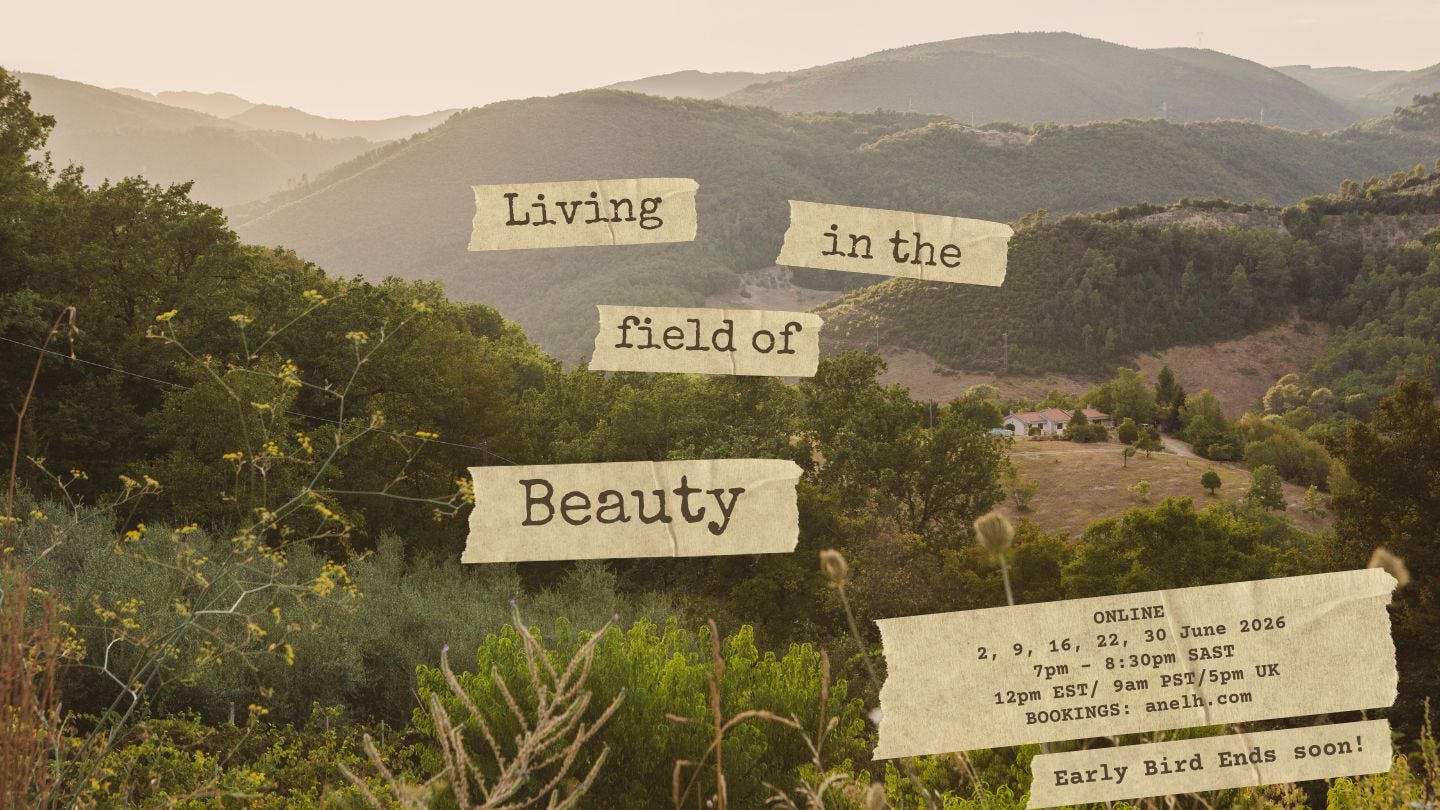
This conversation is part of a series I'm making in preparation for Living in the Field of Beauty, a five-week course starting in June. Next week I'll publish Part 2 which will be an essay reflecting on this conversation. If you'd like to support this work and get early access to future conversations, you can support me on Patreon.
00:00 Maya’s Artistic Journey and Daily Life
03:08 The Conversation of Art
07:00 Attention and Perception in the Modern World
14:01 The Nature of Beauty and Art
24:48 Reflections on Life
30:57 Trusting the World and Finding Humor
33:20 The Illusion of Reality and Human Connection
35:55 Transforming Anxiety into Inspiration
37:16 Finding Joy in Simple Moments
39:32 The Power of Observation and Language
41:23 The Magic in Everyday Life
43:32 Living a Beautiful Life
45:33 Finding Beauty in the Mundane
49:55 The Art of Noticing and Participating
55:47 Empathy and Sensitivity in a Complex World
01:01:18 The Importance of Connection and Community
*This transcript has been edited for length.* Full transcript is available on the post page.
Anél Hamersma (00:00)
Speaking of this idea of being free range and your work, what is it that you do every day? How do you express yourself every day in your work?
Maja Marx (00:12)
I’m a painter, an artist. My day has a very simple formula to it. I have two daughters and an artist husband. Our household is busy — super intense. Four very active people in a kind of interesting setting. Both me and my husband have our studios on the property. We live on the property and we produce work on the property. It’s an amazing gift to have a space like that — a hyperspace of making.
I grew up in a household with an artist mother. Some of my earliest memories are connected to art making and home making and story making. It’s a wonderful thing to have as a starting point — in your mouth, almost. It’s in your language.
My main focus is the development of a narrative — some sort of poetic engagement with surface. People refer to my work as hyperactivations of surface. It involves a very slow process of engaging with the surface through paint and returning to that surface again and again. I’m not that interested in figuration or representation. I’m more interested in the process and the gestural value of engagement — it’s an investigation of the body in that sense.
I get up in the morning and I feed my family and I clean my house and I water my garden and walk my dog, and then I work. The word “work” is perhaps not even the right word. It’s an engagement with something that keeps you honest and kind and true to yourself. I see art making as an essential daily activity. If I wake up at night, I come and paint. There is the space — a kind of sanctuary for that conversation with myself.
Anél Hamersma (04:57)
I love what you’re saying about art being this kind of conversation you’re having with yourself. What kind of conversation are you having? What is that conversation about?
Maja Marx (05:11)
It’s no secret that we have conversations with ourselves — sometimes out loud, and sometimes quietly in the sanctuary of one’s studio. There’s some sort of conversation happening with the self and a kind of bigger self. For some, it might be a spiritual conversation. For others, it’s philosophical or poetic.
We, as beings not only engaged with the basics of eating and sleeping and love, spill out into the world. We have a desire to make certain things — the super ordinary — more meaningful to ourselves. I’m very lucky that I can use art as a kind of filter or pair of glasses that I look through in order to get that connection with the world. A studio is an incredible thing to have access to, but a desk or a page in a book or a walk in the forest can be the same thing.
Anél Hamersma (07:42)
So art making is a kind of evolutionary process for you?
Maja Marx (07:42)
Yes. I love the potentiality of the infra-ordinary — the fact that it’s there and available, and that by framing it in a certain way or allowing ourselves time to engage with it, it can shift into something that has another kind of level of narrative.
I kept little books around in the studio, and every now and then a statement would arrive, or a word would appear, or some phrase. I see these as almost found compositions that I can refer back to later. It’s an interesting kind of mirror into the world.
There’s this fantastic idea of daydreaming as a space where things slow down. Children especially — they’re so open to daydreaming. The eyes see, but there’s no focus. The body is there. You’re blinking, you’re swallowing, but you’re almost dreaming while you’re awake. It’s not something you can force, not something you can switch on. With art making, it is a kind of attempt to switch on a little bit of a space like that for oneself.
Anél Hamersma (10:43)
Does your practice allow you to enter into that space more easily?
Maja Marx (10:57)
I think that is a practice, but some days it won’t work either. One of the scariest moments for a painter — especially a mother who is a painter — is the weapon of interruption. Interruption is voracious and hungry, a kind of being on its own that demands attention.
Of course, we don’t live in bubbles. All those sounds and all those interruptions — there’s a kind of greater beauty to that also. So I started working with that purposefully. I did a series of works essentially based on that clue of interruption. The environment and all those found compositions are there for us to utilise, but also there to interrupt and therefore influence the conversation we have with ourselves.
Since having children, an available hour becomes a very long period. You make do with what you have. Like a writer — when there’s a gap, you take it.
Anél Hamersma (14:01)
We live in an age where attention is being captured all the time. What are your thoughts about attention, and why should we care about it?
Maja Marx (14:38)
Attention is essentially the way in which we perch our thoughts and our interest onto something. We land there and then we sit there and then we observe where we are from that position. There’s a certain kind of blindness that comes with super focus — and unfortunately, that blindness is a kind of scrolling blindness.
For me, when I work, I don’t use my phone. That tiny rectangular block that we use as a viewfinder to the so-called world is such an uninteresting interruption. People get angry at me because I’m not always available. A friend of mine — she’s a surgeon — once asked me why I don’t reply immediately to WhatsApp messages. My reply was: when you’re in surgery and your hands are busy, do you reply?
There’s also this fantastic thing called boredom — and boredom is such a healthy thing for us. Something we are losing in the world, because there’s always something to fill the gap. Boredom is an injection. It instigates new creative processes. Painting allows for a shift in tempo and therefore a different attention rhythm.
Anél Hamersma (20:33)
I love the word “perching” that you used. Tell me about perching.
Maja Marx (20:41)
A very important part of making is not the actual mark, but the process of looking at the art. It has to do with my interest in the science of looking, and also the science of poetry — finding the Lego blocks, the modularity behind things. Maybe it’s my father the engineer and my mother the artist coming together. The poetics and the mechanism.
When we write, we are reading. The same with art. You can’t only consider the making — you have to spend time just taking it in again. Looking at art becomes a way of reading the surface. Painting becomes a way of writing, perhaps.
The marks begin to self-proliferate. That’s the kind of abstract analytics I really enjoy. I love that there’s almost no place for the eye to settle — it allows for a wandering eye, a roaming mind. A surface that is never static.
The big question is always: when is a painting done? That’s where beauty comes in. There’s a moment where you don’t perch anywhere and you want to return again and again to all the different parts of the surface. For me, that is when I know it’s done.
Anél Hamersma (25:10)
How do you define beauty, Maja? What is beauty to you?
Maja Marx (25:16)
For me, what draws me back again and again to a moment or thought or an object is the desire for the double take — the desire to return, to analyse and explore more, to see from another side.
But essentially, the moment of beauty — simply stated — is when I’m engaged with a painterly act and I leave the space of the painting, and the whole world has changed. I can see the painting of the world and I see the world in my painting. That’s my private, very personal definition of beauty.
When I paint, I’m searching for those infra-ordinary moments. I lose myself in the super analytic investigation until I lose the perch. It’s just analytics — just the signs of what you have in front of you. And then the self-proliferation starts. That’s when beauty starts spilling out into the world for me.
Anél Hamersma (28:08)
Let’s go existential, Maja. What is your view on life? What is this ride that we’re on?
Maja Marx (28:17)
I’m so thankful I’ve never mistrusted the world. I went to the ocean yesterday with my husband and we spent the whole day swimming. Shells and rocks and sand and water and sunshine. It’s simple. I feel overjoyed. I think it’s in the super ordinary that I find super trust in the world — the way that light will fall.
It can be a fearful time, but it’s also quite amazing that we are at a place where we can ask questions and find our own understandings. If we come back to the notion of beauty, it is perhaps essentially about being able to offer your time and your attention to find that connection with something — in the smallest form, whatever form it takes.
Anél Hamersma (31:14)
What would you say to somebody who mistrusts the world around them?
Maja Marx (31:37)
Humour would be the best way to shift the mistrust in the world. It’s extremely funny — we find ourselves in this wonderful, ridiculous moment. Humour, and also slowing down. Be less connected to grand narratives and grand truths. We’re in a situation where we are being fed ideas about the world — and it doesn’t mean that that is the world.
Have real conversations. Eat real food. Love your grey hair. Go for a walk. Get a dog!
Anél Hamersma (33:06)
What does “real” mean?
Maja Marx (33:10)
I think we search for acknowledgement or affirmation that what we think is real is real enough to have value.
As a child, I would worry that I wouldn’t be able to sleep. I’ve always been a night owl — quite often I would put the light on and make a drawing. I know my mom would be doing the same thing on the other side of the wall. The solution was: when I was finished with the drawing, I would go back to bed and lie very still so that the tissues could heal.
That moment where something drives you — you wake up and write something down, or draw something — you are alive. You are a singular little being in this massive universe and you’re making something, connecting with your thoughts. The second name of anxiety is inspiration. She just suddenly has something to offer you.
I would suggest simple joys. See that anxiety as a form of inspiration, as a kind of potentiality. Because that is the skill we have as poetic beings. We are all poetic beings.
Anél Hamersma (38:18)
Why does expression matter? Why should people care about developing this language?
Maja Marx (38:38)
I remember a time in my life where I didn’t really speak much — as a young child I was very quiet. I’m thankful for that time, because it was the time of super observation. The way in which I filter things today is informed by that — less about talking and saying things, and more about observing and trying to understand things for yourself.
It was only later that art gave me a kind of voice — a lateral voice, a poetic voice. You don’t have to understand art, but you can sense that something is happening. There’s a kind of sublime exchange that can happen there.
Magic, on the most simple level — it’s not the grand gestures and the large cloaked experiences of splendour. Magic happens in the simple framing of that which is so ordinary. The sip of tea you’re having, the opening of curtains, becomes meaningful. Suddenly you look at the world and all of the ordinary moments can have a bit of magic in them.
Anél Hamersma (42:42)
What does it look like to live a beautiful life?
Maja Marx (43:01)
I have a lot of love in my life — more than I could ever have hoped for or asked for. I think love is the thing that glues all of us together.
Random little compositions of stones and shells and leaves and a bit of colour. Magpie moments. Little treasures brought to me by my children. Beautiful food presented on a simple plate. I want to see every passing cloud. A beautiful life means noticing. Enjoying that lovely moment.
Anél Hamersma (44:58)
Last question. I work in an office block from eight in the morning till six at night. I’m always tired, overwhelmed, spending hours in traffic. When you talk about magic and seeing the beauty in little things, I don’t know what you’re talking about. Everything is just flat and bland and grey. Life is one long transaction.
Maja Marx (45:30)
There are so many people in our world, in our country, who have that experience. I think all of those interruptions and obstacles — you can shift them into a sense of self. Because still in that process, you’re in conversation with yourself.
Usha Seejarim is a fantastic friend of mine, a wonderful artist. She had to commute between Johannesburg and Lenasia every day, sitting in traffic for hours. What she started doing was, through an act of ordinary meditation — just the ordinary activation of a creative reading of the world around you — she started searching for the beauty in every moment. She would look at the exhaust pipes, meditate on the traffic signs, find the charm of the smoggy horizon.
She produced a series of photographs where she documented the red line of the cars’ brake lights, and then in symmetry on the other side, a long snake of white headlights approaching. You had that sense of this long red snake disappearing into the future, slowly in traffic. The beauty of the highway. The human snake. Beautiful — whether we hate it or love it doesn’t change the beauty of it. Once you see it, it’s there.
The act of sweeping — if you shift how you think about it — can be an act of dancing. It’s about switching on a certain sensoric acknowledgement that there’s a poetic value to all these ordinary daily things, in pursuit of the infra-ordinariness of beauty.
Anél Hamersma (56:54)
I have a friend who calls it being porous to the world — allowing yourself to be touched by the world around you. Don’t be a plastic bag, be a paper bag, he always says.
Maja Marx (57:08)
A paper bag — or even better, a carbon paper bag, so that you can show the marks. And if you think of the times in your life when you have been most porous, you were probably most in touch with yourself. That’s a skill.
We are not algorithms. That is not our plug into the world.
My mom was a single mom with three kids, and she kept us alive with art. I can’t actually ever remember saying “I am bored.” There was always something — my mom’s receipt book, for instance. She never used it for receipts. It was full of drawings. I would draw, then my mom would add to the drawing, my sister would add. Or you’d get stuck waiting somewhere and you’d start drawing with rocks on the asphalt. I believe all of that informs the person that I am today.
Anél Hamersma (1:00:05)
All of our friends were completely enchanted by your mother — she had the ability to show you something very simple with a kind of enchantment. She’d go, “Look at this — isn’t this amazing?” And you’d go, wow, I’ve never looked at it quite that way. You can transmit it to other people, that kind of magical way of seeing the world.
Maja Marx (1:00:48)
If you are simply putting that to work, it makes itself available to you. That is a gift. It’s not an exclusive experience. It’s super available.
Anél Hamersma (1:01:45)
There’s something so freeing about being drawn out of yourself. The moment you’re able to see the beauty and the enchantment of something outside of you, you immediately cross the boundary of that enclosed egg that you exist in and you become part of the wider world.
Maja Marx (1:01:45)
Our history in South Africa was something so dark — that purposeful splitting of porousness and connection. The splitting of people and communities and generations. The beautiful thing is we have a desire to be close together.
With lockdown, it shifted how we think about the singular self and the collective self. That initial moment where we were not allowed to leave the house — and then suddenly it opened up between six and nine in the morning. The sound of people rejoicing in human exercise. It sounded like birdsong. What a beautiful thing it is that people desire to connect. More of that.
Anél Hamersma (1:04:17)
If it were 500 years ago, I would have been so thrilled to come across this one broccoli — it would have been a completely miraculous thing. But now, the more freely available things are, they lose some of their power. There’s something about the magic that gets lost in translation.
Maja Marx (1:04:43)
That can shift — and quite easily. The scenarios where joy of colour or composition or beauty are offered to people — it’s still available. You can go to theatre, you can go to an exhibition, you can go for a walk. But you actually have to go. You have to perform it, you have to participate. You have to arrive. That’s the word I’m looking for. You have to arrive to have the experience.
I went to see a fantastic puppet performance the other day. It drove me to tears. Almost 50, and I can cry at a puppet show. But I was there — and if I had seen it on a screen or someone had told me about it, I might have had some cathartic clue. But to sit there, to be in that presence — that’s when it happens. The old Greeks and Romans knew something when they spoke about catharsis. It’s good for us. You have to arrive.
Maja Marx (1:07:08)
At the Art Fair recently — something like 40,000 or 50,000 people through that building over the weekend. Those are real people who want a one-on-one experience, an engagement with surface, with object, with that conversation. It gives me hope. It’s not about the art. It’s about that arrival, that participation. Participation is the core human thing.
For that kind of magic activation of the simple things — so that they can be seen as beautiful, so they can become part of the dictionary of beauty — you have to participate. Maybe that’s the summary of it.
Anél Hamersma (1:09:41)
To be active and to show up. Not just to be a passive bystander. You have to show up.
Maja Marx (1:09:59)
You have to show up.
Anél Hamersma (1:10:01)
Thank you so much for your time, Maja. Thank you for your beingness. I always feel so inspired by spending time with you.
Maja Marx (1:10:19)
Same.
Maja Marx’s work can be found at WHATIFTHEWORLD Gallery, Cape Town. Her most recent solo exhibition was Skin of the Eye (2023).
Watch my conversation with Peter van Straten.
Sign up for Living in the Field of Beauty, starting in June, here.
Join me on Patreon.
More about Free Range Human.
Comments
Nothing yet. Say the first thing.
Sign in to join the conversation.