
I don’t go for cooler-than-thou. Never have. It probably cut me off from some intriguing friendships, but if you’re going to look down your nose at me based on an assumption, I’ll turn away with no regrets. It also may be why I never finished Meet Me In The Bathroom. After all, I shouldn’t have to feel shame for not going to the Mercury Lounge until 2011.
I’m also not a fan of nostalgia, the idea that the golden age is always in the past. Perhaps being the fourth of four children has something to do with that. I mean, who wants to live with three people who think things were always better before you were there? LOL.
Finally, I’m never going to get on the “New York is over” bandwagon. I recently read a musician complaining that there are no more free concerts in the Big Apple. Are you insane? Besides BRIC Celebrate Brooklyn and Summer Stage, there are tons of other opportunities for free shows, whether at Union Pool, Rough Trade, or elsewhere. Having lived in New York all my life, I know there is always something great going on somewhere. Sure, it sucks when your favorite greasy spoon is plowed under for a high-rise designed for the rich, but there’s probably something cool that just opened in a neighborhood you’ve never been to, waiting for you to discover it.
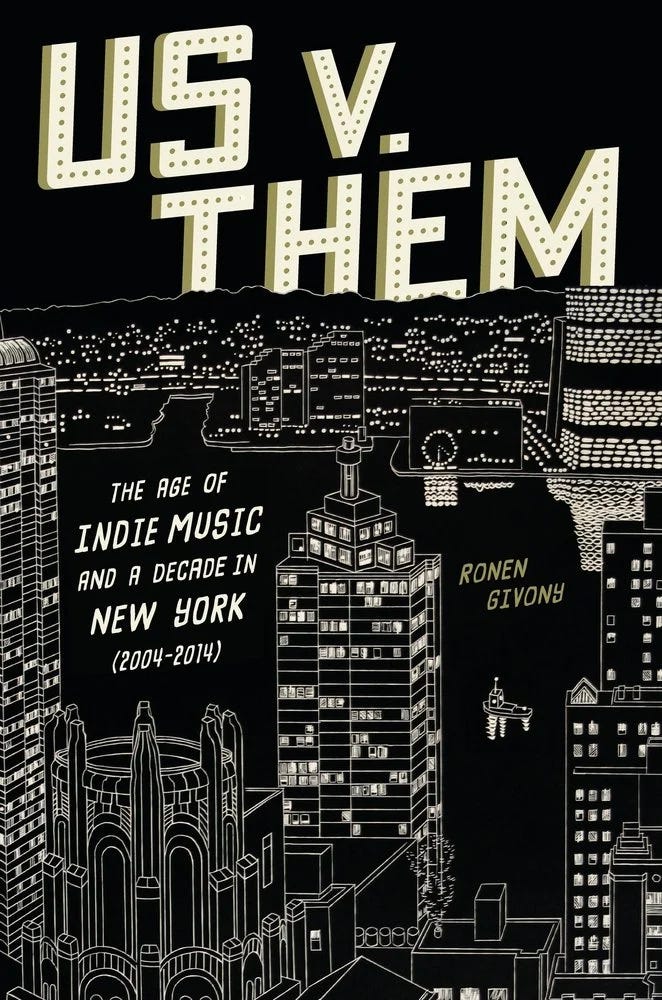
In an act of near legerdemain, Ronen Givony avoids all those pitfalls in his extraordinary book, Us v. Them: The Age of Indie Music and a Decade in New York (2004-2014). Made up of memoir, cultural history, and music journalism, Us v. Them frames a series of events that haven’t been given their due as an era before now, beginning with the Republican National Convention in 2004 and ending with the near-simultaneous closure of DIY venues 285 Kent, Death by Audio, and Glasslands in 2014. In between, he covers the musicians and entrepreneurs who defined New York’s sound and how it was presented during those years.
Givony, who moved to New York in 2004, is someone who has managed to forge a career in music on his own terms, working as a grant-writer for the Chamber Music Society of Lincoln Center, as an “editorial coordinator” at Nonesuch Records, and as a founder of Wordless Music and Le Poisson Rouge. These experiences, plus his love for the artists who performed at the venues listed above, made him eminently qualified to tell the era's tale. But as he writes in the Introduction:
“Who gets to tell the story of a scene?
Is it the people who were there at the outset, who saw it in its infancy, when it was completely unknown? Is it the people who came after them, and saw it at its height? Is it the supposed experts—journalists, historians, critics—or the people who served the drinks, and worked the door, and mopped the floors? It’s everyone, or at least it should be.”
Givony makes good on that promise by including the voices of people behind more than a dozen bands, venues, and websites, creating a kaleidoscopic view of all the ways art can respond to opportunity. Starting with the band Oneida, which was founded in 1997 but released its key album The Wedding in 2005, and ending with Vagabon’s debut EP in 2014, the bands and artists he covers range from those likely forgotten (Sea Ray) to those currently revered (Weyes Blood).
The backstories are fascinating, too, including that of Akwetey and Aku Orraca-Tetteh, twins born to Ghanaian immigrants in the Bronx who grew up in Ohio. Their path of personal and artistic development included studying with jazz legend Yusef Lateef at Amherst College, about whom Aku says, “It was the most beautiful thing to hear somebody like that speak. It’s almost like a grandfather hugging you.”
Their journey led to Fort Greene and the founding of Dragons Of Zynth, who became proteges of TV On The Radio in a trajectory that is at first inspiring, then dispiriting, as the older band appears to rip off their song War Lover for I Was A Lover, the opening track on their breakout album, Return To Cookie Mountain. To add insult to injury, the release of the Dragons’ only album was delayed by a year, leading to a perception that they had stolen from TVOTR. While they’ve since reconciled, their legacies couldn’t be more different, with the Dragons having 81 monthly listeners on Spotify, compared to 1.4M for TVOTR, who did not respond to interview requests from Givony. But thanks to him, now I know about the Dragons of Zynth and will add them to my pantheon of New York bands.
It is notable, however, that this is the only dark tale among the extraordinary community that created the scene. Most of the opposition came from without, courtesy of the Bush and Bloomberg administrations and the NYPD, who could not appreciate what these creative people were bringing to the city. After all, even Beyoncé and Jay Z, in a famous incident discussed in the book, found something of value in the indie scene!
I was somewhat late to the table myself. As a native New Yorker, I can be paradoxically less focused on what’s going on in my backyard, and credit the 2005 release of Gimme Fiction by Spoon, an Austin-based band, with reviving my relationship with new music. While I saw Wilco at McCarren Park Pool in 2008, my first and last visit to Glasslands (I saw the mighty Breton) was in 2013, and it wasn’t until 2015 that I trekked out to Bushwick to see TV Girl at Shea Stadium, another defunct DIY spot. But, having performed and spent time at similarly grimy, patched-together spots like 171A and Laight Street in the early 80s, I felt right at home.
Reflecting on those aspects of my experience after finishing US v. Them only made me more grateful for Givony’s efforts and expertise, which helped connect so many dots in such a compassionate and eloquent fashion. While Givony admits that it’s “easy to be cynical” about gentrification in Williamsburg et al, and despite his “propensity for fretfulness and gloom,” he finds lots of reasons to have hope. I couldn’t agree more. When I read the latest issue of Gunk, the NYC concert zine, and attempt to plot a week’s visits to see Or Best Offer, H. Pruz, The Thing, Mutual Benefit, Hiding Places, Beck Zegans, Nine Perfect Lives, or other NYC stalwarts at Cassette, TV Eye, Market Hotel, Nightclub 101, Baby’s All Right, Union Pool, or even Rippers on Rockaway Beach, where Shea Stadium BK curates the shows, I know NYC’s indie dots are still connecting and will go on forever.
Note: The graphic above is based on a photo I took on July 31st, 2015, on the way to Shea Stadium to see TV Girl. That was also the night I discovered Novelty Daughter!
Comments
Nothing yet. Say the first thing.
Sign in to join the conversation.