
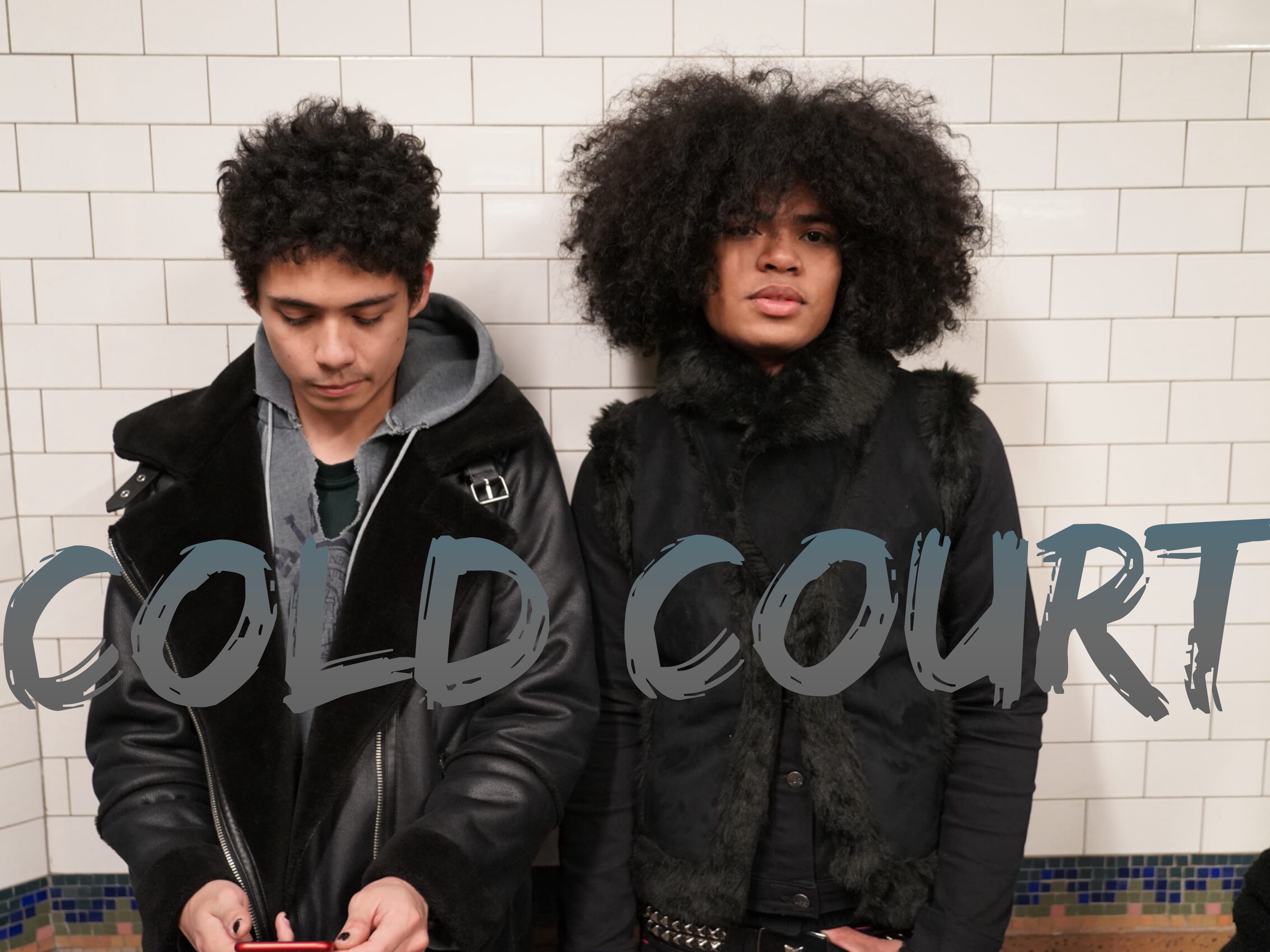
It’s a common complaint among creatives that it’s hard to get attention these days. One way to do it is to grab people by the throat from the jump, which is just what Philadelphia duo Cold Court did last year with their single, Nina, which came out last April. Filed with jagged guitars, stuttering drums, driving bass, distorted keyboards, and authoritative vocals, the song started at 11 and went up from there. It was immediately clear that siblings Mini Serrano and Jojo Lavina-Maldonado knew exactly what they wanted to do and had the skills to execute it.
Now we have \ (^_^) / (HANDS UP, a self-released seven-song EP that further clarifies their sonic blend of hyper-pop studio fuckery and the energy of a live band. The intensity barely flags for 21 straight minutes, with the only respite coming from the groove of Eighty1, which is nonetheless a great song to focus on.
The song starts in a hurry, the vocals almost stepping on the rhythm pattern, while synths burble and whine in the background. After the song’s debt to R&B has revealed itself in the vocal melody, an off-kilter breakdown brings the song into a dubbed-out space, handclaps driving things along as if expecting robots to breakdance. Crunchy, chopped-up synths create a semblance of a solo before the song meets an abrupt demise in a burst of white noise. Exciting stuff - give it your attention.
Nina was actually their second single, following up Twin from 2024. It’s a fun romp, too, 1:47 of stop-start/loud-silent-loud aggression, with just a hint of the adventure to come. It takes audacity to sell one short song on a one-sided 12” single for $27 dollars. But one listen to \ (^_^) / (HANDS UP and you’ll know that Serrano and Lavina-Maldonado have no shortage of audacity.
I’m super-bummed to have missed Cold Court’s New York debut at Night Club 101 earlier this week, but I can only imagine how riveting it must have been. I’ll try to get there next time, and so should you.
Listen to most of the songs for Friday here or below.
Other Recent Releases
Fruit Bats - The Landfill (Merge) You’d think my path to loving a new album by an artist who's been on my top 25 not once but twice would be a short, joyful one. In the case of Eric D. Johnson’s long-running project, I was tripped up by his sweet but somehow inconsequential last album, Baby Man, which came out last year. I had no problem with the format, which presented Johnson in solo mode, accompanying himself on guitar and piano, but the songs felt a little undercooked. So when the singles started flowing for this album, I was gun-shy. But when listening to the full album for the second time, something clicked, and I could feel the same connection I had with those earlier classics, The Pet Parade (2021) and A River Running To Your Heart (2023). But The Landfill is in no way a retread, with Johnson leaning (wonderfully) hard into his vocal eccentricities while spreading his melodic wings in a series of heartfelt songs that are beautifully played by his band.
If Johnson sounds artistically rejuvenated, maybe he’s embraced the philosophy of the New York Knicks’ Jalen Brunson that the score is always 0-0. A clue to that freshness may lie in the way he’s credited the players. Rather than saying “Fruit Bats is Eric D. Johnson with…,” it reads:
Fruit Bats:
Eric D. Johnson – words, singing, guitars, piano, synth, lap steel
David Dawda – electric and upright basses
Josh Mease – electric and acoustic guitars, Fender bass VI, synth, piano, vibraphone
Frank LoCrasto – electric and acoustic pianos, organs, synths, vibraphone
Kosta Galanopoulos – drums and percussion, synth, glockenspiel
As Brunson would tell him, teamwork is a beautiful thing. One of those names is new, too: Galanopoulos, who’s had a very interesting career playing with the likes of Slauson Malone, Art Feynman, and Cassandra Jenkins. He’s also credited for “additional engineering” and co-wrote the music for a couple of songs, as did Mease and Locrasto, further increasing the collaborative nature of the album. The title track, which closes the album, is just one masterpiece here, opening with a strumming guitar as wide as the Mississippi and a rhythm just as steady, as Johnson sings: “This is an ode to eternity/Sung by an old show pony/In this long, slow rodeo/I’ve come to know.” There’s a genius in Galanopoulos’s hi-hat accents, as well as in the soaring guitar solo and the overall anthemic quality. But it’s all driven by an indelible melody and Johnson’s impassioned vocals, proving there’s more life in this old show pony yet.
Ruth Garbus - Profound (Orindal) In 2024, I discovered this Vermont-based artist through the delivery system known as Sam Gendel. He collaborates with so many people that if you follow him on any platform, you’re bound to be introduced to new artists. In Garbus’ case, she formed a trio with Gendel and Phil Melanson to make the “lovely, slightly loopy” Earth Flower. The loopiness is still present on this latest solo album, made with her usual trio of Nick Bisceglia (guitars) and elie mcafee-hahn (guitars) and produced by Kyle Thomas (aka King Tuff), but it’s even more lovely. There’s a smooth, rounded quality to every song and a sense of contentment that’s infectious. Just imagine what it would be like to have the confidence to open an album with a mellow call to arms like I Think I’m Ready Now, which starts with a verse as profane as it is profound: “When I penetrated that man I felt just like a dog/Getting fucked is the season of/the world, my life springs forth/Into the jewel of creation, the/arched back of the imagination.” The only question is: Are you ready for Ruth Garbus?
Me At The Zoo - Vol. 1 (Vacant Stare) Rosy Overdrive has the lore on this debut release from Rob I. Miller’s (Blues Lawyer) new project, which sounds like a work in progress in the best way. Guitars (Miller and Zach Baransky)
as fuzzy as an old sweater are goosed by a swinging rhythm section (Derrek Wismer - bass; Kevin Hudson - drums, percussion), while off-hand vocals compete with searing leads that pop up out of nowhere. Twelve minutes of this grand stuff are not enough, a fact Miller seems to acknowledge in the abrupt ending of the final song. To be continued.
Tara Clerkin Trio - Somewhere Good (World Of Echo) This wonderfully odd and sweet album makes me feel like I’ve just thrown open the curtains in a hotel room after I arrived in a new city late at night, and it’s my first view of my surroundings. On their second full-length, Clerkin and colleagues, Sunny Joe Paradisos and Patrick Benjamin, are untethered by genre, opening the album with Lake Walk, a little poem for synth and piano, before heading into the first song proper, a shimmering shuffle of a song called Lazy Daisy. Clerkin sings as if she hasn’t a care in the world, letting her dreamy voice float over the synth bass, electronic percussion, and acoustic guitar. Then she stops singing, making room for a dialogue between piano and guitar that leads the song to its conclusion. So many wonderful things happen on this album…I’ll let you throw open the curtains on it yourself.
Jo Mango - The Lightswitch (Team Love) Though this is the Scottish artist’s third album, it’s the first one I’ve heard. That’s not totally on me, as her last full-length of original songs came out 14 years ago. She’s been busy nonetheless, writing songs for Teenage Fanclub and touring with Vashti Bunyan, among other activities. Either way, I’m glad I found her now, as this is an elegant collection of chamber folk, with fine playing from the Elysian Collective, a string quartet, among other players, and much character amidst the hushed environs each song creates. Mango’s voice is airy, yet full of conviction as she delivers poetic lyrics like, “The dredger scrapes along the sound/And passes by our door/I feel the churning of the silt/The raising of the stoor/The darkening of the river skies/The veiling of the shore.” Anyone already familiar with Mango must be overjoyed to have her back. I’m just happy to be here.
Michael F. Hunt - Passage Of Time: The Music Of Michael F. Hunt (Phantom Limb) This is quite a discovery by Phantom Limb! Consisting of three works composed and recorded in the 1980s that have never been commercially released, the collection opens up a new room in the mansion of minimalist music. Music For Multiple Keyboards (1983) opens the album with 35 minutes of interlocking, cell-based patterns, the bright, smooth sounds shifting like strata in a colorful sand sculpture. The effect is as celebratory as Butterfly Dreams (1985), created for viola and piano, is meditative. The title piece marries the two modes, with questing violin lines and swirling harp flourishes. Hunt, who was born in 1945, had a bright start to his performing career in 1972 when the Los Angeles Philharmonic premiered one of his postgraduate works. After getting his PhD in 1974, he began a distinguished career in academia, which gave him time and space to explore electronics and advanced compositional strategies. While Terry Riley and Steve Reich are certainly reference points, there’s nothing derivative about Hunt’s work, which sounds as sharp and fresh as if it were created yesterday. Thank goodness Hunt is a secret no more.
The Crossing - Aaron Helgeson: The Book Of Never (Navona) This 30-minute work features Helgeson’s brilliant vocal writing in an equally stellar performance by The Crossing, conducted by Donald Nally. Employing the same flexible approach to text as on last year’s “deeply musical” As I Write This: Songs And Solos, Helgeson stitches together the words of great defiant thinkers of the 20th Century, including Oscar Wilde, Pablo Neruda, Angela Davis, Gertrude Stein, and the Rolling Stones. This also echoes the 1,000-year-old Novgorod Codex, one monk’s attempt to preserve the culture of an excommunicated community. While his writing is never shrill, Helgeson’s feelings about censorship and collective forgetting are heard loud and clear in the overlapping, dynamic voices that resonate long after the work ends.
Seabuckthorn - Never The Same River (Lost Tribe Sound) One of the joys of being an Andy Cartwright fan for nearly a decade has been listening to him iterate on his misty, guitar-based sound. While there are fewer collaborators here than on last year’s “gorgeous tapestry,” A Path Within A Path, this may be his “loudest” album yet. Building up clanking yet contemplative percussion tracks with hand drums and kitchen pans, he then shaped the rhythms with software before layering on a variety of stringed instruments, including acoustic guitar, saz, autoharp, violin, banjo, and a Japanese harp known as a taishogoto, creating richly textured soundscapes with a languid yet epic flavor. Phil Cassel adds rich double bass and, on a couple of tracks, tuba and trombone, while William Ryan Fitch lends swooping layers of viola to Things We Cannot See. Even if you haven’t been listening to Cartwright as long as I have, Never The Same River is the perfect place to start.
Comments
Nothing yet. Say the first thing.
Sign in to join the conversation.