
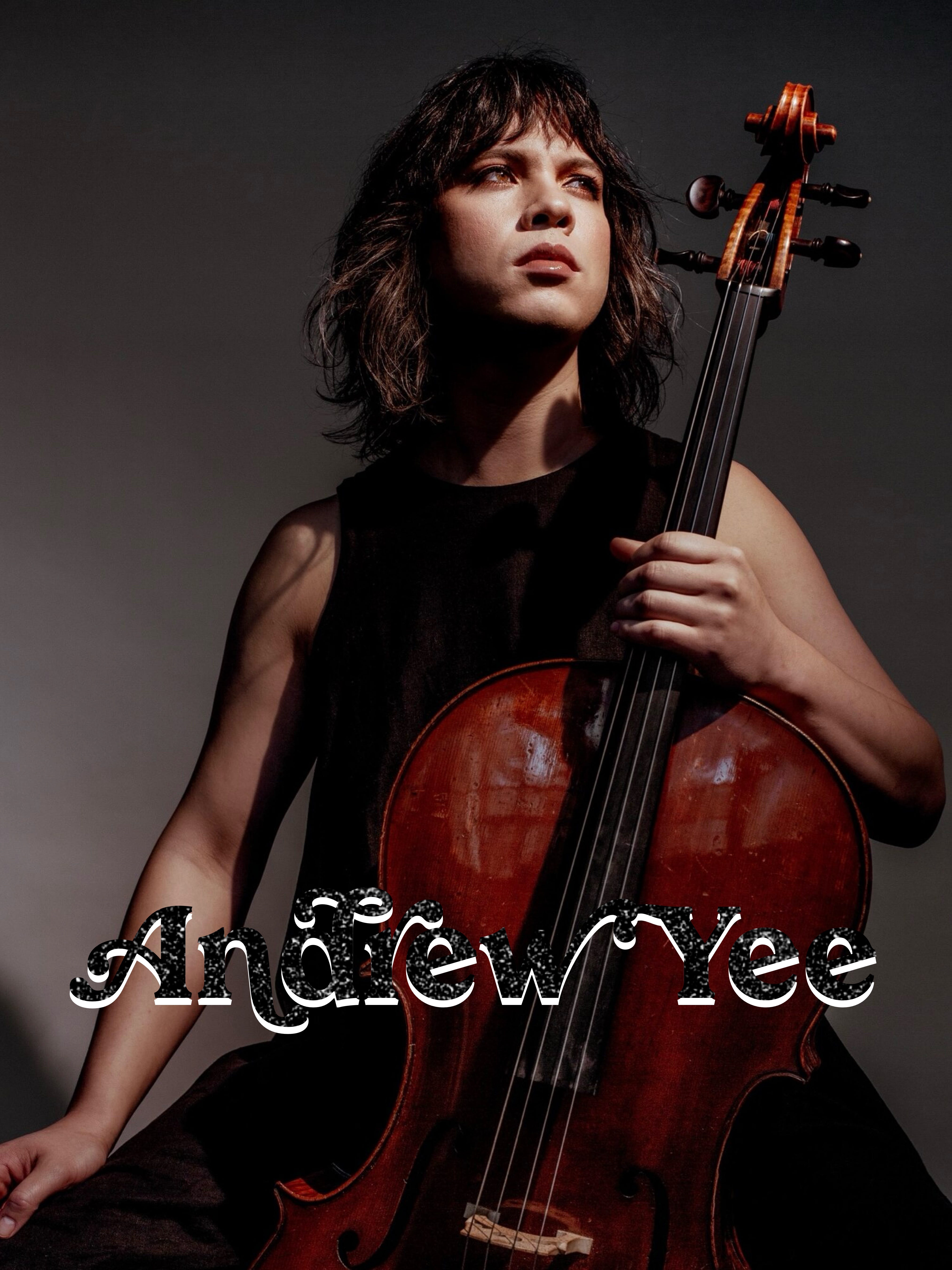
The requiem mass looms large in Western classical music, with roots in a path-breaking late-15th-century work by Johannes Ockeghem, and major iterations by such geniuses as Mozart, Verdi, Brahms, and Britten. It may be the latter who, when he created the shattering War Requiem (1962), first saw the possibilities for political and social commentary embedded in the structure. To bring home his point about the horror and waste of war, Britten interwove poems by Wilfred Owen, who was killed in World War I, amidst the sections of the Latin Mass.
This is the tradition that composer and cellist Andrew Yee joins with the release of her musically rich, deeply felt Trans Requiem (New Amsterdam), which was premiered at Trinity Church Wall Street in 2025. At this time of quote-unquote political division1, there is a fearlessness to the way Yee intermingles the lush embrace of the choral tracks with the straight-to-the-point sections, such as Light, which eulogizes Cecilia Gentili, a trans advocate who was killed by a fatal mixture of drugs, with warmth, humor, sorrow, and rage.
As the bass and tenor voices of the Trinity Choir sing an open note that simultaneously welcomes and threatens, the string section (which includes some of New York’s finest musicians, including Pauline Kim, Jessica Meyer, Chris Gross, Ashley Bathgate, and Caleb Van Der Swagh) trembles and moans. Nearly submerged in the music, Yee intones fragments of remembrance:
She was the brightest light
Her smile was…
She was a resident of…
She knew from a young age…
Suspects have been…
Donations can be sent…
She was
Then, the kicker: “If I had to sum up Cecilia in a few words, I might ask, ‘Why so few?’”
The lyrics that follow range between the poetic (“Her bones were made of stars that exploded long ago…” and the personal (“The quiche she made for me needed salt, but it was delicious…), seeking to capture the micro- and macrocosms of an impactful life, and succeeding completely. As those in power try to silence the trans community, it is not only imperative that we listen, but it is also an invitation to grieve and start to heal the wounds that have been inflicted on all of us who care, whether or not we are members of the trans community.
Following Light is a setting of Lux Aeterna, with a heartbreaking solos by trans vocalists Breanna Sinclairé and Katherine Goforth. While I’ve focused on just one part of this surprisingly concise work (under 30 minutes), it demands and deserves to be listened to in full.
The love and care Yee has put into Trans Requiem is full present in the piece itself, from the orchestration to the performance, which is conducted by Melissa Attebury, with the ideal blend of weight and transparency. Trans Requiem is a masterpiece that works on many levels and one of our era’s defining musical expressions. With gratitude towards Yee, I’ll let her have the last words:
“I want to give trans people the dignity of being grieved—the kind of communal space that we’re so often denied. This isn’t just a requiem for the dead; it’s a requiem for the living. A space to feel sadness, to reflect, to rage, to remember—and also to love and to find peace.” - Andrew Yee
Listen to most of the songs for Friday here or below.
Clair Chase/JACK Quartet/Samuel Clay Birmaher - Terry Riley: The Holy Liftoff (Sono Luminus) When I last caught up with Chase’s monumental Density 2036 project, it was through the “sensuality and surprise” of Anna Thorvaldsdottir’s Ubique. Now, we have something quite different from the Icelandic composer’s typically dark explorations in a major new work by Riley, the 91-year-old composer known for pioneering minimalism while not exactly being a minimalist, per se. That’s a long way of saying he’s an American original. In typical fashion, Riley began working on the piece with 16 improvised bars that inspired a series of drawings and open-ended prompts. Working with Chase and Birmaher, a composer based in New York, the piece eventually took on its current form of circular and songlike movements featuring pillowy layers of flutes (18 in parts!) and mostly sweet (but occasionally tangy) strings played by the JACK. Riley’s trademark wit, mystery, and light touch are also in evidence, making for a truly uplifting work that’s perhaps the most accessible of all the Density 2036 pieces. Ten more years to go…what wonders lie in the future?
Nicholas DeMaison - Broken Thread (Perotin) My introduction to this Westchester-based composer came on Concrete & Void, the excellent album by the all-star Wavefield Ensemble, which hit my Top 25 in 2021. That group also appears on the opening and closing pieces of this stunning album of next-gen chamber music. Three Years Of Light (II), which features a trio of Wavefield players (Julia Den Boer, piano; Russell Greenberg, percussion; and Piero Guimaraes, percussion), starts with a loud, smeared announcement before fragmenting into spiraling shards. The dynamics rise and fall before the piece explores a more lyrical arena and ends with a haunting electronic transmission.
A larger Wavefield group (Erica Dicker, violin; Carrie Frey, viola; Greg Chudzik, bass; Dan Lippel, guitar; Kathryn Andrews, harp; and Den Boer, piano) plays on invisible polyphonies, the third piece, which opens with all those strings going in different directions, as if everyone were drawing different boxes on the same sheet of paper, before cohering and splintering in ways that never cases to fascinate. In between, we get the marvelous andPlay duo (Maya Bennardo, violin, and Hannah Levinson, viola) finding the soul of the swoops, glides, and serrations that make up from perfect nowhere. DeMaison includes a quote from the great Ursula K. LeGuin on the Bandcamp page: “History must be what we have escaped from. It is what we were, not what we are. History is what we need never do again.” This album is proof that he takes that to heart when sitting down to compose.
St. Silva - Forager (AKP) While there’s a wealth of sophistication to the way Ben Dexter Cooley puts together these electronic composites, they also retain a charming sense of naiveté. That might be the result of his deep bond with the forests north of his home base in Burlington, Vermont, including the many birds singing songs and making noises within those dense, leafy environs. For a sense of calm and optimism amidst the storms around us, no need to dig around any further. Cooley has already done the work for you on Forager.
Tricky - Different When It’s Silent (False Idols) On his first album as Tricky in six years, Adrian Thaws head-faked his way out of the paralysis that followed the death of his daughter in 2019. It’s not as if he hasn’t been busy, releasing several projects under different names, and it sounds like this might have been another one of those before his manager insisted it be a Tricky album. Even though Mitch Sanders, an ethereal singer from Bristol who Tricky calls his “nephew,” appears on 12 of 14 tracks, the manager had a point. While not the radical de- and reconstruction of pop music Tricky perpetrated on classics such as Maxinquaye and Pre-Millennium Tension, this is his most consistent and effective album since those halcyon days. With spare backdrops that occasionally explode in slashing guitars, Tricky constructs perfect frames for Sanders’ vocals, seeming to have an infinite array of blacks and grays at his disposal. As someone who understands parental grief and all the ways it never ends, I’m moved by Thaws’ journey back to being Tricky and glad he found the right surrogate voices to speak and sing for him as he traveled that road.
Julian Maas - Gum (QBM) For his second full-length, Maas put together a well-rounded collection of sleek indie rock in a minor key. Scattered amongst the catchy songs are a few more abstract pieces, including the synth excursion of War and a single-minded jam in the Disco Mystic mode called Relaxin’. It all adds up to an intriguing and entertaining listen from someone who seems to know exactly what they want to do.
Max Subar - Anything Could Be (Merge) Try as I might, I could not get into Case Oats, the folksy Americana band led by Casey Gomez Walker and Spencer Tweedy. Maybe there was too much Kimya Dawson and not enough Iris Dement, to name the two influences mentioned in their bio. But now I think it’s an absolute crime that Subar, who plays guitar and pedal steel in Case Oats, has spent any time working on anyone else’s music. It’s all part of a process, I suppose, so I’m going to credit everything he’s done up to this moment with getting us to this quietly magnificent album. While he seems to appear fully formed here, I’ve now discovered his debut EP from 2017, and it’s very good. He has a hushed voice that never grows mannered, can play pretty much anything (guitar, bass, synth, piano at least), produces and engineers his own stuff, and writes wryly reflective songs that feel effortless.
One of my favorites is I Never, which fades in with the memorable couplet: “I’m not myself anymore/Perhaps it’s a good thing.” After a lovely interlude of finger-picking and pedal steel, he completes the thought: “I lost my sense in the war/Against uncertainty.” It’s also one of two songs featuring Tweedy on drums, and his rolling and tumbling part enhances the song beautifully. Jason Ashworth (upright bass) and Scott Daniel (violin) from Case Oats help on a couple of songs, while Max’s brother Sam Subar drums on most of the album. Sarah Weddle (vibraphone, organ, and electric piano), Chet Zenor (electric guitar), and Kelly Hannemann (piano) show up to help on some songs, amplifying the sense of community. But it’s really all about the wonderfully generous, intimate, and perfectly crafted songs of Max Subar. His time has come. Now it’s your turn to make time for him.
Seeking the eradication of trans people from society and encouraging violence against them is not a political position but one based on pure hatred, ignorance, and fear.
Comments
Nothing yet. Say the first thing.
Sign in to join the conversation.