
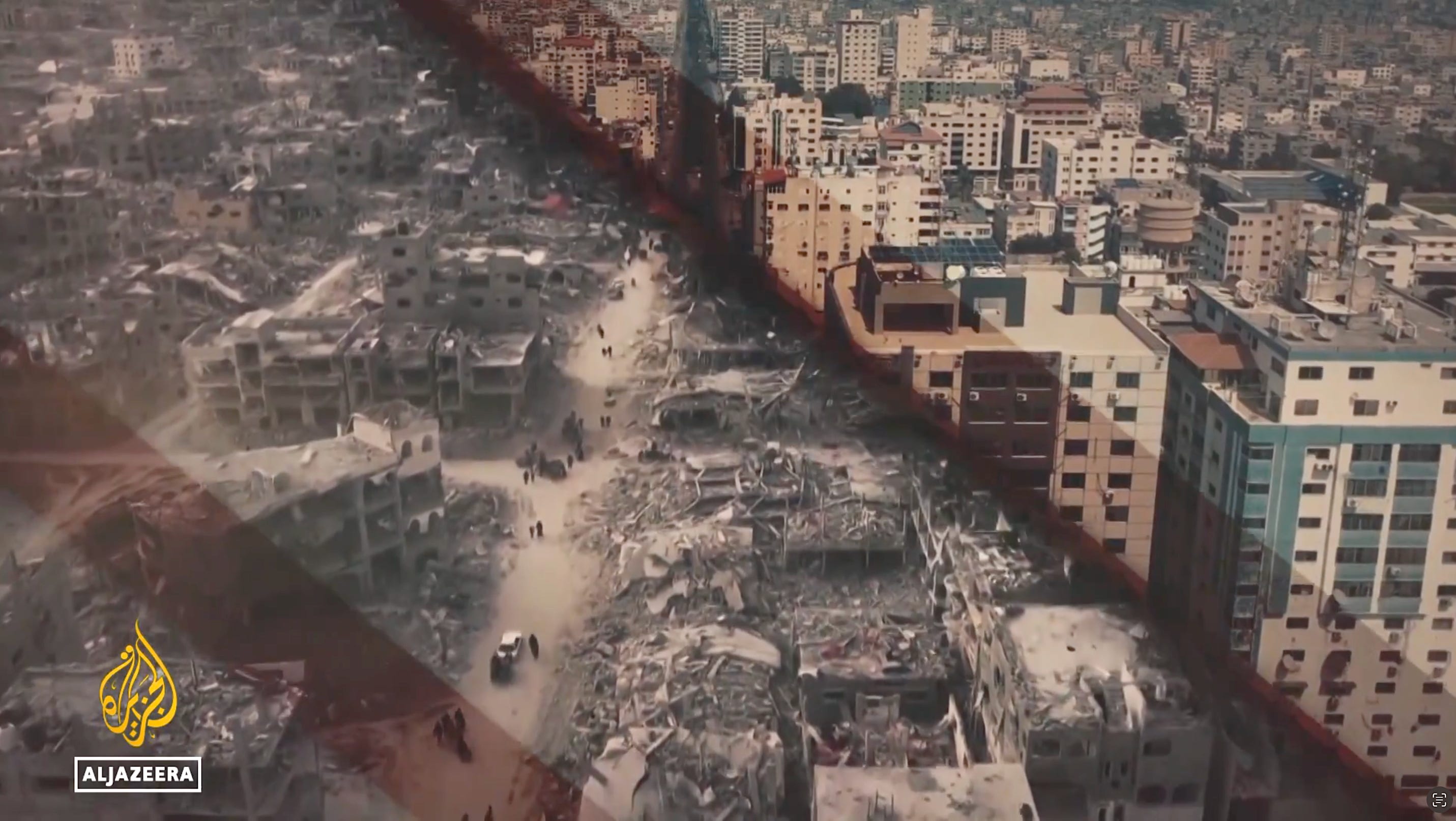
A screenshot from “Gaza: Promises and Reality“, an Al Jazeera feature from July 2, marking 1,000 days of Israel’s ongoing genocide in Gaza.
My new article on my website, Competing Visions for Gaza’s Future: Endless Bloodshed Or Bloodless, Sterilized Techno-Concentration Camps, is an update on the dire situation in the Gaza Strip, after 1,012 days of genocide, as the Israeli-engineered humanitarian crisis continues to make a mockery of the ceasefire declared nine months ago, and as competing visions for Gaza’s future seek to exclude the Palestinians from having any meaningful say in their future. Below are excerpts from the article, but I hope, of course, that you have time to read it in its entirety.
As the UN Office for the Coordination of Humanitarian Affairs (OCHA) recently reported, “overcrowding, inadequate shelter, and limited access to medical services, safe water, and sanitation continued heightening public health concerns” throughout Gaza, with communicable diseases remaining widespread, along with acute respiratory infections and skin diseases, largely caused by the mountains of toxic waste and broken sewage systems for which essential clearing and maintenance equipment remains blocked by the Israeli authorities. Recently, more than 18,000 cases of chickenpox, ectoparasite infestation and impetigo were also recorded.
OCHA also reported that “essential services for an estimated 350,000 people living with chronic diseases remain severely disrupted”, and that “shortages of medicines, diagnostics and specialized equipment continue to affect the treatment of hypertension, diabetes, kidney disease, cancer and cardiovascular conditions.”
OCHA added that “shortages of critical items and inputs — including fuel, engine oil, generators, specialized equipment — persist across all sectors”, both because of funding shortfalls, and because of “Israeli restrictions that limit what and how much can be taken into Gaza.”
Al Jazeera recently reported that hospitals, which have been obliged to rely on generators for power, because 90 percent of Gaza’s power lines have been destroyed, are facing problems because they are obliged to use recycled engine oil, which “has resulted in generators malfunctioning”, leading to power cuts that are regularly preventing the running of “essential life-saving medical equipment at hospitals such as ventilators, incubators and monitoring devices.”
As I explain, “For the Israeli government, all of the above must be enormously satisfying, because all they seek, every minute of their wretched genocidal existences, is for Palestinian civilians to keep dying by whatever means possible.”
On the ground in Gaza, as NPR recently reported, Israel continues to expand its military control. When the ceasefire began, it controlled around 50% of Gaza behind a “Yellow Line”, but, instead of steadily withdrawing, as was planned in the ceasefire deal, it has expanded its control to 60%, and, since the US-Israeli war on Iran, and Israel’s war on Lebanon distracted people’s attention, has now created a new “Orange Line”, swallowing up another 10%, so that, as NPR explained, “Israel’s military now controls nearly 70% of Gaza.”
“In contrast to this ongoing process of slow strangulation and extermination”, as I explain, “a competing, but no less dispiriting vision emerged on July 1, when the Palestinian journalist Tamer Nahed posted a photo on X of a dystopian alternative future — one of sterile, identikit prefabricated housing units in a fenced compound overseen by armed soldiers in elevated surveillance towers.”
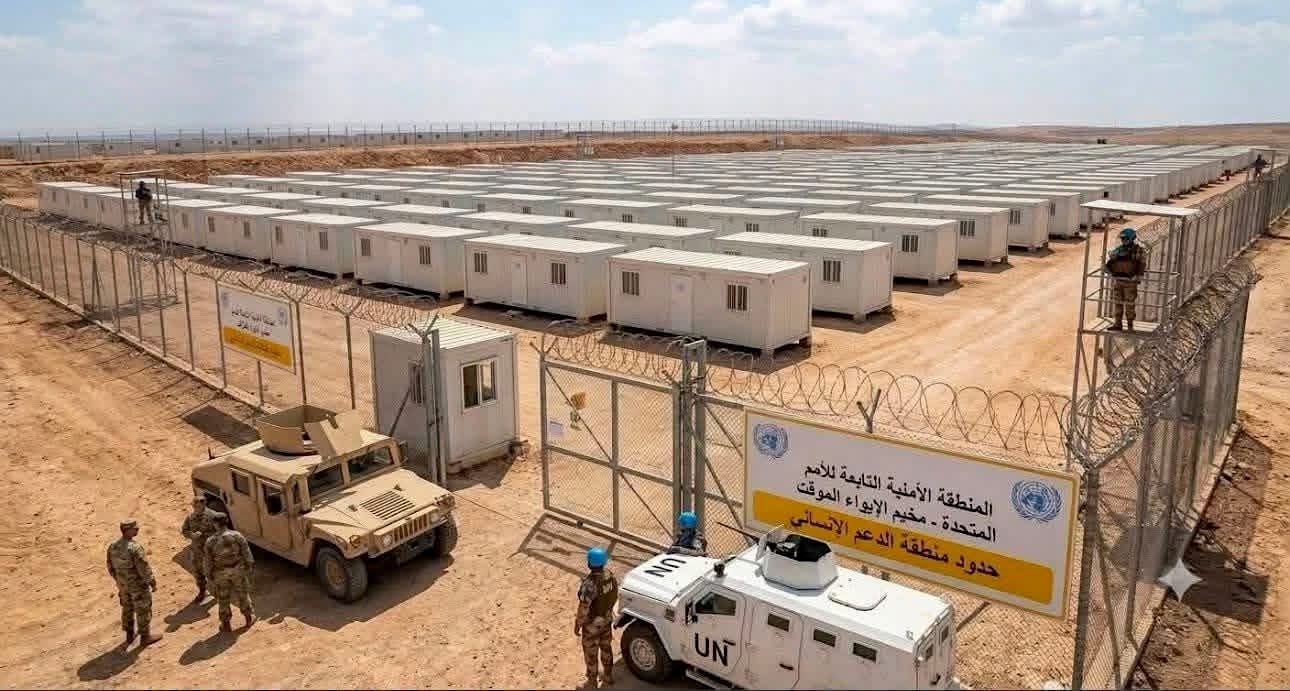
Preparations for the first “concentration camp” in Gaza.
This “concentration camp” plan — intended to start with the transfer of 600,000 Palestinians, and, eventually, the entire surviving population — was first announced by Israel’s defense minister, Israel Katz, a year ago, to the dismay of human rights lawyers like Israel’s Michael Sfard, who said that Katz had “laid out an operational plan for a crime against humanity.”
Reporting on the new plan, Drop Site News accurately described it as “a surveilled, checkpoint-controlled ‘planned community’ in Rafah designed to force Palestinians into what amounts to an Israeli panopticon, tracked and screened as a condition of receiving aid.”
As I explain in my article, “The problem with both of the current realities — Israel’s continuing, militarized takeover of Palestinian land, and the sterile concentration camp option — is that both treat the Palestinians as either irrelevant, or as little more than cattle.”
As I proceed to explain, “Over 1,000 days since Israel launched its ongoing genocide against the Palestinian people, killing at least 70 times more Palestinians than the number of Israelis killed on October 7, it remains completely unpunished in any way whatsoever, while the Palestinians are still treated as collectively responsible for one day’s armed response by Hamas and other Palestinian factions to 78 years of relentless occupation, dispossession, oppression and ceaseless violence and murder.”
“From the perspective of Israel and the US”, as I also explain, “every future scenario involves the complete disarmament of Hamas, even though Hamas never agreed to that, deferring disarmament discussions to the second phase of the ceasefire negotiations, on the understandable basis that the complete surrender of their weapons would lay them open to a merciless Israeli response.”
“They and the other Palestinian factions”, I add, “have, however, always maintained that they would hand over their weapons to a recognized Palestinian civilian replacement for the government in Gaza; specifically, the National Committee for the Administration of Gaza (NCAG), which was assigned that role under Trump’s ‘Peace Plan’, as a key component of the Board of Peace.”
Since October, however, “Israel has resolutely refused to allow the members of the Palestinian committee to even enter Gaza to begin to undertake its day-to-day administration, insisting — with the disgraceful support of the former UN official Nickolay Mladenov, appointed to head the Board of Peace as the colonial-sounding ‘High Representative for Gaza’ — that the committee’s entry to Gaza is contingent on Hamas’ disarmament, even though that was not what was agreed in the ceasefire deal.”
Unexpectedly, Hamas finally managed to reclaim the narrative on July 6, when the Government Media Office announced that its Emergency Committee had been dissolved, ending its 19-year government in “a move intended to facilitate the transfer of administrative authority to the Palestinian-led National Committee for the Administration of Gaza (NCAG)”, as Drop Site News described it.
The Media Office stated that it “had received ‘full assurance’ that preparations for the handover had been completed and formally presented to Palestinian factions, clan leaders, and a United Nations observer”, adding that “only technical and professional staff would remain in their posts to prevent ‘an administrative and technical vacuum’”, and “stressing that all public employees are ‘fully prepared to work’ under the NCAG.” Their statement concluded by “urging all relevant parties to ‘expedite the immediate entry’ of the committee so it can assume its responsibilities.”
Will Hamas’ plan work? I certainly hope so, because, otherwise, the future for the Palestinians appears to be one aimed solely at “disarming the Palestinian resistance and the abandoning of the struggle for Palestinian national liberation”, as Drop Site News described it.
As I state in my conclusion, “It is dispiriting enough that the Palestinians continue to be punished for being victims of a genocide, while the aggressors remain, apparently, above reproach. For the Palestinians to be politically erased after all they have endured, and for Israel to be rewarded for its monstrous depravity, would be an outcome of unprecedented injustice, an inversion of morality so grave that it would be as though, at the end of the Second World War, the Nazis were rewarded for having created Auschwitz.”
Please read the whole article here.
Read my Substack Notes
Just a reminder that, in between posts, I regularly post Notes here on Substack, which you can find here.
Over the last week, I’ve been busy publicizing the plight of Dr. Husaam Abu Safiya, via a number of well-received Notes — condemnation of his treatment by UN experts here, by Israeli doctors here and here, and by Palestinian rapper Tamer Nafar here. Please also visit an important campaigning website here, where you can write to Israeli officials and world leaders.
Other important Notes have involved Israel’s Supreme Court, and ongoing efforts to free 14 doctors from Gaza, including Dr. Abu Safiya, and recent efforts by the Israel Prison Service to gut the court’s recent order to allow the ICRC into its prisons for Palestinians for the first time since Oct. 7, 2023.
Please support my work if you can
If you can, please support me as a reader-funded independent journalist and activist, who is entirely dependent on your generosity to enable me to continue my work, which is now in its 21st year. Since Oct. 7, 2023, I’ve written over 100 articles about Israel’s ongoing genocide in Gaza, which you can find on my website here.
If you’re able to take out a paid subscription to support my work that would be very much appreciated. If you can’t afford a paid subscription here ($8 a month, or $80 a year), you can make a one-off donation via Paypal or via Stripe, where I recently established a new donation page.
No posts
Comments
Nothing yet. Say the first thing.
Sign in to join the conversation.