
I met a man last night who offers soil solutions.
His business is compost. His staff are worms.
More than one hundred thousand of them, according to his website, working through dairy manure and local juice pulp, turning what has been discarded into something living again.
His interest in soil began in his grandfather’s garden. He traveled, studied the patterns of forest edges, became a certified arborist and a grey water irrigation installer, and eventually returned to Southern California to build an edible garden of his own.
The problem he kept encountering was not a lack of enthusiasm. People wanted gardens. They bought plants, installed irrigation, cleared beds, and waited.
The problem was the soil.
His solution was worms.
This made sense to me, because my own education in worms began with my grandparents.
My grandmother was an avid gardener. The scent of roses drifted through her backyard with an almost intoxicating sweetness. Peace roses, Iceberg roses, colors and names I did not yet understand. I knew only that the yard smelled different from the rest of the world.
As her illness began to take more from her, the garden became harder to manage. She no longer had the strength or the footing the work required.
My grandfather found a solution.
His name was Willie.
Willie was a homeless man who spent time around the University of Dayton, where my grandfather was a professor in the engineering school. As the story goes, Grandpa made him an offer. If Willie would help my grandmother in the garden, he could repair the garage and make it his home.
Some cash changed hands as well, but the arrangement soon became more valuable than money could explain.
For Granny, Willie was a partner in the garden. He brought strong hands and sure footing, neither of which she had any longer. He lifted what she could not lift. He reached what she could not reach. He carried the physical part of her devotion when her body could no longer carry it alone.
For Willie, the garage became shelter. Not temporary shelter, not a cot assigned for a night, but a place he could repair and inhabit. A door. A roof. A small claim on the world.
For me, a frequent daytime guest at my grandparents’ house while my mother and father worked, Willie became a friend in the backyard.
And a mentor in worms.
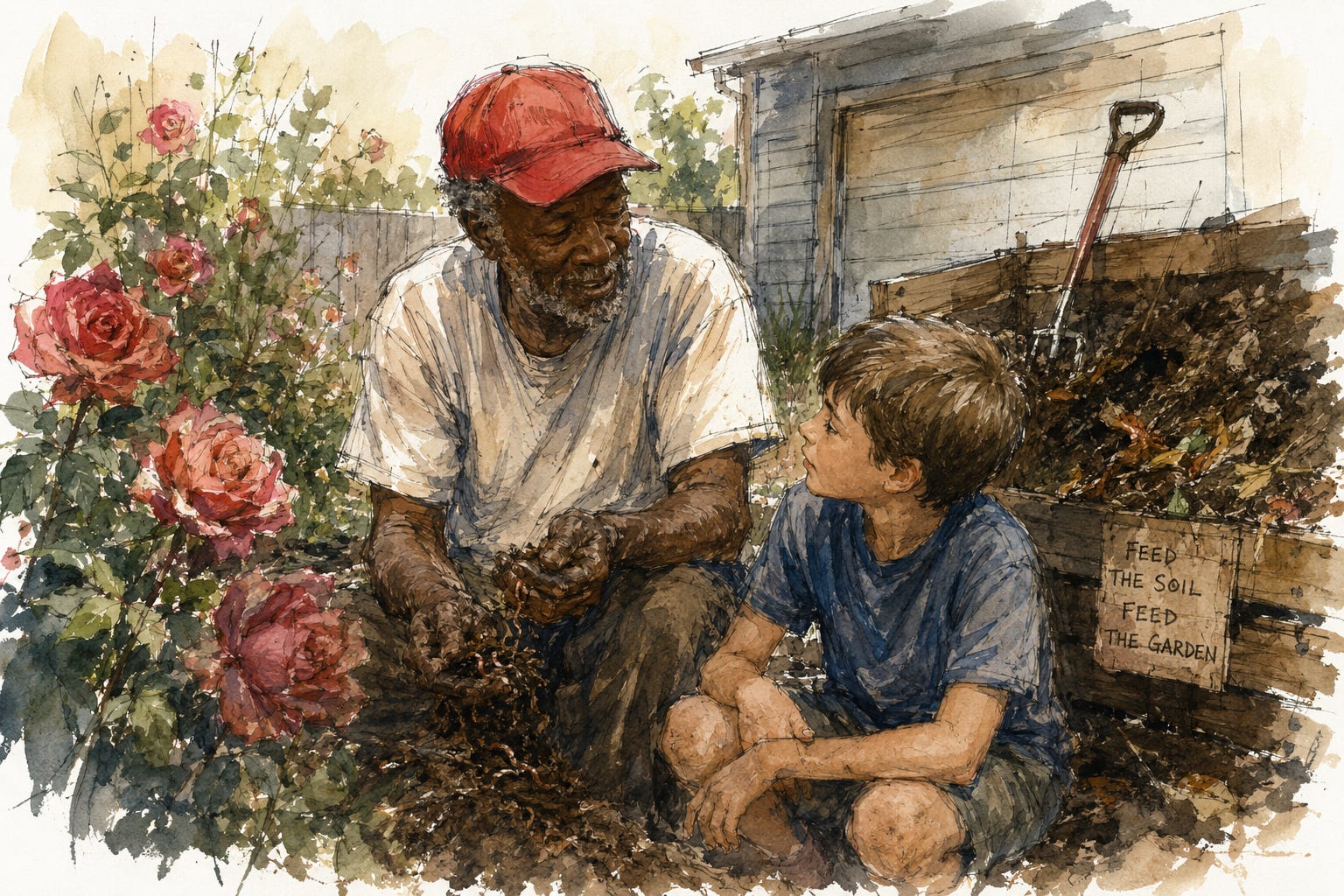
He may not have known the difference between a Peace rose and an Iceberg rose, but that man knew his worms.
The compost pile behind the garage was his domain. He could reach into it with his bare hands and read what was happening there. Too wet. Too dry. Too hot. Not enough air. Too much of one thing, not enough of another.
He could wax poetic about the mighty worm and its importance in Granny’s garden.
At the time, I did not understand that he was teaching me about systems.
The roses were not separate from the worms. The worms were not separate from the kitchen scraps. The scraps were not waste. The compost pile was not a place where things went to disappear.
It was where usefulness changed form.
The worms worked below the level of beauty. No one came into the garden and admired them. They admired the roses. They inhaled the scent, noticed the color, perhaps cut one and carried it inside.
The worms remained behind the garage, turning decay into fertility.
Willie understood this.
I suspect he understood it in ways that had little to do with gardening.
He knew what it meant to be overlooked. He knew how quickly a person could be classified as waste by a system that had no use for him. He also knew that value does not always arrive in a form polite society recognizes.
Behind the garage, he had authority.
He knew the pile.
He knew the worms.
He knew what the roses needed.
There is a temptation to make this story cleaner than it was. To turn my grandfather into a rescuer, Willie into a grateful recipient, my grandmother into the beneficiary of an act of charity.
That is not how I remember it.
The arrangement worked because everyone brought something the others needed.
My grandmother had a garden and diminishing strength.
My grandfather had a garage and the ability to recognize a practical exchange.
Willie had knowledge, labor, and care.
I had time, curiosity, and the good fortune to be standing nearby.
No one remained unchanged by the arrangement.
The garage was repaired.
The garden continued.
The roses bloomed.
A homeless man became, at least for a time, a housed man, a gardener, a teacher, and my friend.
And I learned that worms could turn what looked finished into the beginning of something else.
My new worm friend calls this transformation.
He brews compost tea from worm castings, creating a liquid dense with microbial life. He applies it to soil that has become compacted, depleted, or nearly inert. The goal is not merely to feed a plant. It is to restore the living system around its roots.
That distinction matters.
We often treat the visible problem and ignore the conditions beneath it.
A plant is failing, so we add fertilizer.
A person is struggling, so we offer temporary relief.
A neighborhood is fraying, so we create a program.
But sometimes the deeper work is in the soil.
The unseen relationships.
The exchanges taking place below the surface.
The conditions that allow life to continue.
Worms do not rescue soil.
They participate in it.
Willie did not rescue my grandmother, and my grandfather did not rescue Willie. They entered into an arrangement of mutual usefulness that became, over time, something closer to care.
That may be what healthy systems do.
They take what has been cast off and return it to relationship.
They do not ask whether the material looks valuable before beginning.
They understand that decay is not the opposite of life.
It is one of its processes.
I think of the compost pile behind the garage now. The smell of earth and kitchen scraps. The heat rising from the center. Willie turning it, reading it, explaining what I could not yet see.
Beyond him, my grandmother’s roses.
The beauty was in the gardens.
The work that made it possible was behind the garage.
Comments
Nothing yet. Say the first thing.
Sign in to join the conversation.