
I have been away. Three trains in ten days -- the California coast south, the coast north, and then Buffalo to New York City through the same upstate New York corridor I filmed nearly twenty years ago. What follows grew from those rides, and from a video I made on an earlier journey that I have been trying to understand ever since.
The train doesn’t enter a city the way a road does.
A road brings you through the front. Past the welcome sign, down the commercial strip, past the civic buildings a city has arranged for you to see first. A road flatters a city before it lets you look at it. The train has no interest in that. The train goes through the back. Through the loading docks and the pallet yards and the corrugated steel warehouses and the fenced-off lots where the weeds have found their place in the cracks of yesteryear. Through the things a city needs but doesn’t put on the brochure. Through the inventory of everything that hasn’t been dealt with yet.
I know this because I took the train from New York City to Buffalo in the winter of 2007, and I filmed what I saw from the window.
I was using a phone that would itself be obsolete within the year. One thing it could do was record. So I pointed it at the window and let the landscape come.
I did not know yet that the device in my hand was the thing that would finish what I was looking at.
What came through the window: power towers against winter sky, their wires radiating outward into bare trees and cold light. Bridge trusses seen from the inside, iron crossing iron, the geometry of the nineteenth century still holding. A road running parallel, a car stopped at a crossing, waiting for the train to pass.
Piles of things find their place along tracks. Pallets stacked with precision by someone whose name you will never know. Scrap metal sorted and staged. Lumber. Aggregate. The materials of making, arranged along the right of way as if the tracks created a kind of order for what would otherwise have no address. And against that order, fenced-off lots where the weeds have taken up residence. Homeless weeds in the cracks of what used to be. The fence still up, because someone still technically holds the title, because liability doesn’t disappear when the work does.
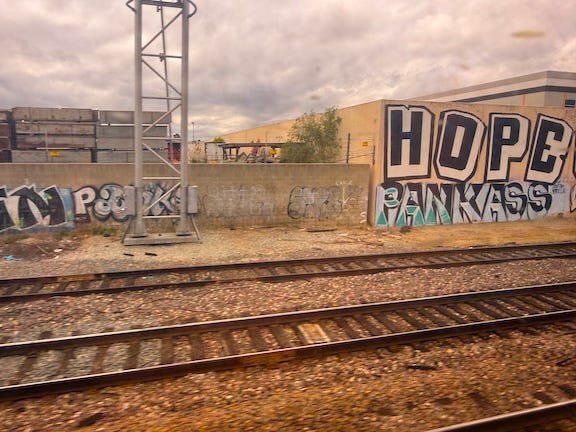
The tracks are also the longest gallery in America. The walls are whatever the rails made available. Retired train cars. Bridge abutments. The random large outcroppings of concrete that infrastructure leaves behind. The graffiti artists understood something the planners didn’t: this is the one continuous public corridor that runs through every city, unsupervised and unsponsored, and the work on its walls is often extraordinary. Color against rust. Scale that matches the industrial structures around it. Nobody commissioned it. Nobody can easily take it down.
Brick buildings built to outlast everyone who built them, their walls intact, their windows gone. Factories so large you passed them for thirty seconds at speed and still hadn’t seen the end of them. Smokestacks. Loading docks. The residue of an economy that believed in making things at scale for people who needed them.
And then, through the window, in the particular light of a winter dusk in upstate New York, a skyline.
A dome. A smokestack. One small light burning in the middle distance. Snow on the ground. The city still organized around its tallest building, still pointed toward it the way cities point toward what they believe in.
The tallest building on that horizon was Kodak headquarters. I did not know that yet.
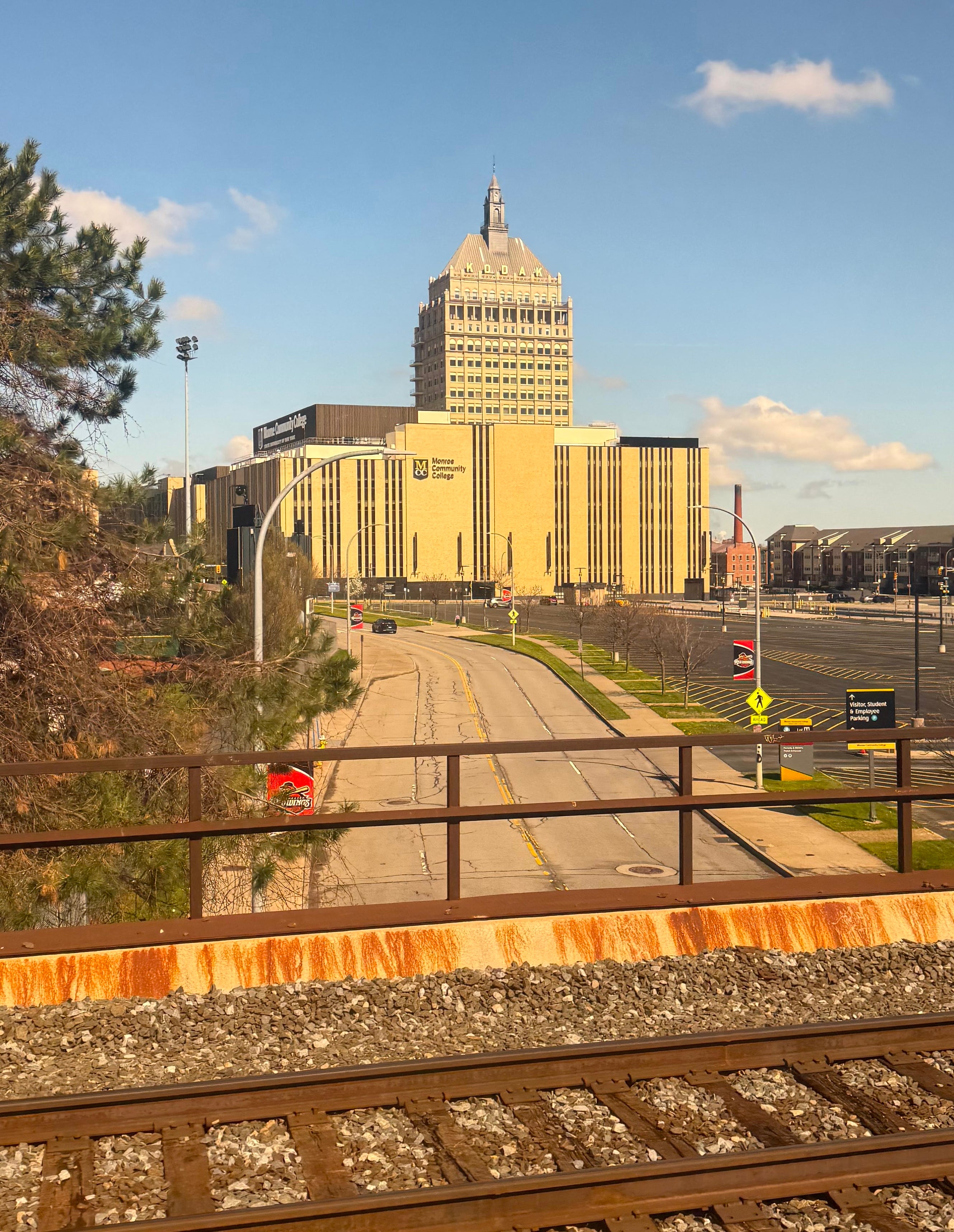
Kodak was still alive in 2007, technically. It would take five more years to file for bankruptcy, nine more to emerge as something smaller and unrecognizable. At its peak it employed 60,000 people in Rochester alone. A Kodak engineer invented the first portable digital camera in 1975. The company patented it, looked at what it had made, and decided the market wasn’t ready. The market arrived anyway, without them.
By the time I filmed that building from the train window, the patent had expired.
In my hand was a phone that would itself be gone within the year -- made obsolete by the device Apple had just announced, a thing that fit in your pocket and contained the future Kodak had refused. I was filming the ruins of one idea about America on a device that was itself about to become a ruin.
Neil Young was on the headphones. The score he made for Jim Jarmusch’s film Dead Man, starring Johnny Depp, improvised live to the footage, electric guitar played in a register that has no name in music theory. In the film, a man moves west through a country that is promise and erasure in equal measure, dying the whole way through. Young watched the images and played what they asked for. No score written in advance. What came out was what the landscape required.
Pointing a device at a passing landscape and letting it record what the landscape required.
The railroad that carried me through upstate New York that winter was built on the same logic as Kodak. Both were civilizational projects. Both required a federal imagination, a willingness to build at a scale that no private interest would sustain alone. The transcontinental railroad, completed in 1869, stitched a continent together. It made distance answerable. It said: you can go. It said: the country believes you are worth the cost of getting there.
Paid by people who received nothing of what they built. Chinese laborers who graded the western grades, blasted through the Sierra Nevada, worked in conditions that killed them at rates the foremen did not record carefully. The wealth went elsewhere. It always went elsewhere. It still does. The men who laid the track did not own what the track became.
That is the original template for American infrastructure: visionary, brutal, and extractive of the people who made it real.
The train I was on runs on tracks it doesn’t own. Amtrak, born in 1971 already underfunded, operates on freight-owned rights of way and gets bumped when freight needs to move. The Interstate Highway Act of 1956. The car as private freedom. The airline deregulation that made flying cheap enough for the middle class and left the train for people who had no other option. Every late train is the compounded result.
Now Spirit Airlines closes due to the impact of a war no one expected.
What I filmed from the window that winter was the record of those decisions. The fenced lots. The stacked pallets. The graffiti walls. The ruined factories still enormous in their silence. The Kodak headquarters against a winter sky, the city still believing in it, the building still the tallest thing on the horizon.
I didn’t title the video. I was still learning what the device could do.
The train was on time that day.
Next: Part Two. The California coast. A cousin not seen in fifteen years. What the train still makes possible.
No posts
Comments
Nothing yet. Say the first thing.
Sign in to join the conversation.