
She sits on the bench nearest the public bathrooms, and she is there every day.
I have come to think of her as the fixed point. The rest of us are the variables. We move through Carpinteria with somewhere to be, beach to eatery and back, and she holds the bench while we churn past, and somewhere in the daily passing the arrangement reverses itself. She is the constant in a world that has gone sideways.
The train is a hundred feet away. Linden Avenue runs the vacationers down to the water and back up to their lunch, a current that turns around on itself by late afternoon. The vacationers come up off the sand with their skin gone bright pink, a single afternoon written on the body. Hers is weathered brown. The same sun is a holiday to one and a climate to the other.
Music crosses the tracks from somewhere near the beach, close enough that the instruments come apart from one another and each one can be heard for what it is. She receives it whole. The people walking through it catch only the part that reaches them between one block and the next.
I have never spoken to her. I pass her, I have passed her for months, and I have learned nothing about her except what the bench will give up to a man walking by, which is to say her surface and the fact of her constancy. I could tell you the color of the light on her and nothing of her name.
This is the problem the photographers spent their lives inside. The ones who did the work understood that the surface is a lie of completeness, that the image arrives finished and the person does not arrive at all. Sebastião Salgado in the Amazon, who understood that you roll to the right when the family of eight rolls to the right in the dark of the cot, that you earn the picture slowly by lying down inside the life and waiting. Colin Finlay in Darfur, who made the photograph from inside the shelter, looking out at two starving children whose only hold on life was their grip on each other. Joseph Rodriguez, who photographed the gangs of East Los Angeles and did not photograph them, not really, not for a long time, who kept the camera on his shoulder and lived among them until the day someone asked him when he was going to start using it. The question was the permission. It came after the closeness, not before. You earn the right to the picture, and even then the picture is a likeness and not a knowing.
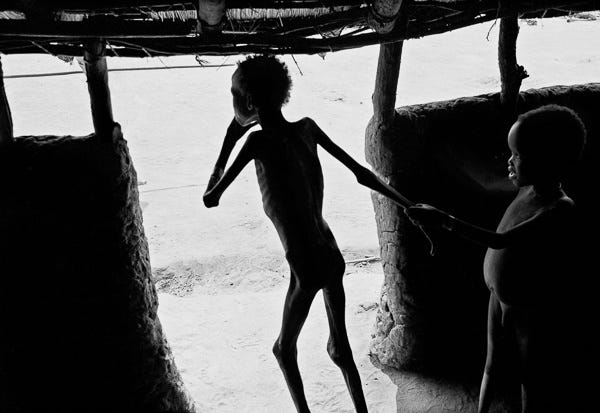
© 1998 Colin Finlay Darfur, South Sudan
Closer, then closer. That was the whole ethic. The only honest image was the one the subject let you take by letting you in, and letting you in took months, took years, took a body lying down beside theirs.
I have done none of it. I keep my hundred feet. I get the pink and the brown, the surface the bench surrenders to a passerby, and I call it observation, and it is the tourist’s version of looking, the kind that never has to roll to the right. The photographers I admire would not recognize what I do as documentation. They would recognize it as walking past.
The whistle is the thing that organizes the day. It is the distinguishing sound of the town, the clock everyone keeps without meaning to. It signals an arrival as surely as the crossing bells warn the cars and the pedestrians, and the bells warn them because they are crossing, because they have somewhere to be on the far side of the tracks. The signal is for people who are going somewhere. She is not crossing. The whistle sounds an arrival several times a day and none of them are hers. Nothing comes for her on that schedule, and nothing comes from me either, who has had a hundred days to cross the hundred feet and has not.
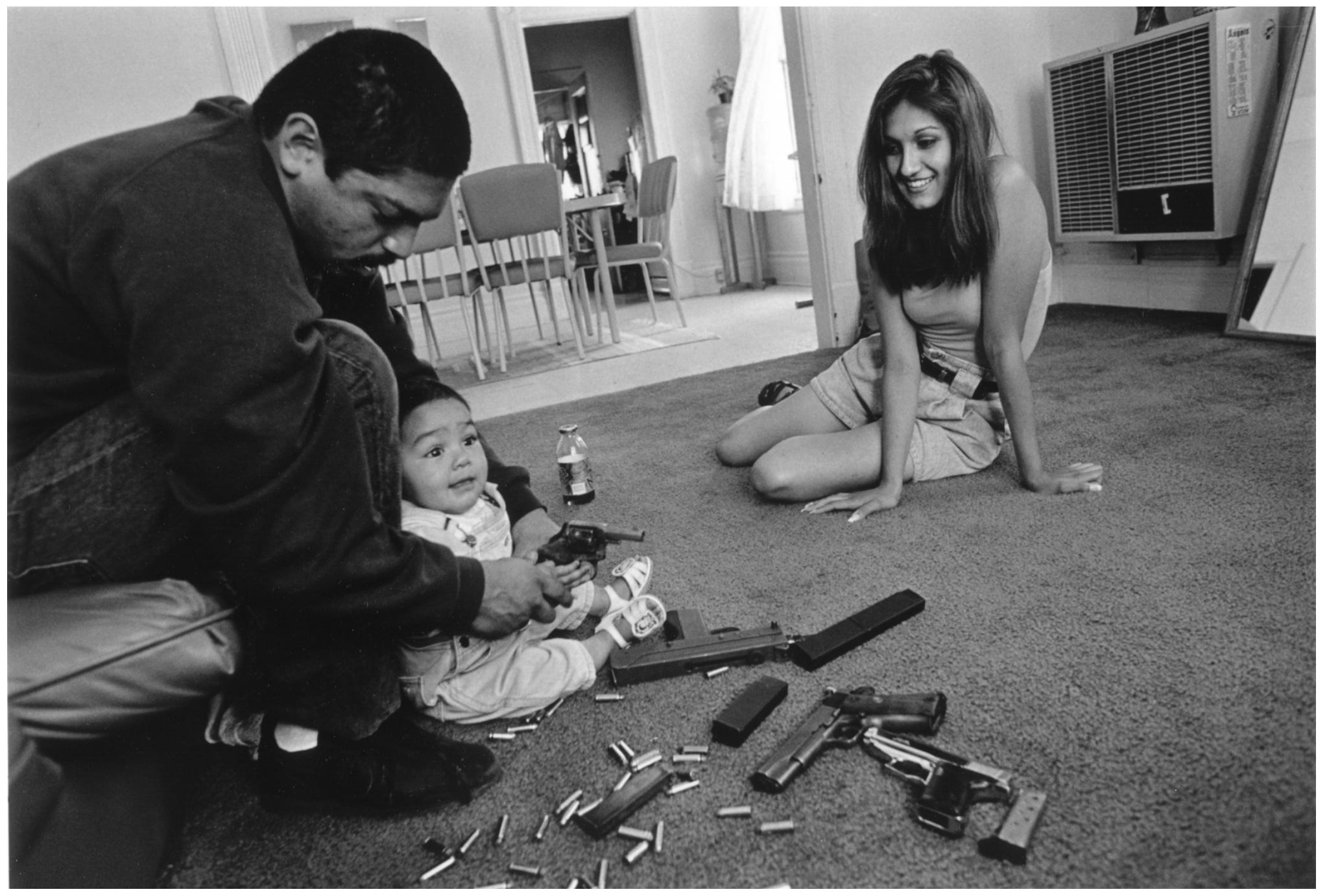
©2017 Joseph Rodriguez The morning after a rival gang tried to shoot Chivo for the fourth time. Chivo teaches his daughter how to hold a .32 caliber. His wife looks on. Botle Heights. East Side Stories
Then it all stops. The train makes its last pass and is gone. The vacationers retreat to the campsites. The brewery closes. The current on Linden runs out, and the town empties of the things that move through it.
What is left to hear are the waves on the shore at Carpinteria Beach. She is still on the bench.
Tomorrow, I hope to know her name.
No posts
Comments
Nothing yet. Say the first thing.
Sign in to join the conversation.