
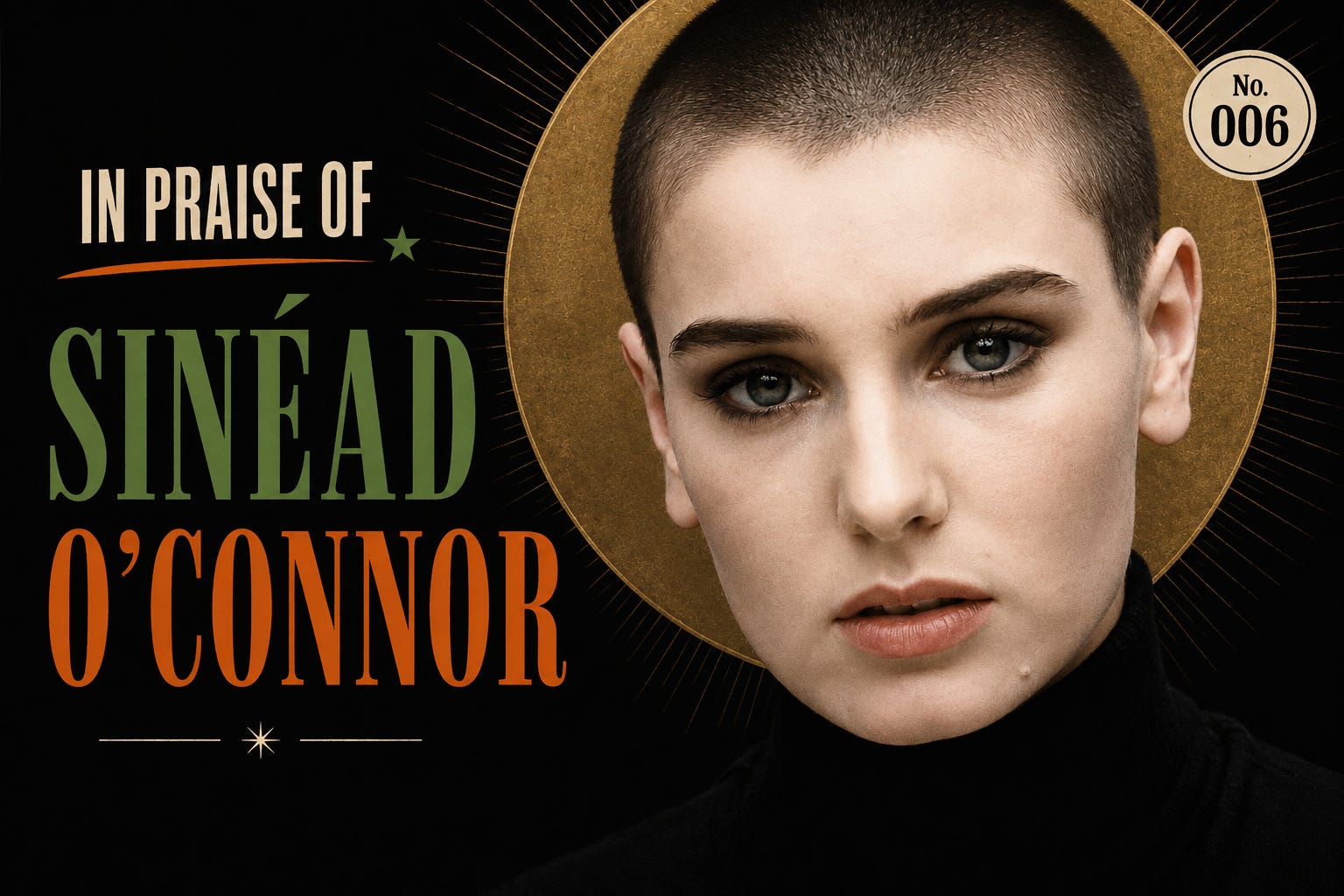
Long before institutions admitted their failures, before documentaries exposed hidden abuses, before social media turned whistleblowing into a daily spectacle, O’Connor stood in front of a camera and did something that seemed incomprehensible at the time. She tore up a photograph of Pope John Paul II on live television and said, “Fight the real enemy.”
The response was swift and brutal. She was mocked, blacklisted, booed at concerts, condemned by politicians, journalists, religious leaders, and fellow celebrities. The moment became a cultural punchline.
Years later, it became clear she had been right.
Andy Might is a reader-supported publication. To receive new posts and support my work, consider becoming a free or paid subscriber.
That pattern defines much of her life and work. Sinéad O’Connor occupies a peculiar place in modern culture: a prophet whose predictions kept coming true, a pop star who seemed fundamentally unsuited to celebrity, and an artist whose vulnerability was so visible that people often mistook it for weakness.
In reality, it was the source of her power.
Most pop stars spend their careers constructing a persona. O’Connor spent hers dismantling one.
The shaved head that became her trademark was not originally a fashion statement. It was a refusal. Record executives wanted her to appear conventionally feminine, marketable, decorative. She responded by removing the feature they most wanted to control.
The gesture feels simple now, but in the late 1980s it was radical. Popular music was filled with carefully manufactured images. O’Connor appeared like a challenge to the entire enterprise. She looked directly at the camera with an intensity that felt almost unsettling, as if she expected honesty from the audience and intended to offer it herself.
That honesty reached its purest expression in “Nothing Compares 2 U.”
The song is often remembered through its music video: a close-up of O’Connor’s face, almost motionless, carrying the entire emotional weight of the performance. There are no elaborate sets, no choreography, no distractions. Just a human being feeling something.
The tears near the end became iconic because they seemed real. Not performed sadness. Not cinematic sadness. Grief.
The video remains one of the most powerful arguments ever made for the human face.
Many singers possess technically stronger voices. Few possess a more recognizable one. O’Connor sang as though every lyric had passed directly through her nervous system. Notes cracked. Emotions surged. Perfection was never the goal. Truth was.
That truthfulness made audiences uncomfortable.
We often celebrate authenticity in theory while punishing it in practice.
People say they want artists to be honest. What they usually mean is that they want artists to be honest within acceptable limits. Vulnerable, but not too vulnerable. Political, but only when their politics align with prevailing opinion. Emotional, but never messy.
O’Connor had little interest in those limits.
She spoke openly about abuse, mental health, religion, colonialism, misogyny, and institutional violence long before such conversations became common in mainstream culture. She did so imperfectly, sometimes chaotically, sometimes contradictorily. Yet even her mistakes emerged from the same impulse: an almost compulsive need to say what she believed to be true.
This made her difficult to categorize.
She was too political to be merely a pop star.
Too spiritual to fit comfortably within secular celebrity culture.
Too rebellious to be embraced by religious institutions.
Too religious to be embraced by many rebels.
Like many genuinely original figures, she spent much of her life occupying a category of one.
Andy Might is a reader-supported publication. To receive new posts and support my work, consider becoming a free or paid subscriber.
There is also something profoundly Irish about her work.
Not merely because she came from Ireland, but because she inherited one of Ireland’s oldest traditions.
Listening to O’Connor at her best, I am reminded less of a pop singer than of the caoineadh, the ritual keening traditionally performed by Irish women. A keener did more than mourn the dead. She gave voice to wounds the community could not otherwise speak aloud. Listen to Troy. Listen to Black Boys on Mopeds. The voice strains against the limits of ordinary language itself. She was not simply performing grief. She was bearing witness to it.
There is something of the banshee in her public life as well. Popular culture remembers the banshee as a monster, but Irish folklore understands her differently. She does not bring catastrophe. She announces it. Again and again O’Connor warned about abuse within the Catholic Church, about misogyny, racism, and institutional hypocrisy long before the wider culture was prepared to listen. Like the banshee, she became identified with the warning itself. History eventually caught up.
Her voice carried history inside it.
Listening to her sing often feels less like hearing a performer than hearing someone channeling generations of longing, anger, faith, and loss. Even her interpretations of other people’s songs seemed transformed by this quality. She did not merely perform material. She inhabited it.
That gift helps explain why her work continues to resonate.
Many artists become trapped in the era that produced them. O’Connor feels strangely contemporary because so many of the issues she confronted remain unresolved. Questions about institutional authority, women’s autonomy, mental health, religious power, and public shaming have hardly disappeared. If anything, they have become more urgent.
The culture that once ridiculed her now increasingly resembles the culture she warned us about.
Yet reducing her to a vindicated truth-teller risks missing something essential.
She was not simply a political artist.
She was a spiritual seeker.
Read her memoir. Listen to the meditation recordings she made later in life. Spend time with Faith and Courage. What emerges is not someone certain of every answer, but someone unwilling to stop searching. Politics, for O’Connor, was rarely separate from spirituality. She challenged institutions not because she had abandoned faith, but because she believed faith demanded more of them.
She was also funny.
Tender.
Playful.
A devoted mother.
A lover of music in all its forms.
One of the tragedies of public life is that a single controversial moment can flatten a person into a symbol. O’Connor spent decades being treated as a symbol when she was, in fact, a complicated human being.
The first time I heard her was on a mixtape my first boyfriend made for me in 1997. Looking back, I realize he wasn’t simply introducing me to a singer. He was introducing me to a way of moving through the world: suspicious of easy answers, unwilling to separate compassion from conviction, and always searching.
The most moving aspect of her legacy may not be that she was right about so many things. It may be that she continued searching despite the consequences.
Courage is often imagined as fearlessness. O’Connor revealed a different version. Courage, in her case, looked like continuing after the crowd turned against you. Continuing after humiliation. Continuing after misunderstanding.
Continuing because silence would cost too much.
Today, younger generations encounter her with fresh eyes. They see not the scandal but the person behind it. Not the controversy but the conviction. Not the punchline but the warning.
And perhaps that is the final lesson of Sinéad O’Connor.
History has a habit of treating certain people as alarm bells. While the building is still standing, everyone complains about the noise. Years later, after the smoke becomes visible, we realize the bell was never the problem.
It was trying to save us.
In Praise Of… is a weekly procession through the hidden city beneath my bookshelf. Each Sunday, a different guide. Writers, artists, teachers, filmmakers, saints, charlatans, and fellow travelers. Some carried lanterns. Some carried knives. Some simply pointed toward a door and smiled. All of them changed the shape of the maze.
Thanks for reading Andy Might! This post is public so feel free to share it.
Comments
Nothing yet. Say the first thing.
Sign in to join the conversation.