
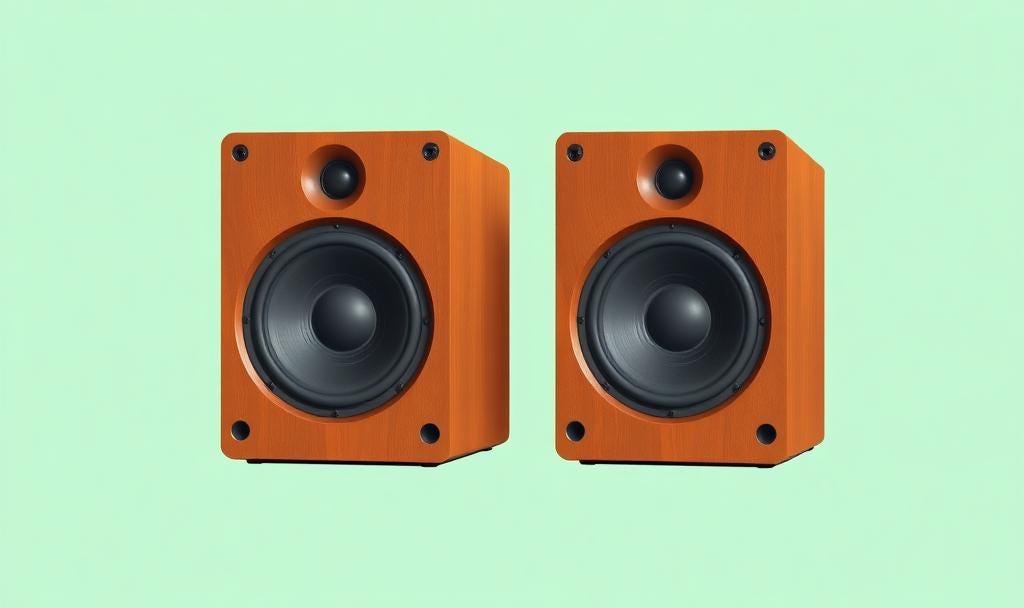
Richard likes his music and likes a nice HiFi, old-school setup, but can't afford a decent set of loudspeakers. One of his existing loudspeakers is making odd, distorted noises, so he looks up reasonably priced loudspeakers and goes to the local HiFi shop and buys a pair that had some good reviews, and were relatively inexpensive, 150 quid the pair.
He puts them in his car, takes them home and wires them in, leaving the old speakers to go to the dump.
Richard puts on his favourite jazz record and the sound is amazing. The crisp highs, the warm middles and an astonishing amount of bass from such relatively small speakers. Then Mozard, Wager and some serious electronica dance music, the bass blows him away. Best speakers he has ever heard. He moves them around the room to get the best effect, but wherever he puts them, they still sound fabulous.
Richard goes online. He looks at the reviews he's already seen (pretty good for the price, good value, well made) and then he sees reams and reams of terrible reviews.
Richard gets an email from the HiFi shop. Due to the very many bad reviews, the manufacturer will buy them back, and provide a voucher for the next best speakers in their range, effectively swapping the terrible speakers for a pair of proven ones. How odd, thinks Richard, these speakers are astonishing.
So he rings up the manufacturers, and after being fobbed off with the offer, eventually gets to speak to one of their techies, and explains that these QX7s are really something, but why the bad reviews? The techie asks Richard for the serial numbers, 100459 and 100460. I'll look into it, says the techie, and get back to you.
The techie, James, about 45, thinning hair, works in the technical drawing department, he's worked in all departments and settled into technical drawing, he likes it there. He talks to some of his colleagues about Richard's experience with 459 and 460 and they all suggest that these QX7s were some kind of odd experiment, and should never have made it to the market, and the offer to purchasers was only fair. But what about 459 and 460? Fluke? Maybe, but, well, yes, but what?
James goes to see the big boss, Simon. Simon knows all there is to know about loudspeaker technology, a world-renowned expert, and is a pretty decent boss too, an unusual combination.
Simon and James go to see Richard to hear the special loudspeakers. They are stunned too. By the amazing sound, the incredible bass, the warm middle and the crisp highs. These aren't our loudspeakers, Simon suggests, but they are.
Simon asks Richard if he can take 459 and 460 back to the lab. Richard isn't convinced, he doesn't want to let them out of the house. Money is mentioned. A lot of money. Richard still isn't convinced.
Simon talks to Richard, Simon is putting a case. Just think, says Simon to Richard, just think of the revolution in loudspeaker design, if we can replicate the 459 and 460 in production, we'd wipe out the competition in a year or two, and Richard could have a fat percentage of the profits.
Richard responds. He asks, so what if you can't? And you've pulled my speakers apart?
They settle on some non-invasive scanning tech, which costs a fortune. But they will take up some of Richard's time, while they analyse the speakers, to see if there's a special something that 459 and 460 have.
They do, and they don't. These speakers are just the same as all the others, nothing special about them at all. Simon brings another pair of QX7s to Richard's house, wires them in and they sound awful. So nothing about Richard's house then. They try everything, and Richard is still enjoying these incredible units.
Richard realises he's sitting on some kind of audio goldmine. If he lets Simon pull his speakers apart, they might, just might, be able to produce the best speakers ever made, for a low cost - £150 or so. And Richard, if he took Simon's word, would be a multi-millionaire. If they found the magic feature of 459 and 460. Simon was pulling all the stops out in his 'suggestions' to Richard.
So, Richard insures the speakers for a million pounds each and puts them up in the loft, for a while, until things settle. Sure enough, while he was on holiday his house was broken into. The speakers were not taken, because they were well hidden. The police were onto it, due to the insurance, and the burglary was amateur. Simon and a few others are serving a sentence. The speakers come out from their hiding place and wired back in, still sounding amazing. The loudspeaker company went bust, no-one wanted to buy from a crook.
Richard, due to a genetic condition, began to go deaf, and then totally deaf. He learnt how to live, being deaf, as so many do. And he researched loudspeaker technology. He built his own and started a small business, with a hearing friend, making bespoke loudspeakers, very expensive and sounding good. But not 459 and 460 good.
Richard now had a lot of money and made a decision. He probably knew enough as Simon about loudspeaker tech. Simon was out of prison and living in a bit of a run-down flat, not very well.
Simon and Richard worked together, day and night, in the workshop, with the 459 and 460.
They found it.
They'd bought a hundred QX7s on eBay to compare. It was a combination of slight warping of the enclosure and all of the components were slightly out of tolerance, in all the right ways. The tolerances were wide because the speakers were inexpensive. 459 and 460 had components out of tolerance by the right amounts, all added together. They made a pair of speakers that sounded exactly the same as the 459 and 460. And another pair, and another. This had taken two years.
All this was done in the utmost secrecy, even the hearing friend didn't know what was going on. They'd done it. Now what? They knew that every HiFi loudspeaker manufacturer would be put out of business by this, unless they could copy the design themselves. They could copyright the design, and make lots of money doing that, of course. Every loudspeaker manufacturer would either pay for their design or go under. It took them two years to find the answer, and it would take at least that for the others to do the same, too long in a very competitive market. And, of course, all loudspeakers ever sold would look and sound the same. So, Simon and Richard sat on it, made a few for their friends and put the detailed design in a safe deposit box in Geneva.
Simon was employed by Richard and eventually, they both retired, very happy and rich men, the bespoke business did well with conventional designs. Richard forgave Simon for the break-in and they died peacefully in their beds.
In an audacious robbery, the bank in Geneva was emptied of most of the safe deposit boxes. The money and jewels were mostly recovered by the Swiss police, but the loudspeaker designs were never recovered, because nobody knew what they were, just some blueprints on ageing foolscap paper. They were probably just binned because they didn't seem to be of any value to the robbers.
Five years after the robbery, a new loudspeaker was announced at a trade fair in Berlin. It was such a small company, no one paid any attention, and the company eventually went bust due to a fire in the main offices.
Loudspeaker design, to this day, is truly conventional.
Comments
Nothing yet. Say the first thing.
Sign in to join the conversation.