
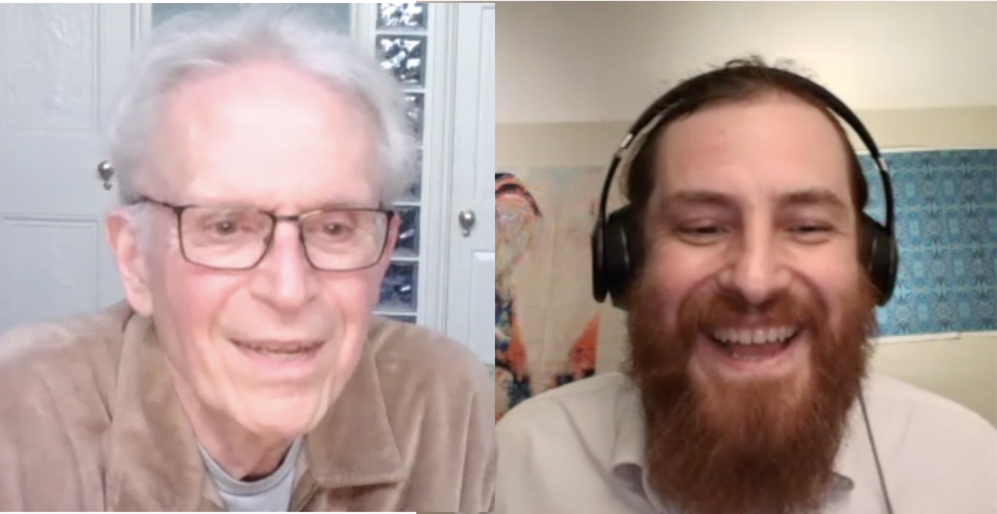
Arnold Zuboff (of Sleeping Beauty Problem fame) joins me (Andrés) to discuss his book "Finding Myself: Beyond the False Boundaries of Personal Identity" - and if his philosophy turns out to be correct, we are quite literally the same person.
I read the book in preparation for this interview, taking extensive notes across the full range of arguments pesented. Like Arnold, I spent much of my teens and early twenties obsessing over the problem of personal identity, eventually arriving at Universalism on my own. In the video I share a little of that journey. I should note I don't consider myself a full Universalist outside of certain states of consciousness (cf. high dose 5-MeO-DMT). A distinction I find useful is between recipe and review: the recipe is whatever method you use to change your mind or orientation, such as a philosophy, a meditation, a substance. The review is what it actually does to you phenomenologically. I mention this because the question of which view of personal identity to actually live by is not just a metaphysical one. My current recipe is what I call the Goldilocks Zone of Oneness: the view that we are all one, that we are each separate individuals, and that each moment of experience is its own being, are here seen as not competing truths but complementary ones. Holding all three at once, rather than committing hard to any single view, seems to produce the best phenomenality.
A note on the book: the writing style is dense and rewards slow reading. It is earnest and argument-driven without cutting corners. Light on math (perhaps to a fault in the Sleeping Beauty sections), but the verbal arguments are rigorous and genuinely strong. Highly recommended if you care about "who on Earth are you? And why?" questions and have some analytic philosophy background.
Thinking carefully about Universalism is genuinely psychoactive. Casually saying "we're all one" is one thing. Actually working through the arguments, being forced to update away from the usual view of personal identity, and not being able to find your way back - that's something else. I had a series of vivid dreams about universalism the night before this interview, including one where a friend's face fractalized into an Indra's Net of all possible faces, both awesome and unsettling, as several stubborn subagents finally let go of the usual view.
In the video we go through several of the key arguments: psychological continuity and why it ultimately fails to do what the usual view needs it to do, the type vs. token distinction and why it matters so much for how we even frame questions of personal identity, and why the Anthropic principle isn't evidence for the multiverse unless Universalism is also true.
Something I've been sitting with since this conversation: taking Universalism seriously can go in very different directions depending on the person. It can genuinely open you up to caring about others without having to construct the motivation effortfully, bring real equanimity about personal setbacks, dissolve in-group/out-group thinking, etc. But it can also go sideways - into grandiosity, into a depersonalization that masquerades as enlightenment, or into something like compassion-overload when you sit with the idea that all suffering everywhere is in some sense (literally) yours. Whether it goes well or badly seems to hinge the degree to which it is accompanied by good for everyone functional restructuring of motivational architecture, in contrast to becoming a phenomenologically clunky conceptual overlay.
The deeper question I want to pursue in the future (my personal frontier on the topic of personal identity) is whether we can develop a mathematics genuinely informed by phenomenology - one precise enough to say exactly in what sense the competing views of personal identity are each tracking something real. More on this soon (perhaps after another round of interviews with Arnold!).
Thank you for tuning in! :-)
Infinite bliss!
----
Relevant links:
Arnold's YouTube channel: https://www.youtube.com/@ArnoldZuboff
Get the physical book: https://www.amazon.com/Finding-Myself-Boundaries-Personal-Identity/dp/1634351177
Comments
Nothing yet. Say the first thing.
Sign in to join the conversation.