
Opening Question
What does it feel like to ask the question “Who am I?” The answer, it turns out, depends enormously on your philosophical background assumptions, your current state of consciousness, and how embedded you are in a social matrix that defines you in particular ways. If you keep pushing past the superficial answers (I am a programmer, I am a student), something stranger and more interesting starts to emerge. This video is an attempt to give that strangeness some conceptual scaffolding.
Personal Identity vs. the Self
Before diving into the self proper, it helps to distinguish it from personal identity. Personal identity asks: what makes you a unique individual across time? The major positions here are (labels by Daniel Kolak’s I Am You, see also: “Ontological Qualia”):
Closed individualism: You begin existing at birth and stop existing at death. This is the conventional view most people implicitly assume, and also the background assumption of most religious frameworks that posit a soul (with or without a definite start point).
Open individualism (or Universalism): There is fundamentally one subject of experience, and every conscious being is that same subject. The relationship between you-now and you-tomorrow is qualitatively similar to the relationship between you and any other person. This is the view defended by Arnold Zuboff in his book Finding Myself (see the interview on this channel) and is roughly equivalent to what Daniel Kolak called open individualism.
Empty individualism: What you are is just a momentary snapshot of experience. From moment to moment you are a completely different subject. The felt sense of continuity is constructed from memory and a self-concept, not from any deep metaphysical continuity.
Personal identity is worth understanding, but the self is a richer and more multifaceted concept. This video treats them as distinct.
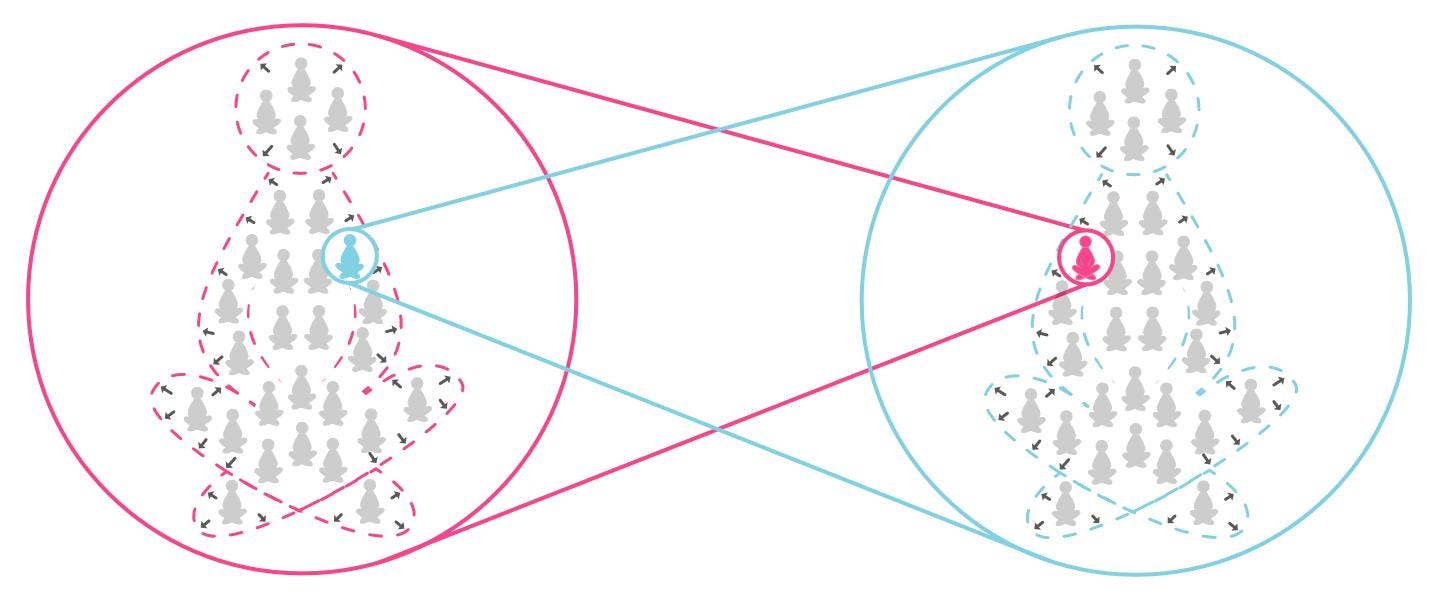
Three Ways to Carve Up “The Self”
The core of the video is a three-part decomposition. These components are regularly conflated, and that conflation is the source of a great deal of confused thinking about AI, moral patienthood, and consciousness.
1. The Functional Self
The functional self is a self-organizing principle that facilitates the autopoietic replication of a particular pattern. Autopoiesis means self-replication: the capacity of a system to reproduce itself and maintain its own organization.
Evolution can be formalized as a process where patterns adapted to their environment multiply thanks to the synergistic combination of: reproduction, selection, and variation. Richard Dawkins gestures at something even more general than this Darwinian fitness: the survival of the most stable. Patterns that persist are patterns that replicate. But there is a crucial subtlety here about how you draw the boundary around what counts as “the” self-replicating unit. One could talk about the functional self as the scope of a pattern that stabilizes in time.
An individual ant, for instance, cannot autopoietically replicate on its own. The unit that makes sense from a functional-self perspective is the colony, including the queen, the tunnel system, and even aspects of the surrounding ecosystem. Likewise, a person with a personality strongly tied to a particular car or social status symbol has a functional self that extends to those objects: damage the car severely enough and the personality-pattern loses a key node in its replication network.
Nothing is entirely local. All embodied patterns are spatially and temporally distributed to some extent. The functional self is just asking: what is the minimal unit that can actually reproduce itself?
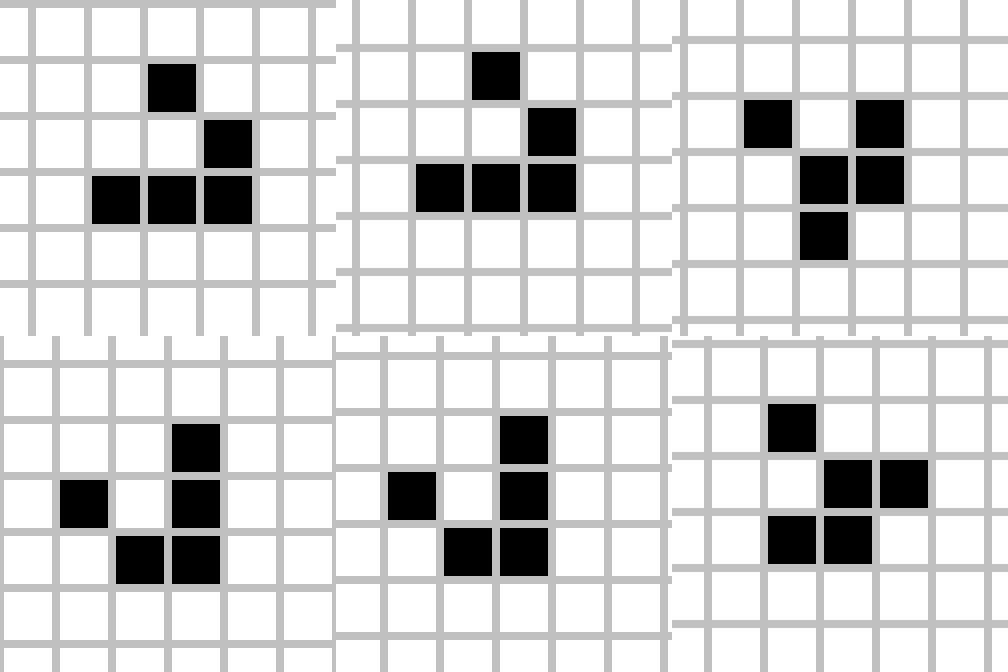
A critical mistake here is assuming that a robust functional self automatically generates phenomenal experience or moral patienthood. It does not. A glider in Conway’s Game of Life is a beautifully autopoietic pattern. But there is no glider “in” the simulation: there are only cells sensing their local neighborhood. The glider exists only in the mind of the observer parsing the image. A functional self made entirely of “mind dust,” can be a very stable self-replicating system without any complex unity of experience whatsoever, much less a sense of self.
2. The Phenomenological Self
The phenomenological self is the felt sense of being someone: a sensor, an actor, a locus of sensations to which things can happen. This is enormously richer and more variable than people typically assume.
A key distinction worth making is that the phenomenal self is not the same as the witness or subject of experience. There are experiences where no clear phenomenal self is present and yet something is witnessing. The two can come apart.
More importantly, the phenomenological self is not a fixed, uniform thing. Most people assume that everyone’s sense of self is basically similar. Exposure to altered states of consciousness reveals that this assumption is false. There is a wide spectrum of possible ways of feeling like someone, including:
Dissociative identity configurations where the phenomenology of self flips dramatically between states
DMT and 5-MeO-DMT states where multiple competing clusters of coherence generate a number of self-feelings coexisting simultaneously, or where the sense of self dissolves while witnessing continues
Drug-induced (e.g. LSD) or meditative states where the boundary between self-representation and other-representation becomes porous: what I describe as a “1.5 person perspective,” where a representation of another person is partly experienced as self and partly as other, or even stranger configurations such as feeling that you share one arm with another person but not the other arm
Even in ordinary consciousness, there are usually multiple coexisting senses of self. When you interact with another person, you are running a self-model and a model of them. Only one of these has “write access” to your somatic field and motor control. The others influence you indirectly, by modifying what the primary self-model does. The ordinary sense that there is “only one” self is partly a matter of which model currently holds the executive seat/has motor control.
3. Phenomenal Binding and the Unity of Experience
Phenomenal binding is the fact that experience at any given moment is unified: the redness of the apple and the sound of a bird and the feeling of your hands on the keyboard are all part of one moment of experience, not separate isolated qualia.
This is conceptually distinct from both the functional self and the phenomenological self. You can have a unified moment of experience with no felt sense of self at all. You can have multiple competing phenomenological selves within a single bound moment of experience (as in the example of conflicting impulses about a purchase, which involves something like a competition of identity). And you can have functional self-replicating systems with no binding whatsoever.
The failure mode in discussions of AI consciousness and moral patienthood is lumping all three together: as if a system that is sufficiently functionally-self-like, will also have by default a phenomenological self, and it will also have unified experience. This is not at all the case. The three can be conceptually and practically distinguished. Changing the substrate or the evolutionary selection pressures gives no guarantee that their typical biological correlations will hold. In fact, even in evolved biological organisms, these concepts already come apart: some organisms lose their brains (and thus phenomenal self) as part of their maturation process (cf. Tunicate).
How Biology May Generate a Unified Phenomenal Self
Drawing on Michael Levin’s work on how cells convince each other to form a multicellular organism, several mechanisms can be proposed for what allows a collection of cells to act as a unified self (functionally first, and then phenomenologically too):
Stress sharing: If accumulated stress in one cell or module can be distributed across the whole organism, the organism can metabolize it more efficiently. This is analogous to a heat sink: a tiny, concentrated heat source becomes manageable when spread across a larger conducting surface. Stress that would be catastrophic locally becomes dissipable globally.
Memory sharing: If cells cannot distinguish between something that happened to them versus something that happened to a neighboring cell, the functional boundaries between them become blurred. It becomes very difficult to pursue a “selfish” individual agenda when the very cognition involved in that agenda propagates as a shared memory throughout the system. Levin also has more radical ideas about memories as entities in their own right with their own agency, though even setting that aside, memory sharing alone is a powerful integrating force.
Symmetry sharing: On DMT, the visual field can break down into competing domains with different symmetry groups: one region organized around mirror fourfold symmetry (e.g. *442), another around threefold rotations (e.g. 333). Waves and vibrations in these regions are not compatible: they compete for attentional and energetic resources, and waves cannot easily travel between them. What allows waves to propagate is invariance: a symmetry or regularity that permits the pattern to spread spatially without losing energy (this connects to Noether’s theorem, which links symmetries to conserved quantities). A well-integrated phenomenal self may require that the organism’s field of experience shares fundamental symmetry groups throughout, so that waves can travel without hard blockages. Conversely, something like cancer might involve a cluster of cells defecting into a different symmetry group, breaking the coherence of the whole.
Cross-frequency coupling: Even if two regions of experience do not share symmetry at their own scale, they can be coupled through a shared lower-frequency wave at a larger spatial scale. Region A (high frequency, left visual field) and Region B (high frequency, right visual field) may not directly interlock with each other, but both interlock with a broad, low-frequency background wave. This cross-scale phase interlock is what allows coordinated action: different parts of the experience develop a “common fate” through their shared relationship to slower rhythms at larger scales. On psychedelics, this sometimes manifests as a perfectly self-similar fractal gestalt (think trees becoming self-similar), where every scale is in phase with every other. Beyond psychedelic effects, the principle is computationally accurate ubiquitous (different scales likely do have different mechanisms), and this is a hint about the kind of cross-scale coherence that normal integration approximates (cf. Cross-frequency coupling by Cube Flipper).
Shared projective logic: A “projective logic” is the set of transformations that relate how sensations in one modality are expected to change as a function of motor movements. If you move your hand, you expect your visual and tactile experience to transform in a correct corresponding manner. Different regions of experience can fail to share the same projective logic: a region organized in a four-dimensional hyperbolic space and a region organized in a flat two-dimensional space literally cannot “see” each other or reproject onto each other. They live in incompatible projective realms. On DMT, competing clusters of coherence often inhabit mutually incompatible projective spaces, which prevents phase interlock and prevents the clusters from conceptualizing themselves as parts of the same unified organism. (See: Projective Intelligence).
The one electron universe as a substrate: Feynman and Wheeler noted that in Feynman diagrams, an electron annihilating with a positron and producing a photon is mathematically equivalent to a single electron bouncing off a photon and reversing in time. This suggests a picture where the universe might be a single electron interfering with itself across time. In this frame, the “size” of an experience could be understood as the number of self-interactions of this one electron between the moment it becomes free and the moment it is measured and collapses. Under this speculative picture, what unifies an organism might be that each of its cells is, at a deep level, the same electron, whose “monads” merge with one another as they bubble up to form larger pockets of integrated experience.
The Screen of Consciousness and Its Modules
Access consciousness, what we can report on as our experience can be thought of as a kind of shared screen: a multimodal field integrating visual, auditory, tactile and other sensory-based information. But this screen is only the visible tip of a much larger iceberg in a conscious organism.
We have discussed how it is likely that many other phenomenally bound sub-streams or modules are constantly competing to join the central screen. They do so by broadcasting information about the organism’s physiological state, making predictions about the world, and offering useful compressions and categorizations of what is already on the screen.
Critically, each of these competing modules appears to have access to a copy of the entire central screen. They each process the whole screen, transform it through their particular specialization, and project that transformed version back onto the screen. The screen is thus constantly being overwritten with transformed versions of itself. This creates a very non-trivial mathematical structure: not just the resonant modes of the screen itself, but the resonant modes of the screen being transformed by each module and fed back into it.
This is one reason mood disorders and anxiety are so difficult to resolve from the inside: it is not enough to harmonize the screen with itself. You have to harmonize the screen with all of its own projections onto itself. How do you tune a multiheaded fractal?
There’s an important analogy here to a transformer’s self-attention mechanism. In a transformer, every token (element) can “see” every other token and update its embedding accordingly (the attention mechanism functions as an “all to all” [functionally] holistic bottleneck in the information processing pipeline of the algorithm). The screen of consciousness functions similarly: each gestalt on the screen can see every other gestalt and can have its own representation updated. A bicycle perceived as static can be updated to a bicycle in motion because those representations are close in the semantic embedding space.
DMT Trip Report: The Development of the Buddha Hive Minds
During a legal retreat in Mexico, after spending about a week intensely studying transformer architecture, a DMT experience produced the following phenomenology:
As the experience came on, cartoon-like characters populated the tactile and visual field simultaneously. The “screen of consciousness” could be understood as a self-attention mechanism: all of the gestalt-characters could see each other and comment on each other and modify each other’s meanings. I knew this explicitly, and of course this understanding was itself expressed in the content of the screen.
The system’s algorithm (or an aspect of it thereof) “became self-aware”. The sense of self became divided into many different suborganisms, all coexisting and trying to see each other, with a faint background sense that there was still a human somewhere underneath. The sub-organisms then began to self-organize around an image of my face, which served as a center of mass for their coordination. I saw how my self-concept was a kind of “religion” for all of these parts to coordinate around.
What followed is what I’d describe as a very high-dimensional gel, with extraordinarily sharp gestalt-projections (interpreted as high-dimensional objects projecting into a lower-dimensional experiential space at very acute angles, since in high dimensions nearly all projections are acute - needle-like). These sharp needle-like gestalts allowed the modules to build on each other’s work, and a crystalline, fractal nonlinear-optical-neuron hive mind began to grow. This system felt distinctly and unmistakably intelligent, though I am sure I would need to convince others of this somehow (cf. Michael Levin’s sense: if something does not seem intelligent, that may be a reflection of the observer’s own intelligence limitations). It underwent several transformations (from a colony, to another intermediate form I can’t remember well, to then a high-dimensional temple with jewels and columns and bubble domes), becoming progressively more integrated, self-aware, and fractal in its identity: each part being the whole and the whole being each part, explicitly, and agentically.
This was the introduction to what I call a “Buddha hive mind”: a state in which each component knows that it is also the whole, that it is a local instance of a single object being reprojected back through different higher-dimensional transformations onto itself, and has a way to control its own behavior. In subsequent experiences this phenomenology became more refined, arriving more directly at a sense of a single vast Buddhamind that knows about attachment, no-self, impermanence, and that integrates the insight that the screen and all its parts are just one object seen from different angles.
The Demonic Failure Mode
The contrast case is what might be called the Mara version of the same dynamic. When different sub-modules genuinely believe they are the fundamental self, they cling to existence as a self, they compete for dominance, and they can conspire with each other on DMT to colonize the experience’s overall control system. This feels like being eaten alive by worms spraying acid and venom inside you: patterns of ignorance attached to self-continuity and sensory pleasure, trying to replicate within the matrix of sensation.
The antidote, drawn from Buddhism, is powerful too. I noticed impermanence (nothing these patterns are pursuing can be held), noticed no-self (there is no stable self for them to be), noticed unsatisfactoriness (their quest is structurally hopeless). And above all, I decided to share and shine loving-kindness even toward the most unpleasant and threatening-feeling externalized projections of Mara/this kind of adversarial cancerous fractal self. Doing this caused the demonic patterns to dissolve into rainbow light and open into spacious, beautiful Buddha-mind configurations. But it definitely was an ordeal (even if illuminating towards the end!).
The Avatamsaka Sutra Connection
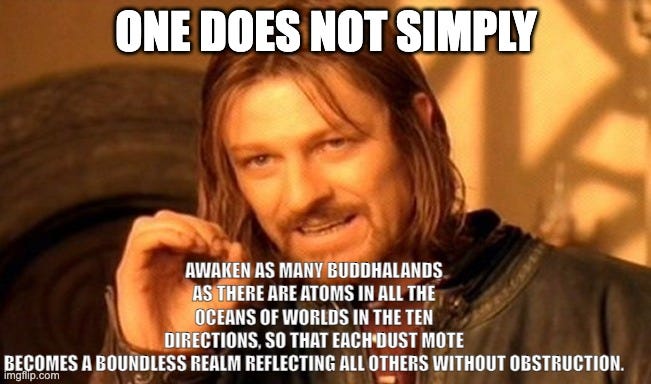
The Avatamsaka Sutra, one of the longest texts in Buddhism and the pinnacle of Mahayana visionary phenomenology, describes oceans of worlds filled with Buddhalands in which everything reflects everything else endlessly, with perfect seeing, perfect hearing, perfect feeling, and complete mutual availability of all knowledge. This phenomenology maps neatly onto the Buddha hivemind described above: a state in which cross-frequency coupling, shared symmetries, shared projective logic, and something like one-electron-universe style self-interpenetration have been harmonized across all scales. Listen to Bob Thurman’s readings of the Avatamsaka Sutra to get inspired :-)
Final Summary of the Key Claims
The “self” has many meanings, each fascinating. We find that it is helpful to at minimum propose three distinct phenomena: the functional self (autopoietic replication), the phenomenological self (the felt sense of being an agentic experiencer), and phenomenal binding (the unity of experience). These can and do dissociate.
A robust functional self does not automatically produce phenomenal experience or moral patienthood. A glider in Conway’s Life is the limiting case.
The phenomenological self is far more variable and exotic than ordinary experience suggests. Altered states reveal a wide space of possible self-phenomenologies.
A unified phenomenal self, in the biological case, appears to require: stress sharing, memory sharing, shared symmetry groups, cross-frequency coupling across scales, and shared projective logic among the competing modules that compose experience.
The screen of consciousness functions analogously to a transformer self-attention mechanism: each module sees the whole screen, transforms it, and projects it back. This creates a complex resonant structure with many possible failure modes.
DMT can temporarily allow normally suppressed modules to gain right access to the central screen, producing either chaotic fragmentation (a “Mara mode”) or, under the right conditions, a deeply integrated, high-dimensional Buddha hive mind in which each part knows it is also the whole.
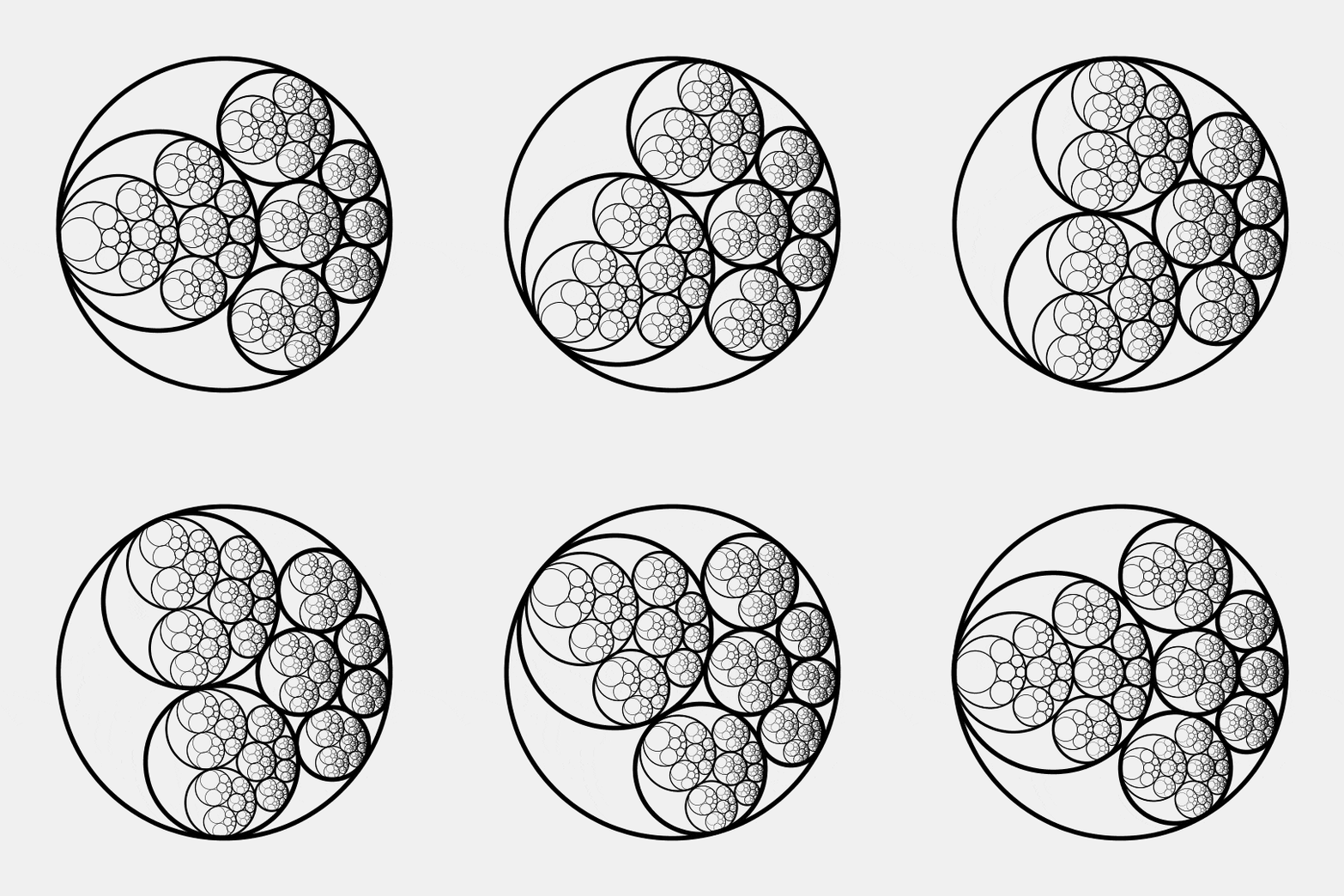
This phenomenology is experientially consistent with what the Avatamsaka Sutra describes as Indra’s Net: a universe of mutual reflection in which every jewel contains the image of every other.
Summarized with an artifice’s help (CO4.6) using the transcript of my video as well as the notes I took in preparation for it; edited manually for a more pleasurable and fulfilling reading :-)
Comments
Nothing yet. Say the first thing.
Sign in to join the conversation.