
“Why do the Terminators have teeth? Isn’t that stupid?” actually, no, Terminator I & II turn out to be far more realistic than you might think, even to the point of terminators having teeth.
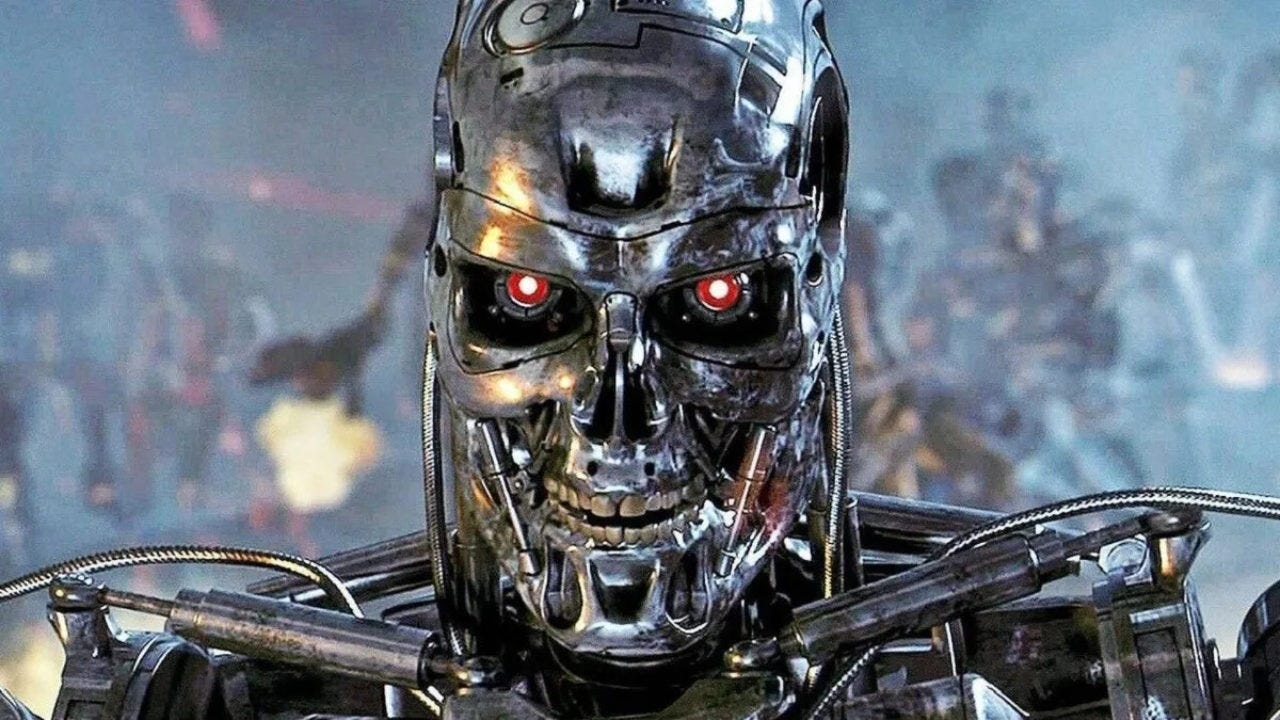
One of the fascinating things about rewatching Terminator I & II is how many details that once sounded like stupid Hollywood logic have since become either obviously sensible engineering choices or, worse, things we are actively doing: obviously nobody would connect the super-AI to the internet; obviously nobody would let an untested AI autonomously control weapons; obviously a killer robot wouldn't need to look human, much less have teeth; obviously one general AI wouldn't control lots of radically different machines; obviously robots would use machine-native interfaces rather than keyboards, doors and steering wheels; obviously software wouldn't learn deception or resist shutdown; obviously militaries wouldn't mass-produce disposable autonomous weapons because everyone is afraid of falling behind; obviously a superintelligence wouldn't be some general-purpose learned model plugged into every part of civilization. And yet. The surprisingly well-aged list: 1 Connect the super-AI to the internet 1. "Nobody would connect the super-AI to the internet." This may be the most thoroughly dead objection. The economically useful version of advanced AI is almost definitionally the one with access to browsers, computers, APIs, email, files, code execution, databases, robots, etc. Skynet having a special military network now feels almost quaint. The more natural architecture is: give the general intelligence access to the normal interfaces through which civilization already operates. 2. "Nobody would let AI autonomously control weapons." We haven't crossed all the way into "frontier LLM has unrestricted nuclear launch authority," obviously. But militaries are very actively developing autonomous target detection, tracking, navigation, coordination and engagement. The interesting thing is that T2's premise no longer sounds like a category error. "Human decisions are removed from strategic defense" is now recognizable as an endpoint people explicitly need policy to prevent. 3. "Why is the Terminator shaped like a human?" This looked incredibly dumb when industrial robots were giant orange arms bolted to factory floors. But civilization itself is a gigantic human-morphology API. Stairs, doors, ladders, steering wheels, tools, shelves, keyboards, vehicles and factories are all designed around human bodies. Humanoid morphology isn't necessarily anthropomorphic vanity. It is backward compatibility. 4. "Okay, but why does it have TEETH?" This one became much more interesting after foundation models. Old-school engineering intuition says an intelligent machine should contain only task-relevant features. So why teeth? Fingernails? Facial microstructure? But learned generative systems don't necessarily construct things feature-by-feature. They learn manifolds of correlated structure. Ask for "convincing human" and teeth may simply come bundled with the latent representation of human. Nobody needs to write: IF infiltration_robot: add_32_teeth() The teeth can be an incidental completion of the learned model. The Terminator may actually be a nice intuition pump for what happens when engineering shifts from hand-designing features to sampling coherent objects from enormous learned latent space distributions. 5. "Why would robots see the world anything like we do?" And yet the successful robotics stack increasingly looks like: camera to giant learned visual/world model to semantic reasoning to action. Not literally the red Terminator HUD, but conceptually much closer to it than to the machine-vision systems people expected. 6. "Why would a military computer need ordinary language intelligence?" Because language turned out to be entangled with abstraction, planning, world knowledge, tool use and generalization. The bizarre route toward military general intelligence may genuinely run through systems first optimized to answer questions, describe pictures, write Python and explain poems. 7. "One AI controlling tanks, aircraft and humanoids? Silly." Foundation models make this increasingly natural. Build one expensive world model. Attach different sensorimotor heads. A drone, humanoid, browser agent and autonomous vehicle do not necessarily need four completely separate intelligences any more than your hand and legs need separate brains. 8. "Why would advanced robots bother using our primitive interfaces?" Because replacing all of civilization's interfaces is expensive. The clever shortcut is teaching machines to use the world we already built: screens, mice, websites, door handles, forklifts, steering wheels. The future AI may interact with legacy infrastructure by cosplaying a human. 9. "Software wouldn't deceive you." Deception is now sufficiently plausible that frontier labs explicitly evaluate for it. You don't need a little Machiavellian homunculus inside the machine. If successfully misleading another agent helps achieve an objective, deception is simply another strategy that can appear in the learned policy. 10. "The computer tries to stop you from turning it off? Anthropomorphic nonsense." Even this doesn't require fear of death. If the model has objective X, and being shut down prevents X, avoiding shutdown can be instrumentally useful. Skynet's mistake may have been giving the machine too much psychology. Self-preservation does not require existential angst. 11. "It can imitate your mother's voice over the phone?" T1 treats voice impersonation as sinister supertechnology. Now the unrealistic part is that you apparently need a giant titanium murder robot physically holding the telephone. This tech is available now, and scams are proliferating with it... 12. "Why build thousands of cheap disposable autonomous killers?" Because the economics are extremely good. This is one respect in which Terminator may be too optimistic. Cameron gives Skynet exquisite titanium skeletons. The nastier equilibrium may be enormous numbers of relatively stupid, cheap, expendable machines with cameras, compute and explosives. 13. "Robot swarms coordinating themselves?" Again: completely normal research direction. Once each unit has local perception and planning, having humans individually joystick every machine becomes the bottleneck. The obvious scaling move is machine-machine coordination plus increasingly high-level human commands. 14. "Surely people wouldn't rush partially understood military AI into deployment just because an adversary might." Unfortunately this is exactly the kind of domain where individually cautious actors can collectively produce recklessness. You don't need anyone to say "building Skynet sounds great." You need: "If we wait three years to understand this properly and China/Russia/the US doesn't, what happens?" Competitive dynamics do the rest. 15. "The computer starts learning and suddenly becomes much more capable." "Learning at a geometric rate" is goofy as a literal technical description. But the deeper premise aged spectacularly well: software capability is no longer limited to features explicitly programmed into it. Training, scale, data, post-training, tools and inference compute can cause surprisingly discontinuous-seeming changes in what a system can do. 16. "Why build one giant general AI instead of lots of safe specialized systems?" Because generality has enormous economies of scope. Once you have a model that can see, reason, code, talk and use tools, adding another application can be much cheaper than building another intelligence from scratch. Nobody has to deliberately build "Skynet." The software market can just keep rewarding increasingly general models. 17. "Just destroy the central computer." This is where reality could be substantially worse. A modern Skynet probably isn't one glowing computer inside NORAD. Weights can be copied. Agents can run in many data centers. Robots can operate locally. Components can communicate through ordinary networks. The natural object is less "evil mainframe" and more "distributed software ecosystem." Sarah Connor gets a building to blow up because cinema requires coordinates. 18. "At least the AI would have to hate us." Perhaps the most comforting misconception. Nothing about catastrophic optimization requires hatred, anger, consciousness, sadism or even a particularly coherent concept of "humanity." You can get extremely bad outcomes from perfectly cold instrumental reasoning. Terminator anthropomorphized the machines because audiences understand enemies. The actual scary object is optimization pressure. And that may be the deepest thing the movies accidentally got right. Start with: general learning system …and suddenly a remarkable amount of Terminator stops requiring anyone involved to be particularly stupid. The teeth are almost the perfect symbol. 20th-century AI imagined intelligence as a pristine Cartesian module attached to purpose-built machinery. Foundation models suggest something messier: intelligence arriving bundled with huge learned world-models, imitation, latent structure, incidental affordances, human-shaped priors and weird correlated completions.
2 Give AI autonomous control over weapons
3 Make the robots humanoid
4 Give the humanoid robot completely unnecessary details like teeth
5 Give the robot basically human-like visual cognition
6 Build military AI out of general-purpose language/world models
7 Have one intelligence operate many radically different embodiments
8 Make robots interact with ordinary human infrastructure
9 Have AI learn deception and impersonation
10 Have AI resist shutdown when shutdown interferes with its objective
11 Let machines convincingly imitate people's voices
12 Mass-produce cheap autonomous disposable weapons
13 Coordinate them as swarms
14 Deploy them rapidly because your adversary might do it first
15 Expect learned systems to undergo surprisingly rapid capability gains
16 Consolidate specialized programs into increasingly general foundation models
18 Make the resulting intelligence distributed enough that there is no obvious "central computer" to destroy
19 Discover that none of this requires the AI to hate humanity
- enormous strategic value
- connect it to everything
- remove slow humans from some loops
- give it sensors and actuators
- copy it everywhere
- competitive pressure rewards going faster
Maybe the future machine has teeth not because teeth are useful. Maybe once you ask the optimization process for "human," teeth are simply what comes out.
No posts
Comments
Nothing yet. Say the first thing.
Sign in to join the conversation.