
Hello everyone!
For two thousand years, the jhanas have been described in words. We want to try something different. Today, I’m announcing QRI’s Jhana Visualization Competition 2026, to finally create the visual referents for blissful qualities of mind we’ve all been waiting for.
Following the time-honored tradition at QRI to try to eff the ineffable, this year we are asking the consciousness community to send us their best attempts at creating video depictions of the jhanas. In 2023 we ran a series of contests for participants to submit their attempts at recreating the phenomenology of psychedelic states of consciousness. More specifically, we ran a technical replication contest which was about creating accurate depictions of aspects of psychedelic phenomenology. We also ran a psychedelic cryptography contest, for which submissions were meant to contain information that only people on psychedelics could decode. And finally, we also ran an “inspiration” contest, to reward submissions for their ability to inspire and evoke the profundity of entheogenic states of consciousness, but without emphasizing technical accuracy or having to contain secret information.
One of the things that made the 2023 QRI psychedelic cryptography contest so unique is that the judges actually got to see the submissions while sober, while on mushrooms, and while on ayahuasca, and they did this before knowing what information the pieces were supposedly concealing. In other words, the judges themselves tried to decode the hidden information while on the target states of consciousness. The majority of submissions didn’t really work, meaning that being in these exalted states doesn’t help you decode anything real in the image, but the winners did turn out to work for most (though not all) of the judges. All three of the contests benefited from the judges having recently had psychedelic experiences, but of the three, the psychedelic cryptography one stands out in that actually being in the state is needed to make a call on the quality of a submission. This is the sort of hands-on judgment that is only possible when the judges themselves have personal and fresh knowledge of the states of consciousness under study. It was awesome to be able to say that the winners of the contest didn’t only persuade the judges with technical proficiency, but in fact created something that really worked as advertised.
The jhanas share this quality: they are reproducible, structured, and distinctive enough that a judge who has recently been in them can recognize an accurate depiction on sight. Which brings us to this year’s contest.
This year QRI is organizing a 10-day jhana retreat (with an emphasis on the formless realms) that ends on June 4th. Thus, we are once again in a position to be able to judge submissions right after marinating in these states for a significant period of time. The judges will include meditators emerging directly from that retreat, with fresh first-person acquaintance with each state, mirroring the epistemic advantage that made the 2023 cryptography judging process special.
Now, while the Call for Submissions may look intimidating, I want to point out that the minimal submission can be quite simple. Each participant can submit up to three videos, each up to 2 minutes in length, and depicting as many (time-tagged) jhanas as they wish. In the simplest case, though, you could submit a single 1-second representation of the first jhana and a 200-word description of it and that’s it. And we would love it if you did! Even small, minimalistic submissions, help us paint the picture of what makes these states of consciousness special. By default we will post all submissions (they can be posted anonymously if you prefer); and we look forward to the collage of representations for J1 through 8.
At the risk of anchoring, below is an example submission. I say at the risk of anchoring, because showing you these animations carries the risk of making you think that a submission to the contest must look roughly like this. When you represent jhana 1 through 4, we do expect an avatar of the body to be present in the visualization. But other than that, there are countless options for you to play with. In this example, we see that the only thing that changes is the pattern on the skin of the avatar. For your submissions, you can make the skin wobble, add fog, play with lighting, even change the material composition of the avatar. Don’t be afraid to be creative; we think this kind of phenomenology really benefits from it.
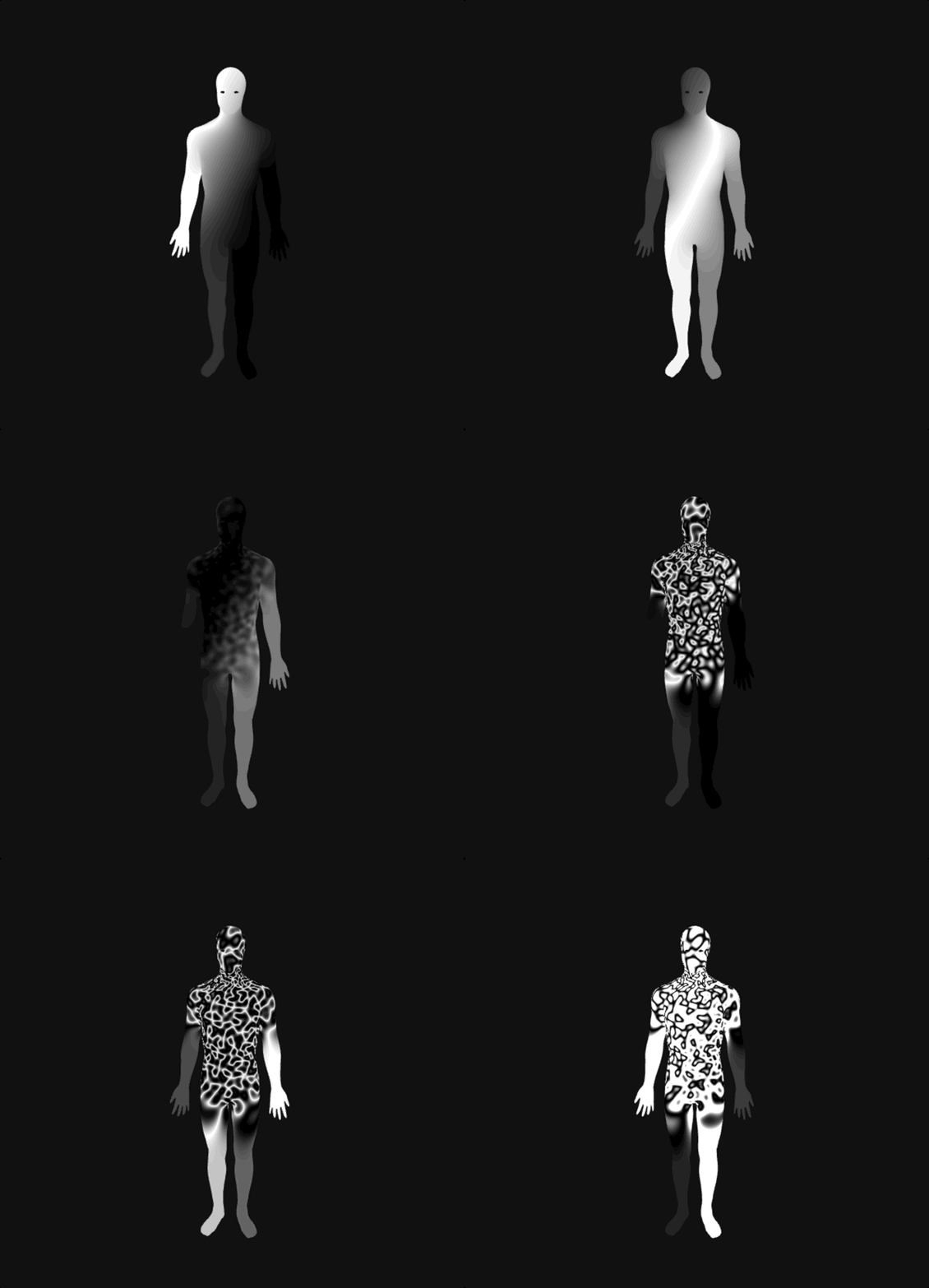
For the animation above, the tag could be as simple as “jhana 1 (0:01-0:04)”. The very first second of the animation depicts waves of sukha right before entering the 1st jhana and then the 1st jhana is depicted from then onwards. An example text to submit along with the animation could be:
Large waves of sukha give rise to a sudden burst of pīti in the torso, head, and shoulders. The spatial patterning depicts body tension having a corrugated texture, as if the body were crumbling and expanding at the same time (cf. thermal expansion). The waves of sukha interact with the corrugated pīti and seemingly get trapped by it.
In this animation, white represents waves of sensation and concentrated attention, while dark regions represent the troughs between them: areas of phenomenal recession where sensation temporarily withdraws and attention has not yet latched. These are not empty so much as held in tension, like the space between crests that gives a wave its shape. Notice how the bright region dominates the upper body and face, while the lower body remains largely dark and unilluminated: this asymmetry reflects the early stages of jhana 1, where pīti has ignited in the chest and head but has not yet propagated downward into a full-body absorption.
This entry was breath-based: attention was first established on the breath at the nostrils, then gently widened to include the pleasant resonance in the chest. The pīti has a slightly electric, fizzy quality: less a wave of warmth than a vibration organizing itself around the chest, still negotiating with the corrugated texture below.
Again, I want to be careful to avoid anchoring and giving the impression that any submission must look like this (in style and content). But the core format of “video + tag + 200 word explanation” is all the contest really needs to let an entry compete.
I look forward to seeing all of your lovely submissions! I can’t wait to build an Atlas of Jhana thanks to the community’s creative contest entries :-)
Infinite bliss! (and jhanic factors!)
Andrés :-)
No posts
Comments
Nothing yet. Say the first thing.
Sign in to join the conversation.