
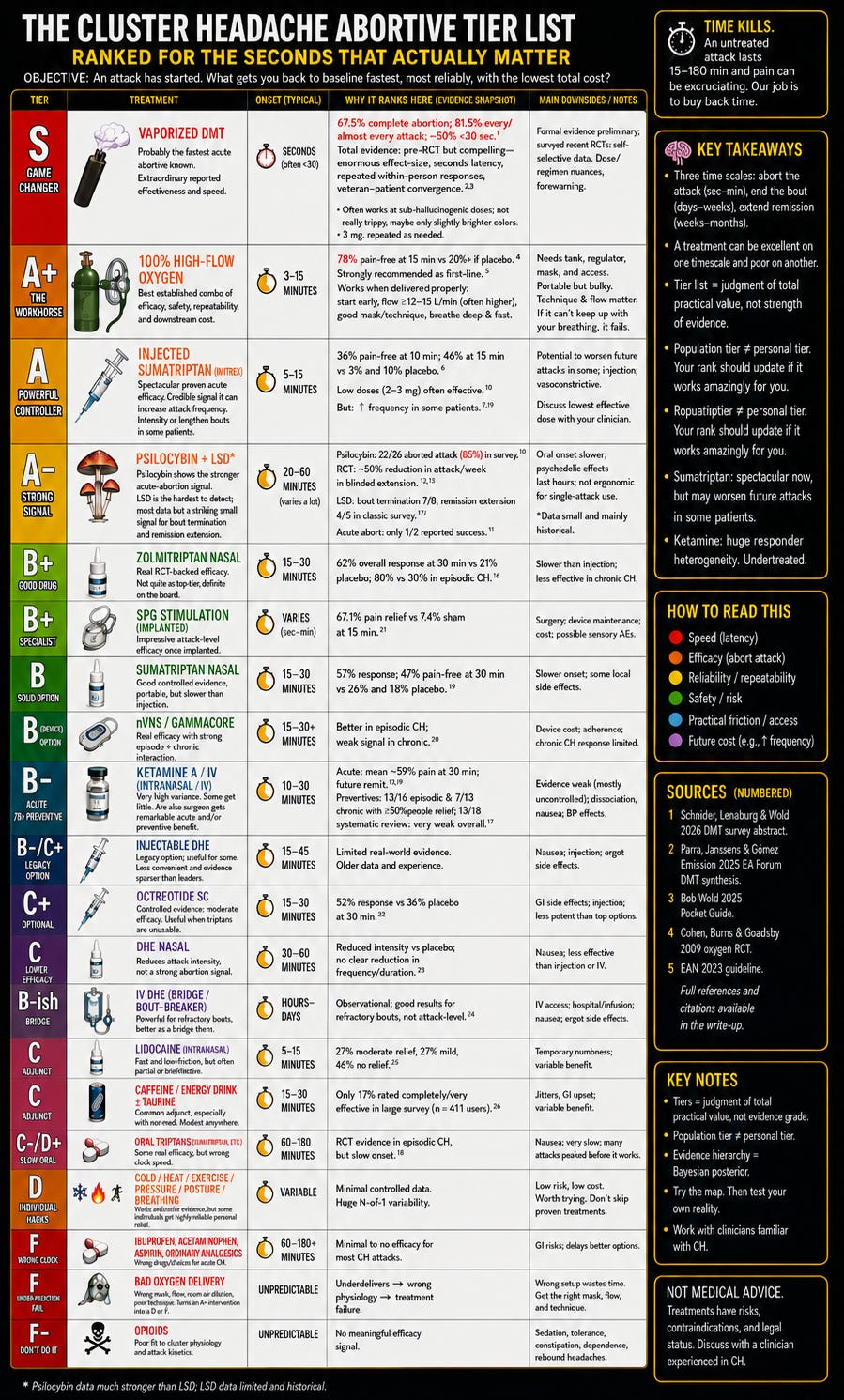
Cluster headache creates an unusual medical optimization problem. Untreated attacks typically last 15 to 180 minutes, can occur several times per day, and reach pain intensities at the extreme end of human experience. For an acute treatment, waiting 30 minutes instead of 3 minutes is therefore not a minor inconvenience. Latency is part of efficacy.
This tier list asks one specific question: an attack has already started. What is most likely to get someone back toward baseline quickly, reliably, repeatedly, and at the lowest total cost?
I am not ranking treatments simply by FDA approval, guideline status, or number of randomized controlled trials. Those are important evidence variables, but they are not identical to our best estimate of what is actually true.
My rough objective function is, schematically, probability of abortion x magnitude of relief x speed x within-person reliability x repeatability, minus acute risk, practical friction, and any evidence of worsening the future attack distribution.
That last term matters. Cluster headache is not one isolated event. A patient may have several more attacks tomorrow. A treatment can be spectacular at terminating the current attack while having complicated effects on what happens afterward.
S: Vaporized DMT
Probably the fastest acute abortive currently known. Formal evidence remains preliminary, but the total evidence is unusually compelling.
A+: 100% high-flow oxygen, properly delivered
The workhorse. Excellent controlled evidence, extremely safe, highly repeatable, and often very fast when equipment and technique are optimized.
A: Injected sumatriptan / Imitrex
Spectacular proven acute efficacy, but there is a credible signal that it can increase attack frequency, intensity, or bout duration in some patients. Probably still net positive.
A−: Psilocybin + LSD*
Psilocybin has a surprisingly strong observational acute-abortion signal, plus controlled evidence suggesting effects on subsequent attack frequency. LSD has almost no direct acute data, but a striking small observational signal for terminating cluster periods and extending remission.
*LSD belongs here mainly because of its bout and remission effects, not because of strong evidence for acute abortion.
B+: Zolmitriptan nasal
Real RCT-backed efficacy. Mostly loses because 20 to 30 minutes is expensive in cluster headache.
B+ / specialist: Implanted SPG stimulation
Impressive attack-level efficacy once implanted. Surgery, device burden, cost, and adverse effects are the giant asterisks.
B: Sumatriptan nasal
Good controlled evidence and portable, but slower than injection.
B for episodic CH / C for chronic CH: nVNS / gammaCore
Real efficacy with an unusually strong episodic-versus-chronic interaction. Much more convincing for episodic cluster headache.
B− acute / B+ experimental preventive: Ketamine
High variance. Many patients get little, but there appears to be a genuine subgroup with remarkable acute or preventive benefit. The preventive signal is particularly interesting, although the evidence remains mostly uncontrolled.
B− / C+: Injectable DHE
A legacy option with plausible utility for some patients, but sparse direct modern evidence and more friction than the leaders.
C+: Octreotide SC
Controlled evidence, moderate efficacy, and particularly useful when triptans are unsuitable.
C: DHE nasal
Controlled evidence suggests reduced attack intensity, but not a strong attack-abortion effect.
B-ish bridge, not really an acute abortive: IV DHE
Potentially powerful for refractory cluster bouts, but better thought of as a bout-breaking or transitional protocol than as treatment for the individual attack happening right now.
C: Intranasal lidocaine
Fast and relatively low-friction, but commonly partial or ineffective.
C: Caffeine ± taurine / energy drink
A common patient-community adjunct, particularly alongside oxygen. Formal evidence is weak and average efficacy appears modest, although some individuals report substantial benefit.
C− / D+: Oral zolmitriptan and other slow oral strategies
Some real efficacy exists, but the pharmacokinetics are badly matched to cluster attacks. The problem is mostly latency.
D: Cold, heat, intense exercise, pressure, posture, and individualized breathing tricks
Weak population evidence, but occasionally excellent personal N-of-1 interventions. A D-tier treatment globally can become much more valuable for someone who repeatedly finds that it works.
F: Ibuprofen, acetaminophen, aspirin, and ordinary oral analgesics
Wrong clock speed and generally poor cluster-specific efficacy.
F: Badly delivered oxygen
An A+ intervention implemented as an F-tier delivery system. Wrong mask, substantial room-air dilution, insufficient flow for the chosen breathing strategy, delayed initiation, or poor technique can make oxygen appear ineffective.
F−: Opioids
Poor fit to cluster physiology and attack kinetics, with substantial additional downside including sedation, tolerance, dependence, and medication-overuse problems.
The tier labels are judgments about total practical value, not evidence grades. B+ experimental preventive ketamine does not mean that ketamine has stronger formal evidence than nasal zolmitriptan. It means that after appropriately discounting the weak evidence, I think the potential effect is large enough to take seriously.
My current best educated guess is that vaporized DMT is probably the fastest acute cluster-headache abortive currently known.
The newest quantitative evidence is a 2026 international survey by Emmanuelle Schindler at Yale, Kevin Lenaburg, and Robert Wold, published as an abstract in the Neurology AAN meeting supplement. Among 85 respondents who had used DMT specifically to abort cluster attacks, 67.5% reported complete pain elimination, 45.7% said it worked every time, another 35.8% almost every time, and more than half reported onset in under 30 seconds. That gives 81.5% every-or-almost-every-attack reliability among the surveyed abortive users.
The abstract is here: Schindler, Lenaburg & Wold 2026.
Those numbers should not be interpreted as a clean population efficacy estimate. This is an interim descriptive survey, not a randomized acute trial. Respondents were self-selected, had already chosen to try DMT, and often learned about it through cluster-headache or psychedelic communities. Selection could substantially inflate the apparent responder fraction.
But there is an easier proposition to evaluate: does there appear to be a real subgroup of cluster-headache patients in whom inhaled DMT repeatedly terminates severe established attacks extraordinarily rapidly? Here I think the evidence is already quite strong. The answer is, simply, yes.
The best single synthesis of this argument is Alfredo Parra, Curran Janssens, and Andrés Gómez Emilsson’s 2025 EA Forum post, “Emerging evidence on treating cluster headaches with DMT”.
Importantly, that article predates the 2026 survey results. It assembled the evidence that generated the strong prediction in the first place: extreme reported effect sizes, seconds-scale latency, repeated within-person responses, long-term patient experience, Bob Wold and Clusterbusters’ accumulated observations, DMT’s short pharmacokinetic duration and portability, and a plausible serotonergic/tryptamine prior.
The 2026 survey is therefore not merely where the hypothesis came from. It quantitatively reproduces a very specific phenotype that had already been described.
This matters epistemically. You see, “anecdotal evidence” is not a homogeneous category. “My chronic pain seemed 20% better over the following two weeks” is weak evidence. A veteran cluster patient with hundreds or thousands of highly stereotyped attacks repeatedly experiencing extreme pain, inhaling something, and becoming essentially pain-free within 30 or 60 seconds is a much more diagnostic observation.
Placebo, expectancy, recall distortion, selection bias, regression to the mean, and spontaneous resolution can affect both observations. They have much more difficulty jointly explaining magnitude, latency, and repeatability.
The classic injected-sumatriptan RCT gives a useful empirical anchor. After placebo, only 3% were pain-free at 10 minutes, rising to 10% at 15 minutes. After 6 mg subcutaneous sumatriptan, 36% were pain-free at 10 minutes and 46% at 15 minutes. The Sumatriptan Cluster Headache Study Group, 1991.
This does not prove that any particular 30-second DMT response is causal. It does establish that repeated complete sub-minute attack termination is not simply what the ordinary placebo distribution in cluster headache looks like.
Bob Wold founded Clusterbusters in 2002 and has spent decades immersed in cluster headache. In his current Pocket Guide he says that he personally tried over 70 treatments in his first 20 years with the disease.
His current guide is available here: Bob Wold’s Pocket Guide to Cluster Headaches.
He describes DMT as an intervention where one inhalation can terminate an attack for many patients, often in less than a minute. The practical phenomenology he describes is roughly: inhale, wait around 30 seconds, and if the cluster has not disappeared, reassess.
Bob is not an RCT. But he is also not epistemically equivalent to a random first-time testimonial. His judgment incorporates decades of personal attacks, comparison across a huge treatment set, extensive familiarity with oxygen and sumatriptan, and contact with a very large number of other cluster patients.
The rational move is to discount this evidence for bias and uncontrolled conditions, not to round it down to zero.
The total DMT case is therefore cumulative: the 2026 survey, enormous reported effect size, seconds-scale temporal coupling, repeated within-person response, multiple veteran-patient reports, Bob Wold’s unusually informed comparative judgment, Clusterbusters’ accumulated experience, the earlier evidence synthesis, and a reasonable pharmacological prior all point in the same direction.
Another major practical feature is that patients often report that full psychedelic effects are not necessary.
The reported useful range frequently appears to be sub-hallucinogenic or only minimally psychoactive. Experienced patients describe low-single-digit-milligram vaporized doses as sometimes sufficient, with effects more like slightly brighter colors or a mild alteration in perception rather than a full DMT breakthrough.
Around 3 mg vaporized is a commonly discussed patient-level figure, sometimes repeated if the attack persists. This is important because if the therapeutic effect can be separated substantially from the psychedelic intensity, DMT becomes a very different practical proposition from taking a conventional psychedelic dose during every attack.
That said, this is still community and interview evidence, not a validated dose-response result. The 2026 survey abstract explicitly says that detailed dose and regimen analysis is forthcoming. I would therefore not present 3 mg as an established medical dose.
The current claim is narrower: the strong responder effect often appears at surprisingly low, sometimes barely psychedelic exposure.
This substantially strengthens DMT’s position relative to psilocybin or LSD as an acute intervention. The goal is not an hours-long psychedelic experience. The goal is to perturb the cluster state and return to normal as quickly as possible.
My overall assessment is therefore: formal evidence preliminary, total evidence compelling, exact responder fraction uncertain, optimal dose uncertain, existence of a large and extraordinarily fast responder phenotype highly likely.
The obvious next experiment is a prospective acute crossover trial. If the reported effect survives anything close to intact, an enormous sample should not be necessary to detect it.
If DMT is the anomalous experimental off-switch, oxygen is the civilization-grade workhorse.
The landmark randomized double-blind crossover trial was performed by Cohen, Burns, and Goadsby. Patients treated attacks at onset with 100% oxygen at 12 L/min for 15 minutes or high-flow air placebo. At 15 minutes, 78% of oxygen-treated attacks were pain-free versus 20% of air-treated attacks, with no important treatment-related adverse events.
Cohen, Burns & Goadsby, JAMA 2009.
The 2023 European Academy of Neurology guideline strongly recommends 100% oxygen at a flow of at least 12 L/min for 15 minutes, alongside subcutaneous sumatriptan as a first-line acute treatment.
European Academy of Neurology guideline, 2023.
The important practical point is that “oxygen” is not one binary intervention. The controlled trial establishes efficacy at 12 L/min through appropriate mask delivery. Experienced patient practice adds an engineering layer: use enough flow that the system can satisfy the patient’s inspiratory demand, begin immediately, minimize dilution with room air, and use a breathing strategy that delivers oxygen aggressively.
Bob Wold’s guide recommends starting as soon as the attack begins, breathing deeply and quickly, emptying the lungs fully during exhalation, and setting the regulator high enough that the reservoir does not completely collapse during inhalation. If 15 L/min cannot keep up, many experienced patients use 25 L/min regulators or demand-valve systems.
The distinction is important. The RCT establishes that 12 L/min works. It does not establish 12 L/min as the physiological optimum for every person or breathing strategy. Conversely, it would be wrong to imply that anything under 15 L/min is ineffective.
The useful principle is simple: start early, use near-pure oxygen through an appropriate non-rebreather or demand system, breathe deeply and vigorously (THIS CAN’T BE EMPHASIZED ENOUGH) if that works for you, and make sure oxygen supply is not becoming the bottleneck.
If the reservoir repeatedly empties and you are waiting for it to refill, the system is not keeping up with your breathing.
This gives oxygen an extraordinary position on the Pareto frontier: strong evidence, large effect, very low systemic toxicity, no intoxication, and the ability to use it repeatedly across multiple daily attacks. Its disadvantages are mainly logistical: tanks, regulators, masks, access, portability, and the remaining minutes of severe pain before the attack terminates.
Subcutaneous sumatriptan is one of the clearest examples of an excellent acute drug with a potentially important hidden complication.
The acute efficacy is not in dispute. In the classic randomized double-blind crossover trial, 6 mg subcutaneous sumatriptan produced mild or no pain within 15 minutes in 74% of attacks versus 26% after placebo. Complete pain freedom occurred in 36% versus 3% at 10 minutes and 46% versus 10% at 15 minutes.
The Sumatriptan Cluster Headache Study Group, NEJM 1991.
The more interesting concern is that repeated injected sumatriptan may worsen the future attack distribution in some patients.
Rossi and colleagues described six patients who had never previously used subcutaneous sumatriptan. All six obtained rapid relief, but all six developed increased attack frequency after beginning treatment. Attack frequency returned toward the patients’ previous patterns after sumatriptan was withdrawn or replaced.
Dousset and colleagues examined 47 patients using subcutaneous sumatriptan as their exclusive acute treatment. Twenty reported increased attack frequency, eleven increased intensity, and eleven declining efficacy. Many were high-frequency users, so confounding by disease severity and medication overuse is substantial.
Hering-Hanit separately described four patients with marked increases in attack frequency after beginning subcutaneous sumatriptan, with changes in headache character in three and prolonged cluster periods in two.
These are small observational datasets. The calibrated conclusion is not “sumatriptan has been proven to worsen cluster headache.” It is: there is a credible but low-quality and unresolved clinical signal that subcutaneous sumatriptan increases attack frequency, and possibly intensity or bout duration, in some patients.
Bob Wold’s position is more forceful. His analogy is that Imitrex is like a relative you cannot stand who happens to be the only person willing to watch your dog while you go away. It clearly works, and has probably saved many lives, but he believes the downstream cost can be real.
Lower doses are also interesting. In a prospective open study of 81 patients, 74% of those using 3 mg reported efficacy and 89% of those using 2 mg reported efficacy, while adverse effects were less common at 2 mg than with the standard 6 mg dose.
This was not a randomized dose-response study, so the superficially higher response at 2 mg should not be interpreted as evidence that 2 mg is superior to 3 mg. The reasonable conclusion is simply that many patients appear able to abort attacks with substantially less than the standard 6 mg dose.
I keep injected sumatriptan at A because the attack happening right now has enormous moral weight and this drug is extraordinarily effective at ending it. The more accurate description is: excellent local controller, potentially non-neutral longer-term controller. Probably net positive overall, but less dynamically innocent than oxygen.
Psilocybin belongs on the acute list. My earlier instinct to put it entirely in the preventive category was too conservative.
The classic 2006 Sewell, Halpern, and Pope study interviewed 53 medically documented cluster-headache patients who had used psilocybin or LSD therapeutically. Among patients who had used psilocybin during an acute attack, 22 of 26 reported successful abortion. The same study found that 25 of 48 psilocybin users and 7 of 8 LSD users reported termination of a cluster period, while 18 of 19 psilocybin users and 4 of 5 LSD users reported extension of remission.
Sewell, Halpern & Pope, Neurology 2006.
This is retrospective self-report from a highly selected population. The 85% acute-abortion fraction should not be treated as a population efficacy estimate. Still, 22 of 26 is a striking observational signal.
Psilocybin also has something DMT currently lacks: controlled evidence on the longer-timescale attack distribution.
A small randomized double-blind placebo-controlled study of a patient-informed psilocybin pulse regimen found a moderate reduction in attack frequency, although the primary efficacy endpoint was not statistically significant.
The blinded extension was more encouraging. Ten returning participants received another psilocybin pulse at least six months later. Average attack frequency fell from 18.4 to 9.8 attacks per week, approximately a 50% reduction.
Why A− rather than S or A+ for acute abortion? Mostly pharmacokinetic ergonomics. Even if psilocybin has enormous underlying efficacy, oral psilocybin is a cumbersome solution to a seconds-to-minutes control problem. The onset is slower and the psychoactive state lasts much longer than the acute-control task requires.
LSD belongs beside psilocybin with an asterisk. Direct acute-abortion evidence is almost nonexistent. Only two acute LSD users appeared in the classic series, with one reporting success. Its bout and remission results, 7 of 8 and 4 of 5 respectively, are striking but tiny observational samples.
The sensible summary is psilocybin has the stronger acute signal; LSD’s main case is bout termination and remission extension.
Ketamine deserves much more respect than its average acute performance initially suggested.
The useful model is not “ketamine is mediocre.” It is ketamine has a very broad response distribution. Many patients seem to get little. Some get moderate relief. A fraction report remarkable acute effects, dramatic preventive effects, or both.
The best prospective acute study is an open-label pilot in 23 patients with chronic cluster headache, 20 of whom treated an attack. The prespecified 15-minute endpoint was not met. Mean pain reduction at 15 minutes was only about 15%.
By 30 minutes, mean pain intensity had fallen 59%, and 11 of 16 evaluable patients had pain scores of 4/10 or lower. Four patients had taken rescue medication at 15 minutes and were excluded from the 30-minute analysis, which is important context. Half of participants said they preferred ketamine to oxygen and/or injected sumatriptan.
The preventive literature is even more provocative.
A 2016 observational series reported 29 refractory patients treated with IV ketamine, with prolonged attack suppression reported in all 16 episodic patients and 7 of 13 chronic patients.
A separate refractory chronic-cluster series using ketamine plus magnesium, not ketamine alone, found that 13 of 17 patients achieved at least a 50% reduction in attack frequency, with mean attacks falling from 4.3 to 1.3 per day.
These are uncontrolled studies in a disorder where regression to the mean and spontaneous bout termination can generate spectacular-looking false positives. They need huge discounts. But discounting is not deleting.
A 2024 systematic review found only four previous reports involving 68 patients, all uncontrolled case series, with substantial heterogeneity in protocols and outcomes.
This matches what one hears repeatedly in cluster-headache support communities. Some people report essentially nothing. Others describe ketamine as one of the most effective interventions they have ever found.
That disagreement is compatible with strong responder heterogeneity.
There is also a measurement issue. Conventional headache trials emphasize pain intensity and pain freedom. Ketamine may separately alter pain intensity, aversiveness, attentional capture, emotional response, and behavioral incapacitation. A patient can therefore experience a large reduction in suffering without satisfying a strict “pain-free” endpoint.
For extreme suffering, that distinction matters.
My placement is therefore B− for acute treatment of an unknown patient, B+ experimental for prevention or bout modification, and potentially much higher for a known strong responder.
Population tier is not personal tier.
Intranasal zolmitriptan is legitimate medicine. In the 2006 randomized crossover study, the overall 30-minute response was 62% with 10 mg versus 21% with placebo. The often-quoted 80% versus 30% result refers specifically to the episodic-cluster subgroup.
The main reason nasal zolmitriptan sits below injected sumatriptan is the clock. Thirty minutes is a long time when the untreated state is extreme pain.
Intranasal sumatriptan has a similarly clean controlled signal. At 30 minutes, 57% responded versus 26% with placebo, and 47% were pain-free versus 18% with placebo.
nVNS, usually gammaCore, is interesting because averaging everyone together hides a strong interaction. Pooled analysis of randomized sham-controlled trials found substantially better acute efficacy in episodic cluster headache than in chronic cluster headache.
This is a reminder that “Does this treatment work?” is often underspecified. The better question is “For which phenotype does this treatment work?”
Implanted sphenopalatine ganglion stimulation is difficult to rank on the same scale as a tank of oxygen.
In the Pathway CH-1 randomized sham-controlled study, full stimulation produced pain relief in 67.1% of treated attacks versus 7.4% with sham stimulation at 15 minutes.
That is a very large acute effect.
The catch is that the device has to be surgically implanted. The trial also reported procedure and device-related adverse events, particularly transient sensory disturbances.
There are therefore two different questions: how good is SPG stimulation once someone already has the implant, and how attractive is acquiring an implant as an acute-treatment strategy?
I think of it as roughly A-ish conditional efficacy, B+ specialist practical value.
Dihydroergotamine needs to be separated by route and timescale.
Nasal DHE has controlled evidence, but the old double-blind placebo comparison found a reduction in attack intensity, without convincing reductions in attack frequency or duration.
IV DHE is different. Observational refractory-cluster studies report impressive longer-term outcomes after courses of treatment, but it is better understood as a bout-breaking or transitional strategy than as a convenient treatment for an individual attack.
Subcutaneous octreotide has controlled acute evidence. In a randomized placebo-controlled crossover study, 52% responded at 30 minutes versus 36% after placebo.
Intranasal lidocaine is the archetypal C-tier treatment. The classic study found 27% moderate relief, 27% mild relief, and 46% no relief.
Some patients find it useful, it is fast and local, but it is not a broadly reliable off-switch.
Caffeine and energy drinks are ubiquitous in cluster-headache communities, often used at the first hint of an attack or together with oxygen. They are cheap, fast, and readily available.
The formal evidence is much weaker than their community salience.
In a large international treatment survey, only 17% of 41 caffeine or energy-drink users rated them completely or very effective.
This does not tell us whether rapid caffeine specifically accelerates oxygen in an individual responder. It does tell us not to promote average caffeine efficacy into oxygen territory simply because the method is popular.
I keep caffeine ± taurine at C: plausible cheap adjunct, potentially useful for an individual, weak population evidence.
Cold, heat, exercise, pressure, posture, unusual breathing techniques, and similar interventions occupy weak-evidence territory globally. Cluster headache nevertheless creates a rational incentive to experiment with low-risk options because attacks recur so often. If something is inexpensive, low-risk, and repeatedly cuts one person’s attacks short, that person’s posterior should update.
A D-tier intervention globally can become A-tier personally.
Ordinary oral analgesics mostly fail because they solve the wrong problem at the wrong temporal resolution. Cluster attacks ramp rapidly, and ibuprofen, acetaminophen, aspirin, and similar generic analgesics are poorly matched to the mechanism and kinetics.
I would not put all oral triptans into F. Oral zolmitriptan has randomized evidence in episodic cluster headache. Its problem is mostly latency, not complete pharmacological inactivity.
Bad oxygen delivery deserves its own F tier, but this does not mean that 12 L/min is bad. The controlled oxygen trial directly disproves that. Bad delivery means the wrong mask, substantial room-air dilution, flow that cannot support the patient’s chosen breathing strategy, delayed initiation, or some combination of these.
An A+ intervention can appear useless when implemented through an F-tier delivery system.
Opioids belong at the bottom. Extreme pain creates a tempting but mistaken inference that the solution should be a very strong generic analgesic. Cluster headache instead responds unusually well to specific state-transition interventions.
Opioids add sedation, tolerance, dependence, and medication-overuse concerns without competing well on cluster-specific speed and reliability.
One reason cluster-headache discussions become confused is that “treatment” refers to interventions operating on radically different timescales.
The first problem is aborting the attack already happening, over seconds to tens of minutes. DMT, oxygen, injected sumatriptan, nasal triptans, ketamine, nVNS, SPG stimulation, octreotide, and lidocaine compete here.
The second is suppressing or terminating the current bout, over days to weeks. Psilocybin, LSD, ketamine, IV DHE, steroids, nerve blocks, and transitional treatments become more interesting.
The third is preventing future attacks or extending remission, over weeks to months. Standard preventives belong here, but so do some of the psychedelic and ketamine signals.
Treatments can have completely different rankings on these three axes.
Oxygen is elite at terminating the immediate attack and largely irrelevant to the longer-term landscape.
Psilocybin is comparatively awkward for an individual attack but appears capable of changing subsequent attack frequency.
Sumatriptan is spectacular locally, with a credible possibility of making the later attack distribution worse in some patients.
Ketamine appears mediocre on average as an acute intervention but unusually interesting in a strong-responder subset and on longer timescales.
This is why a scalar tier list is useful but inevitably lossy.
The deeper epistemic point is not that RCTs are overrated. RCTs are fantastic. They estimate population effects, reduce confounding, and protect us from exactly the selection biases that make patient communities dangerous sources of prevalence estimates.
But “has an RCT” and “is probably true” are different variables.
DMT is the clearest example. We are highly uncertain about its unselected population response rate. We can simultaneously be much more confident that the huge rapid-response phenomenon itself is real.
Magnitude, latency, within-person repetition, cross-patient convergence, veteran-patient comparative judgment, a pre-existing prediction, and pharmacological priors all contain information.
The 2025 EA Forum synthesis is important precisely because it lays out that total-evidence case before the 2026 survey supplied quantitative confirmation of the reported phenotype.
Ketamine illustrates a complementary failure mode. A treatment can have an unimpressive average while hiding a very large right tail of responders.
Sumatriptan illustrates a third. A trial optimized to ask whether an attack improved at 15 minutes can correctly conclude that the drug is excellent while being almost blind to an adverse effect operating across the next several days.
The evidence hierarchy is indispensable, but it does not replace inference.
S: Vaporized DMT. Probably the fastest off-switch currently known. The newest formal evidence is still an interim survey abstract, but it quantitatively matches the extraordinary phenotype described in earlier patient reports and synthesized by Parra, Janssens, and Gómez Emilsson in 2025. Reports that the effect often occurs at sub-hallucinogenic doses make the intervention even more practically interesting. The exact responder fraction and optimal dose remain unknown.
A+: Properly administered 100% high-flow oxygen. The best established combination of efficacy, safety, repeatability, and low downstream cost. Equipment and breathing technique are part of the intervention.
A: Injected sumatriptan. One of the best proven pharmaceutical abortives ever developed. Probably strongly net positive, but there is enough clinical and patient-community evidence of increased attack frequency and possibly intensity or bout duration that the concern should be taken seriously.
A−: Psilocybin + LSD*. Psilocybin has surprisingly impressive observational acute evidence, with controlled evidence now providing a real, although still small, signal for attack-frequency suppression. LSD belongs nearby mainly because its bout and remission observations are striking.
Ketamine deserves special treatment rather than one clean rank. B− for acute treatment of an unknown patient, B+ experimental for prevention or bout modification, potentially A-tier or higher once someone has demonstrated a large reproducible personal response.
The map is not the territory. The evidence hierarchy is not the Bayesian posterior. Population averages are not personal response functions. And in cluster headache, seconds have enormous moral weight.
ClusterFree.org is the primary resource I would point people toward for current research, treatment access, advocacy, and the ClusterInfo treatment guides.
ClusterBusters.org contains more than two decades of patient knowledge, advocacy, citizen science, and practical treatment experience. Bob Wold’s Pocket Guide is particularly useful as an expert-patient source.
OPIS, the Organization for the Prevention of Intense Suffering works on the broader problem of extreme suffering and the ethical failure to adequately prioritize states at the far end of the pain distribution.
Qualia Research Institute is relevant to the consciousness, valence, pain phenomenology, and extreme-suffering side of the problem, but does substantially less direct cluster-headache work than ClusterFree or Clusterbusters.
1. Schindler EA, Lenaburg K, Wold R. DMT use in Cluster Headache: Interim Analysis of an International Survey (S23.003). Neurology. 2026;106(11 Suppl 1):2531.
https://doi.org/10.1212/WNL.0000000000215894
2. Parra A, Janssens C, Gómez Emilsson A. Emerging evidence on treating cluster headaches with DMT. EA Forum. 2025.
https://forum.effectivealtruism.org/posts/x8P8EGnujSZm6fyMH/emerging-evidence-on-treating-cluster-headaches-with-dmt
3. Wold R. Bob’s Pocket Guide to Cluster Headaches: Opinions, Facts & Observations in the Treatment of Cluster Headaches. Clusterbusters, 2025.
https://clusterbusters.org/wp-content/uploads/2025/06/Complete-Handbook-1-5-June-2025.pdf
4. Cohen AS, Burns B, Goadsby PJ. High-Flow Oxygen for Treatment of Cluster Headache: A Randomized Trial. JAMA. 2009;302(22):2451-2457.
https://doi.org/10.1001/jama.2009.1855
5. May A, Evers S, Goadsby PJ, et al. European Academy of Neurology guidelines on the treatment of cluster headache. Eur J Neurol. 2023;30(10):2955-2979.
https://doi.org/10.1111/ene.15956
6. The Sumatriptan Cluster Headache Study Group. Treatment of Acute Cluster Headache with Sumatriptan. N Engl J Med. 1991;325(5):322-326.
https://doi.org/10.1056/NEJM199108013250505
7. Rossi P, Di Lorenzo G, Formisano R, Buzzi MG. Subcutaneous Sumatriptan Induces Changes in Frequency Pattern in Cluster Headache Patients. Headache. 2004;44(7):713-718.
https://doi.org/10.1111/j.1526-4610.2004.04132.x
8. Dousset V, Chrysostome V, Ruiz B, et al. Does repeated subcutaneous administration of sumatriptan produce an unfavorable evolution in cluster headache? J Headache Pain. 2004;5:110-114.
https://doi.org/10.1007/s10194-004-0078-5
9. Hering-Hanit R. Alteration in Nature of Cluster Headache During Subcutaneous Administration of Sumatriptan. Headache. 2000;40(1):41-44.
https://doi.org/10.1046/j.1526-4610.2000.00007.x
10. Gregor N, Schlesiger C, Akova-Oztürk E, Kraemer C, Husstedt IW, Evers S. Treatment of Cluster Headache Attacks With Less Than 6 mg Subcutaneous Sumatriptan. Headache. 2005;45(8):1069-1072.
https://doi.org/10.1111/j.1526-4610.2005.05189.x
11. Sewell RA, Halpern JH, Pope HG Jr. Response of cluster headache to psilocybin and LSD. Neurology. 2006;66(12):1920-1922.
https://doi.org/10.1212/01.wnl.0000219761.05466.43
12. Schindler EAD, Sewell RA, Gottschalk CH, et al. Exploratory investigation of a patient-informed low-dose psilocybin pulse regimen in the suppression of cluster headache. Headache. 2022;62(10):1383-1394.
https://doi.org/10.1111/head.14420
13. Schindler EAD, Sewell RA, Gottschalk CH, et al. Psilocybin pulse regimen reduces cluster headache attack frequency in the blinded extension phase of a randomized controlled trial. J Neurol Sci. 2024;460:122993.
https://doi.org/10.1016/j.jns.2024.122993
14. Petersen AS, Pedersen AS, Barloese MCJ, et al. Intranasal ketamine for acute cluster headache attacks: Results from a proof-of-concept open-label trial. Headache. 2022;62(1):26-35.
https://doi.org/10.1111/head.14220
15. Granata L, Niebergall H, Langner R, Agosti R, Sakellaris L. Ketamine i.v. for the treatment of cluster headaches: An observational study. Schmerz. 2016;30(3):286-288.
https://doi.org/10.1007/s00482-016-0111-z
16. Moisset X, Giraud P, Meunier E, et al. Ketamine-Magnesium for Refractory Chronic Cluster Headache: A Case Series. Headache. 2020;60(10):2537-2543.
https://doi.org/10.1111/head.14005
17. Neumann J, Bornemann-Cimenti H, Rumpold-Seitlinger G, Lang-Illievich K, Klivinyi C. Ketamine as Treatment for Cluster Headache: A Systematic Review of Literature and a Case Series. Pain Ther. 2024;13(3):651-662.
https://doi.org/10.1007/s40122-024-00606-5
18. Cittadini E, May A, Straube A, Evers S, Bussone G, Goadsby PJ. Effectiveness of Intranasal Zolmitriptan in Acute Cluster Headache. Arch Neurol. 2006;63(11):1537-1542.
https://doi.org/10.1001/archneur.63.11.nct60002
19. van Vliet JA, Bahra A, Martin V, et al. Intranasal sumatriptan in cluster headache: randomized placebo-controlled double-blind study. Neurology. 2003;60(4):630-633.
https://doi.org/10.1212/01.WNL.0000046589.45855.30
20. de Coo IF, Marin JCA, Silberstein SD, et al. Differential efficacy of non-invasive vagus nerve stimulation for the acute treatment of episodic and chronic cluster headache: A meta-analysis. Cephalalgia. 2019;39(8):967-977.
https://doi.org/10.1177/0333102419856607
21. Schoenen J, Jensen RH, Lantéri-Minet M, et al. Stimulation of the sphenopalatine ganglion for cluster headache treatment. Pathway CH-1: a randomized, sham-controlled study. Cephalalgia. 2013;33(10):816-830.
https://doi.org/10.1177/0333102412473667
22. Matharu MS, Levy MJ, Meeran K, Goadsby PJ. Subcutaneous octreotide in cluster headache: randomized placebo-controlled double-blind crossover study. Ann Neurol. 2004;56(4):488-494.
https://doi.org/10.1002/ana.20210
23. Andersson PG, Jespersen LT. Dihydroergotamine nasal spray in the treatment of attacks of cluster headache: a double-blind trial versus placebo. Cephalalgia. 1986;6(1):51-54.
https://doi.org/10.1046/j.1468-2982.1986.0601051.x
24. Magnoux E, Zlotnik G. Outpatient intravenous dihydroergotamine for refractory cluster headache. Headache. 2004;44(3):249-255.
https://doi.org/10.1111/j.1526-4610.2004.04055.x
25. Robbins L. Intranasal lidocaine for cluster headache. Headache. 1995;35(2):83-84.
https://doi.org/10.1111/j.1526-4610.1995.hed3502083.x
26. Pearson SM, Burish MJ, Shapiro RE, Yan Y, Schor LI. Effectiveness of Oxygen and Other Acute Treatments for Cluster Headache: Results From the Cluster Headache Questionnaire, an International Survey. Headache. 2019;59(2):235-249.
https://doi.org/10.1111/head.13473
27. Schindler EAD, Wright DA, Weil MJ, Gottschalk CH, Pittman BP, Sico JJ. Survey Analysis of the Use, Effectiveness, and Patient-Reported Tolerability of Inhaled Oxygen Compared With Injectable Sumatriptan for the Acute Treatment of Cluster Headache. Headache. 2018;58(10):1568-1578.
https://doi.org/10.1111/head.13405
This is an evidence synthesis and harm-reduction discussion, not individualized medical advice. DMT remains legally restricted in many jurisdictions and does not have an approved cluster-headache indication. Oxygen requires appropriate equipment and fire precautions. Triptans, ketamine, psychedelics, DHE, and other medications have contraindications, interactions, and practical risks. Treatment decisions should ideally be discussed with a clinician knowledgeable about cluster headache.
[This writeup, research, and summary aided with GPT5.6 Sol; based on years of research and countless interviews; feedback by Alfredo Parra; see: clusterfree.org, clusterbusters.org for more]
No posts
Comments
Nothing yet. Say the first thing.
Sign in to join the conversation.