
Today’s Newsletter Includes:
Why garlic might be the closest thing cooking has to a universal language
A 5,000-year journey from Central Asia to the rest of the world
How Gilroy, California turned garlic into an identity, a festival and some serious agricultural chutzpah
How I make garlic confit at home
A few weeks ago, in my trio of mussel recipes, I used an ingredient that several of you had questions about. Garlic confit is one of those things that I make all the time, so that I always have it handy. I use it smeared on toast for sandwiches, in scrambled eggs, mashed with a fork for some very simple pasta dishes, salad dressings, salads, anywhere I want sweet garlic flavor. Since so many of you were interested in this ingredient, rather than just print a sub recipe I thought I would make a fun video for you, obviously rather short, and supply you with what I think is equally important, which is the history of the vegetable itself.
Garlic may be the closest thing that cooking has to a universal language. Think about it. If you crush a fresh clove in a pan with some hot oil almost anywhere on earth, pretty soon someone will walk over and expect dinner to be served.
Garlic is also very, very, very old. Garlic’s ancestral home is in Central Asia, the region around modern Kyrgyzstan, Tajikistan, Turkmenistan and Uzbekistan. That’s where the wild relatives of garlic still grow. From there, Allium sativum began one of the great migrations in food history. Egyptian and Indian cultures were writing about garlic over 5,000 years ago. And there is clear evidence of Babylonian use of the ingredient over 4,500 years ago. The Chinese cultivation of garlic began 3,000 years ago.
The Egyptians famously fed garlic to laborers and left it in tombs so that those who passed on would have enough garlic in the great beyond. The Greeks and the Romans used it as both food and medicine. Greek athletes ate quite a bit of it, Roman soldiers carried it on their person and Hippocrates prescribed it! Ancient medical texts from Egypt, Greece, Rome, India and China all mention garlic by name, which is fairly remarkable when you consider that these civilizations were not comparing notes over Snapchat.
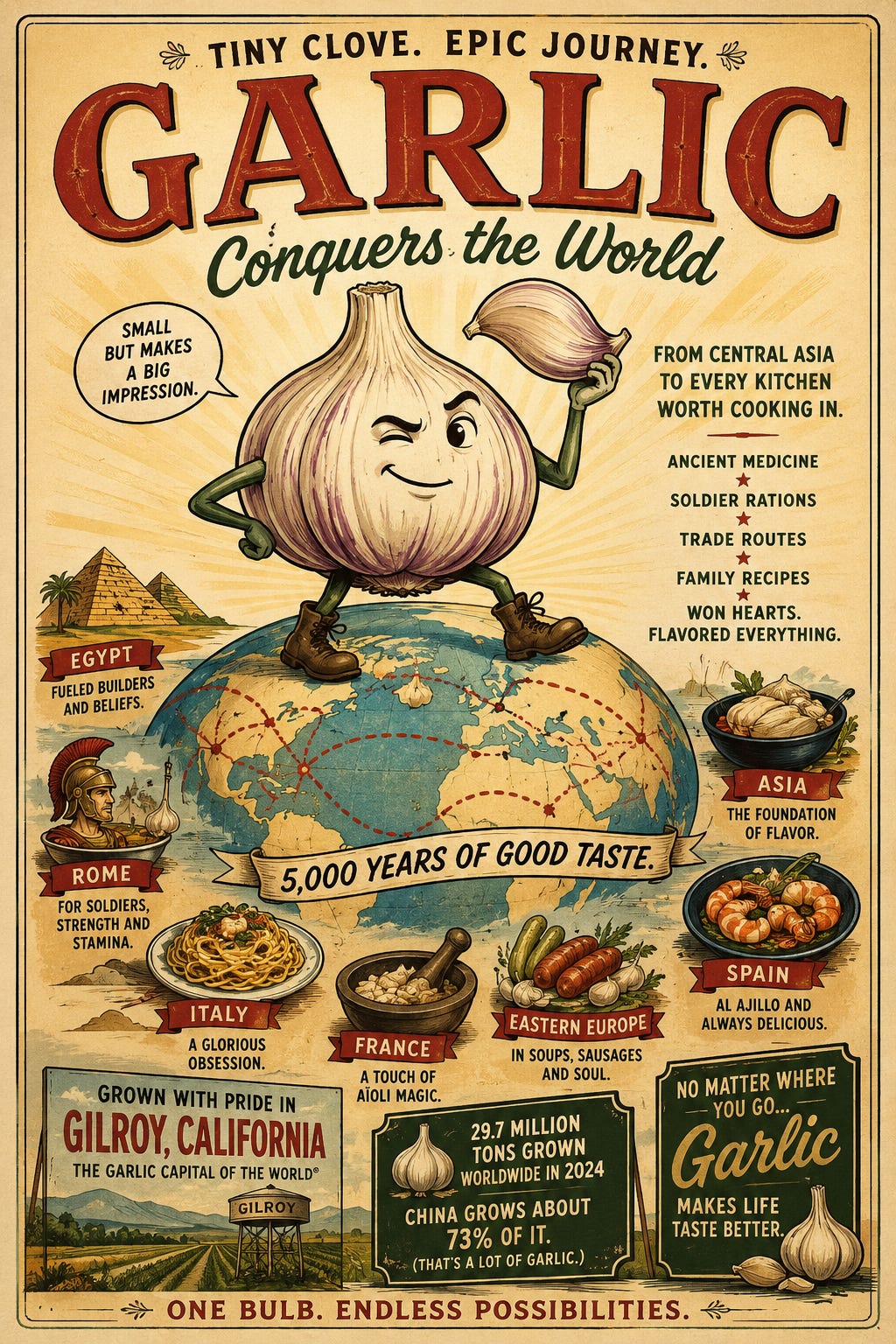
Garlic moved west around the Mediterranean and east through Asia. It was carried along trade routes, military campaigns and human migration. Eventually, it became indispensable without belonging exclusively to anybody. Italy alone has enough garlic mythology to fill a small library. Spain and France certainly use a ton of it in their cooking. Eastern Europe famously puts it into sausages and pickles. Russia has long embraced it raw and preserved. Across China, Korea and Southeast Asia it is less of a seasoning than it is part of the actual architecture of cooking. Eventually, garlic traveled to the Americas with the Europeans and subsequently embedded itself in cuisines from Louisiana down through Mexico, the Caribbean and South America.
So, does everybody eat garlic? Almost, but not quite. Jainism famously excludes garlic and onions, along with all other underground vegetables of any type, partly because harvesting them destroys the entire plant and can disturb or kill tiny organisms in the soil. Certain Buddhist traditions also avoid these pungent alliums. And there are plenty of traditional food cultures, including some African communities, where garlic has historically played no role whatsoever. “Universal” is one of those words that I think all of us should approach very cautiously, and not just when we talk about food!
Today the scale is extraordinary. The world produced about 29.7 million metric tons of garlic in 2024, the last year that hard data is available. 21.6 million tons, about 73% of the planetary supply, was grown in China. Long ago garlic may have wandered out of Central Asia, but Asia never relinquished full custody, that’s for sure.
Which brings me to the subject of Gilroy, California, the self-proclaimed “Garlic Capital of the World.” The title is wonderful American agricultural chutzpah. It is not mathematical fact. Not even close.
Commercial garlic became important around Gilroy during the 20th century, and by the 1960s garlic was among the row crops replacing the orchards that once dominated that area. The first Gilroy Garlic Festival took place in 1979 and attracted more than 15,000 people, turning a crop into civic identity.
Gilroy could never compete with some of the places in China when it comes to tonnage. But it did do something even more American. It created some extra extraordinary branding. And perhaps that is part of garlic’s real genius.
5,000 years after somebody first decided that this ferocious little bulb smelled like something worth eating, we roast it, fry it, pickle it, pound it, ferment it, grate it raw and I confit it in olive oil.
Garlic crossed borders, religions, empires and oceans because it performs the oldest trick in cooking: it makes inexpensive food taste richer, meat taste meatier, vegetables more compelling… And an empty kitchen will smell, almost instantly, like somebody cooking in it really knows what they’re doing.
Like this post? Share it with your friends using the button below.
No posts
Comments
Nothing yet. Say the first thing.
Sign in to join the conversation.