
Everyone knows the Taj Mahal.
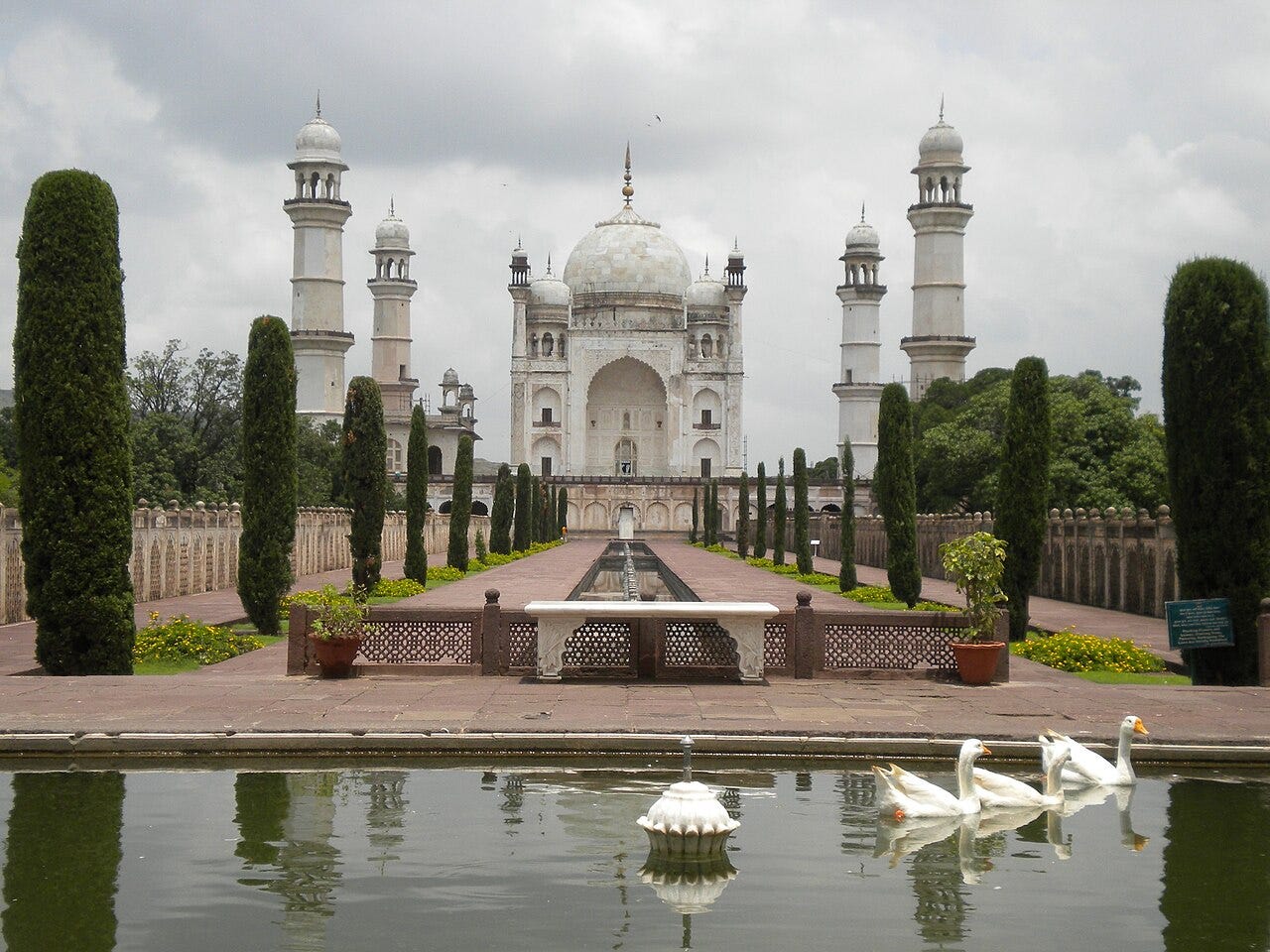
The above photo isn’t it.
That’s Bibi Ka Maqbara. In English: “Tomb of the Lady.” It’s another Mughal monument to loss and love, and practically no one outside India has ever heard of it.
Not so the Taj, of course. Its world famous. The white dome appears on postcards, coffee-table books and Instagram feeds so often it’s less a building, and more a logo. Certainly it’s a backdrop. Trump posed there. So did the Clintons. And a lovelorn Princess Di. Each year millions of lesser mortals make the passage to Agra, joining the entrance queue to view what may be the most celebrated collection of carved stones ever built.
You should go.
The Taj is simultaneously delicate and astoundingly massive, even from the air. It shouldn’t be missed and deserves every superlative ever written about it. But its unknown relative is equally fascinating.
Bibi Ka Maqbara lies 650 miles south of the Taj, in Maharashtra state, in the city of Chhatrapati Sambhajinagar—formerly Aurangabad. At first glance it feels like the Taj’s body double. The same four slender minarets guard a luminous white dome. Also, a long reflecting pool that pulls your eye toward the mausoleum, and its formal Mughal gardens divide the grounds into geometric perfection.
For a moment, you wonder if you’ve somehow wandered back to Agra.
The resemblance is no accident.
The Taj Mahal inspired generations of imitators, from scaled-down replicas to extravagant private mansions. None, however, approaches the ambition of Bibi Ka Maqbara. Built in the 1660s, roughly 20 years after the Taj Mahal was completed in 1648, it wasn’t trying to compete with the Taj. It was continuing a family’s decades-long conversation with grief.
Even architecture can sprout a family tree.
As many people know the Taj Mahal was commissioned by the Mughal emperor Shah Jahan after the death of his beloved wife, Mumtaz Mahal.
Two decades later, Jahan’s son Aurangzeb faced a similar heartbreak.
His wife, known to history as Rabia-ud-Durrani, died shortly after giving birth to their fifth child. Their son, Prince Azam Shah, oversaw construction of her mausoleum. His architect, Ata-ullah, was the son of one of the Taj designers.
Walk through the gateway and the similarities with the Taj are unmistakable.
The gardens follow the classic Mughal charbagh plan, symbolizing the four gardens of paradise. Water channels divide the landscape. Fountains punctuate the approach. A mosque anchors one side of the complex. Every line seems intended to slow your pace before you reach the tomb itself.
But Bibi Ka Maqbara shows off something the Taj never does.
A budget.
Shah Jahan spent lavishly on the Taj Mahal. Aurangzeb famously did not. Whether out of personal austerity or an empire stretched by expensive military campaigns, the budget for his wife’s memorial was tightly controlled. Marble was reserved primarily for the dome and key decorative elements, while much of the rest of the monument relied on finely finished plaster over basalt.
The result earned it the nickname: “the poor man’s Taj.”
I think that misses the point entirely. Calling Bibi Ka Maqbara the "poor man's Taj" is like calling Asa Butterfield the poor man's Tom Holland. The comparison tells you less about talent than it does about celebrity.
I mean, would you call Siena the “poor man’s Florence”?
And I don’t think Bibi Ka Maqbara is in any way diminished because another architectural masterpiece is far more famous. If anything, its quieter scale makes it easier to appreciate. Instead of bulldozing past group tours from Hunan or Dayton, you find yourself noticing the carved latticework, the delicate floral details and the changing light sliding across pale stone.
With fewer folks about, the building has room to breathe.
And so do you.
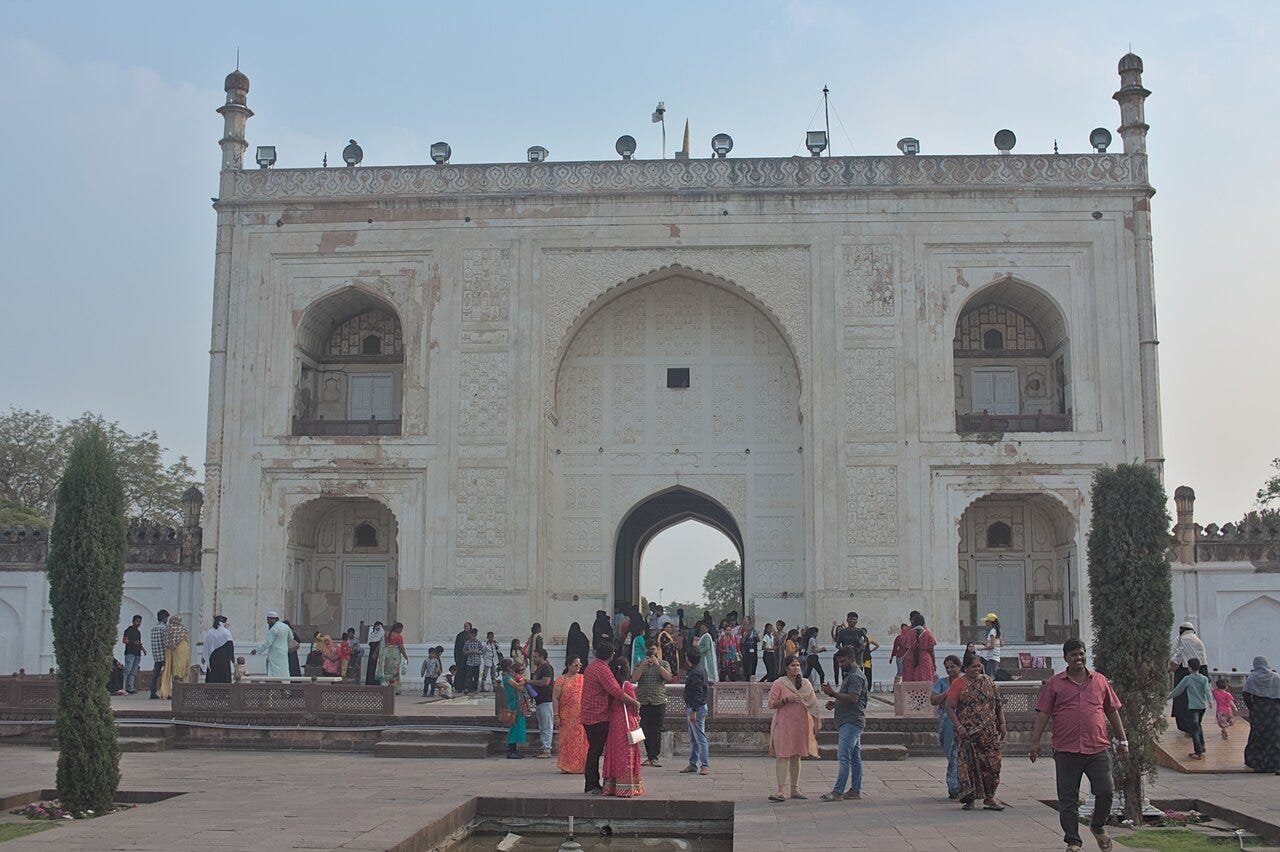
Visit the Taj Mahal and your expectations are lining up before you get there. Bibi Ka Maqbara, on the other hand, asks nothing of you before walking through the entrance gate.
There is no obligation here to pose for the perfect selfie. Look where I am! Instead, the tomb offers you something increasingly rare: enough quietude to ponder the people who built it and the people whose memory they built it for
And that may be the real fame game. We’re compelled to visit what we already know, while other, equally extraordinary places wait patiently in the shadows for us to notice them. Our travels become richer when we finally do.
###
What destination body doubles are your favorites?
Other under appreciated wonders:
Field Notes:
Bibi Ka Maqbara. Fly into Chhatrapati Sambhajinagar Airport (IXU), which has regular nonstop service from major Indian cities including Mumbai, Delhi and Hyderabad. From the airport, the tomb is about a 20-minute taxi ride (roughly 10–15 km), making it an easy first or last stop in the city. Most visitors pair the mausoleum with the nearby UNESCO World Heritage sites of Ellora Caves (about 35 km away) and Ajanta Caves (about 100 km away), making Chhatrapati Sambhajinagar an ideal two- or three-night base.
No posts
Comments
Nothing yet. Say the first thing.
Sign in to join the conversation.