
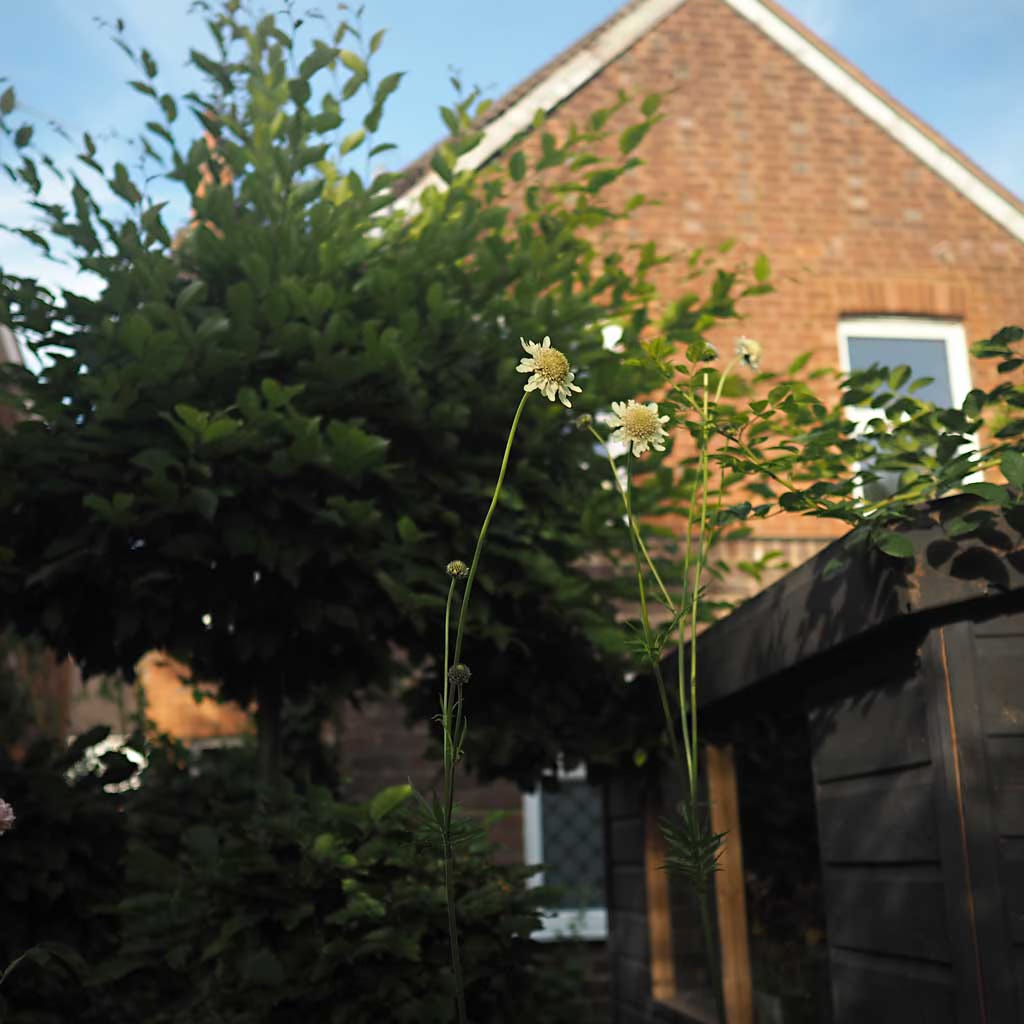
The giant scabious (Cephalaria gigantea) refused to be moved entirely. Which is not the same thing as saying that it entirely refused to be moved – there’s a bit of it right up the other end of the garden from where it was, flowering happily in the bright sun of the June heatwave and interfering most egregiously with my unnecessaries on the washing line.
Where it was, just in front of Shed #1, is still blessed by a portion or two of the same plant. But cephalaria, in spite of being a hefty, fast growing herbaceous perennial, is far better behaved than some I could mention, and whether steadily expanding outwards or persisting in one spot after ostensibly being relocated to another, I can’t really see it causing offence.
I want to spend a few moments with you in simple observance of this plant, since it’s both quite odd, and quite wondrous. My original specimen has deep sentimental value as the only plant I ever had from the garden of my late aunt Joy. I loved Joy to bits; an affectionate, stylish, bonkers, and deeply fabulous presence throughout my childhood – an abstract artist who studied at The Slade in the vibrant, creative melting pot that was London in the early sixties. I don’t think she’d mind me saying that her particular brand of fabulousness – which included long, painted, talon-like nails in gorgeously sophisticated shades – often hindered her from getting much done, and the notion of her actually gardening is frankly laughable. That my cephalaria came from her garden is the thing, and whether it got here by her decree, or because my uncle took it upon himself to gift us with the treasured chunk, is really neither here nor there. Our gardens are spaces we firstly construct and then go about filling with meaning, and the plants we receive as gifts from the ones we love slip effortlessly into their role, pinning the thread of our lives down into the soil while we, or the garden, go about the business of filling the gaps in between. Some artists form a lifelong relationship with the line – Joy painted with regions of light and shade. If she were to capture a Polo mint’s portrait, she’d start with the hole in the middle. I’m no artist, and I couldn’t tell you if that’s how I garden, but she taught me to see the world in that way.
I took a division of my plant to my (now dearly departed) Friday garden – it’s still there, for all I know, dancing around with tall grasses and hemp-leaved hollyhocks in the last cultivated bed before the meadow. Here, we garden on a slightly less exalted scale – less topiary and meadow, more shed and washing line. Domestic. But the cephalaria works just as well, and this is almost certainly due to what also makes it quite such a curious plant. It’s dainty up above – the flowers are clotted cream buttons, really not much bigger than those on the far less lofty field scabious Knautia arvensis, or Devil’s Bit scabious Succia pratensis. But it’s that loftiness that makes the plant so useful, bringing height and airiness to the garden without any accompanying bulk in that all-important zone, from about 40cm to 160cm above the ground, that we spend our time in the garden peering around and through. But there is bulk, and quite a lot of it – from that 40cm point back down to the ground, where the mounds of light green lobed foliage that rapidly appear from nothing as winter turns to spring threaten to produce something far more dramatic, imposing, even muscular. A giant, thick stem with the head of a thistle, perhaps; an onopordum or a cardoon. But none of this transpires – instead, we get creamy white pincushions on wires.
It doesn’t need staking. In high winds, there might be damage, but I’ve yet to have any wherever I’ve planted it. It seems remarkably pest free, and I’ve only ever had to water it in the few weeks after relocating a division (goes without saying that it’s remarkably cooperative about being divided via the simple expedient of chopping through a clump and carting one of the bits off to a new location). It reliably gets on with doing its thing with that precious combination of visual interest and absence of faff so critical to a good garden plant, and manages to do so with more than a hint of a sense of humour in promising one thing, and producing something quite different. Just the kind of character I want around the place.
in case you missed it…
Midsummer gone
·
Jun 21
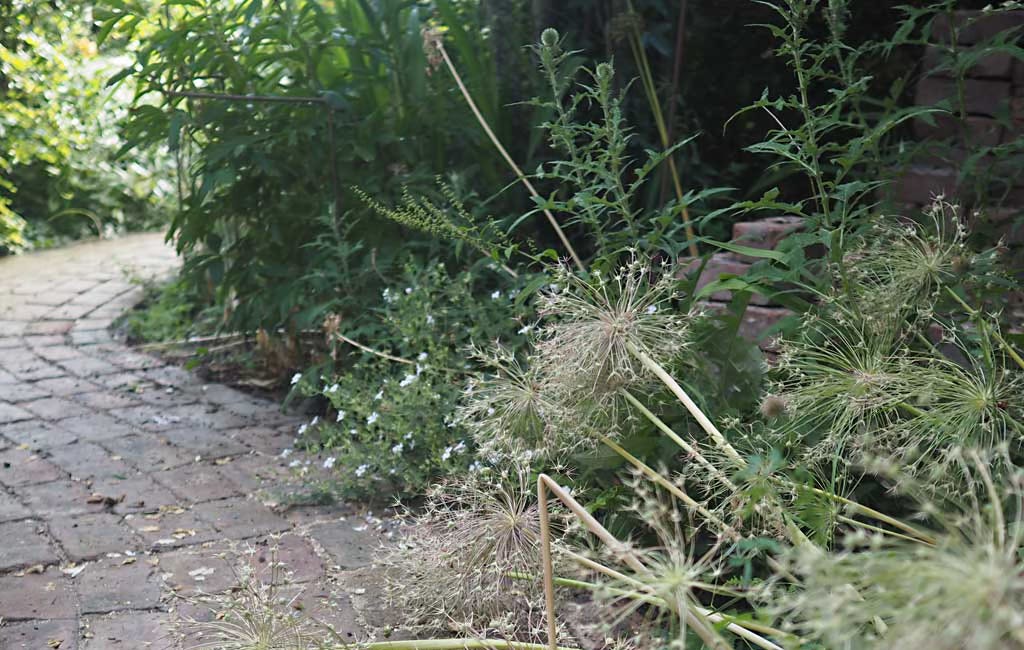
I’ve already moved on from midsummer. With characteristic prescience, I felt its approach, marked its significance, and ploughed straight on through – a little previous, since at the time I started writing this, the solstice was still 24 hours away. I’ve been mildly reproaching myself for not making more of a fuss – though it seems that the whole of social media has that covered, so the sun should be appeased – but I’ve realised it’s just me. It’s what I do with people’s birthdays, which I have an uncanny knack for remembering a week or so before the event, mentally flagging, and then forgetting on the actual day. It’s not that I’m in a particular rush to get anywhere – quite the contrary. I’d rather we just hit the pause button and stay here for a while, milking the moment for every last sensory drop. And while my favourite day of the year is always whatever day it is today, my favourite time in the garden is very much not midsummer which, to my mind, is the week or so right before everything, including the gardener, starts to look more than a bit knackered, and in need of a long, cool drink.
Comments
Nothing yet. Say the first thing.
Sign in to join the conversation.