

Feeling of the day: Dense emergence, cloud cover
Signal 01 · Hospitality
Regenerative hospitality crosses from theory into institutional expectation
The HOTEL Yearbook 2026 frames the central question of the industry as “what hospitality must become” — 25 global experts examining the shift from extractive to regenerative practice. The ITB 2026 recap centred “regenerative by design” as the defining practitioner narrative. EU sustainability standards are tightening with direct compliance implications for European-market operators.
Regenerative is no longer a positioning story. It’s becoming an institutional expectation with regulatory teeth. The question is no longer whether to engage — it’s whether you’re building the operational and narrative infrastructure to demonstrate it credibly.
Signal 02 · Food Systems
Regenerative farming’s commitment problem — and its mirror in hospitality supply chains
Earth Day analysis from the Cotswold Grain Partnership cuts through the optimism: “The sector doesn’t have a supply problem, it has a commitment problem.” Farmers are ready. Practices work. The barrier is fragmented supply chain standards — retailers, manufacturers, and millers moving independently, without aligned frameworks or consistent definitions of “regenerative.”
This is structurally identical to the hospitality sourcing problem. Meanwhile, agtech investment is surging, with Mars and ofi announcing a five-year regenerative cocoa programme across 9,000+ hectares in Ecuador. Scale is beginning. But ground-level coordination remains unsolved.
Signal 03 · Longevity + Wellness
Healthspan enters the built environment — longevity residences as the next hospitality frontier
The Global Wellness Summit’s 2026 trends identify longevity residences as a structural category shift: architecture, circadian lighting, diagnostics, and concierge medicine operating as a continuous longevity system. A backlash against over-optimisation is also forming — therapists flagging that data-driven wellness tips from motivation into fixation.
The implication for hospitality: healthspan is not about adding spa amenities. It’s about embedding health intelligence into the physical and operational fabric of a property. The properties that will lead treat healthspan as an operating logic, not a product layer.
Signal 04 · Tourism + Travel
“Whycation” and the slow travel shift — experience as emotional infrastructure
Hilton’s 2026 Trends Report names “whycations” — travel driven by emotional motivation: rest, reconnection, meaning. 55% of travellers now prioritise authentic experiences over traditional sightseeing. Between 37–41% of new luxury hotel construction in 2024 was in extended-stay formats.
The “more is more” era of travel is in structural decline. What replaces it is depth — longer stays, genuine place-based engagement, restoration over stimulation. For regenerative hospitality operators, this is the most direct market signal available. The guest is arriving already converted to the value proposition.
Signal 05 · Innovation + AI
AI as operational logic vs. AI as hospitality theatre
BCG’s analysis of AI-first hotels frames the opportunity as “leaner, faster, smarter” — 67% of hotels using AI for personalisation with measurable satisfaction gains. The key insight from Hospitality Net’s 2026 outlook: “experience can no longer sit on top of operations as a corrective measure — it increasingly defines how operations are designed in the first place.”
But there’s a tension worth naming: AI-driven hyperpersonalisation accelerates at the same moment that travellers are fleeing overstimulation. The risk is building more sophisticated machinery for delivering the wrong thing. The discipline is to use AI to reduce friction for restoration, not to add more touchpoints.
Signal 06 · Macroeconomics
IMF April 2026: global economy in the shadow of war
The IMF’s World Economic Outlook is titled “Global Economy in the Shadow of War.” Growth projected at 3.1% in 2026, below pre-conflict expectations. Middle East conflict is the primary downward pressure. US tariff volatility continues: the Supreme Court ruled IEEPA doesn’t authorise tariffs — rates dropped overnight, then a new blanket rate pushed them back to 10.7%. Uncertainty itself is the dominant business constraint.
For regenerative investment: the cost of capital remains elevated and the long-horizon commitment that transition requires is harder to justify under macro uncertainty. This explains why the “commitment problem” is so persistent — it’s not only cultural. It’s financial.
Cross-domain tensions
Commitment vs. Conditions — Every domain is telling the same story: practices exist, practitioners are proving them, markets are signalling demand. What’s failing is economic and institutional confidence to commit at scale. Fragmentation — no shared standards, no unified incentives — is the structural culprit, compounded by the macro environment.
Depth vs. Efficiency — AI is optimising for friction reduction and personalisation at exactly the moment guests are seeking depth, slowness, and authentic presence. These aren’t incompatible — but only if AI is pointed at the right target. Most of the industry is using it to improve operational metrics, not protect conditions for restoration.
Nature as Solution and Collateral — The High Seas Treaty entered into force — a genuine win. But Africa’s forests have flipped from carbon sinks to emitters, and the climate/biodiversity trade-off in reforestation strategies is being surfaced by new research. Nature is increasingly positioned as the solution while the systems protecting it are under the same structural pressure as everything else.
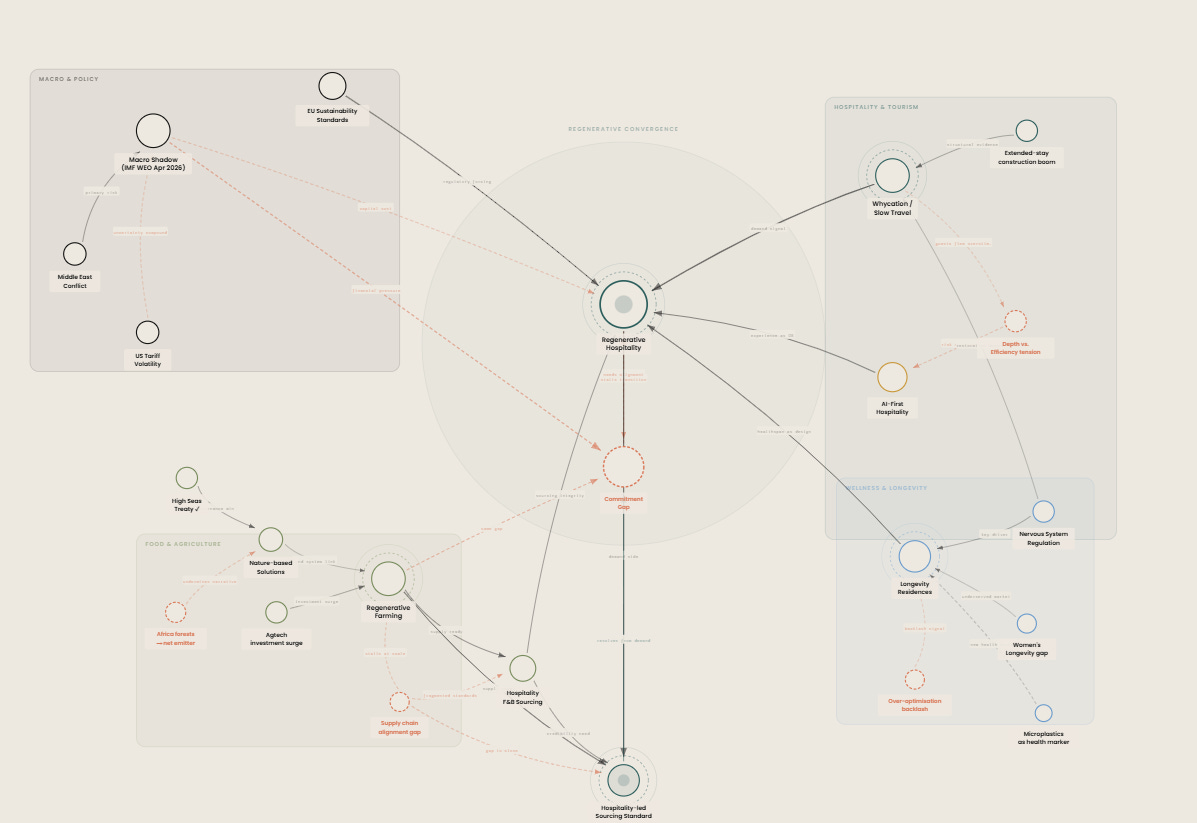
Explore the interactive system map → Six domains · five analytical phases · convergence signals and commitment gaps
Next inquiry
The alignment question in regenerative food supply chains. If regenerative farming’s scaling problem is fundamentally a commitment and standards alignment problem — not a supply problem — then the hospitality industry has an outsized opportunity to resolve it from the demand side. What would a hospitality consortium-led regenerative sourcing standard actually look like? Who is closest to building one?
Enzyme Consulting · Daily Intelligence · andrew@enzyme.consulting
Thanks for reading! Subscribe for free to receive new posts and support my work.
Comments
Nothing yet. Say the first thing.
Sign in to join the conversation.