
Three by-elections on 13th August 2026, and we start with the Parliamentary Special:
House of Commons, Essex; caused by the resignation of Reform UK MP Nigel Farage.
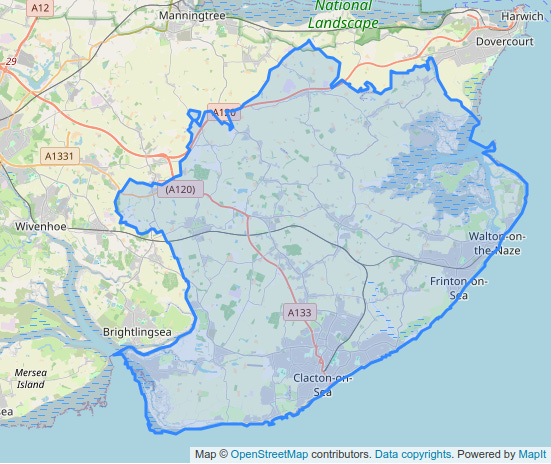
One of the exhibits in the Natural History Museum in London is thought to be England’s oldest-known wooden weapon. It’s a spear made of yew, which was found in 1911 in a dried-up riverbed at Clacton-on-Sea that yielded a number of Stone Age archaeological finds. The spear is thought to be around 400,000 years old.
In those days the landscape around Clacton was very different. The ancient riverbed may well have been that of the Thames, which in those days took a much more northerly course than it does now. About half a million years ago the Thames ran through the locations of modern-day St Albans and Colchester before meeting the Medway at Clacton and then flowing northwards into the North Sea basin. This route was blocked by Ice Age glaciation around 450,000 years ago, resulting in the Thames’ present route through London; but when the Clacton Spear was produced the sea level was much lower, and the Thames turned north from Southend towards Clacton before curving around into the proto-Dover Strait.
Today’s sea levels are much higher, and Clacton is a coastal town on the smooth and eroding Essex coast. That was certainly the attraction for Peter Bruff, who had made his name and fortune as the resident engineer for a number of railway lines in the Colchester and Ipswich areas. In 1855 Bruff had bought a house in Walton-on-the-Naze, and he saw its potential as a seaside resort; he opened a new pier, and in 1867 Walton was connected to the railway network with the opening of the Tendring Hundred Railway from Colchester.
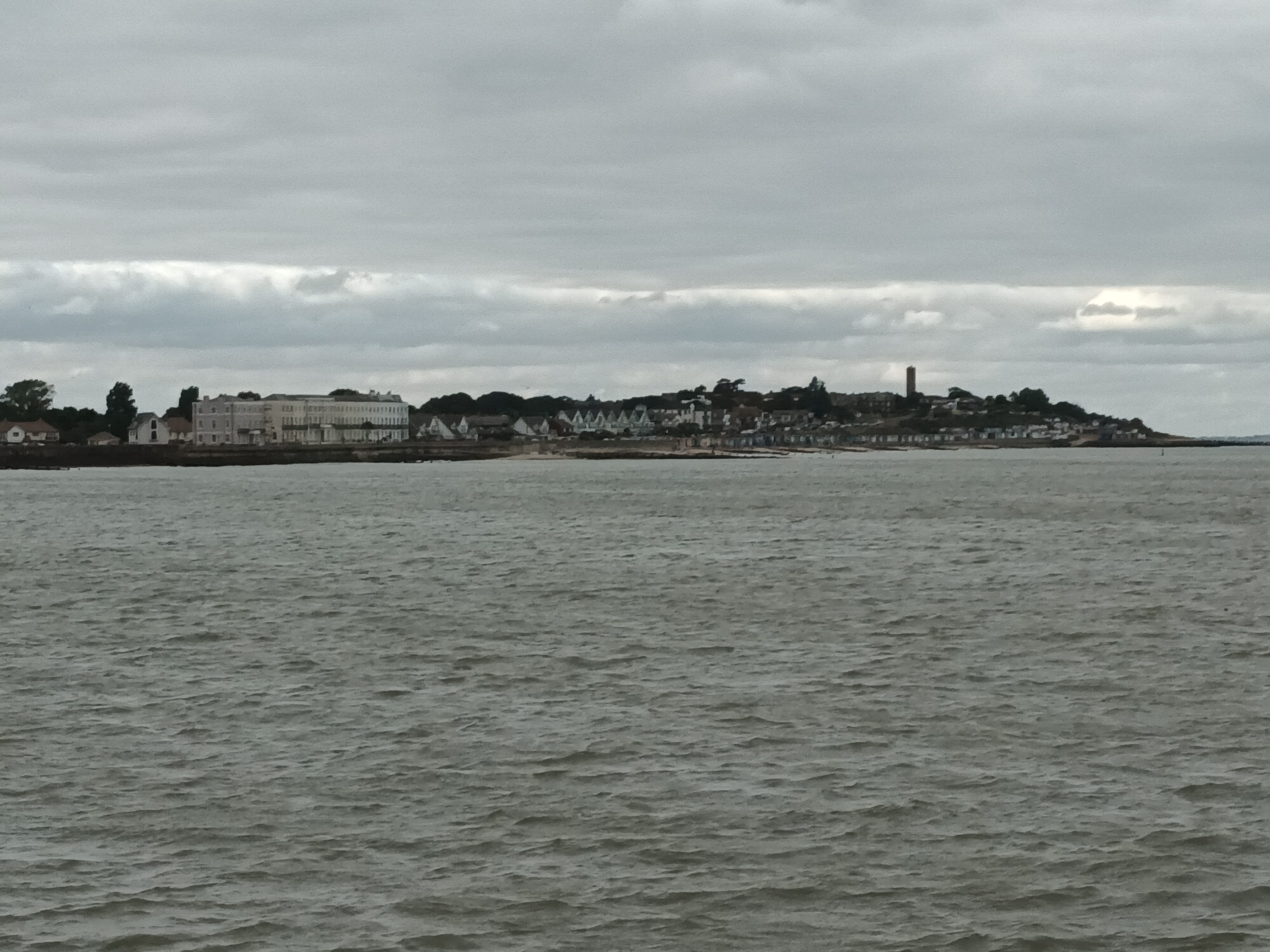
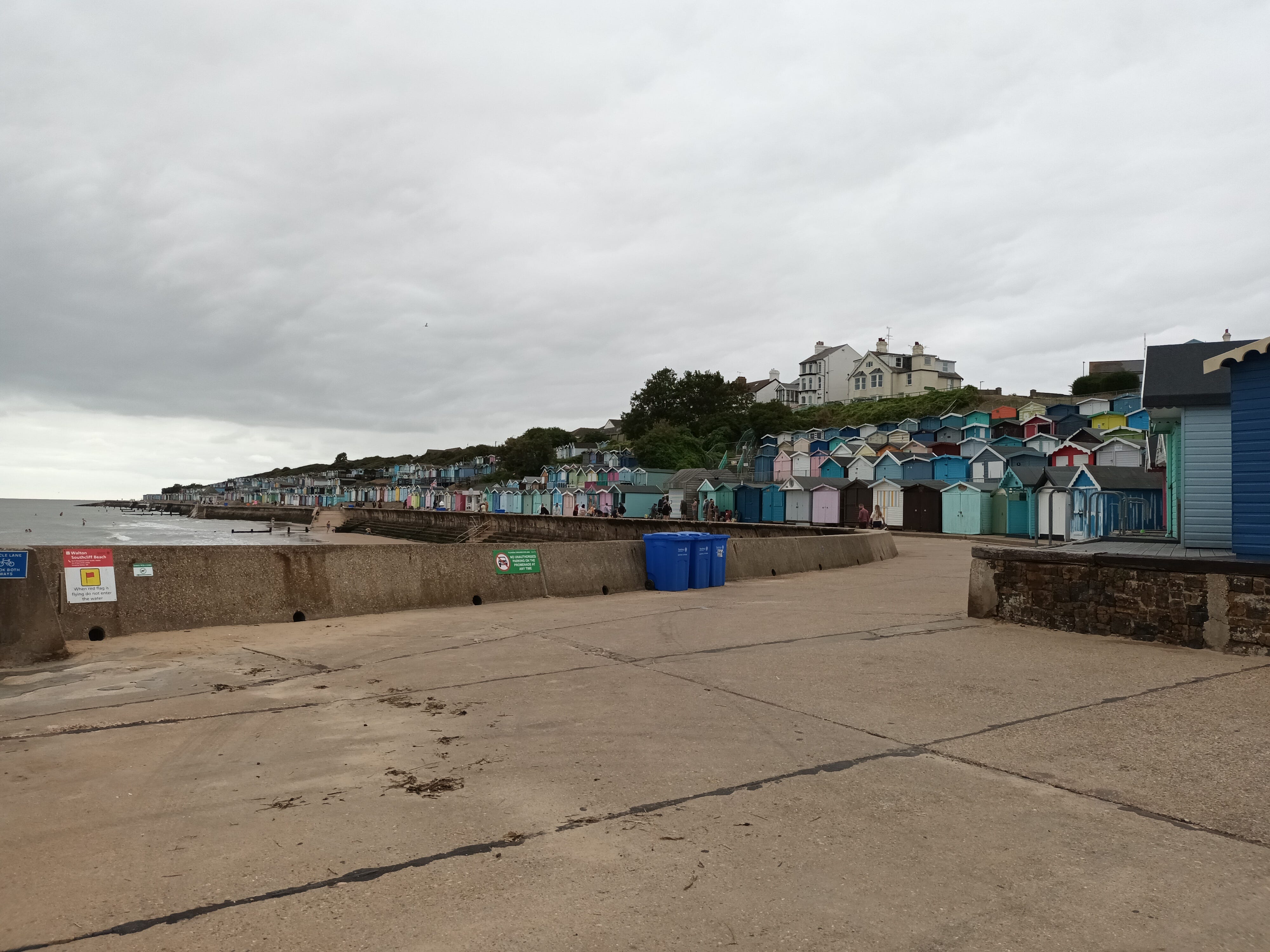
Walton-on-the-Naze takes its name from the Naze, a headland to the north of the town which protects the tidal marshes of Hamford Water from the full force of the sea; these marshes are a favourite location for migrating birds, and for the twitchers who watch them. To the north of the town is the Naze Tower, which was built in 1720 by Trinity House as an aid to navigation; it is now open to the public and forms a fine viewpoint, although possibly not for much longer given the erosion rate of the cliffs it stands on. The town has had a pier since 1830, with the present structure dating from 1895 and dominated by a large arcade area. (Is it me, or are penny fall machines more complicated than they used to be?) The beach at Walton has won several awards and is overlooked by hundreds of beach huts.
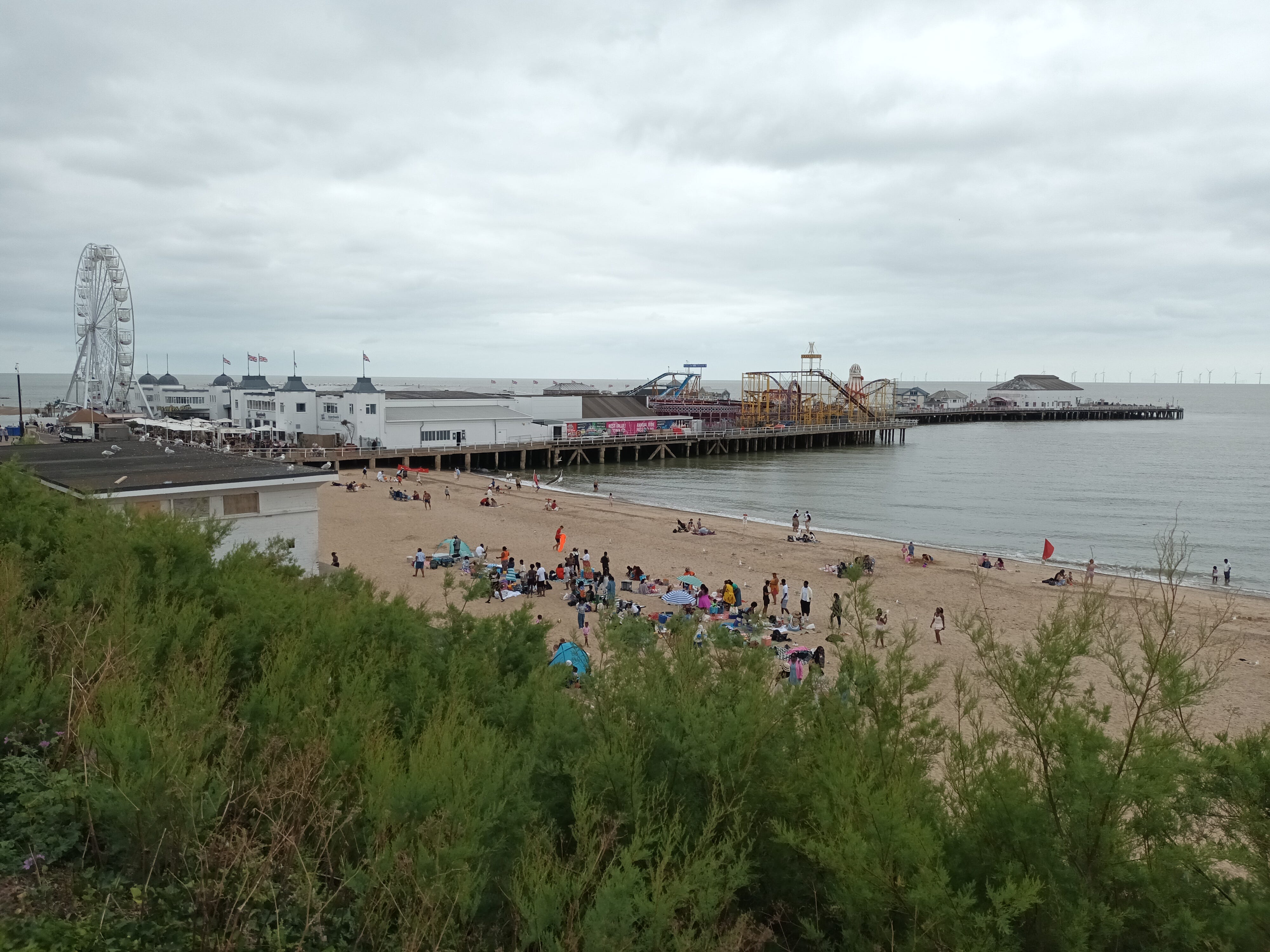
Peter Bruff’s next project was to buy 50 acres of land on the cliff-edge near to the village of Great Clacton for a brand-new seaside resort, on which work began in 1870. The following year Clacton Pier was opened as Clacton-on-Sea’s first public building, and it wasn’t just for pleasure. The Pier was and still is a proper landing stage, bringing into Clacton not only goods and material but also people: the Woolwich Steam Packet Company’s steamship service between London and Ipswich immediately started to call at Clacton, placing the town within easy reach of holidaymakers from the capital. Their Queen of the Orwell was the first vessel to dock here.
In 1882 Clacton was joined to the railway network, via a branch line to Thorpe-le-Soken on the existing Walton route. Clacton station normally has an hourly service to Liverpool Street station in London; there are extra trains at peak times, but the journey time to London of around 90 minutes each way is a bit too long for the town to be viable as a commuter centre. Instead the Clacton and Walton branch lines are marketed for tourists, under the banner of the Sunshine Coast line.
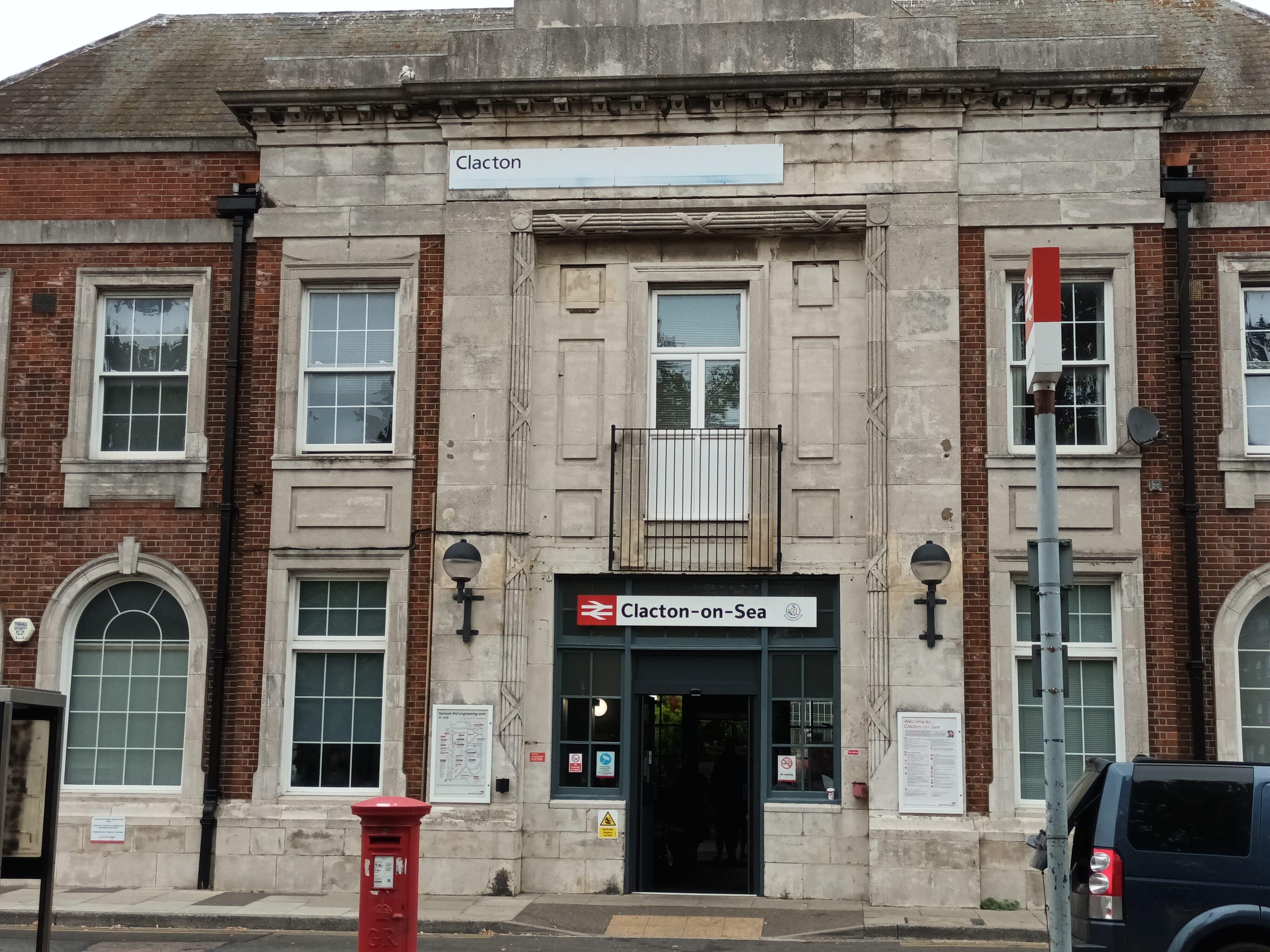
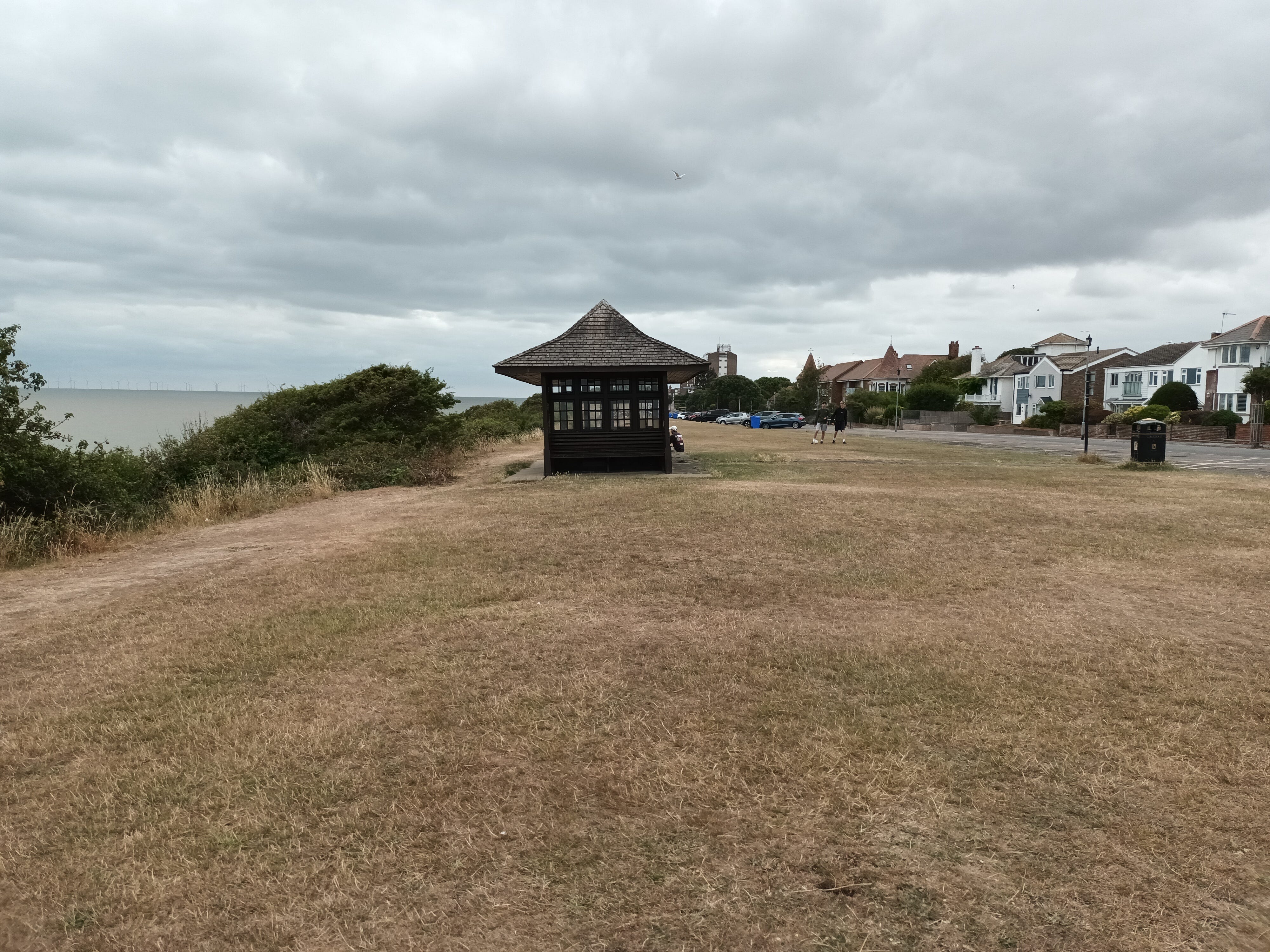
Peter Bruff’s final resort project for this coast was the new town of Frinton-on-Sea, just to the south of Walton. This developed into a much more exclusive area, with expensive and high-quality housing overlooking a wide esplanade of green space next to the clifftop.
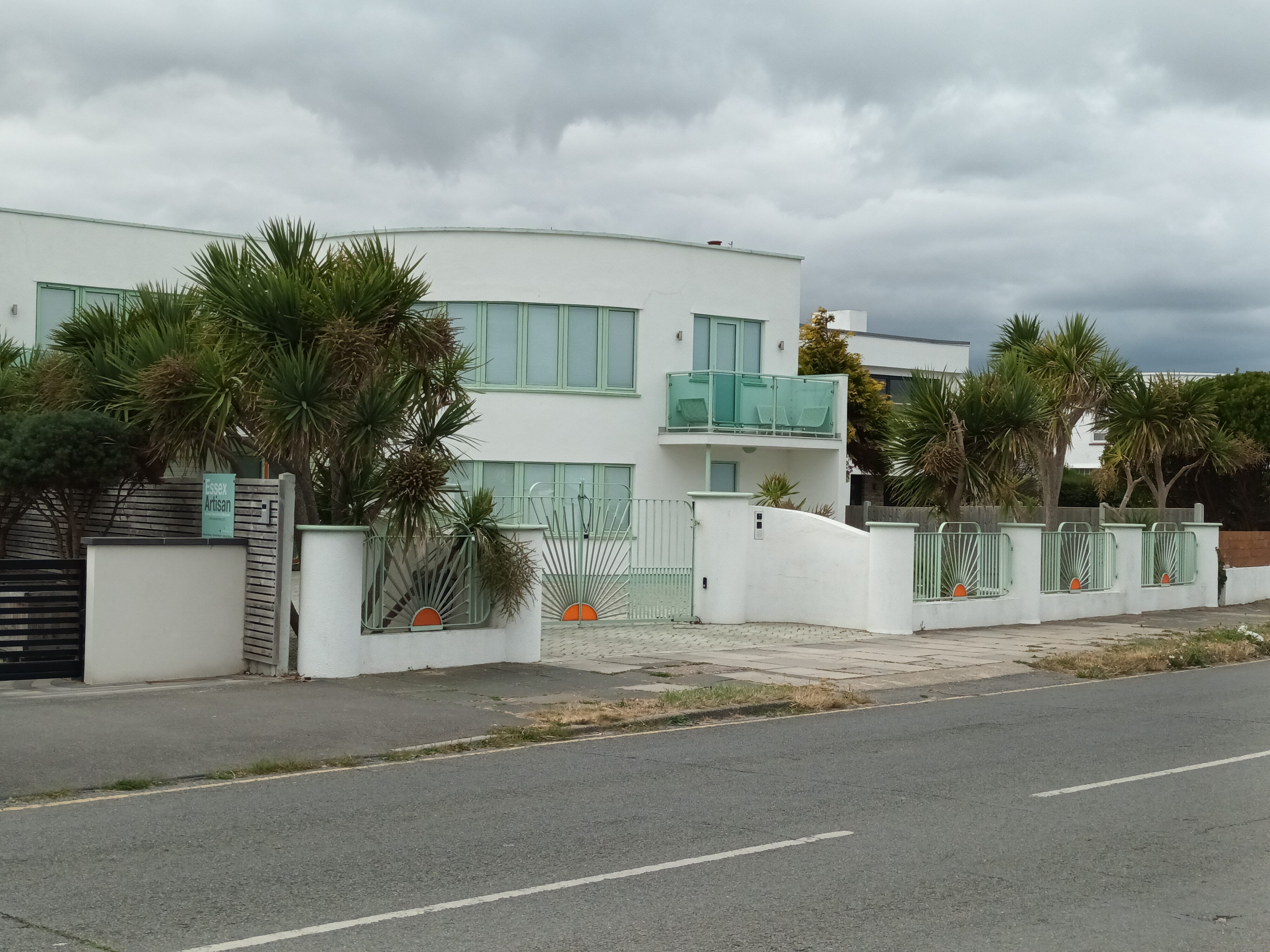
Some of the housing at the northern end of the seafront is so Art Deco you half expect Poirot to answer the door.
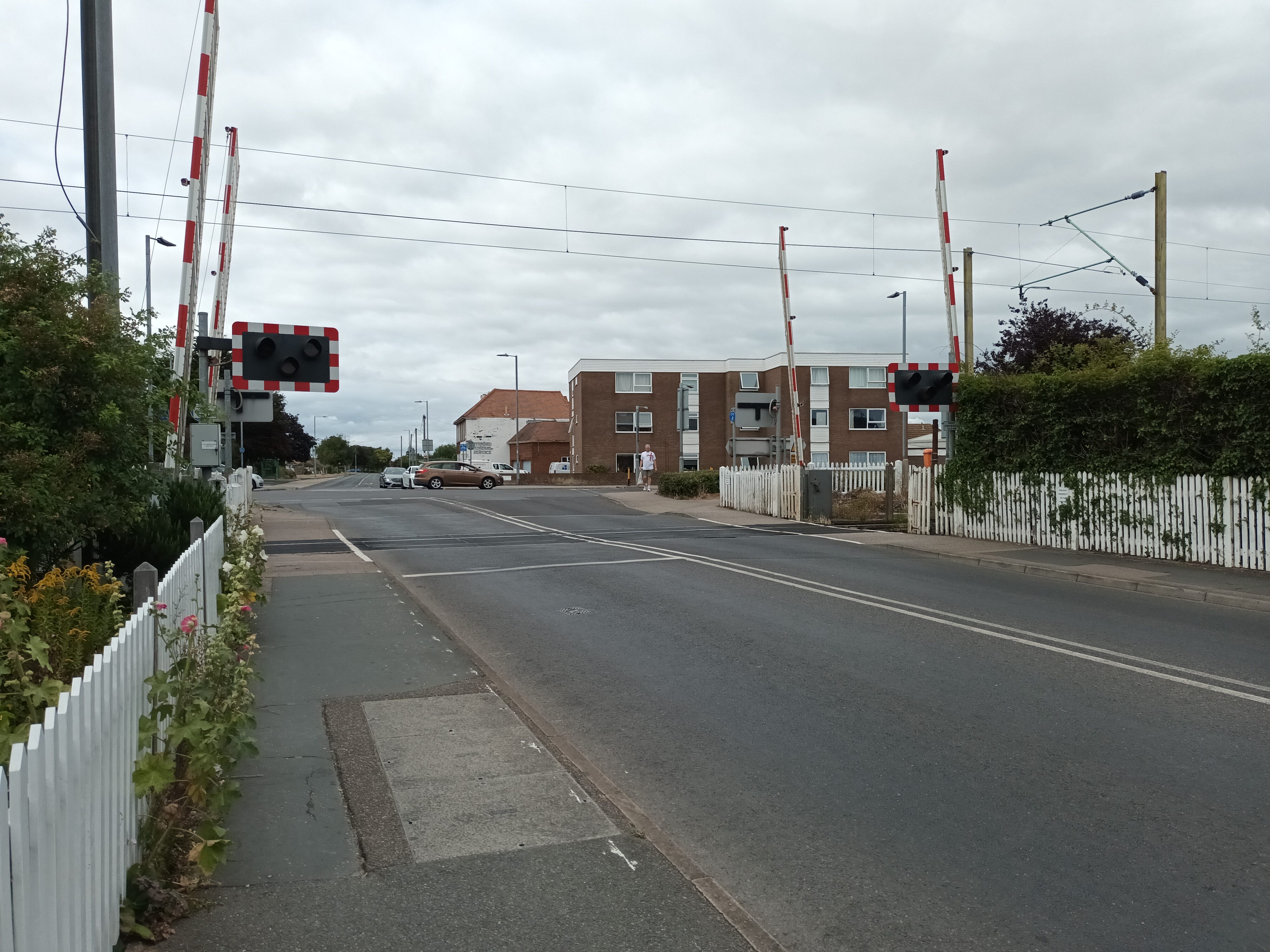
In order to keep the riff-raff out, pubs in the town were banned until the opening of the Lock and Barrel in 2000. This is located on Frinton’s main shopping street Connaught Avenue, which was opened in 1904 by and named after Princess Louise, Duchess of Connaught, and no doubt many Frintonians wish it hadn’t changed since. Connaught Avenue runs up to Frinton railway station and its level crossing gates, which were modernised in 2009 in the teeth of opposition from locals: the crossing is now remotely controlled from Colchester.
Those who look out to sea from Clacton and Frinton will note the wind turbines on the horizon: this is Gunfleet Sands 1 and 2, a pair of windfarms which were developed by DONG Energy (now Ørsted) and came online in 2010. They contain a total of 48 turbines supplying a nameplate capacity of 172 megawatts of power for the National Grid. The windfarms stand on Gunfleet Sands, an area of shallow water off Clacton which has long been a hazard to shipping. They have recently been the subject of a legal case concerning the tax treatment of surveys and studies which Ørsted carried out during the windfarms’ development: in April the UK Supreme Court, on an appeal from HMRC, ruled that the costs of those surveys do not qualify for capital allowances under UK tax law.
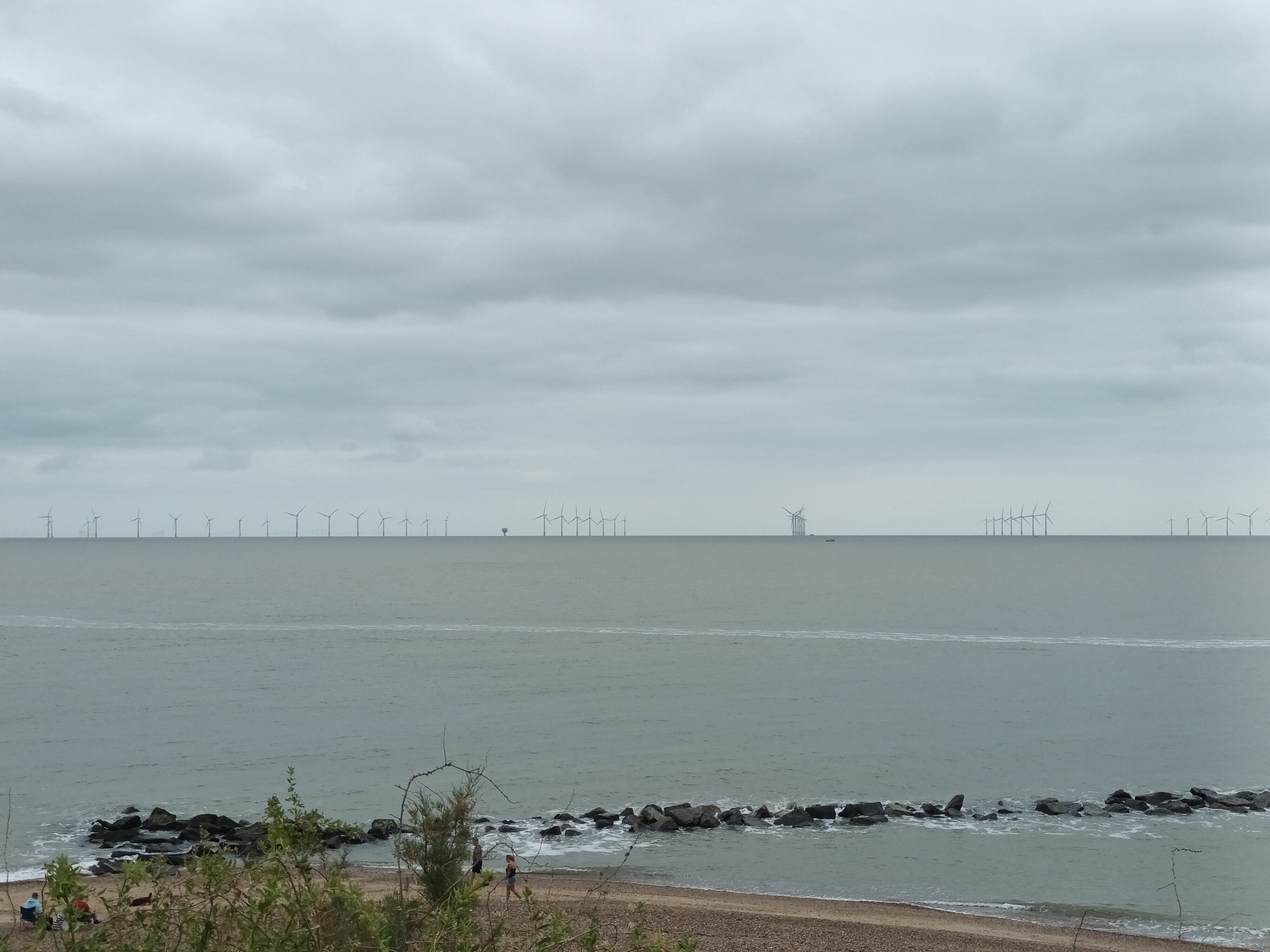
Before the windfarms were erected, some more dubious stuff was going on in the sea off Clacton. Not too far from the Naze can be found HM Fort Roughs, which had been built in 1943 as a Royal Navy fort in what were then international waters. Since 1967 this fort has been occupied and managed by the Bates family, who declared it to be an independent state as the so-called Principality of Sealand. It’s fair to say that nobody has yet established diplomatic relations with Sealand. The micronation’s founder Paddy Roy Bates had previously been involved in pirate radio, and the waters off Frinton were a popular location for the pirate ships until they were outlawed in 1967: indeed in 1966 the Mi Amigo, host ship of Radio Caroline South, actually ran aground on the beach at Frinton after losing its anchor in a storm.
The demographic of those who are old enough to remember Radio Caroline maps more or less perfectly onto this corner of Essex. When we look at the 2021 census return, the Clacton wards stick out in a number of the England and Wales Top 100 Wards lists which this column notes. One common factor here is residents who identify only as English, a variable which is strongly correlated with support for Reform UK: 13 of the constituency’s 22 wards are in the top 50 in England and Wales for that statistic, with the highest figure being 34.5% in St Bartholomew’s ward which covers Holland-on-Sea. Little Clacton ward is in the top 100 nationally for owner-occupation, at 88.2% of households.
Frinton ward has the Eastern region’s third-highest rate for Christianity, at 63.0%. West Clacton and Jaywick Sands ward has England and Wales’ second-highest proportion of residents with no qualifications, at 42.6%; Burrsville ward in northern Clacton also makes the top 100. (Number 1 for that statistic is Ingoldmells ward in Lincolnshire.) West Clacton and Jaywick Sands ward is number 1 in the Eastern region, and in the top 40 across England and Wales, for residents who are long-term sick or disabled (11.8%); Clacton’s town-centre Pier ward also makes the top 100. Four of the wards in this constituency are in the top 15 for retired population, with Homelands ward in western Walton-on-the-Naze top of the list at 52.4%. All this is strongly correlated with age: Homelands is also top of the local list for residents in the 65-84 age bracket at 40.5% of the population, with two other wards in the top 10 (St Bartholomew’s and Frinton) and two further wards in the top 100. Five wards within the Clacton constituency are also in the top 100 for residents aged 85 or over, with Homelands (again) having the highest score of 7.5%. Like all the best jokes, “Harwich for the Continent - Frinton for the incontinent” has a grain of truth in it.
For those people living in Clacton who are young enough to work, five of the wards in this constituency are in the top 100 for residents working in “caring, leisure and other service occupations”, with Coppins ward in western Clacton having the highest score of 19.5%. Coppins is also ranked 5th across England and Wales for residents in semi-routine occupations at 20.7%, with three other Clacton town wards in the top 100.
Frinton-on-Sea became a town in 1907, and in 1934 it merged with Walton-on-the-Naze to form a single urban district which also took in the neighbouring villages of Kirby-le-Soken and Great Holland. This reduced the area of the Tendring Rural District, which was the local authority for the villages and the rural parts of the Tendring peninsula.
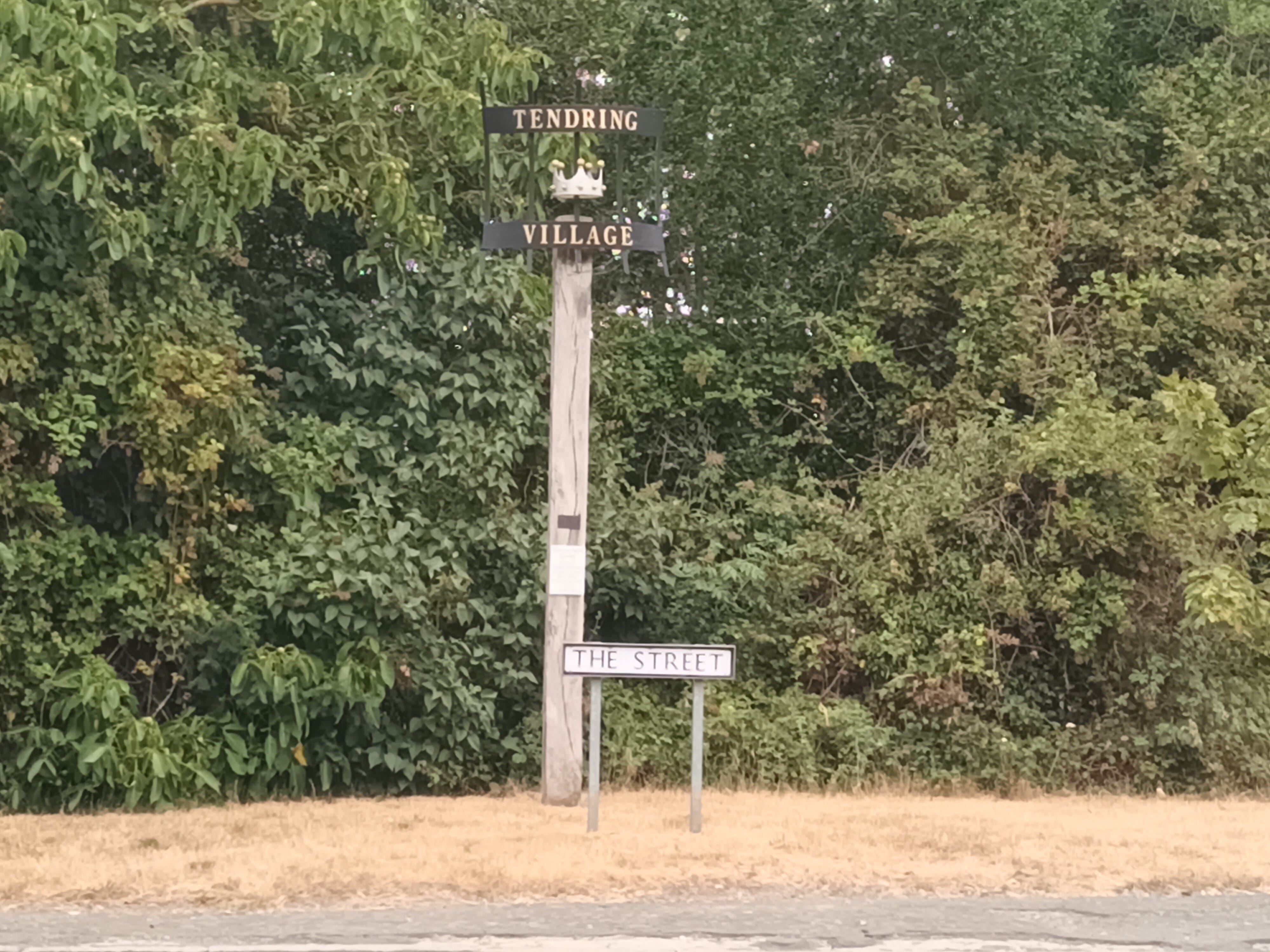
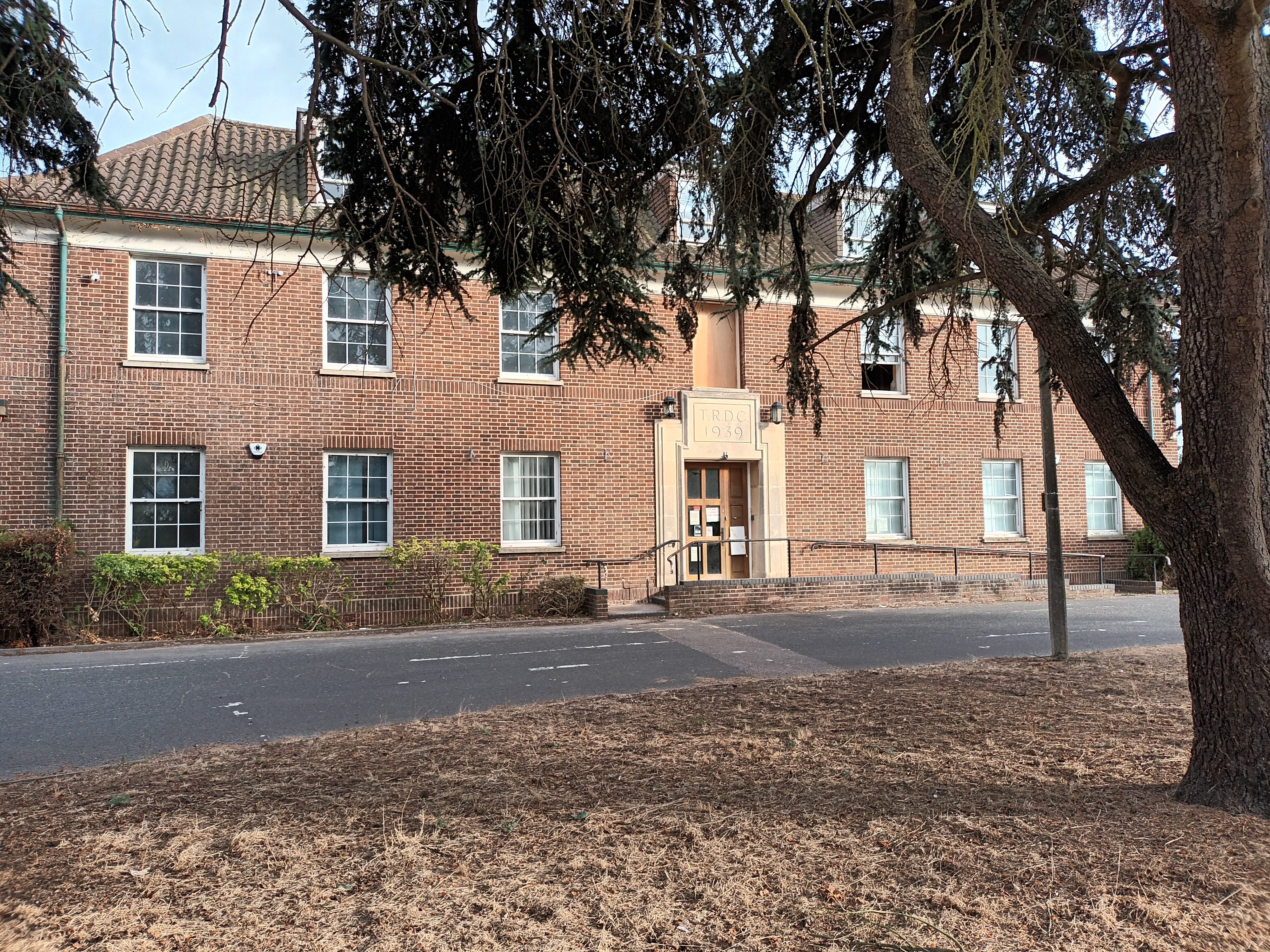
There is a village called Tendring, but the peninsula takes its name from an ancient Hundred of Essex which basically covered the same area as the modern Tendring council. In 1939 Tendring Rural District Council built a headquarters building for itself in the village of Weeley, in the distinctive 1930s Municipal architectural style; this building remains in local government use today.
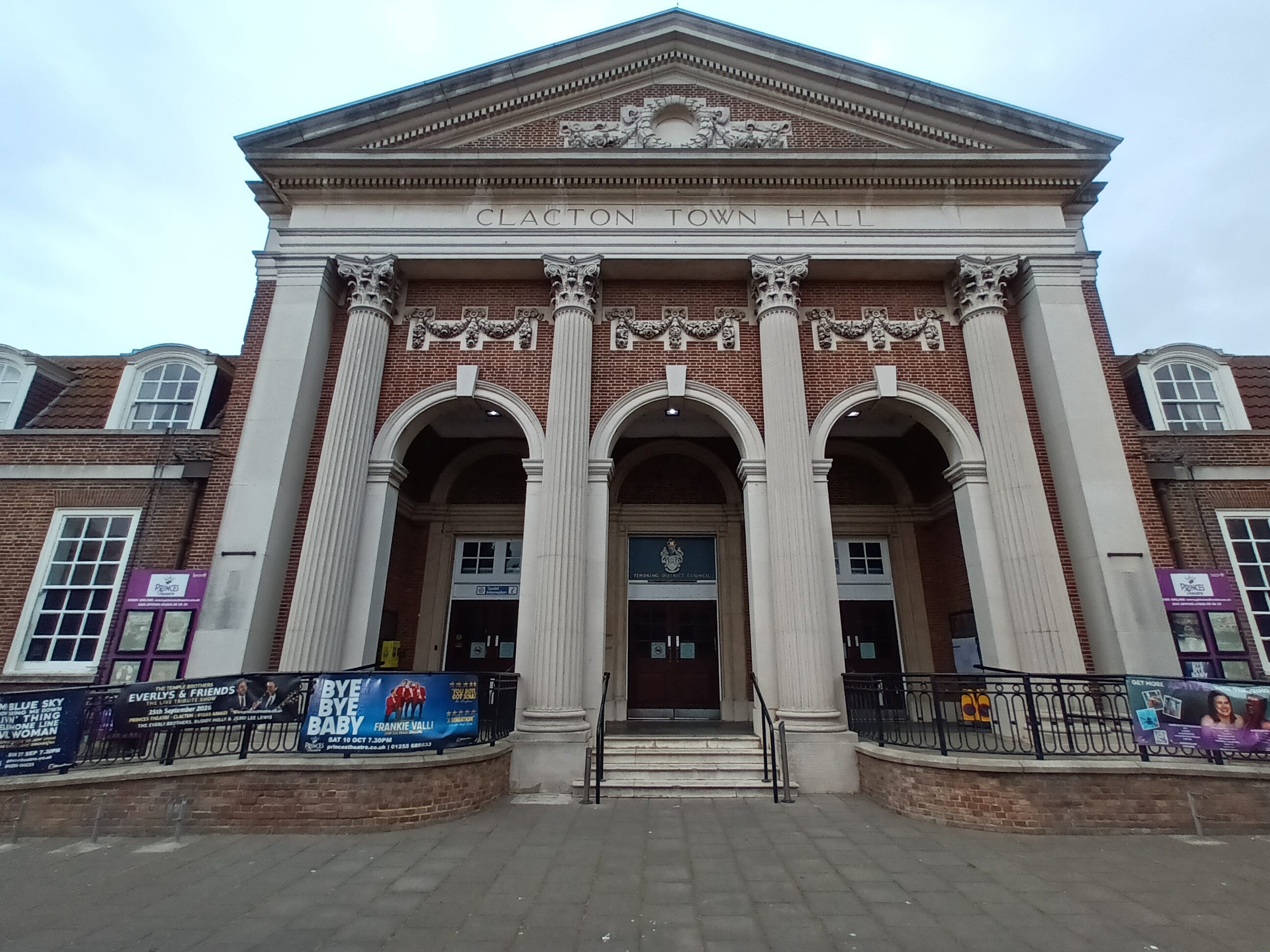
The modern Tendring council is based in Clacton Town Hall which also dates from the 1930s, with Prince Arthur of Connaught being the VIP at the opening ceremony in 1931. The town hall has a very distinctive portico for its main entrance.
Not long after the opening of its new Town Hall, Clacton Urban District expanded its reach in 1934 by annexing its eastern suburb of Holland-on-Sea, which is part of the same urban area but rather more upmarket than Clacton proper. Holland’s village green hasn’t stood up to the heatwaves we’ve had this summer.
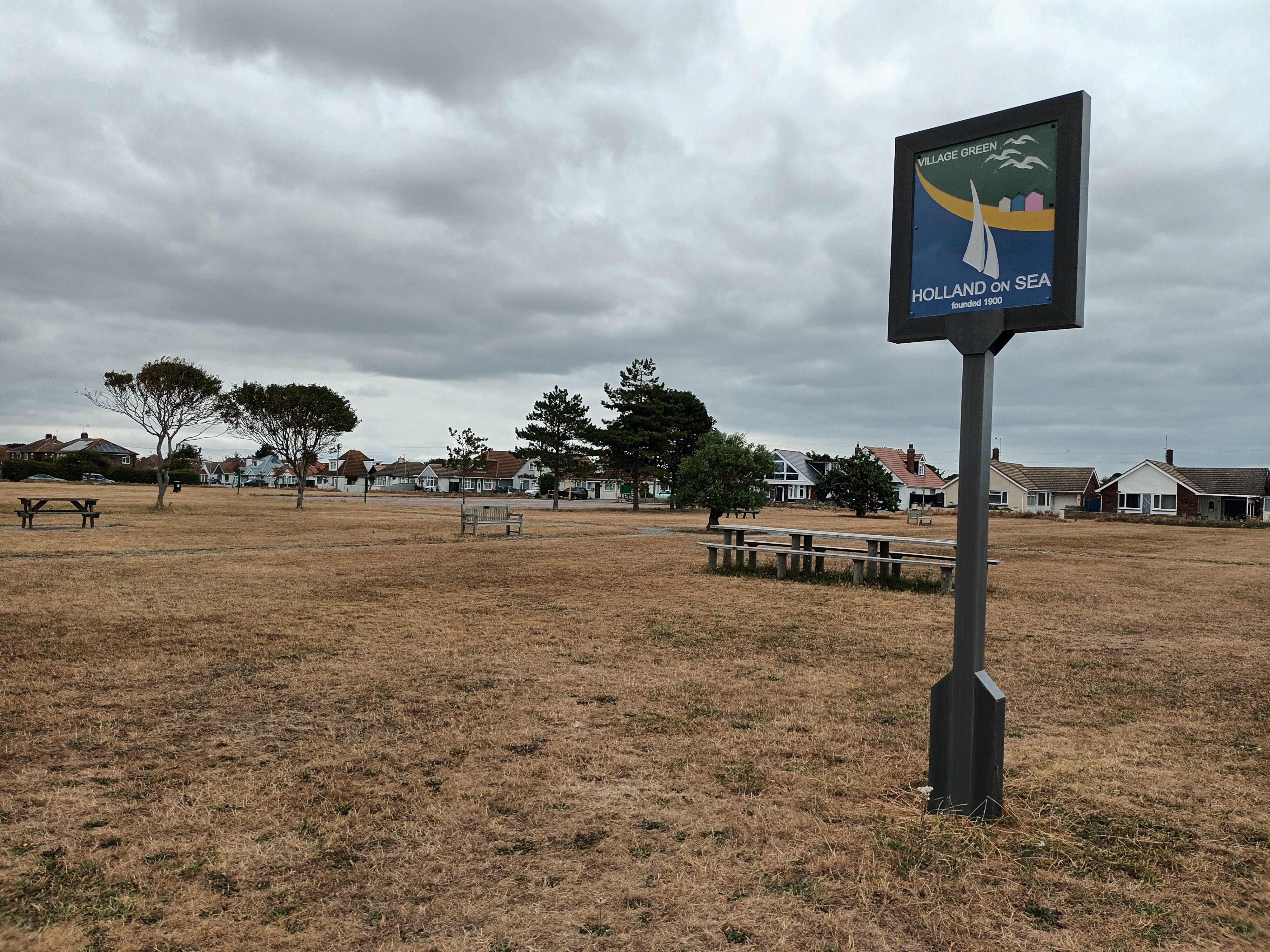
Holland-on-Sea is in an unusual place for a middle-class suburb. In most large British towns and cities the western suburbs are more upmarket than the eastern ones, because of the way that the prevailing westerly wind tends to blow pollution towards the east meaning that western suburbs normally get cleaner air. So what do we find at the west end of Clacton?
Well, around half of a mile west of the pier the cliffs come to an end and the landscape flattens out, with a massive sea wall to protect the area from flooding. This was the location of the Clacton Butlin’s camp, which opened in 1938, closed for the duration of the war and reopened in 1946. After several more decades of Hi-De-Hi and Ho-De-Ho, Butlin’s closed the camp at the end of the 1983 season; its managers then tried to keep it going as a theme park, but they admitted defeat a year later and the whole site has now been redeveloped for housing.
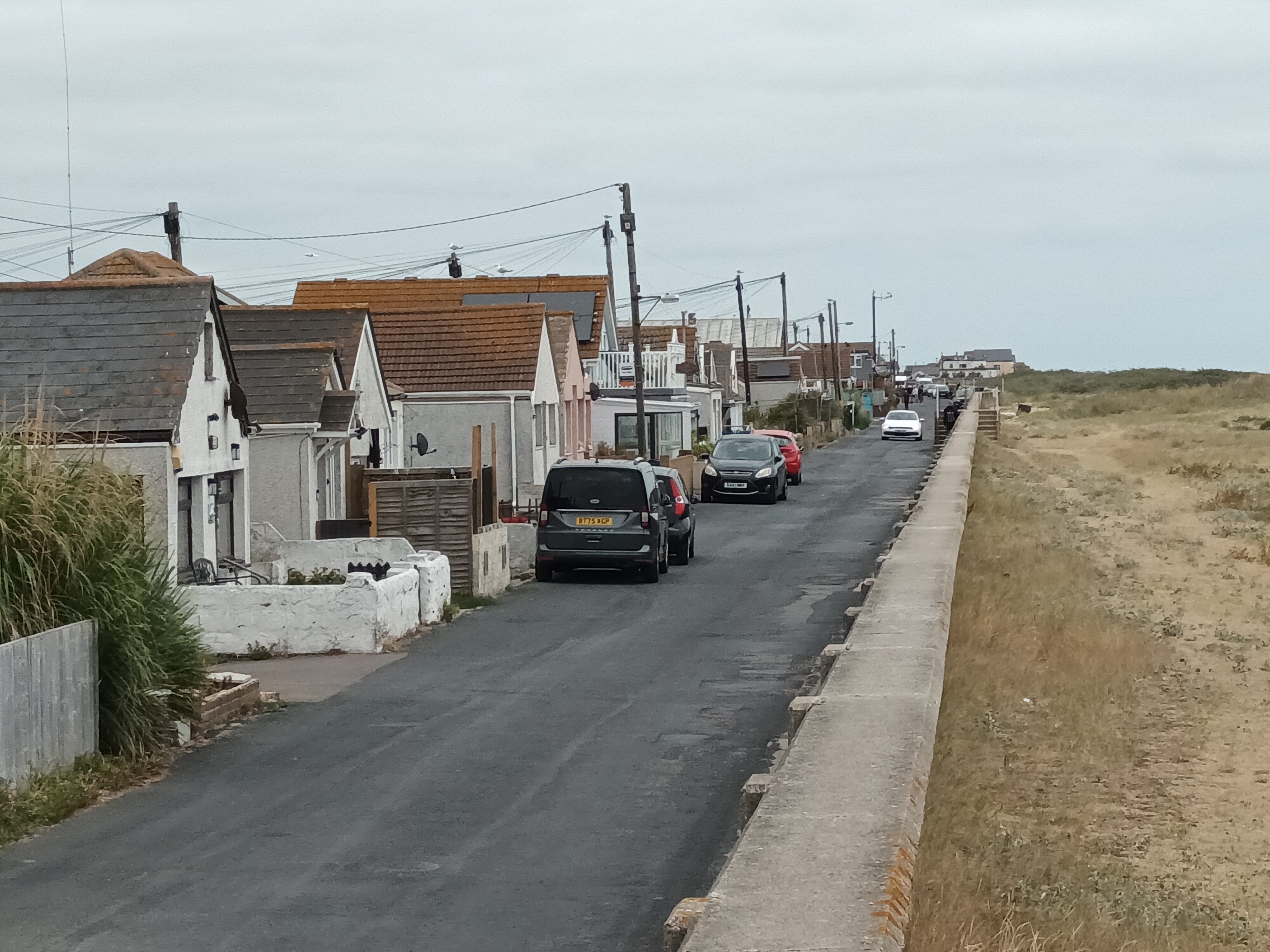
The closure of the Butlin’s camp had a devastating effect on the village of Jaywick Sands to the west. This lies on saltmarsh very close to sea level, and if and when the seawall is ever breached here the place will be in serious trouble. The 1953 North Sea flood killed 37 people in Jaywick.
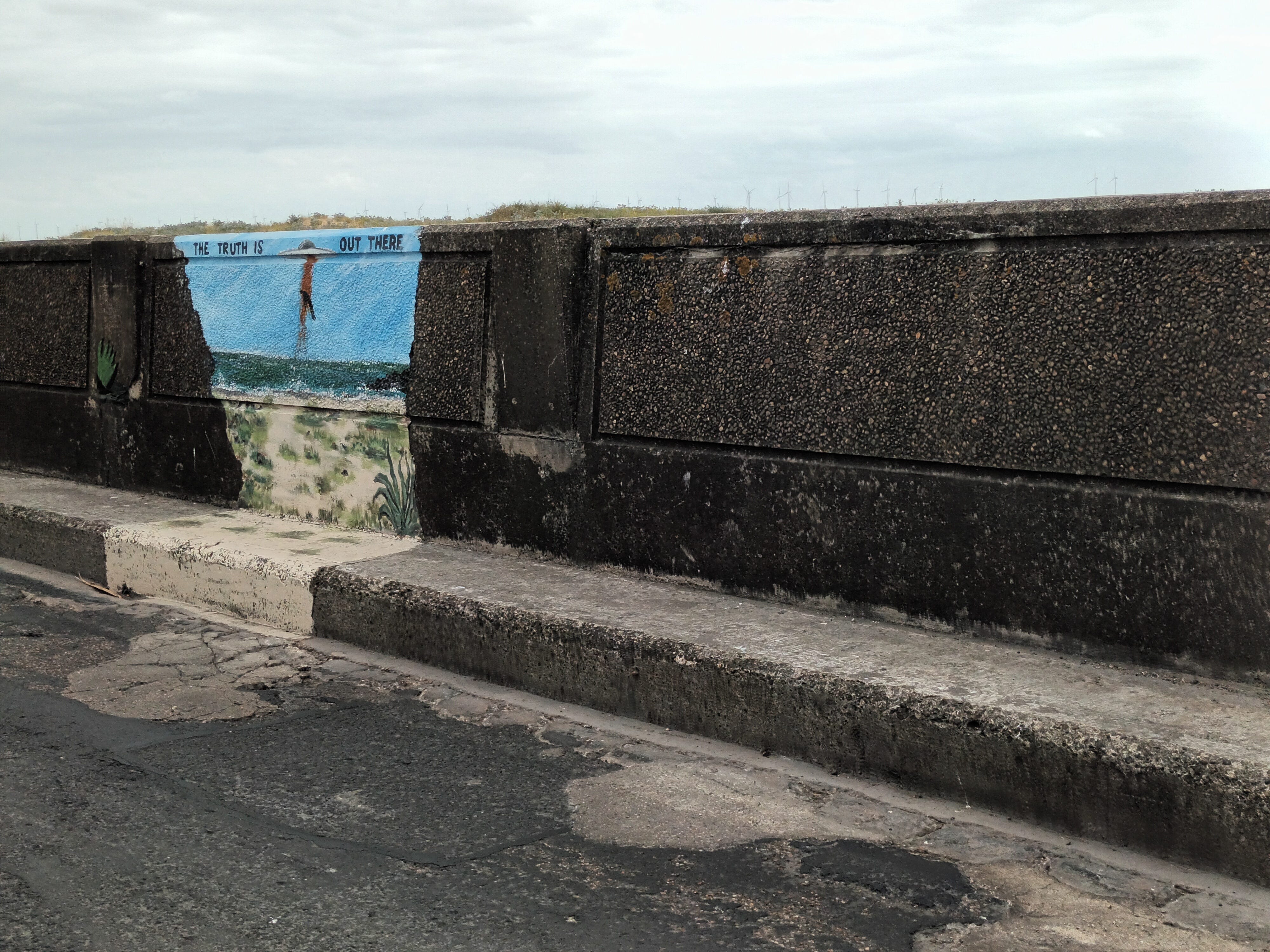
This resident of Jaywick wouldn’t tell me who they were voting for.
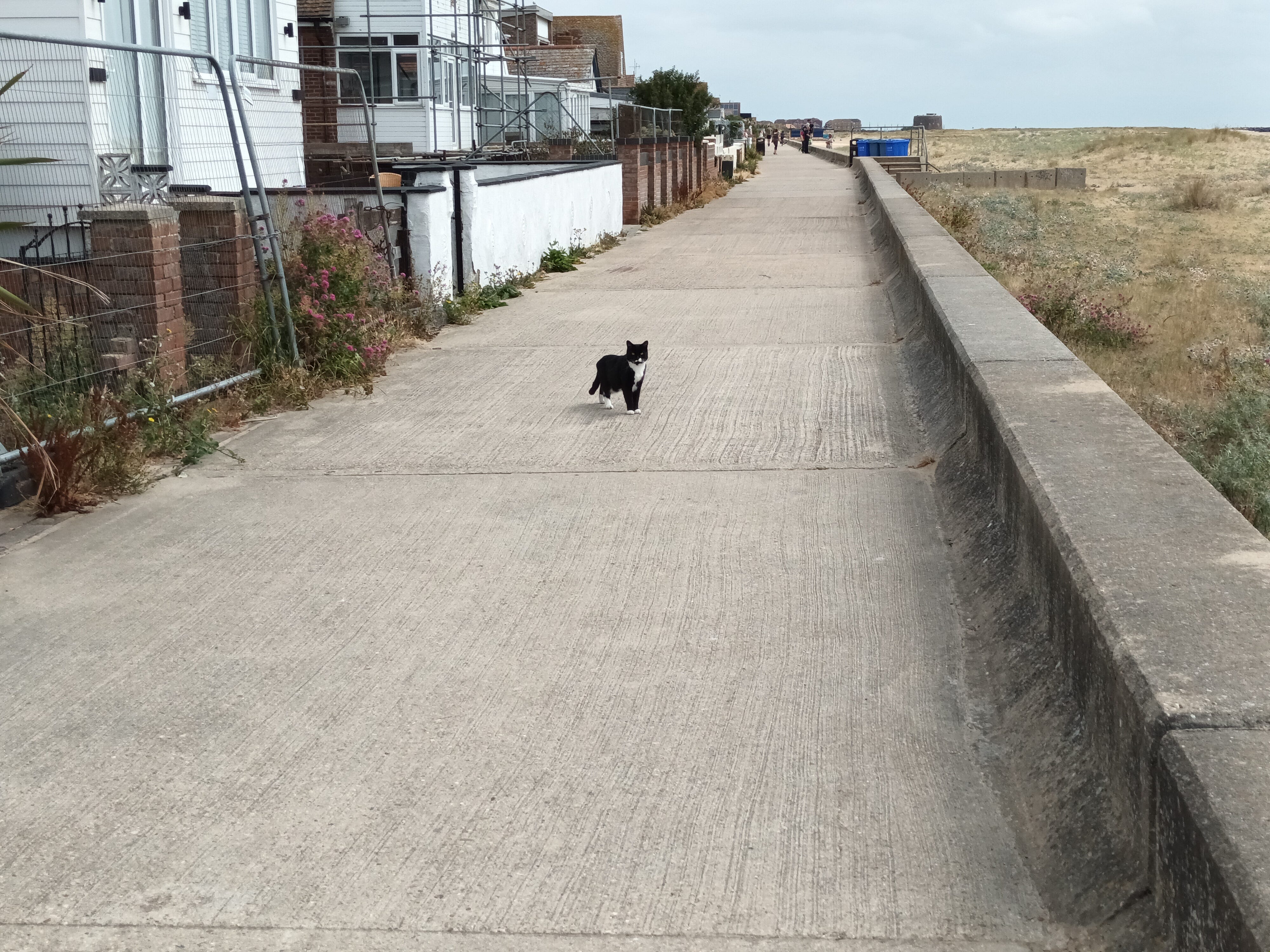
Jaywick started in 1928 as a plotland development, with one Frank Stedman starting to sell off small freehold plots of land to people from Essex and London who wanted to erect their own holiday homes. Many of those wooden 1930s chalets still exist today in full-time residential use which they were never intended or designed for, and they are now seriously delapidated. Mains sewerage didn’t come here until the 1970s; many of the roads here remain unadopted. Tendring council has tried on at least one occasion to knock the whole place down and rehouse its residents somewhere better, but - perhaps surprisingly - long-term residents of Jaywick don’t want to move. In response to that the council has imposed special planning rules on Jaywick to try and strangle the place with red tape, with even minor alterations and improvements (like garden sheds) requiring full planning permission to be applied for.
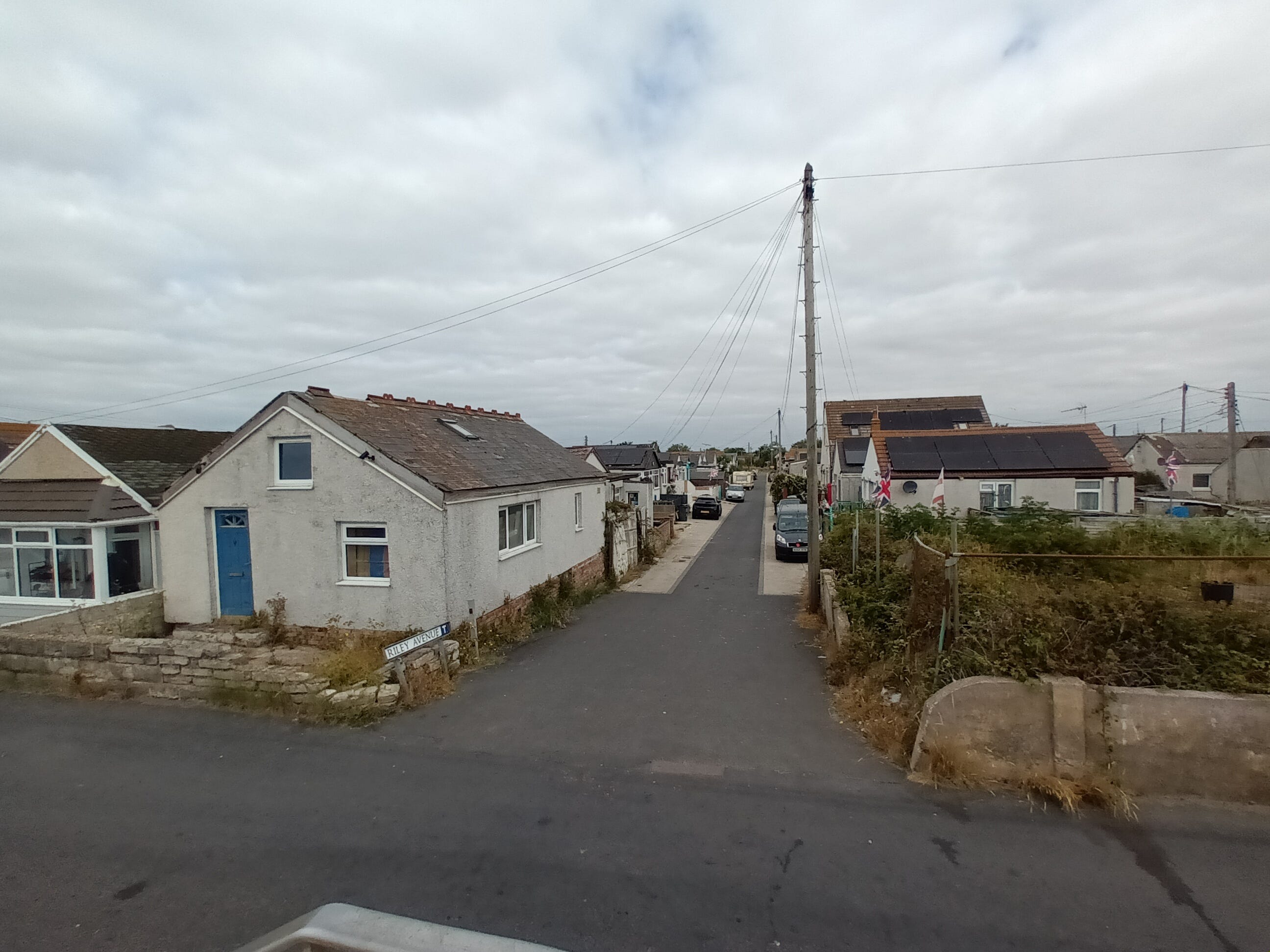
The quality of life here is laid bare by the deprivation indices, in which the census district covering the Brooklands Estate in Jaywick, with its closely-packed streets named after racing cars, is right at the top. Despite some investment having gone into the place in recent years, Jaywick is and remains the closest thing the UK has to a shanty town.
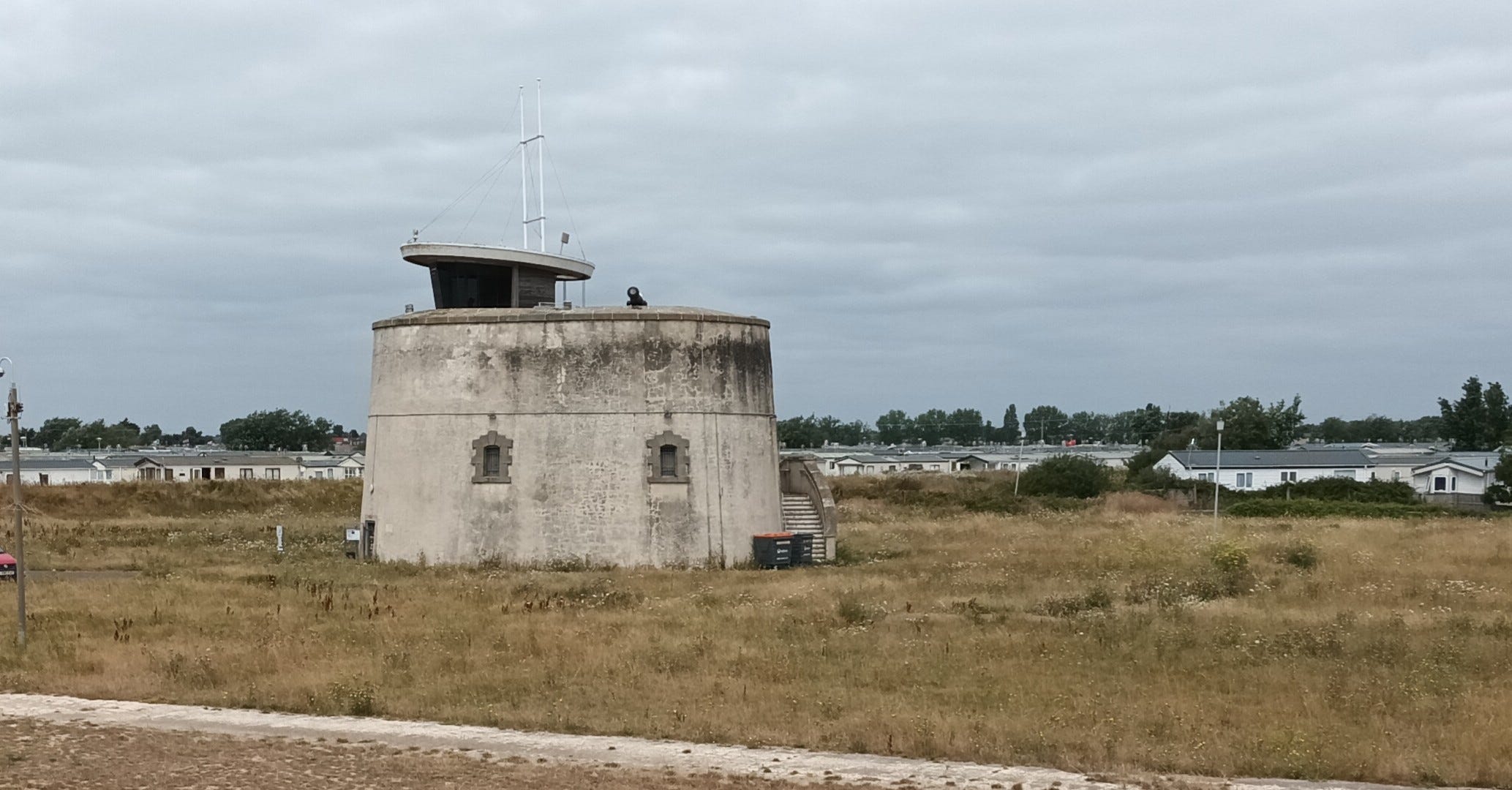
The most solidly-built structure in Jaywick has been here for over two centuries. It’s a Martello Tower, completed in 1811 - after a delay while the tower subsided into the saltmarsh - to protect the Essex coast against invasion during the Napoleonic Wars. Originally there were 29 Martello Towers in Essex, identified by letters A to Z and AA to CC; the Jaywick Tower is C, and Towers D and E still exist along the seafront between here and Clacton. All of them were based on the design of a Genoese defensive tower at Mortella Point on the north coast of Corsica, which impressed attacking British forces by holding out against them for two days in 1794. None of the Martello Towers erected on the British coast ever fired a shot in anger.
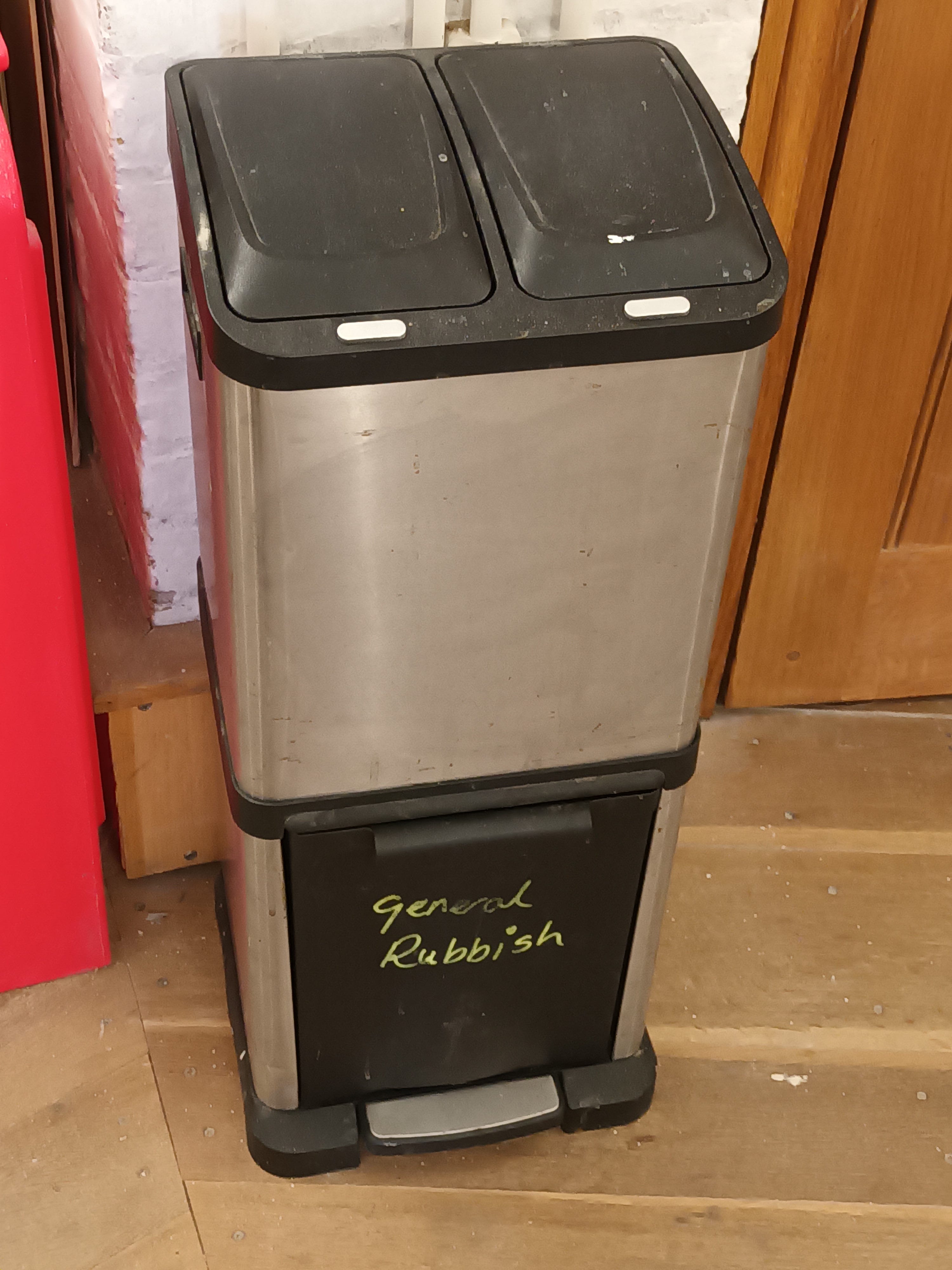
The Jaywick Martello Tower is now run by Essex county council - who earlier this year abandoned plans to close it to save money - and it is open to the public for a nominal admission fee. The ground floor contains an exhibition about the history of the tower, while the first floor is in use as an arts centre; the roof is presently closed due to nesting seagulls. On my visit there were a number of artworks here which had been made out of items discarded as rubbish.
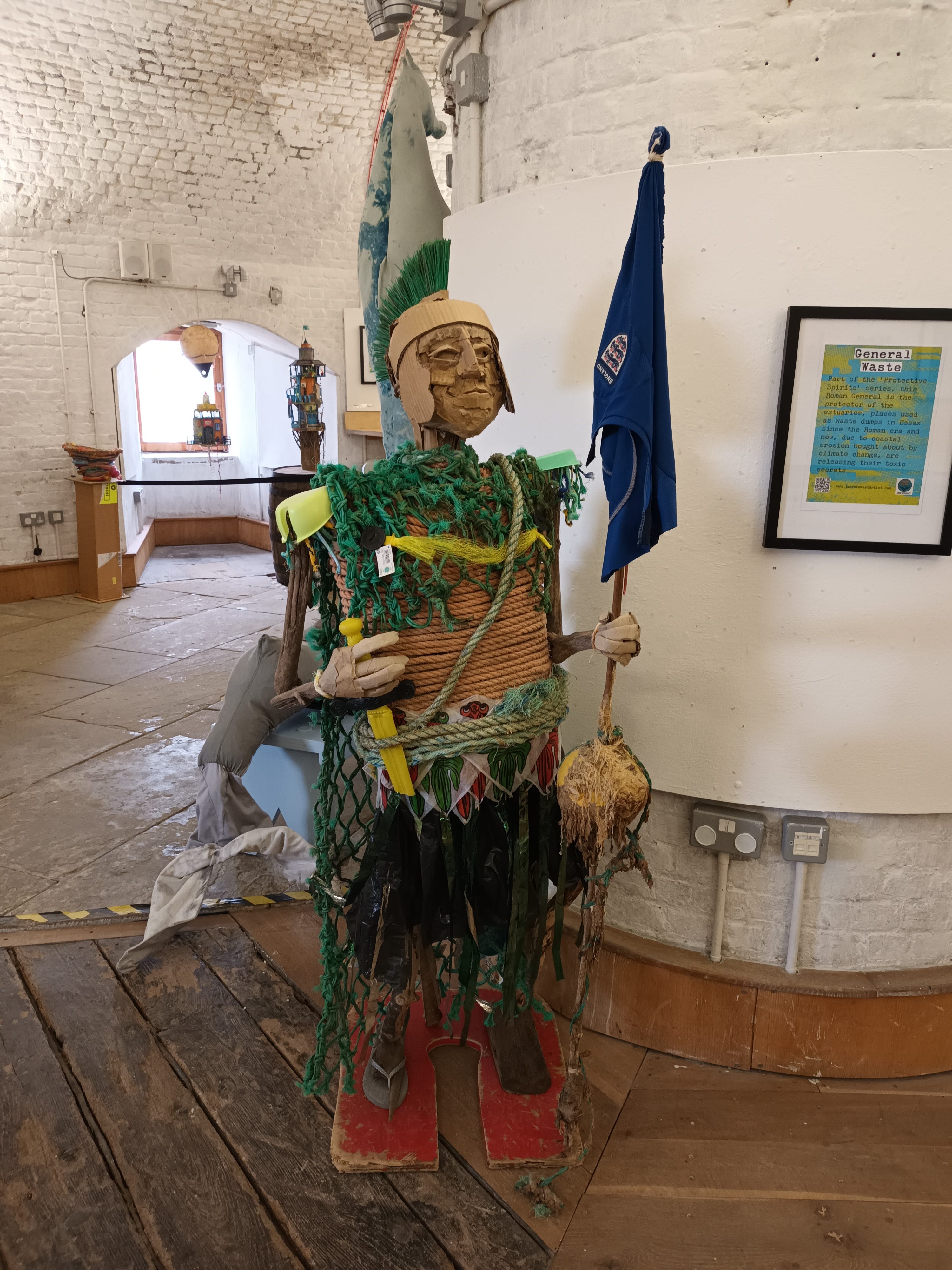
One wonders if Count Binface had been campaigning here.
Art is not always meant to be sympathetic. Back in May in a rare foray to London, I managed to catch a well-reviewed production of Benjamin Britten’s opera Peter Grimes at the Royal Opera House. Its director, Deborah Warner, had updated the East Anglian coast setting of the opera from the 19th century to the 21st, to a left-behind town not unlike Jaywick. Near the end of the show the on-stage crowd descended into a full-on mob of contemporary thugs and hooligans brandishing flaming torches and Union Jacks, marching in search of Grimes and prepared to fight anybody or anything who got in their way. It was a terrifying scene on the London stage, but here on the real-life Essex coast there’s one major problem with it. They’re all far too young.
The Jaywick Martello Tower C lies next to a large caravan park, as does Martello Tower A at Point Clear, on the Colne estuary. This is also a museum, dedicated to Second World War aircraft. The only way into Point Clear is through the much older village of St Osyth, which takes its name from a Mercian noblewoman called Osgyth who established a convent here, ruled as its first abbess, and was then beheaded by raiding pirates in or around the year 700. There were no Martello Towers to defend the coast in her day.
St Osyth gained an Augustinian priory in or around 1121, which became one of the most important religious houses in Essex. The priory’s gatehouse, which dates from the late 15th century and whose exterior is decorated with local flint, still stands today and is a private residence. From 1954 to 1995 it was the home of the writer Somerset de Chair, who had previously been a Conservative MP from 1935 to 1945 and again in 1950-51.
However, Somerset de Chair was not one of the former Clacton MPs whom the winner of this by-election will be standing in the footsteps of. The Clacton parliamentary seat was only created in 2010, but the Tendring area’s position in the north-east corner of Essex has generally made the constituency map here stable over the decades and centuries. There is effectively only one predecessor to this seat covering the whole of the period since 1885, when single-member constituencies became the norm for UK parliamentary elections: but until 2010 that seat took its name from an older town which is no longer part of this constituency.
The port of Harwich had been enfranchised in 1604, entitling it to send two members to Parliament who were elected by the borough corporation until the First Reform Act of 1832. In practice its elections were controlled by the government and particularly by the Treasury, which had a major influence in Harwich thanks to its control over lucrative jobs in the town’s customs house and post office, and as a result Harwich had more than its fair share of notable MPs. The diarist Samuel Pepys represented the town briefly in 1679 and again from 1685 to 1689, while he was secretary of the Admiralty. From 1807 to 1826 one of Harwich’s two seats was held successively by Tories William Huskisson, a long-serving and high-profile statesman who is now best remembered for being killed by a train on the opening day of the Liverpool and Manchester Railway in 1830; then by Nicholas Vansittart, whose service as Chancellor of the Exchequer from 1812 to 1823 has since been beaten only by Gladstone (who had four separate stints in the job); and then by the foreign secretary George Canning, who was subsequently prime minister for a period of approximately 2.4 Liz Trusses. A series of elections here in the late 1840s and early 1850s were voided for bribery and corruption, and after two failed Harwich by-elections in 1851 Parliament refused to issue a writ for a third by-election for almost a year, effectively leaving one of the town’s seats vacant as punishment for bad behaviour.
Having been reduced to one seat by the Second Reform in 1868, Harwich was disenfranchised by the Third Reform in 1885 but its name was transferred to the new county division covering the north-east corner of Essex. The 1885 Harwich constituency contained the whole of what is now Tendring district plus the rural area surrounding Colchester, which was the only one of the three ancient Essex parliamentary boroughs left standing by that redistribution. Nonetheless Essex came out of the 1885 boundary changes as a winner, with the creation of two new county seats and the enfranchisement of West Ham ensuring that the county went up from 10 MPs to 11.
The reorganised Harwich seat was won at its first contest in 1885 by Conservative James Round, who came from a prominent local landowning family and had represented the predecessor seat of East Essex since 1868. Round was one of the select group of MPs who had played first-class cricket, and he turned out in a total of 22 first-class matches for Oxford and MCC in the 1860s; he also played for Essex in the days before Essex was a first-class county. James Round’s first-class career batting average was 16.85, but he had better success at the ballot box where he never lost an election; his closest call came in the 1892 general election where his majority over the Liberals was 305. Nobody opposed Round’s final re-election in 1900, and he was sworn of the Privy Council in 1902 as a reward for his long service in the House of Commons.
James Round retired at the 1906 general election after 40 years on the green benches. His Harwich seat then fell in the Liberal landslide to Arthur Lever, a former Royal Fusiliers officer who had retired from the Army with the rank of major. Lever’s majority over the Conservative candidate Harry Newton was 342 votes.
This narrow margin wasn’t sustainable when the Liberal landslide subsided. A rematch between Lever and Newton in January 1910 resulted in a win for Newton by over 1,000 votes, and Harry Newton went on to serve as MP for Harwich for 12 years. Newton had been called to the Bar, but his father Sir Alfred Newton, 1st Baronet, was a Hull-born businessman who had become a City financier and chairman of the board of Harrods. Newton senior was also involved in City politics and he rose to become Lord Mayor of London in 1899-1900, the year that the Boer War broke out; his contribution to this was to establish the City of London Imperial Volunteers to fight in South Africa, and young Harry went with them.
In 1921 Harry Newton succeeded to his father’s titles and became Sir Harry Newton, 2nd Baronet, in controversial circumstances. Sir Alfred Newton had suddenly died of a seizure at Harrods, and the police investigation found that he had taken prescribed indigestion medicine from a bottle which contained enough strychnine to kill several people. The medicine bottle had been made up by the Harrods pharmacist. After the inquest jury had heard evidence from the pharmacist about her working practices and seen a post-mortem report which indicated that Alfred Newton’s heart was in poor condition, the coroner recorded a verdict of death by heart failure.
Sir Harry Newton retired as MP for Harwich in 1922, and again the Conservatives failed to pass the seat on to their new candidate. The Harwich constituency had been redrawn in 1918 with the same boundaries as the modern Tendring district, and it returned the Liberal Party candidate Albert Hillary, a businessman who ran the Carson’s chocolate factory in Glasgow. Hillary won the seat in 1922 by 764 votes and increased his majority to 1,917 at the next general election the following year.
But Hillary’s tenure in the Commons was brief. He lost his seat in 1924 by 2,315 votes to the Conservatives’ Sir Frederick Rice, who was a building contractor by profession and had lost to Hillary the previous year. 1924 was the first time that Labour contested the Harwich seat, but the Labour candidate lost his deposit and Rice had over 50% of the vote anyway.
Sir Frederick Rice stood down at the 1929 election and yet again the Conservatives failed to pass the Harwich seat on. This time the Liberal winner in Harwich was John Pybus CBE, an engineer and businessman who had become chairman of the engineering conglomerate English Electric in 1926. He defeated the Unionist candidate John Mayhew, who later served for 14 years as MP for East Ham North, by 2,700 votes; there was also an Independent Unionist candidate on the ballot, but he lost his deposit and Pybus had over 50% of the vote anyway.
When the Ramsay Macdonald Labour government fell apart in the summer of 1931 and the first National Government was formed, John Pybus was offered and accepted the post of Minister of Transport in the new régime. He then joined the breakaway Liberal Nationals and was re-elected on their ticket in 1931 with a runaway win, polling 86.4% of the vote against only Labour opposition. Pybus remained in government until 1933, and he was created a baronet the following year.
Sir John Pybus died on 23rd October 1935 at the age of 55, leaving no heir to his baronetcy. There was no by-election to replace him because the 1935 general election had been called a few days previously, and Parliament was dissolved two days after Pybus’ death. The 1935 general election in Harwich marked a return to the Commons for National Liberal candidate Stanley Holmes, a chartered accountant and former London county councillor who had previously served as the Liberal MP for North East Derbyshire from 1918 to 1922. Holmes had lost that seat to Labour in 1922 by just five votes, a result which he challenged in the Election Court: but following a recount and adjudication by the Court on doubtful ballot papers, the Labour majority was increased to 15 votes.
Harwich proved to be a much safer berth for Stanley Holmes, who won four terms of office here on the National Liberal ticket without serious opposition. He was knighted in 1945, and then left the Commons in 1954 by being elevated to the House of Lords as the first (and only) Lord Dovercourt.
By this point the National Liberals were officially allied with the Conservatives, and for the resulting Harwich by-election of 11th February 1954 the defending candidate was Julian Ridsdale standing on a joint Conservative and Liberal ticket. This neatly reflected his upbringing as a nephew of a former Liberal MP and a former Conservative MP - the latter being none other than three-time Prime Minister Stanley Baldwin. During the Second World War Ridsdale had been a military intelligence officer specialising in Japan, which brought him into contact with a secretary called Paddy Bennett who married him in 1942; Bennett had been Ian Fleming’s secretary, and the character of Miss Moneypenny in the James Bond universe is generally thought to be based on her.
Julian Ridsdale had been a Conservative candidate in the 1951 general election, standing unsuccessfully against Labour in Paddington North. In the 1954 Harwich by-election his only opposition came from Labour’s Shirley Catlin, who was 23 years old and standing in her first election: her previous main political role had been as chair of Oxford University Labour Club. Readers might know Miss Catlin better under her married name of Shirley Williams. Ridsdale ended up winning by 19,532 votes to 13,535, a majority of 5,997 votes which represented almost no swing from the 1951 result. A rematch between Ridsdale and Catlin at the following year’s general election saw the Conservative and Liberal majority increase to 9,464 votes.
Ridsdale went on to win eleven terms of office as MP for Harwich, transitioning to become a Conservative MP after the National Liberals finally merged with the Tories in 1968. His frontbench career was brief, as a junior Air minister from 1962 to 1964, and his backbench position after that might well have been cemented by a full-throated defence of Enoch Powell’s “Rivers of Blood” speech. Sir Julian, as he became in 1981, never lost his fascination with Japan: he chaired the British Japanese parliamentary group for 28 years and led a number of UK parliamentary delegations to the country.
Major figures who took Julian Ridsdale on over the years, as well as Shirley Williams who we have already mentioned, include William Robinson who was the Labour candidate here in 1959 and later briefly served as MP for Walthamstow East; David Winnick who was the Labour candidate here in 1964 and later had a long Parliamentary career in Croydon and Walsall; Liz Lynne who was the Liberal candidate here in 1987 and later served as a Lib Dem MP for Rochdale and MEP for the West Midlands; and Andrew Phillips who was the Labour candidate here in 1970 and later served as a Lib Dem member of the House of Lords and as the legal eagle on Jimmy Young’s Radio 2 show.
From 2003 to 2014 Phillips was the chancellor of the University of Essex, which was located within the Harwich constituency from its foundation in 1965 until boundary changes transferred it into the Colchester North constituency in 1983. When he assumed that role the vice-chancellor of Essex was Sir Ivor Crewe, a former political academic at that university who co-directed the British Election Study for much of the 1970s and frequently appeared as an electoral commentator on TV and radio. I hope Sir Ivor won’t mind me reproducing the Harwich entry from the 1984 book British Parliamentary Constituencies: A Statistical Compendium which he co-wrote with Anthony Fox, and which I have found invaluable over the years. In case you were wondering, the number 21 in the top-right-hand corner is a demographic code for “resort and retirement areas”, with Harwich being one of 29 constituencies so classed according to the 1981 census.
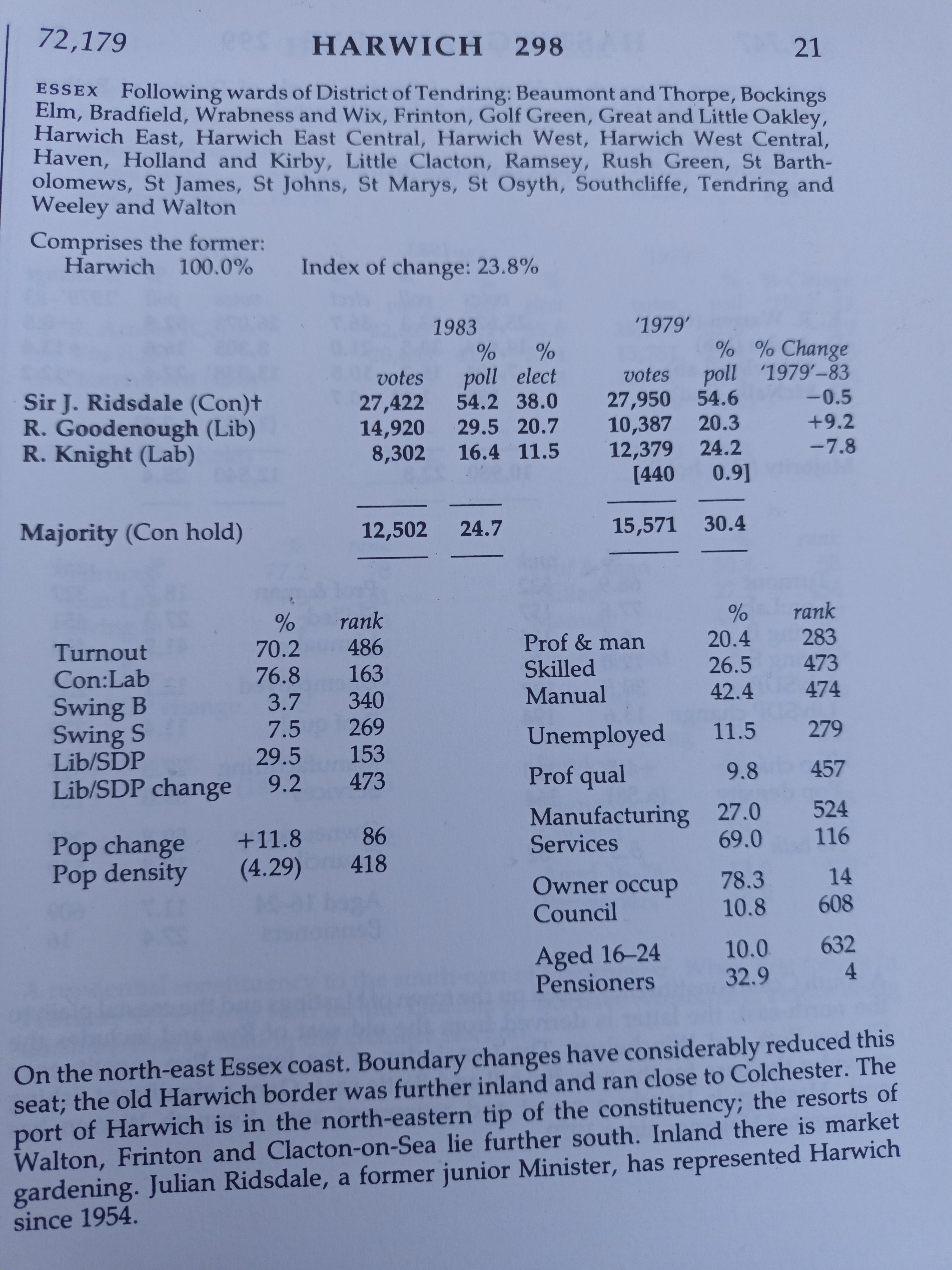
Ivor Crewe also co-wrote several books, including a history of the SDP, with his fellow psephologist Anthony King who taught government at Essex from 1969 until his death in 2017. Many readers of this column will remember Professor King as a BBC election night analyst, a role he performed at every general election from 1983 to 2005.
Sir Julian Ridsdale finally called it a day at the 1992 general election after 38 years’ service, and this time the Harwich Conservatives finally managed to pass a seat on to their new candidate after their MP retired. This election marked a return to the Commons for the accident-prone Iain Sproat, who had previously been MP for Aberdeen South from 1970 to 1983. Following boundary changes to that seat, Sproat had attempted to do the chicken run to Roxburgh and Berwickshire - but not only did he lose there, but his Conservative successor held on to Aberdeen South. With a much safer majority in his new English constituency - he had defeated the Lib Dem candidate by over 17,000 votes in 1992 - a frontbench career beckoned, and Iain Sproat spent most of the 1992-97 Parliament as minister for sport in the Major government.
So it must have been a shock to Iain Sproat when he went down to defeat in the 1997 Blair landslide, as Harwich returned its first and only Labour MP with a majority of 1,216 votes. It was certainly a shock to the Labour candidate Ivan Henderson, a trade union official at the port of Harwich, who had to phone his boss on the morning after the 1997 election and say that he wouldn’t be able to work the shift he was down for that day because he’d won the election. A rematch between Henderson and Sproat in 2001 saw Henderson increase his majority to 2,596 votes. Henderson lost his seat to the Conservatives in 2005 but he is still active in local politics: he served as mayor of Harwich in 2021-22, he was the Essex county councillor for Harwich from 2013 to May 2026 and led the county council’s Labour group for most of that period, and he has been a Tendring councillor since 2011 where he currently represents Harwich and Kingsway ward.
One possibly-decisive factor in Henderson’s 1997 win was that Harwich had the best score in any constituency that year for the short-lived Referendum Party, whose candidate Jeffrey Titford - a former Conservative councillor in Clacton - polled 9.2% of the vote. It was a sign of things to come. Titford later served as leader of UKIP twice (once on an acting basis) and he was an MEP for the East of England from 1999 to 2019.
Jeffrey Titford was the UKIP candidate for Harwich in 2005, but on that occasion he lost his deposit as the Conservatives took the Harwich constituency back by 920 votes. The new MP was Douglas Carswell, who was born in Africa to Scottish parents who were both doctors: his father Wilson Carswell had diagnosed Uganda’s first AIDS cases in the 1980s. After graduating in history from the University of East Anglia and King’s College London, Carswell had worked in TV broadcasting in Italy before joining the Conservative Party’s policy unit. He had stood in the 2001 general election as the Conservative candidate against Tony Blair in Sedgefield. In Parliament, Carswell emerged as a campaigner on traditional Conservative values, calling for radical political reform (he was the only Conservative MP to support proportional representation) and withdrawal from the European Union. He was a big advocate of a recall process for MPs.
Douglas Carswell’s position was significantly improved by boundary changes for the 2010 general election, which took the town of Harwich - and with it Ivan Henderson’s powerbase - out of the Harwich constituency. This meant a new name for the seat was needed, and “Clacton” was chosen after the main town in the area. The new Clacton seat was projected to be safely Conservative in 2005 conditions, and a rematch between Carswell and Henderson in 2010 saw Carswell increase his majority to 12,068 votes.
In 2014 Douglas Carswell defected to UKIP. Unlike most defectors in Parliament or at lower levels of government, he immediately resigned his seat in order to seek re-election to the House of Commons under his new purple colours - something which he achieved with ease at the resulting first Clacton by-election of 9th October 2014. Carswell even increased his majority to 12,404 votes, defeating the Conservative candidate Giles Watling by 60-25 in percentage terms. Round 2 of Carswell v Watling at the 2015 general election was closer, with Carswell winning his fourth term of office by 3,437 votes.
Douglas Carswell quit UKIP to become an independent MP in March 2017 - not triggering a by-election this time - and he didn’t seek re-election at the 2017 general election a few months later. The new UKIP candidate Paul Oakley came nowhere near holding the seat - he finished third with just 7.6% of the vote - and the Conservatives’ Giles Watling cruised to victory by 15,828 votes over Labour.
Watling was a Conservative councillor for Frinton ward from 2007 to 2019, but before entering the Commons he had been an actor and he was best known for playing Oswald the vicar in the TV series Bread. Unfortunately, his last credited film role was a cameo in the notorious 2012 film Run for Your Wife, which starred Danny Dyer as a bigamist taxi driver and Denise van Outen and Sarah Harding as his wives. Run for Your Wife had run for nine years in the 1980s and 1990s as a successful stage farce in the West End but it completely failed to make the transition to the silver screen, with the film having a rare 0% rating on Rotten Tomatoes and appearing on Wikipedia’s “List of 21st-century films considered the worst“. This list is one of my guilty pleasures because the savage reviews quoted on that page are always good for a laugh, and Run for Your Wife‘s entry does not disappoint with critics’ quotes including “makes The Dick Emery Show look edgy and contemporary” (Peter Bradshaw in the Grauniad) and “never in the field of light entertainment have so many actors sacrificed so much dignity in the cause of so few jokes” (Anthony Quinn in the Independent). The Metro‘s review of Run for Your Wife opined that “no-one emerges unscathed among the cameo-packed cast that reads largely like a roll-call for Brit TV legends you’d previously suspected deceased”, which is a bit unfair on Giles Watling. Not that any of this had an effect on his support at the ballot box: Watling was re-elected in 2019 nearly 25,000 votes ahead of Labour candidate Kevin Bonavia, who has since made it into the Commons as MP for Stevenage.
Despite that lead, Giles Watling went down to defeat at the 2024 general election when he was opposed by the Reform UK leader Nigel Farage, who needs no introduction. Farage had been an MEP for south-east England from 1999 to 2020, but this was the first time he had got into the Commons in eight attempts. He won Clacton in July 2024 with 46% of the vote against 28% for the Conservatives’ Giles Watling and 16% for Labour’s Jovan Owosu-Nepaul; Farage’s numerical majority over Watling was 8,405 votes.
The Parliamentary successes over the years for Farage and his political parties have been reflected in local elections. The Clacton parliamentary seat is entirely covered by the Tendring district, which has been under no overall control since 1999 with the exception of a Conservative-majority term in 2011-15. The 2015 local elections here were held on the undercard of Douglas Carswell’s re-election as a UKIP MP, and on that occasion Tendring council finished up with 23 Conservatives, 22 UKIP, 11 independents and localists and 4 Labour. In an inspired move, the Tendring Conservatives then offered UKIP a coalition deal and the UKIP group immediately split over whether to accept it.
The UKIP local vote in the district then progressively collapsed and by 2023 all their councillors were gone. That year’s Tendring elections returned 19 Conservatives, 16 independents, 8 Labour, 4 Lib Dems and 1 councillor for the localist group Tendring First, and a coalition of independent, Labour and Lib Dem councillors was set up to run the show - defeating a Conservative-led administration. Three by-elections here since 2023 have all resulted in a change of party: in January 2024 Labour lost Bluehouse ward in northern Clacton, while in 2025 Reform UK gained seats in The Bentleys and Frating ward and Frinton ward from the Conservatives. Defections on top of this mean that the Reform UK group on Tendring council is now up to 7, with the Conservatives down to 13.
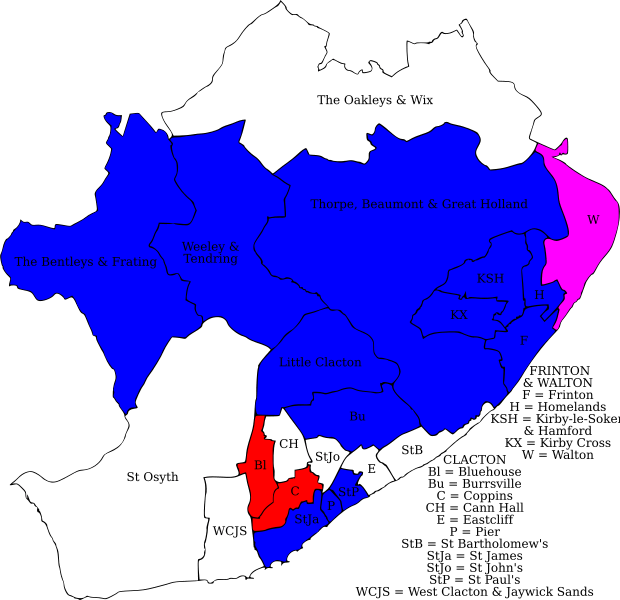
If the Tendring council area had been just the area of the present Clacton constituency, then the Conservatives would still have won a majority in 2023: the wards making up the constituency returned 16 Conservatives, 12 independents, 2 Labour and 1 Tendring First councillor (in Walton ward). This was based on votes cast of 38% for the Conservatives, 24% for independent candidates and 18% for Labour.
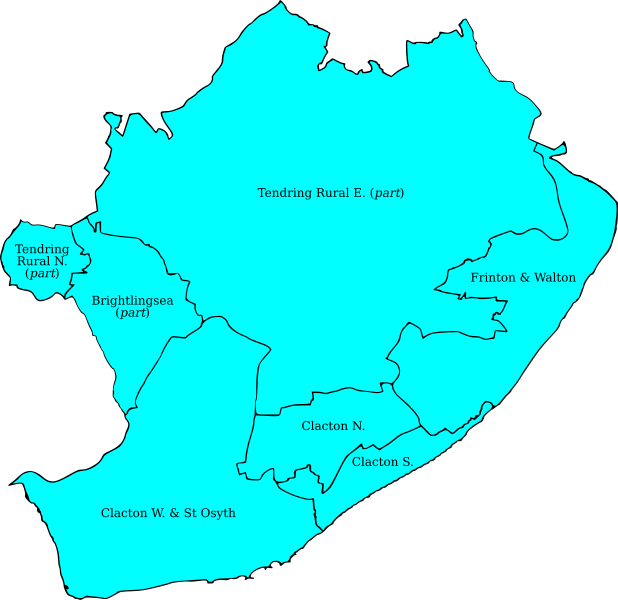
There was a very different result here the last time that Clacton went to the polls, in the 2026 Essex county council election. On that occasion Reform UK swept the board and won all eight of Tendring district’s county council seats. If we take as a best fit for this constituency the three Clacton county divisions, Frinton and Walton, and Tendring Rural East, then votes cast come out as 53% for Reform UK, 19% for the Conservatives and 13% for independent candidates. Reform UK’s best performance in the 2026 Essex county council elections was the 61% they polled in Clacton West and St Osyth division.
Nigel Farage is never short of controversy, and in recent months some attention has been focused on his financial interests. This is all a bit murky at the moment, with allegations swirling around in particular over a gift of £5 million received from a cryptocurrency millionaire based in Thailand which wasn’t properly declared to the Parliamentary authorities, and over Farage’s professional relationship with a convicted fraudster whose mother has donated £500,000 to Reform UK. The Parliamentary Commissioner for Standards is looking into all this, so hopefully things will get a bit clearer in due course.
Farage has denied any wrongdoing by the unusually forceful method of seeking re-election as a vote of confidence from his Clacton constituents. He tendered his resignation from the Commons last month by applying for the post of Steward and Bailiff of the Manor of Northstead. He is the defending Reform UK candidate for the resulting by-election.
Reform UK offered to pay for the cost of the by-election themselves, but this is strictly against the rules (and one wonders where the money for that would have come from). Back in the days of rotten boroughs candidates were often expected to pay the cost of polling themselves, but this meant that elections were out of reach for all but the very wealthy - and that elections were often uncontested. Today candidates for Parliament are expected to pay a £500 deposit in order to stand, which they will get back if they exceed 5% of the votes cost (we’ll come back to this in a moment), but this sum deliberately doesn’t cover the cost of organising and staffing an election. That cost is borne by the returning officer in the first instance and ultimately by the Treasury, a policy which has been the case for an extremely long time because it reduces the entry barriers for candidates and opens up politics to the masses.
And the masses have certainly taken to this by-election, as one look at the candidate list reveals. None of the established political parties other than the defending Reform UK have shown any interest at all in contesting this by-election, but the days when parliamentary elections could be uncontested - as most recently happened in Harwich in 1900 - are long over. Instead we have the ridiculous sight of Nigel Farage fighting 33 relative unknowns in the largest field ever assembled for a parliamentary election.
The sheer number of candidates has exposed some problems with the parliamentary elections rules. One is a potential issue with the deposit rule. To quote rule 53(4) of the parliamentary rules, “the deposit shall be forfeited if a poll is taken and, after the counting of the votes by the returning officer (including any recount) is completed, the candidate is found not to have polled more than one twentieth of the total number of votes polled by all the candidates”. A little bit of maths will reveal that the maximum number of candidates who can get their deposit back under this rule is nineteen: if you have 19 candidates in an election who each poll one vote then they are all over 1/20th of the vote, but if you have 20 candidates in an election who each poll one vote then none of them are over 1/20th of the vote. Since we have 34 candidates here, it follows that at least 15 of them (and probably more) will lose their £500 deposits and the Treasury can bank £7,500 straight away.
This is fair enough, but with 34 candidates we also run into the issue that somebody could win this thing and still lose their deposit. Consider an election with 34 candidates in which 34,001 votes are cast, candidate A wins with 1,001 votes and everybody else scores 1,000. The winning score here is 1,001/34,001 or 2.94%, so despite winning the election candidate A still doesn’t get their deposit back. This possibility is admittedly remote but it does seem a little unfair.
The parliamentary elections rules also contain an Appendix of Forms, which among other things gives specifications for the ballot paper. These are implicitly written on the assumption that all the candidates are to be arranged in one column. This is the template given for the front of the ballot paper in the current edition of the rules:
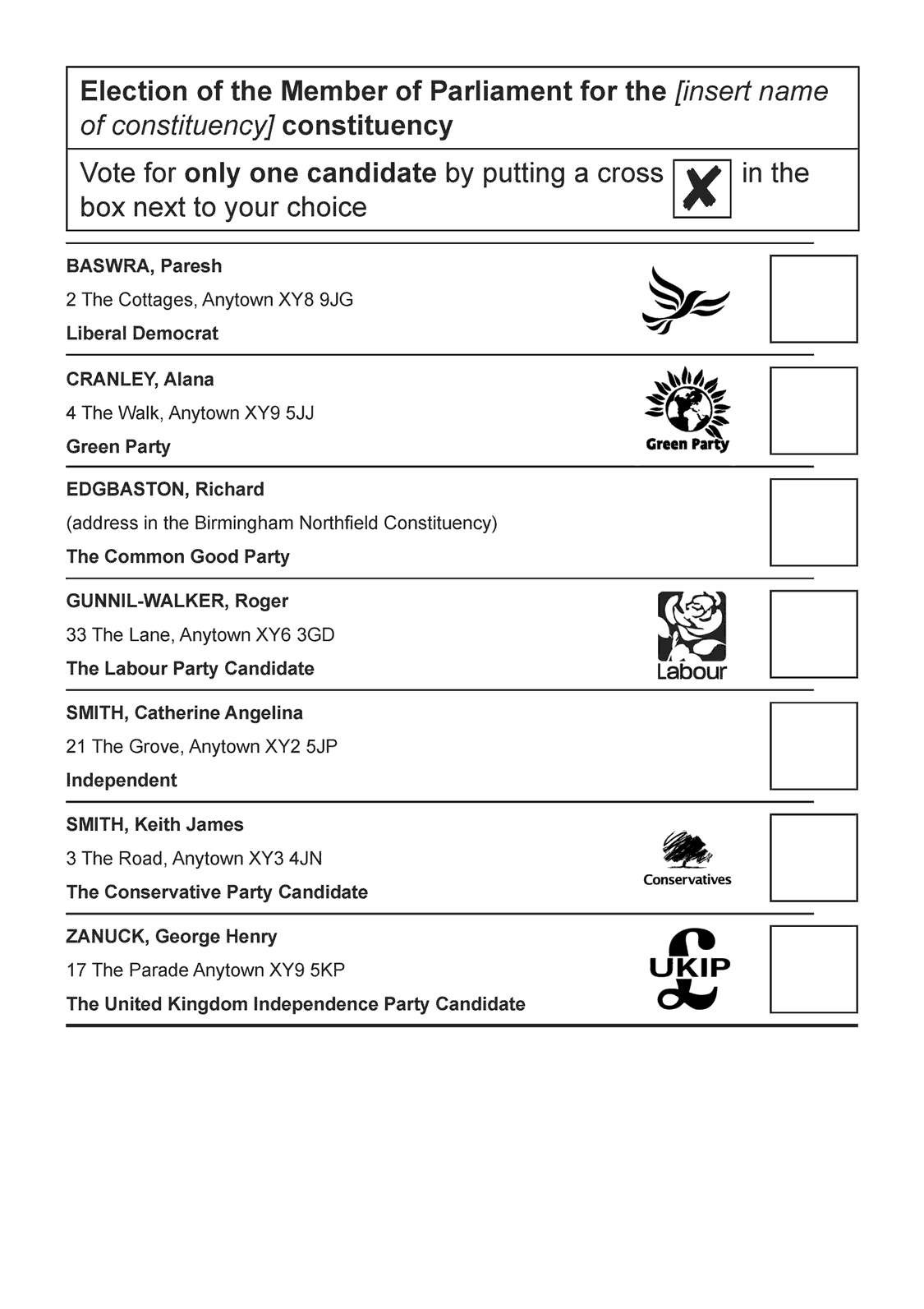
This is followed by a set of “Directions as to printing the ballot paper”, which are to be observed “so far as is practicable”. One of the directions states that “The horizontal rules [separating the particulars of the candidates from one another] must be equally spaced and the space between each of them must be a minimum of 2.5 centimetres”. With 34 candidates, that means that the ballot paper for this election is 85 centimetres long plus space at the top for the instructions, for a total of around 90 centimetres. Or, as the older voters of Clacton might put it, about three feet.
The last time the record for candidates in a parliamentary by-election was broken was in Haltemprice and Howden in 2008, with 26 candidates standing then. That should have resulted in a ballot paper around 70 centimetres long, but the returning officer for Haltemprice and Howden couldn’t find a printing firm which could handle that. The election staff then had to seek emergency permission from the Electoral Commission to redesign the ballot paper with the 26 candidates arranged in two columns.
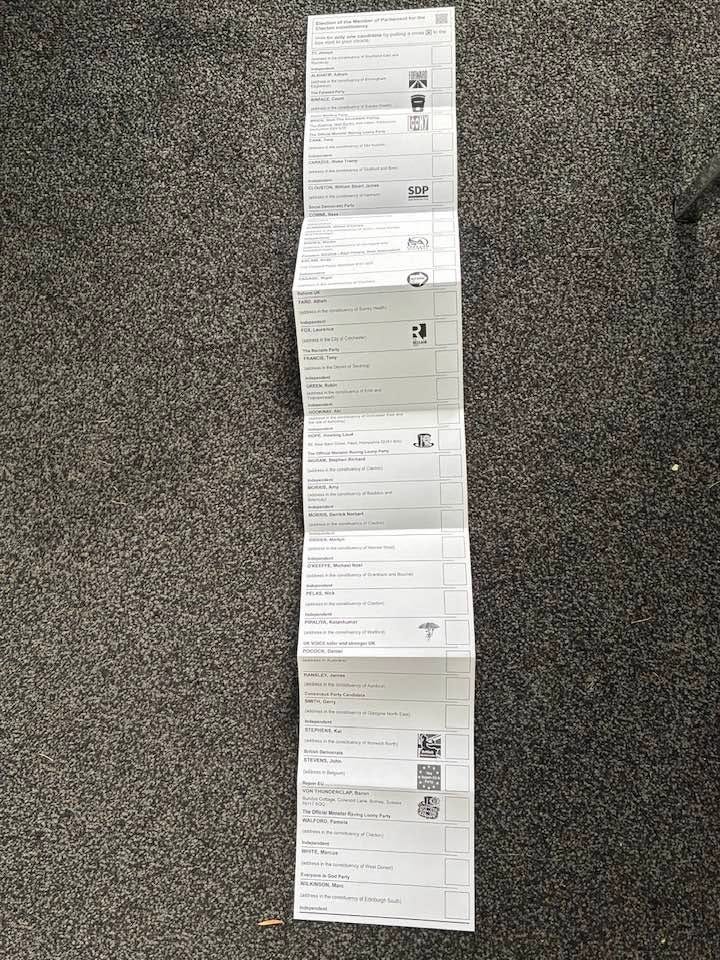
This time the Clacton returning officer has found a printer who can handle sheets of paper which are 90 centimetres long, but at a price: the printing costs for this by-election are far higher than normal. There are also going to be all sorts of issues at the count: apart from the difficulties in physically handling such a volume of paper, the ballot is simply too long to fit on Tendring’s normal counting tables. Tables are having to be doubled up to counter this, which will reduce the space available in the hall and lead to a slower count.
One opinion poll for this circus has been attempted by the polling company Survation, which gave Farage 73% of the vote against 20% for his main challenger, Count Binface. Binface, who leads his own eponymous party, claims to be the leader of the Recyclons from the planet Sigma IX. His earthly alter-ego is Jonathan Harvey, a comedy scriptwriter who has worked on Have I Got News for You and The Thick of It, among other programmes. Binface’ terrestrial address on the ballot paper is given as in the Sussex Weald constituency. Quite where his vote is going to come from is not clear, but I’d expect Binface to do well in the village of Weeley because of all the Weeley bins there.
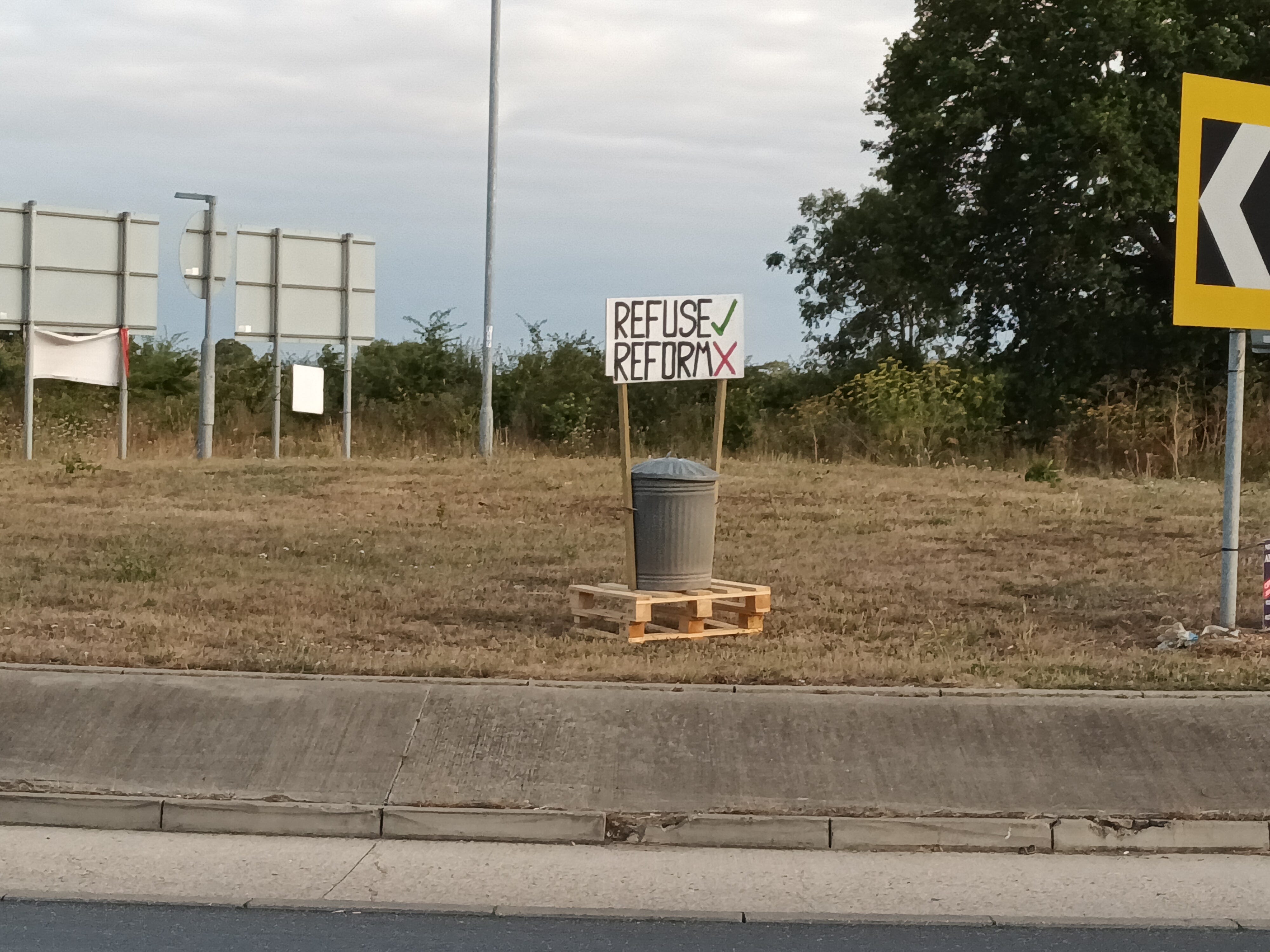
The character of Count Binface arose from a copyright dispute. Harvey had stood for election in 2017 against the then Prime Minister Theresa May in Maidenhead under the character of “Lord Buckethead”, which had originated in the 1984 science fiction film Gremloids. Released in the USA under the title Hyperspace, Gremloids was a Star Wars parody in which, according to Rotten Tomatoes (which has no rating for it), “Lord Buckethead (Robert Bloodworth) and his evil minions mistakenly land in a backwoods Southern town and proceed with their search for a rebel princess”. The film’s UK video distributor Mike Lee decided to publicise Gremloids by standing in the 1987 general election against Margaret Thatcher, under the name of Lord Buckethead who was supposedly representing the Gremloids Party (this was before the days when political parties were required to be registered). Lee repeated the trick in 1992, this time standing against John Major.
Unfortunately, Harvey’s 2017 campaign and other subsequent media appearances came to the attention of the director of Gremloids Todd Durham, who then wrote to Harvey asserting his legal rights over the character of Lord Buckethead. Durham took the character of Buckethead back and enlisted film journalist David Hughes to stand in the 2019 general election under that name, while Harvey’s response was to create Count Binface as a blatant ripoff of what was already a blatant ripoff of Darth Vader. Binface and Buckethead went head-to-head in the 2019 general election in Uxbridge and South Ruislip, with Buckethead - now on the ticket of the Monster Raving Loony Party - polling 125 votes to 69 for Binface. Nothing more has been heard of Lord Buckethead since, but Binface has had two high-profile runs in the 2021 and 2024 London Mayor election, polling over 24,000 votes and around 1% on both occasions and finishing in the top half of the field in 2021. He was last seen on a ballot paper at the Makerfield by-election two months ago, where he polled 95 votes and finished in the top half of the field: 7th place out of 14 candidates. Andy Burnham looked pleased to be standing next to Binface at the declaration.
The grandfathers of silly election campaigns are of course to be found in the Official Monster Raving Loony Party (beware of imitations), who have pulled off their own stunt by nominating three candidates for the one seat available in this by-election. This is something they have done before at local council level: there were nine Loony candidates for one ward in the 2012 election to Elmbridge council, and a Kingston upon Thames council by-election in May 2021 had 13 Loony candidates - six of whom managed to beat the Trade Unionist and Socialist Coalition’s nominee. Both of those efforts were orchestrated by Peter “Chinners” Chinnery, who deserved some sort of award for this: in this column five years ago I suggested that the Turner Prize would probably be the most appropriate award, but sadly their judges didn’t agree. The main barrier to pulling this stunt at parliamentary elections is the £500 deposit, so standing multiple candidates for a single vacancy gets very expensive very quickly as well as being a somewhat dubious electoral tactic. Nevertheless, the money has been found and we have three Loonies on the ballot paper. The party leader and Fleet town councillor Alan “Howling Laud” Hope is 84 now but he is still hopeful of beating Screaming Lord Sutch’s record for elections stood in (by my count, Sutch stood in 42 parliamentary elections while the BBC have this as Hope’s 38th contest); he is joined by Nick “The Incredible Flying Brick” Delves and former Bolney parish councillor Peter Berry aka “Baron von Thunderclap”.
We do have a few supposedly-serious political parties standing as well, and I’ll take their candidates in a random order. Adham Alkhatip is the candidate of the Forward Party, and he is no stranger to mammoth ballot papers: in May Alkhatip stood on that ticket for Tower Hamlets council in London, and he finished in 21st and last place in Bethnal Green East ward. Kai Stephens is standing for the British Democrats, a far-right group which split from the BNP in 2013; in May he was an unsuccessful candidate for Norfolk county council. Laurence Fox, who was the only candidate other than Farage and Binface prompted for in Survation’s poll (they gave him 2% support), is an actor who played DS James Hathaway in the long-running ITV detective series Lewis; he now leads the Reclaim party, and he was last seen on a ballot paper in the 2024 London Assembly elections. Fox’ last parliamentary campaign was the 2023 Uxbridge and South Ruislip by-election, where he finished in fourth place. Ketankumar Pipalaya is the leader of an outfit called UK Voice: he was an unsuccessful candidate for Mayor of Watford in May and he finished in 9th and last place in South West Hertfordshire at the 2024 general election. James Ransley, who runs a small business making furniture and is the chair of Kingsnorth parish council in Kent, is a former Conservative who fell out with the party over the Liz Truss Experiment; he now runs his own party called Consensus, and he stood on that ticket in Ashford at the last general election. John Stevens has beaten Nigel Farage before, when they both stood against the Speaker of the House of Commons John Bercow in the Buckingham constituency at the 2010 general election; Stevens was the Conservative MEP for Thames Valley from 1989 to 1999, when he lost re-election on the ticket of the short-lived Pro-Euro Conservative Party, and he is now standing for Rejoin EU from his EU address in Belgium. Martin Davies is the leader of the Freedom Alliance, and he regularly stands for them in local elections in Calderdale. William Clouston, who is the chair of Corbridge parish council in Northumberland, is the leader of the continuing SDP - a rather different political beast to the original SDP that Ivor Crewe and Anthony King wrote about - and he stood on their ticket in Hexham at the 2024 general election. And Marcus White, who was an independent candidate for West Dorset in 2024, is standing for a new group called the “Everyone is God Party”. This may be true, because I’ve got the body of a God ... unfortunately, it’s Buddha.
The remaining 20 candidates are independents, and again I will take them in no particular order. Amy Morris is one of just 5 women on this ballot paper (against 29 men): she gives an address in the Basildon and Billericay constituency, and she is standing on the single issue of abolishing inheritance tax. Daniel Pocock wins the award for the person who has travelled the longest distance to take part in this circus, as he gives an address in Australia. Robin Green, who lives in the Erith and Thamesmead constituency, wants you to “vote for me to put the brakes on AI, unseat Farage, and support common sense moderation”. Rees Cowne is a talent executive and business founder who was a Lib Dem candidate in Kensington and Chelsea at May’s local elections. Attieh Fard has been a regular recent candidate for the Conservatives in Surrey Heath, and she appeared in this column last year when she contested a by-election to Surrey county council in Camberley West division. Martyn Obrien, who gives an address in Harrow and is standing in his first election, describes himself as a normal hard-working Dad with family in Clacton. Pamela Walford was the Reform UK candidate for Maldon in the 2024 general election: before that she was the Conservative candidate trying to take over Giles Watling’s seat on Tendring council in 2019, but on that occasion she lost in Frinton ward to the localist party Tendring First. Abi Hookway is a business owner and property investor who gives an address in the Doncaster East and the Isle of Axholme constituency; she is standing for election for the first time. At the top of the ballot paper, “Joseph 77” is the pseudonym of Thomas Darwood who is a regular independent candidate in parliamentary elections (most recently in Southend West and Leigh in 2024). He last appeared in this column for the 2023 Uxbridge and South Ruislip by-election where I noted that the name “Joseph 77” is an allusion to the Book of Exodus: it refers to the seven years of plenty and the seven years of famine under Joseph’s viziership of Egypt. Tony Francis, who contested the Harwich and North Essex constituency in 2019 and gives an address in the Tendring district, is “offering voters a serious, independent and genuinely local choice”. “Woke Trump Carrzee” is the pseudonym of Matthew Carr, who stood under his real name in Cities of London and Westminster in 2024 and finished in 11th and last place. Andy Erlam, who is one of four candidates giving his full address on the ballot (the other three are the Monster Raving Loonies), has already earned his place in electoral history as the lead petitioner in the Election Court case of Erlam v Rahman, which saw Lutfur Rahman disqualified for corrupt and illegal practices in the 2014 Tower Hamlets mayoral election; Erlam, who now lives in Suffolk, was last seen on a ballot paper in 2019 when he was a Labour candidate for West Suffolk council and an independent candidate in that year’s general election for Poplar and Limehouse. Right at the bottom of the alphabetical ballot paper is Marc Wilkinson, who is the leader of a party called Edinburgh and East Lothian People and stood for the Scottish Parliament on their ticket in May; Wilkinson has turned up in this column in a number of recent Scottish by-elections over the last couple of years, and we will meet him again in three weeks time when he contests a by-election to Edinburgh city council. Nick Pelas gives an address in the constituency and is running on a localist ticket: by his own account, he has been working in the health and social care sector for over 30 years and he directs theatre productions and runs the annual Colchester Film Festival. Gerry Smith, who lives in Glasgow, wants better support for care leavers based on her own experiences of growing up in institutional care. Tony Cane, who gives an address in Norfolk, wants to put taxpayers and pensioners first. I have no information on Glenn Cummings beyond the fact that he gives an address in Staffordshire. Michael O’Keeffe is a retired teacher from Lincolnshire. And the two remaining candidates both give addresses in the constituency: I know no more than that about Stephen Ingram, while Derrick Morris came to Clacton as an asylum-seeker from Guyana and is “here to create The New Greater Clacton”. It’s not impossible that some of these people could end up with no votes at all - something which hasn’t happened in a Parliamentary election since the advent of the universal franchise.
That is your list of 34 candidates, breaking the record of 26 which, as noted, was set in 2008 by the Haltemprice and Howden by-election - another seat whose MP resigned to seek re-election and where none of the major parties stood. (The Greens did stand, but they were not really a major party then.) On that occasion the outgoing MP David Davis was re-elected. Nigel Farage will be hoping to repeat that trick; a galaxy of other people will be hoping they can beat him.
Before we leave Clacton, I’d like to thank the generosity of Andrew’s Previews’ subscribers. Twelve years ago I wrote another Parliamentary Special for this seat entirely from my desk. This time your subscriptions helped to fund a site visit to the constituency, which involved a weekend in a hotel and a drive of five hours there and five hours back. This piece is the result of your investment, and I hope I have done you justice.
Essex county council divisions: Clacton North, Clacton South, Clacton West and St Osyth, Frinton and Walton, Tendring Rural East (all except Ramsey and Parkeston parish), Brightlingsea (part: Great Bentley parish), Tendring Rural West (part: Frating parish)
Tendring council wards: The Bentleys and Frating; Bluehouse; Burrsville; Cann Hall; Coppins; Eastcliff; Frinton; Homelands; Kirby Cross; Kirby-le-Soken and Hamford; Little Clacton; The Oakleys and Wix; Pier; St Bartholomew’s; St James; St John’s; St Osyth; St Paul’s; Thorpe, Beaumont and Great Holland; Walton; Weeley and Tendring; West Clacton and Jaywick Sands
ONS Travel to Work Area: Clacton
Postcode districts: CO7, CO11, CO12, CO13, CO14, CO15, CO16
Joseph 77 (Ind)
Adham Alkhatip (Forward Party)
Count Binface (Count Binface Party)
Nick The Incredible Flying Brick (Loony)
Tony Cane (Ind)
Woke Trump Carrzee (Ind)
William Clouston (SDP)
Rees Cowne (Ind)
Glenn Cummings (Ind)
Martin Davies (Freedom Alliance)
Andy Erlam (Ind)
Nigel Farage (RUK)
Attieh Fard (Ind)
Laurence Fox (Reclaim)
Tony Francis (Ind)
Robin Green (Ind)
Abi Hookway (Ind)
Howling Laud Hope (Loony)
Stephen Ingram (Ind)
Amy Morris (Ind)
Derrick Morris (Ind)
Martyn Obrien (Ind)
Michael O’Keeffe (Ind)
Nick Pelas (Ind)
Ketankumar Pipalaya (UK Voice)
Daniel Pocock (Ind)
James Ransley (Consensus)
Gerry Smith (Ind)
Kai Stephens (British Democrats)
John Stevens (Rejoin EU)
Baron von Thunderclap (Loony)
Pamela Walford (Ind)
Marcus White (Everyone is God Party)
Marc Wilkinson (Ind)
July 2024 result RUK 21225 C 12820 Lab 7448 LD 2016 Grn 1935 Ind 317 UKIP 116 Climate Party 48 Heritage Party 33
Kirklees council, West Yorkshire; caused by the resignation of Reform UK councillor Craig Wiles.
Clacton is not the only seat Reform UK are defending this week. We also have a by-election taking place to Kirklees council, which is in West Yorkshire and is based on Huddersfield, Dewsbury and associated towns. This is a council which Reform UK took minority control of after May’s elections - but it took a very long time for this to be decided, with successive council leadership votes deadlocked until a Reform UK leader was finally installed in July. Kirklees council has a right-wing majority - May’s election returned 29 Reform UK councillors and 9 Conservatives against 14 independents, 12 Greens and 5 Lib Dems - but it took a long time for the Conservatives to reluctantly accept the Reform UK group leader as leader of the council.
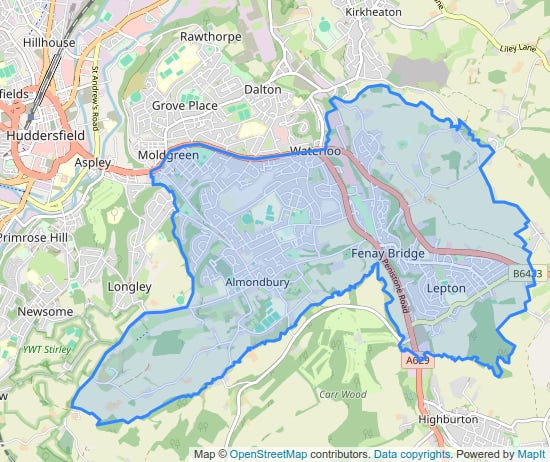
In fact, by the time the Kirklees branch of Reform UK were confirmed in power they were two seats down, after one councillor went independent and Craig Wiles quit the council altogether: Wiles handed in his resignation in late June on health grounds. He had been elected in May to represent Almondbury ward, which lies in the south-east corner of Huddersfield. Almondbury itself is an old village which was once the centre of an extensive parish but which has been swallowed up by Huddersfield’s growth, and its history is attested to by the presence of King James’s School: this is named after James I, who gave the school a royal charter in 1608. The village name is not a reference to almonds: “bury” comes from an Old English word for a fortification, and almenn is an Old Norse word for the whole community - literally “all men”.
The Almondbury ward extends south-west to take in the summit of Castle Hill, which was once a prehistoric hillfort and is now topped by the 106-foot Victoria Tower, which was erected in 1899 to mark Victoria’s Diamond Jubilee. The ward’s northern boundary is the main road towards Wakefield, on which we find Ravensknowle Park and the Tolson Museum inside it. This is a Victorian mansion which was given to Huddersfield Corporation in 1919 by Legh Tolson in memory of two of his nephews who had been killed in the First World War: the museum has been open since 1922, and its original natural history collection has been expanded over the years with exhibits relating to Huddersfield’s industrial history. For one day only, it’s also a polling station for today’s by-election.
The main road forks at the Waterloo junction, at which traffic can either go straight on towards Wakefield or turn right for Sheffield. Either direction will take you over the Fenay Beck into the large parish of Kirkburton, although this wasn’t always the case: the part of Kirkburton parish within Almondbury ward roughly corresponds to the former Lepton urban district, which was an independent unit of local government until 1938. As well as Lepton, we find here the village of Fenay Bridge down in the valley, and the newer housing of Lascelles Hall; the namesake Hall itself, another Victorian mansion, is currently lying empty.
The whole of Kirklees council was up for election in May following a boundary review, although this had little or no effect on the lines of Almondbury ward. The Reform UK slate topped the poll here three months ago with 37% of the vote, against 29% for the Liberal Democrats and 17% for the Greens. The ward had previously had a full slate of Lib Dem councillors, although the party hadn’t had it all their own way here over the last two decades: Almondbury ward voted Labour in 2015 and returned a Conservative councillor in 2016 and 2021. This is area is part of the Huddersfield parliamentary seat which is represented by first-term Labour backbencher Harpreet Kaur Uppal.
Craig Wiles was elected here in third place in May, so the winner of this by-election will fill in for the rest of a one-year term and will need to seek re-election in 2027. Defending for Reform UK is Graham Haigh, a retired business development manager who contested Greenhead ward in May. The Lib Dems’ Paola Davies is seeking to get straight back onto the council after losing her seat here three months ago: Davies was first elected for this ward in 2019 (gaining her seat from Labour) and was re-elected in 2023. Standing for the Greens is Sa’Dia Mosaddeq, a retail worker who contested Dalton ward in May. Also on the ballot are Robert McGuin for the Conservatives, Navraj Singh Hare for Labour and independent candidate Marquis Craven, who was runner-up in the town’s Ashbrow ward as a Reform UK candidate in May.
Parliamentary constituency: Huddersfield
ONS Travel to Work Area: Huddersfield
Postcode districts: HD4, HD5, HD8
Marquis Craven (Ind)
Paola Davies (LD)
Graham Haigh (RUK)
Navraj Hare (Lab)
Robert McGuin (C)
Sa’Dia Mosaddeq (Grn)
May 2026 result RUK 2224/2135/2060 LD 1755/1477/1378 Grn 1001/782/696 C 532/466/432 Lab 477/379/331
Previous results in detail
East Devon council; caused by the resignation of Labour councillor Violet Bonetta.
We’ll finish for the week in the West Country, at the scene of one of the UK’s more bizarre and more dangerous Quaint Traditions. Honiton is an old market town, located on the Fosse Way and the A30 London-Exeter road and known for its Georgian architecture and its traditional lace-making industry. The Georgian buildings are a byproduct of the town having been mostly destroyed by fire in the mid-eighteenth century; and heat is also a feature of the town’s annual Hot Pennies ceremony, dating from the Anarchy, in which warm pennies are thrown from balconies in the High Street to crowds of local people each July.
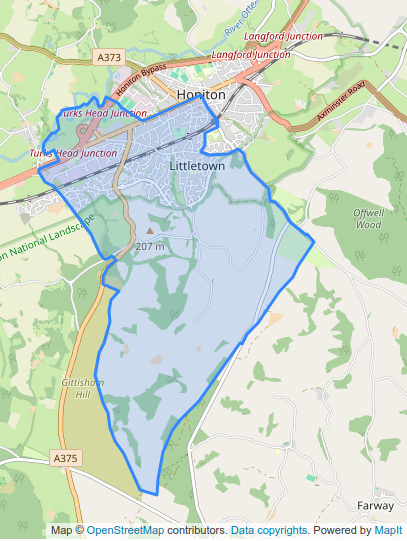
The town of Honiton is divided into two wards, of which St Michael’s is the south-western one. This is one of those wards which comes up in Andrew’s Previews over and over again, and this column has previously covered the ward in 2016 and 2021. The previous by-election here was a surprising Labour gain for a 19-year-old man called Jake Bonetta, who became the first Labour member elected to East Devon council in more than 20 years. He was subsequently the Labour candidate for Honiton and Sidmouth at the 2024 general election, and he last appeared on a ballot paper in 2025 when he was an unsuccessful candidate for Cornwall council.
Jake Bonetta didn’t seek re-election to East Devon council in 2023. Honiton St Michael’s was normally a Conservative ward, but Jake did manage to pass the Labour seat on to his younger sister Violet Bonetta, who was elected at the age of just 18 and broke her brother’s record as the youngest person ever elected to East Devon council. St Michael’s ward split its three seats three ways three years ago between the Conservatives’ Jenny Brown on 31%, Labour’s Violet Bonetta on 26% and Roy Collins on 23% in a rare local government win for the continuing Liberal Party; the remaining 21% of the vote went to independent candidates. None of the three outgoing councillors had stood for re-election. East Devon council is hung, with an alliance of Lib Dem, independent and Green councillors in control.
Despite this the two most recent polls in Honiton have had Lib Dem winners. The July 2024 general election in Honiton and Sidmouth pitted two outgoing MPs against each other, with the Lib Dems’ Richard Foord - who had won the 2023 Tiverton and Honiton by-election - seeing off a challenge from the Conservatives’ Simon Jupp who had previously represented East Devon. Not only did Jupp’s attempted chicken run fail, his old seat - renamed as Exmouth and Exeter East - remained in Conservative hands. The last election here was the 2025 Devon county council election, at which the Liberal Democrats gained the Feniton and Honiton division from the Conservatives.
Violet Bonetta left the Labour party last year and she has now quit East Devon council altogether. No reason appears to have been disclosed for either of these resignations, but her LinkedIn suggests she is pursuing a legal career and it wouldn’t surprise me if she has left the town in furtherance of that. She was also one of the UK’s few openly transgender councillors.
Defending this seat for Labour is Jack Stacey, who is a doctor and a British Medical Association rep. The Conservative candidate is Paul Carter, who stood here unsuccessfully in 2023 and previously appeared in this column at a 2022 by-election in Newton Poppleford and Harpford ward: he is a farm manager at the Donkey Sanctuary in Sidmouth. There is no Liberal Party candidate this time so their vote is up for grabs. We have two independents on the ballot: Jo Fotheringham is a former Honiton town councillor who stood here unsuccessfully in 2023, and John Taylor was elected to the town council in a by-election for Honiton’s other ward last year. And given last year’s county council result the candidates for two parties which didn’t stand here in 2023 might fancy their changes: Reform UK’s Humphrey Clemens is a long-serving former Teignbridge Conservative councillor who represented Dawlish South West from 2003 to 2019, while the Lib Dems’ Rhys Wallis is chief of staff to a Lib Dem MP and has recently been co-opted to Honiton town council.
Parliamentary constituency: Honiton and Sidmouth
Devon county council division: Feniton and Honiton
ONS Travel to Work Area: Exeter
Postcode district: EX14
Paul Carter (C)
Humphrey Clemens (RUK)
Jo Fotheringham (Ind)
Jack Stacey (Lab)
John Taylor (Ind)
Rhys Wallis (LD)
May 2023 result C 708/508/531 Lab 598 Lib 534 Ind 477/419
July 2021 by-election Lab 807 C 522 LD 63
May 2019 result C 790/763/530 LD 700
Previous results in detail
If you enjoyed these previews, there are many more like them - going back to 2016 - in the Andrew’s Previews books, which are available to buy now (link). You can also support future previews by becoming a paid subscriber to this blog - which will also you get you early access to the Previews.
Andrew Teale
No posts
Comments
Nothing yet. Say the first thing.
Sign in to join the conversation.