
Edited by Tom Gledhill
The debut album from Verses GT is grown and sexy dance music. At first, I was surprised at how subdued the full-length collaboration from Nosaj Thing (Jason Chung) and Jacques Greene (Phil Aubin-Dionne) was. But then it made sense: both artists have orbited the peripheries of dance music rather than fully living inside it. But, crucially, the pair understand dance music. Both their discographies show an impressive grasp of the mechanics that underpin everything from drum & bass bangers to soulful house.
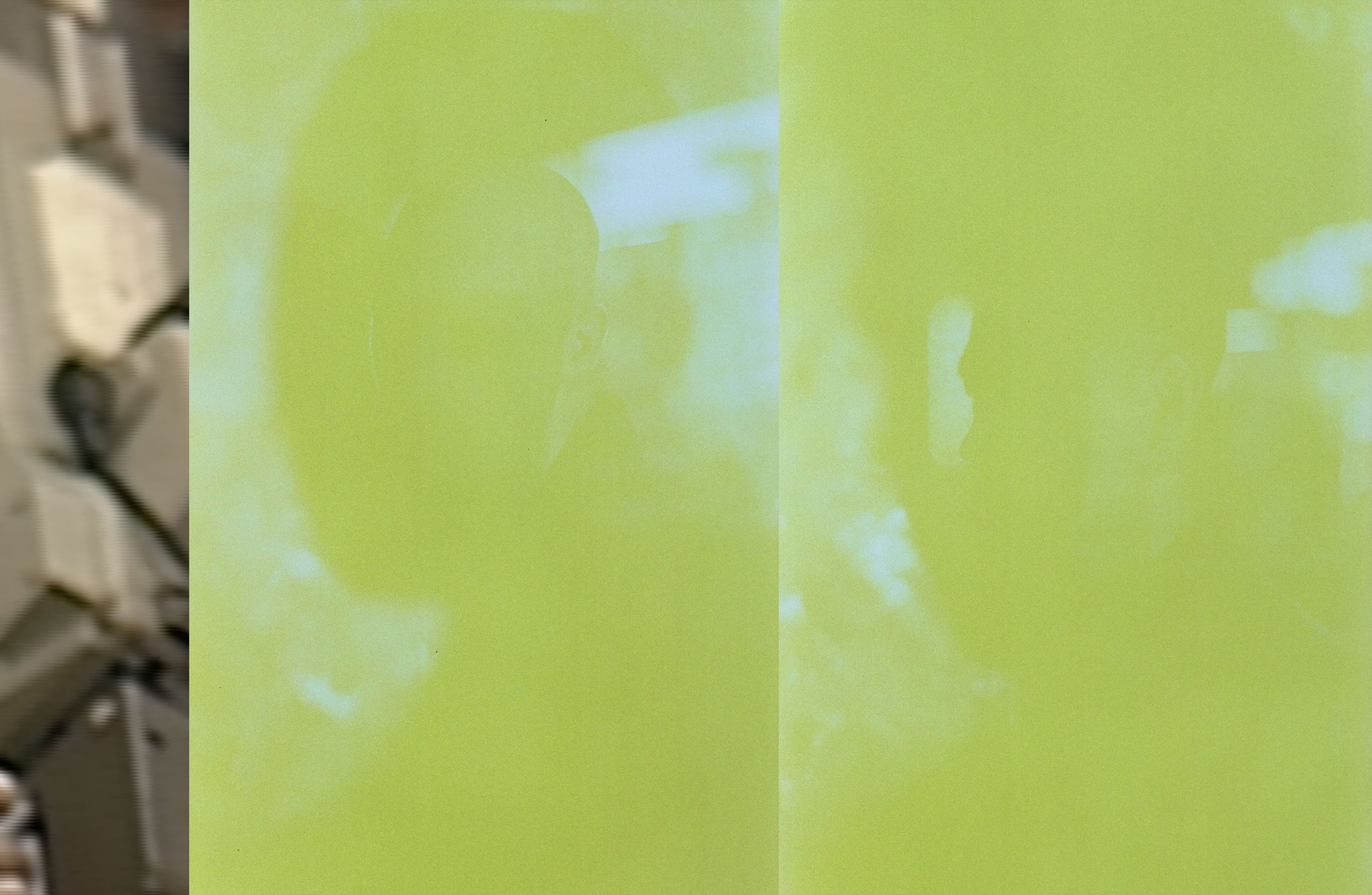
Each artist also operates with a distinct visual language, though there’s a shared lexicon informed by arthouse cinema, music history, and, above all, fashion, from luxury designers to streetwear companies. You can feel it in pretty much anything either artist has put out on their own, as well as the album cover: a fetching pea-green abstraction that’s actually a portrait of the two artists. Streamlined, sleek, meticulously (but seemingly effortlessly) designed, these traits transfer over to the music, which revels in its lack of flashiness. The drums knock, the basslines roar, the technicolor synths blanket the soundscape. But the abyss also yawns. Every time you think a track is going to kick into high gear, the duo pull back. There’s precision and elegance here, but not always at the expense of power.
Take “Forever,” which is kind of like a Chainsmokers song if it were actually good. It builds up towards a glowsticks-in-the-air chorus with some beautifully weepy trance synths and a revving bassline waiting in the wings. But instead of letting it all hit at once, the duo suddenly pull back the low-end and rhythm section, so vocalist KUČKA is hanging in the air alongside that Kaskade-worthy chord progression. Put together, all of these elements would make a barnstormer, but the duo never let these to crescendo. Waiting for a drop that never happens can be frustrating at first, but the minimalism is also kind of chic.
Verses GT is stays at a simmer instead of giving in to any clubbier impulses. Ambient-ish tracks like “Wan”—a beautiful dead-ringer for peak era, pockmarked Clams Casino, and possibly named after him—are every bit as interesting as the meatier songs. Even “Intention,” the most straightforwardly housey track, leans more ambient than dance, moving at a listless, almost hungover pace. Other songs are ambient and dance at the same time: “Left” muffles its kick drum underneath Burial atmospherics that whirr and whine like a flurry of spirits leaving a graveyard in a hurry.
I might have preferred an entire album made up of the vocal collabs that anchor Verses GT. (Or sounded like their great first single together, “Too Close,” featuring Montreal singer Ouri, which isn’t on the LP.) These pop songs instead provide tension for the album, like the anxious “Your Light,” whose suppressed feelings and low rumbles sound like a drum & bass track having a heated argument with itself. But they didn’t make that kind of album, and that’s OK. They made something prettier and more exquisite. Because despite their recent predilection for studio work, here, these two aren’t really pop producers. They’re more like sound sculptors, and their tracks function that way too. The album invites you to appreciate each of its manicured compositions on its own, like pieces on display in an art gallery.
For the interview below, the duo spoke to me over Zoom from Jacques Greene’s Montreal studio during the rehearsals for their in-progress live tour. We spoke about the nature of collaborating, putting together the album, and the value of working together in person.
How did you start working together way back when?
Phil: Our good old friend Rob Squire is the great unifier here. There was a crazy moment where Rob was on tour in California, and you opened the show, like… 2007?
Jason: Yeah, Sixtoo was playing this small venue in Pasadena called The Terrace. I was like… what the hell? How could he be playing in Pasadena? I knew the venue owner, and he asked if I wanted to open. I remember after I played my set that I brought a box of my own CDs that I burned, and it was the first time I had ever sold out of them. Rob came up to me and said, “Yo, man, sick set, I’m gonna bring you to Montreal one day.”
I had never played outside of LA, and sure enough, 6 to 12 months later, he brought me out to Montreal and let me stay at his place.
Phil: This was around the time that I first ran into Rob, and he was lending me synthesizers and stuff I was making inroads into DJing around the city. He really took me under his wing. That was one of the first parties where we all connected. That was the first connection. And we were, like, the younger generation coming up under him.
We were friendly—we weren’t actual friends for a while. And then we would run into each other, especially with, like, the Wedidit guys or whatever.
Jason: It was a slow build.
Phil: In the mid-2010s, we went on tour together with Dimtri From Paris and Jim-E-Stack. That’s when we became true friends.
OK, so how did you start making music together?
Phil: At first it was kind of like a relief, a nice escape. Right up until the time it got stressful with deadlines. The point of working together, or why we started doing it more—I was coming to LA to make music, so we would link up, go to the San Gabriel Valley and get a meal, and we started freeforming and putting beats together. It was relaxing and comfortable.
I always like making music—I don’t think it’s ever truly stressful, but in this case, it was just nice. From the start we were giving ourselves fertile ground to try stuff and surprise each other in a way that felt really good.
Jason: I was trying out different lanes, getting more behind the scenes and doing more session work. I would get thrown in with all kinds of artists and it was rare to have a session where things aligned so well, especially taste-wise. When I started working with Phil, I was like, “OK, we’re aligned.” We get each other, our references are similar. It was just easy. Not even just on a music tip. He would see my books and my art. I was living in the Arts District at the time so we would go out for walks and check out some shops, and some clothes. Everything we talked about, we aligned.
Phil: It was basically just wanting to push a good hang further.
So at first you were basically just having fun. Not doing anything with a project in mind.
Phil: It snuck up on us, honestly. Even at first, before 2020, we had a couple loose ideas, but it would never be like, “this is for my album,” or “this is for your album,” or, “we should send this to a singer.” It was just… some cool music. At first I thought that maybe one day I’d sample the stems from these tracks in one of my own tracks.
When we started linking up after Covid, we made the “Too Close” record. But I don’t think either of us thought there would be an EP or an album with this—it was just a really cool track. We thought we should just put it out together. Then it dawned on us that we had a few other ideas that could be usable, and it felt like, well, this is not quite a JG track, and it’s not quite a Nosaj track. There was this little pocket developing.
By the time we had three or four of those, and then we made “Unknown,” we were like “Oh.” [smiles] “Oh, let’s go for it.”
Why do you think you guys work so well together? What is it, aside from having similar taste?
Jason: We come from the same time. What was going on in Montreal with Phil, Lunice, Sixtoo, was similar to what was happening with Low End Theory. HudMo. 2007 to 2011, we were all touring together. Then Phil and I were like, wow, we’re still here, we’re still rocking together.
Phil: That’s something Hudson Mohawke said to both of us at different times, like—how insane it is, how against the odds it is that we’re all still around, the idea that we’re these bedroom producers that made it through the Myspace wars and the trench warfare of SoundCloud. I think with that comes a certain moodiness or texture that overlaps between our music, but at the end of the day there’s a lived experience, and a lot of cultural reference points. We just speak the same language.
Jason: Also, just zooming out, me personally, I get more excited when I see other producer homies collaborating more than when I see a feature from an artist. As a fan, that’s how I feel.
You do everything in person, right?
Phil: Obviously at some point, we’ll be apart and I’ll be like, “Hey, I lowered the snare a bit.” Like there’s some minutiae that happened from far away. But we probably would have had an album ready a year and a half earlier if we didn’t insist on working together in person. I think there’s only one song that started as an idea when we were apart. Every other song, the entire bones and structure and foundation, was all done together. I think it helped us with demo-itis, or allowing ourselves to reinvent songs, because we would be like “move this all the way this way,” and then apart we’d make incremental moves, and then three months later I’d be back in LA and we’d move it ahead again. Or maybe we haven’t even thought about that song in two months, because by design we’re not just toiling away at it all the time.
So when you’re working together in person, how do you come up with an idea or decide to start working on something—what does that look like?
Jason: I think our best ideas developed outside the studio—just from going for a walk around the block, or getting a coffee or something. Phil’s kind of an idea generator. He’s always like, “What if we did something like this?”
Phil: You’re eating a bowl of pho and I’m like, “What if we did a track that started like this?”
Jason: He really likes to serve the ball. I respond, and then we’ll start building this world together. By the time we’re back in my apartment or Phil’s studio, we know exactly what to do. Those are the highlight moments: “Unknown,” or “Found”—those are two examples.
Phil: And “Intention.”
Jason: Those are all tracks that were complete in like an hour.
Phil: “Unknown” was one of those ones that materialized in front of us while we were making it, but “Intention” and “Found” felt like they were done before we even started making them. We’d have talked enough about them. This was right before our first ever live show. And we wanted something ¾ of the way through the set—we were picturing the SAT, it’s MUTEK, this is the headspace, this is the context, this is the time of night, this is what the room is going to feel like. Where do we want to go, like, 45 minutes into the set? It’s gotta be loopy, hazy, we gotta drag people through the mud and bring them into the light. And then it just happened, because there was less guesswork around it. That’s been the best part of this project. When you’re working on your own music, alone, you have to be like,. “What do I want to tell the world?” And you’re only having that conversation with yourself. When we’re serving, playing this creative tennis, throwing ideas back and forth, it becomes easier to create a plan you can trust and second guess yourself less.
So you feel less self-conscious working together.
Phil: There are certain moments on the record where I knew that Jason made those parts, or these creative decisions that are more a part of Jason’s brain, and that not only feels less self-conscious, because it’s less of myself, but it’s also really exciting because it feels greater than my own POV, than what I would choose by myself. It becomes a richer text.
You said that you finished a few tracks in an hour. Knowing you, Phil, I think that’s not usually the case, right? Why is it easier to decide when something is finished while working together?
Jason: I think it’s just from all the conversations we have. We built some constraints. We had multiple conversations. Growing up listening primarily to hip-hop producers, you could tell any Timbo beat or Neptunes beat or Mannie Fresh beat in the first three seconds. So we started by making this palette of sounds. There’s no extra guesswork—we know exactly what we were gonna do. Once we had that toolkit and sound palette, we knew exactly what to do. We also had an opportunity to DJ and do this back-to-back tour, and that was super helpful.
Phil: It was helping us form our own context, our own world. Picking out music and being like, “Oh, this is a Verses record.” And finding something else that’s not. And the speed is also down to using the Ableton Link function and having two laptops at once. It was very jammy, not like a jam band, but in the sense that I would have a chord going and before I even figure out how the melody resolves he’s got a rhythm that goes with it. So it’s actually all moving very fast. It’s those constraints, a sense of trust, and we’re pretty proficient at working together after doing it for so long. All those things together, we’re just working around the room. He turns on the Prophet and adds a bassline and I’m like, “Yeah, that’s the note. Keep doing that.”
A lot of this process was about removing second-guessing, and having the other person help with that. Sometimes my role in the duo was to just be like, “No, that’s good. Don’t overthink it.” Which I think comes from watching interviews with rappers who just crank shit out and have a trust in their ability, and to recognize that one burst of inspiration. Like, “Yeah, that knocks.” And I would never be able to come to these decisions on my own.
Jason: The timing was good, too. We’ve already done solo albums, collaborated and done vocal features, and learned a lot individually.
You said you created a sound palette at the beginning, I guess almost like a moodboard. What are those sounds you wanted to be associated with the project?
Phil: It was more of a mood, a feeling—we wanted something that didn’t feel too splashy or showy. We wanted it to be loopy, with not too many changes. A pared-down feeling. And a reserved feeling of cool, and confidence. Not forcing it. And there was a subconscious mishmash of all our influences we wear on our sleeves—in the drums, and the Reese basslines, and shit like that.
Jason: Our DJ tour definitely helped shape that sound, too. We were always surprising each other every night, and our set got really tight after a few gigs.
What were those surprises? What would you bring to your back-to-back sets that you wouldn’t bring to your own sets?
Phil: Jason would often play housier than me, and make me reach for a Mood II Swing record, or something that I wouldn’t reach for these days. Maybe I would have played it in an earlier JG DJ set like ten years ago. That traditional dance music zone was really fun, and feeds into some of the simplicity and cohesive sounds across the record. And then I would try to surprise you or reach far and wide on some of the new-school UK stuff, like Livity Sound or Cloudcore—where there’s intricate low end work but the drum patterns are really weird and interesting.
Jason: I learned a lot from that tour. I consider Phil a very seasoned DJ and I learned so much from him. I would be a little more on the safe side and play more drum tracks, like pocket-focused, and he would play something weirder.
Phil: I would hold back some of my sillier impulses. Still, now, when we DJ together, the bigger moment might be a Leon Vynehall record, not an Addison Rae remix.
The album sounds big, but it’s also subdued. I found myself thinking… like, what or who is this record for? For you guys, is it dance music, or are you more of a band?
Phil: It’s more car music, in-the-house music. When we were trying to make decisions on breakdowns or EQing, I would say: live act at Sonar By Night. Or Club 2 Club. Picturing the final optimal live context for the music. But we also made decisions based on what would sound good in the car. It’s definitely night-driving music.
Jason: To me, this project is just a beginning. It’s not just a music project, it’s also a visual project. We put out some photography by our friend Xavier Tera and our friend who we’ve known forever, Terence Teh, creative directed the project. We have these short films coming out, and we’re going to be scoring Xavier’s first feature-length film. We’re excited about where it’s gonna go.
Phil: As far as who the record’s for, that’s truly… without being annoying, or clichéd, this is a case of making a record for each other. But this is also the first album I’ve made that I would listen to myself. I haven’t really revisited my two albums to cross-reference, but this one feels more in tune with records I’m putting on in my house, like Ghettoville by Actress. This record feels closer to that lineage in electronic music.
And hopefully we start to figure out who those people are this week.
What drove you in that home-listening direction, instead of making a straight-up dance record?
Phil: We’re old now, I guess. That’s part of it. I love clubbing, but… I think there are different things for different contexts. Sometimes you can run a ceviche spot and not be jealous of the hamburger guy. You can focus on what speaks to you and what you want to be working on.
We would play tracks to our friends, all kinds of stuff that we were working on, not just Verses stuff, but we would get to “Unknown” and people would be like, “Damn, what’s this one?” There were a few moments like that. And then it was just like, not giving too much thought to things like, “Is this a Beatport track?” That’s not really entering our headspace. It was a lot more self-indulgent. When I left a session I would load up the export in my shitty rental car in LA, listen, and then think: “Do I want to run it back? Do I want to listen to it a few times?”
What did the drive tests reveal to you about the music?
Phil: To me, it was less is more. If every ingredient is well-considered, then there shouldn’t be anything fighting for relevance. You can appreciate each element. I went back and forth on maybe making some songs longer. We did have longer versions of the ambient tracks, but in today’s economy and even with my own ADD, I’m happy with how every track leaves you wanting more instead of dragging.
Driving is a good space because you’re also busy—you’re fully listening, but maybe 20% of your attention is distracted. In the car I immediately know if a part is too long or if a snare is too loud. Everything is in its right place if it feels good in a car.
Jason: The drive test was important. For me, it was just about if it feels good. Simple as that. I don’t overthink it. It’s the same thing: do I want to run it back? During the process, sometimes I would listen to the same track on a loop for the whole drive.
Phil: It can be kind of addictive—like if I was excited about a new track, I could just listen to it forever. But you actually need some distance. Because then demo-itis sets in.
Jason: There were some fun moments where we would both be in our separate cars and then meet for dinner.
Phil: We’d get to that place in Koreatown and be talking about the track, the parts we liked, and we would both be excited.
Jason: That’s how collaborating should be.
Phil: At the end of the day, it was just about psyching each other up. Just making each other say, “Damn, that’s crazy!” Trying to make each other excited.
Jason: We just had a lot of fun making this record.
What can the two of you do together that you can’t do by yourselves, aside from finishing a track quickly?
Phil: For me, personally, Jason’s presence and instinct allows for a directness and simplicity I’m unable to get to. I stack things, it can sound busy. I don’t revisit my stuff too often, but sometimes I do and I think I wish I had a Nosaj Thing there to tell me to mute that tom.
Jason: Phil always surprises me with what he throws on a track. It’s always different, too. It could be a crazy vocal chop thing, or just a simple drum pattern. He’s really good at placing things. He has such a good understanding of dance music. But I wouldn’t consider this record a dance record. So having those ideas is exciting for me.
If you don’t consider it a dance record, then what do you consider it?
Jason: For me, it’s more like an “electronic” record.
Phil. Electronica. Period. Electronica is back, baby. It’s not really audible on the record, but one north star for me was: what if Massive Attack started today? If, instead of taking from hip-hop, dub reggae and dusty breaks, what if what they were taking from was more contemporary to us? What would that sound like? That same sense of cool and restraint? It’s amorphous, but there’s a throughline—a mood and a taste level—that holds it together. Thinking about what if I was Massive Attack and just starting out in 2025, what would I think is dope? And think backwards from that. It’s by no means a trip-hop record, but… electronica is what I’m standing on. Because it’s a band-based, song-based approach to electronic music.
Jason: It was exciting for me when I would go to Tower Records and listen to those CD stations. There was a Roni Size record, a Röyksopp record and a Chemical Brothers record.
Phil: Jason and I have such shared musical history that goes way back. Like, we were huge fans of Prefuse 73, Boards Of Canada. The Warp/Ninja overlords, but also Def Jux. Even Institubes…
Jason: Astralwerks!
Phil: But I also don’t think any of my own albums are full-on dance music. 909s, 132 BPM, sure, but it’s not that straightforward.
Given how dance music can be so rigid in characterization, do you think there’s more of an audience for this kind of in-between music now than there was before?
Phil: I think in general audiences are more open-minded, but club bookers and dancers are more closed-minded than ever.
Mic drop.
Phil: I think since Covid, clubs and festival stages are extremely narrow musically, and it’s much harder to present something that’s outside the box or have them wrap their heads around it in the club environment.
Jason: I hope there’s more of an audience for this music. We’ll find out on this tour, I guess. We don’t know.
Doing this tour as a live act, does it feel different than going on tour as a DJ?
Phil: Oh my god, you have no idea. We’re talking to you from a table that’s full of gear. I’ve spent $250 on cables in the last two days. We have two or three hard pelicases coming with us.
Jason: We don’t have a tour manager with us. It’s just ourselves.
Phil: We have a week of ten-hour days of rehearsal and light programming. And every day we have to pick an earlier flight option so we can make it in time to soundcheck. For me, because I tour more as a DJ than Jason does, I feel like it’s a bit of karmic balance. It’s good points of Mana for every time I showed up with just a USB and had a chance to have a nice dinner before going to play at the club. Every DJ should be forced to do this for six weeks every two/three years.
Are you excited?
Phil: Absolutely. Making the music is fun, but finishing and putting it out is a bit of a grind. All of the management, strategizing, even sorting out the [publishing] points, really removes you from the music and the joy of creation. Then the sprint to release is exciting but stressful. I think when we play the first note of music on Thursday, it’s gonna feel great.
And to that question earlier, who is this record for—of course old fans of ours, but also ideally new people who are just starting to come to us. We worked on this record all by ourselves, and then we just put it on Spotify and Bandcamp, or whatever. To see who shows up in the real world will be very exciting to me.
Jason: It’s a new lane, for sure.
Phil: I just want to hear it loud.
No posts
Comments
Nothing yet. Say the first thing.
Sign in to join the conversation.