
7:32 AM. I pull my Honda Civic into the driveway of a rural Minnesota home. A study in countryside kitsch, the yard is adorned with various lawn ornaments and, most importantly, about a dozen bird feeders. As I step out of my car, the dawn chorus of Black-Capped Chickadees, Pine Siskins, White-Breasted Nuthatches, and Hairy Woodpeckers gives my sleepy brain a healthy jolt. This is allegedly one of the most reliable spots in the Sax-Zim Bog area to spot Evening Grosbeaks, but it seems luck is not on my side today.
As I expectantly scan the feeder visitors, my eye is drawn across the snow covered dirt road to the neighbors front lawn. A hand-written sign reads: “PRIVATE PROPERTY! NO BIRDWATCHING!” God forbid an Evening Grosbeak alight on one of their trees lest I get a reprimand or worse for even looking in their direction. The contrast established by this front lawn admonition got my brain churning. Here I was on one side of the road parked in the driveway of a total stranger who has put trust in the birding community to treat her home and its avian visitors with respect. On the other side, some sort of personal or political beef has resulted in total birder banishment. If the Sax-Zim Bog has friends, clearly it also has enemies.
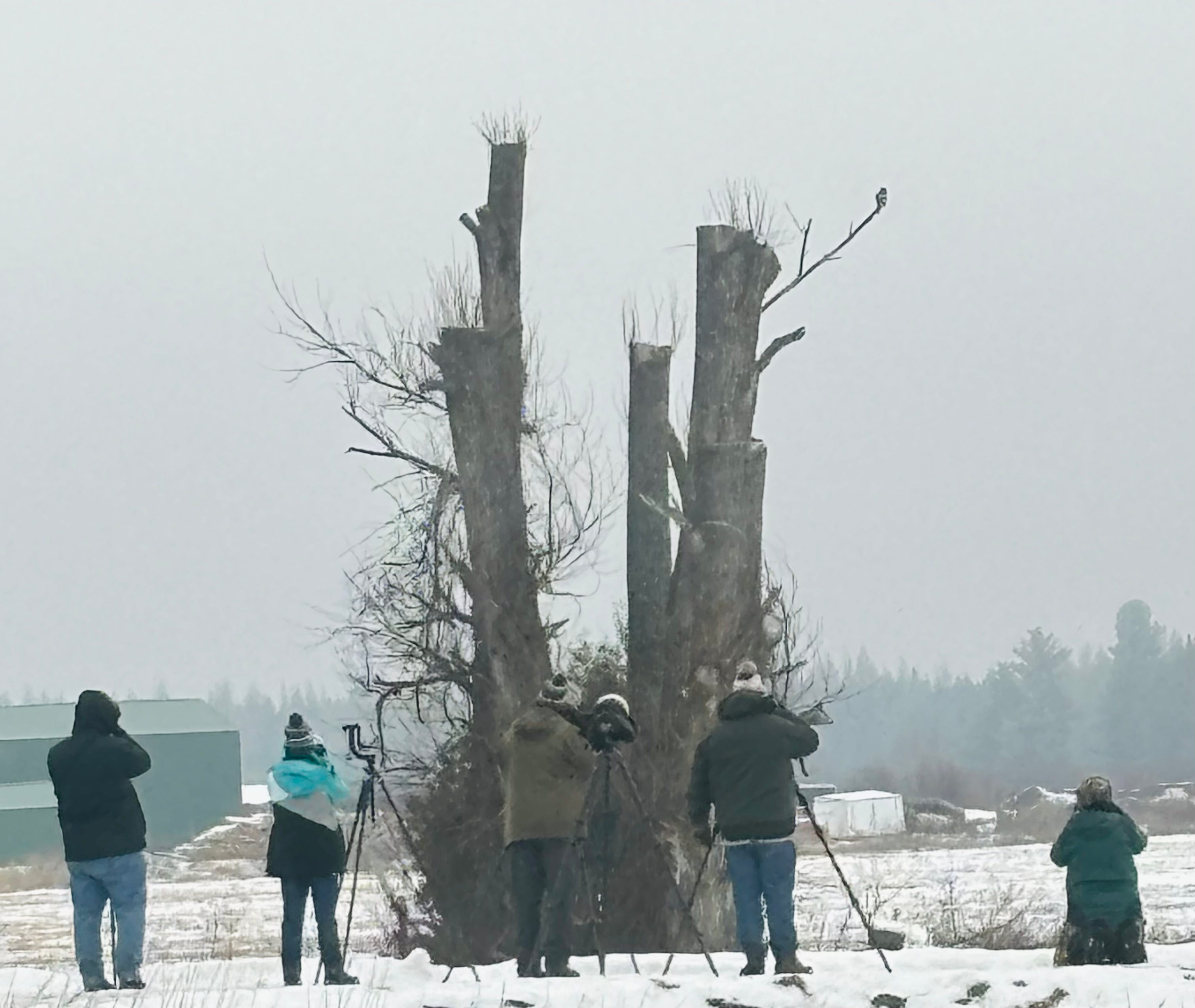
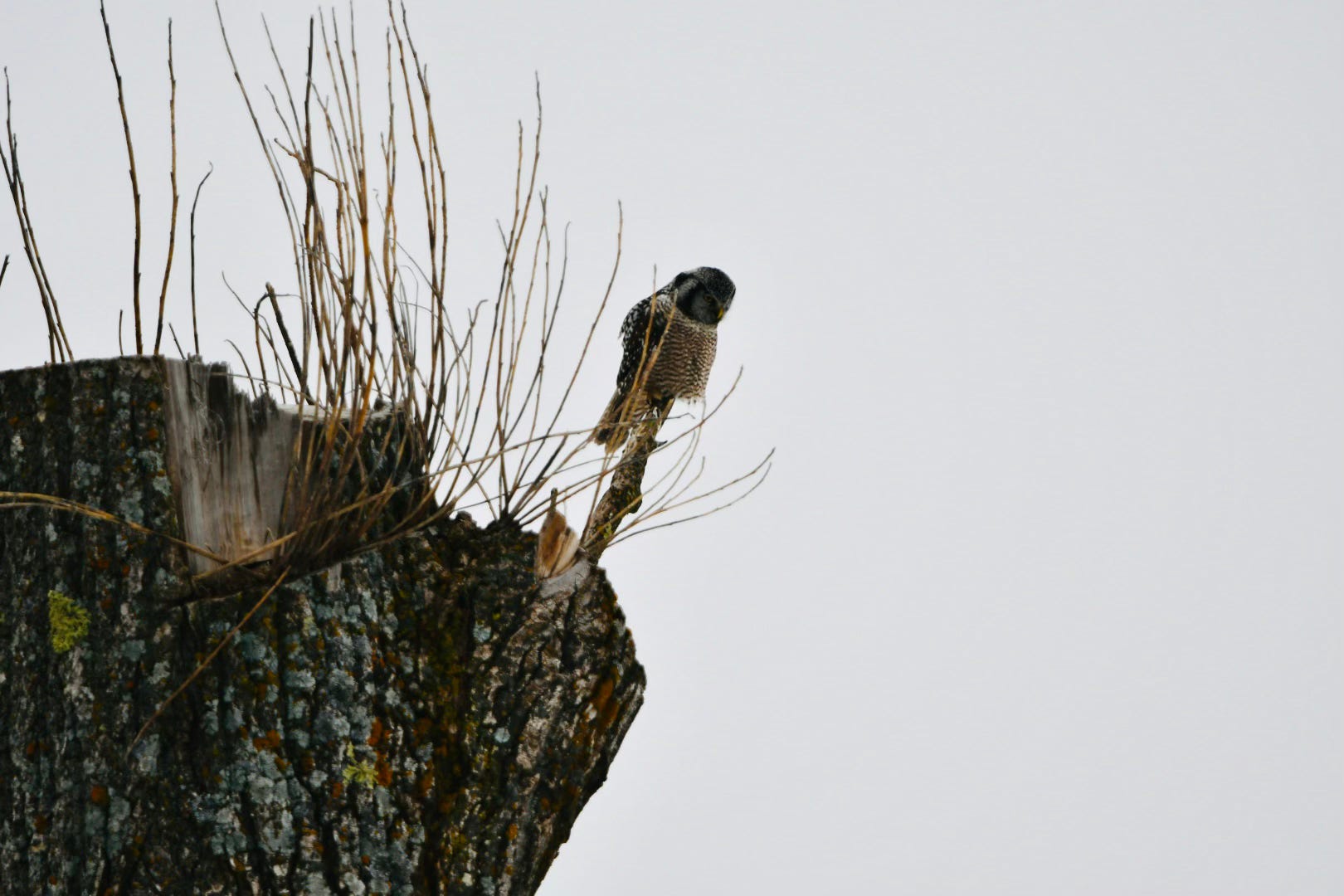
These thoughts only intensified for me when, later that day, a local posted an exasperated rant on the bog bird sighting Telegram chat. A Northern Hawk-Owl was perched on large snag on the side of a paved 55 mph speed limit county highway. As with any owl sighting, the long lens brigade descended quickly, parking their vehicles on both sides of the road and even blocking residents driveways. This provoked the ire of the local man, and he entreated the visiting birders to act more mindfully in the pursuit of the perfect photograph. Putting aside the feelings of residents about traffic on their roadways, how must the owl feel about this mob forming around him? Contrasted with the quiet of the boreal forest, this hullabaloo must be at the very least irksome.
And there I was, in the middle of it all. I always fancy myself an ethical enjoyer of wildlife, but did I not stop my car on the side of the road to get a view of the same owl the day before? Did I not gift myself a snazzy new camera and telephoto lens for Christmas so I could take the very same pictures? Was I not enjoying birds coming to visit a feeder? Did I not use three tanks of fossil fuels driving between Chicago and northern Minnesota? These doubts swirled in my brain and ultimately crystallized into one big question mark: Should I even be here?
I would like to take a minute to clarify that this is not meant to be a dig at the fantastic work that Friends of Sax-Zim Bog has done to protect this critical habitat and the birds and other wildlife that rely on it. These are merely the personal musings of a man constantly plagued by doubts about his relationship to nature. Traveling far from home just happens to bring these doubts into sharper focus.
When I bird my usual haunts in Chicago I feel like I belong. I know exactly how to behave, I know which trees to scan for which birds, I know where I am. I actively steward these areas as well. Between monitoring the piping plovers, picking up plastics from the beaches, and politely correcting dog owners who have strayed beyond their boundaries, I feel as if my impact on these areas is more positive than negative. I also know that Chicago’s small nature footholds are mostly a result of careful restoration of former steel mills, airports, etc. These spaces would not be blooming and buzzing with birds and butterflies were it not for invested birders and nature lovers. Finally, I can quiet my conscience since almost all of these oases are accessible via bikes, buses, or trains! Nothing beats zero emissions birding.
To reach and then properly explore Sax-Zim Bog, however, you’re going to burn through at least a couple tanks of gas. The area itself is not one discretely bound wildlife refuge, but instead a 300 square mile patchwork of protected bogs, forests, and meadows interspersed with towns, farms, and industrial operations. Far from a pristine wilderness, the human impact on the place is undeniable.
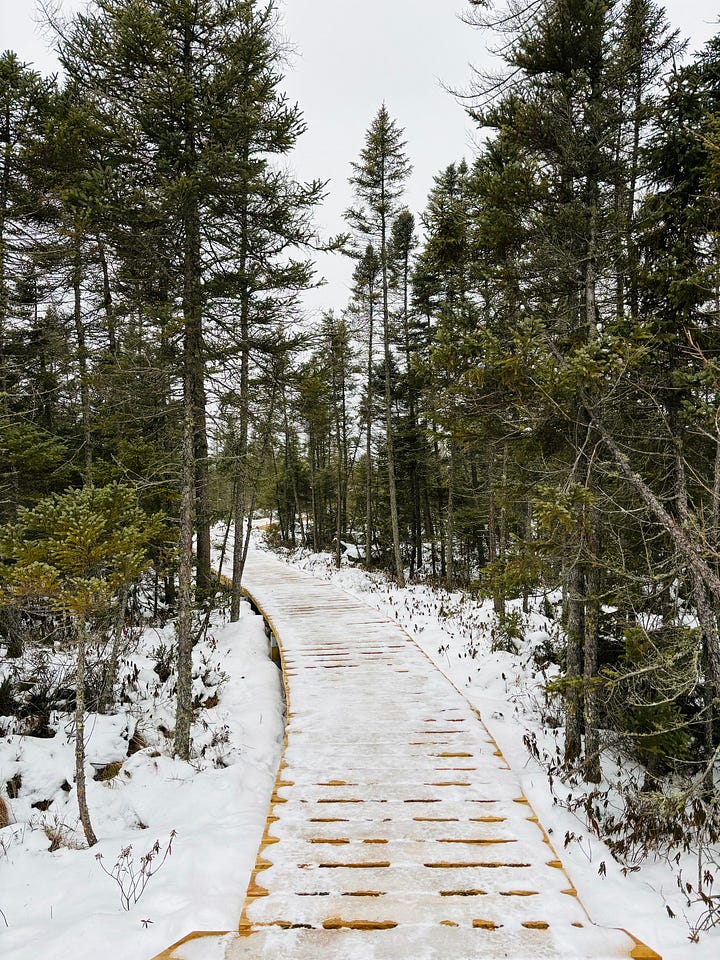
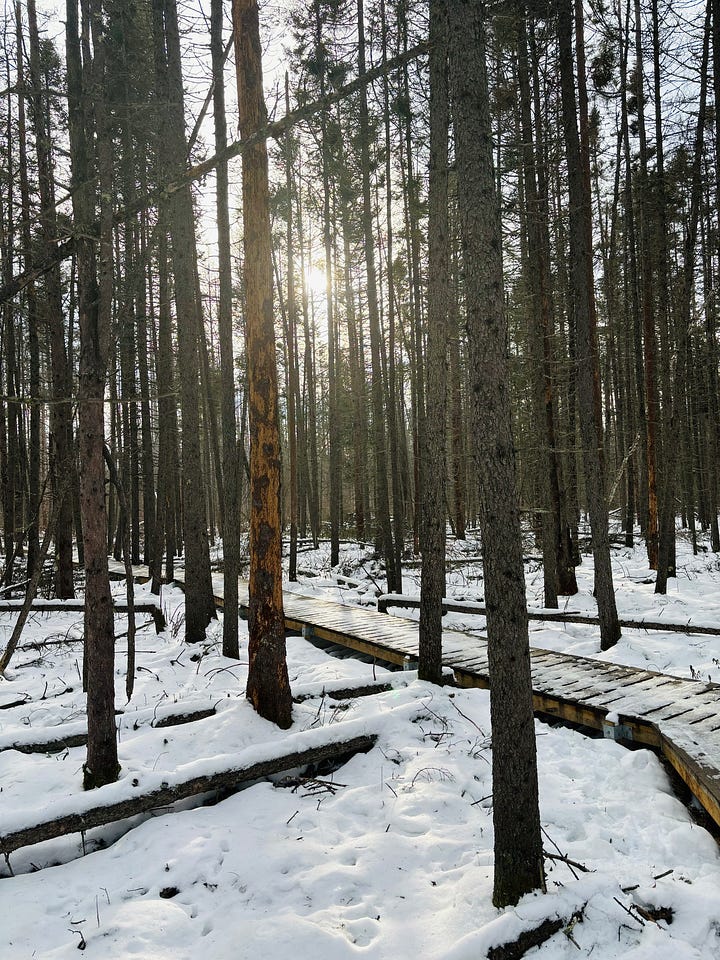
I spent the lion’s share of my time in the bog on the many dirt roads that slice and dice stands of black spruce and tamarack trees into neat rectangles. Birding from the front seat of a Honda was certainly a new experience for me. It was a balmy 35 degrees during my time there (thanks global warming!), but I can imagine how, in the proper Minnesota winter chill, leaving the warmth of your vehicle would be less tempting. This style of birding, however, did not quite square with my admittedly romantic notions of exploring the untouched northwoods. Of the nine lifers I added on the trip, all of them were spotted from within 5 feet of my car, and four were spotted at feeders. It was almost too easy; as if a sort of Disney World of boreal avifauna had been designed for hordes of visiting birders to stop, snap a few photos, and drive on to the next reported sighting.
A couple boardwalks provided a deeper glimpse beyond the roadside treeline into the mystery of the bog. I so desperately hoped to find the elusive Black-Backed Woodpecker on these brief forays. Partial to the recently burned forests and bogs in the far north and mountain west, this was one of my only chances to see this highly specialized bird. As I listened in vain for drumming or its sharp call note, the search for this woodpecker came to represent something greater about my bog adventure. If I could just spot this bird with my own powers of observation in its natural habitat, high in a tree, actively foraging on wild prey, I could recapture the true magic of birding that, at that moment, felt as elusive as the woodpecker itself.
How foolish this all sounds as I recount it: Whining about how nature doesn’t feel wild enough when I’m the human interloper traveling hundreds of miles beyond my native range chasing an experience, a feeling, a memory. But therein lies the paradox of birding and really all nature hobbyism and ecotourism. To observe something is to change it, and, unfortunately in the case of wildlife, to harm it. As interest in birding increases and more and more enthusiasts visit the bog every year, the effects of noise pollution, habitat degradation, and climate change will only become more pronounced. So why must we observe nature in the first place? Would the more conservation-minded thing to do be not to visit distant birding locales like the Sax-Zim Bog at all? Essentially we arrive at my original question: Should I even be here? I think a wrong answer to this question would be an unequivocal yes. However, flatly saying no is also a perilous response given the realities of wildlife conservation.
The fact of the matter is that birders’ interest in the Sax-Zim Bog is the reason that Great Gray Owls still have enough intact forest to nest or Sharp-Tailed Grouse have enough untouched meadow for their leks. Amidst the anti-wetland fervor of the early 20th century, ditches drained this wild landscape in favor of agricultural production. While largely unsuccessful, these attempts cleared massive tracts of forest and severely lowered the water table. In the 1960s, the first nesting group of Northern Hawk-Owls in the Lower 48 was discovered in the bog, and the tide began to turn. A major irruption of Great Gray Owls in 2004-2005 really put the Sax-Zim Bog on the map, and finally in 2011 a group of local birders and conservationists coalesced into the Friends of Sax-Zim Bog. The group has since purchased over 500 acres of lowland black spruce bog; 500 acres whose fate would be uncertain without the protection of invested birders.
If we briefly expand our perspective globally, every inch of peat bog protected has massive implications for the global climate. Few landscapes store carbon quite as well as bogs; but this also makes bogs a ticking carbon time bomb. Logging, farming, and falling water tables threaten to belch long dormant carbon dioxide and methane into the atmosphere. The calculus is complex indeed, but if visits from a couple thousand birders a year can provide the impetus to conserve these crucial lands, then by all means snap on that telephoto lens and start shooting.
Wait, wait, WAIT!! Maybe slow your hand just a bit. Our rudimentary cost-benefit analysis has resolved the question “Should I even be here?” Now we must take up a thornier line of inquiry: “How do avoid being an asshole?” As I write this very paragraph, I am seeing my Telegram app light up with the same complaints that originally inspired this piece. Apparently, a visit from a snowy owl has caused such a frenzy at the bog that some photographers were trespassing on private property and walking along busy railroad tracks just to get a glimpse. Not only are these birders risking obliteration by train, they’re risking all the hard work that it took to make this habitat worthy of an itinerant snowy owl in the first place. Evidently these owl-chasers don’t torture themselves about the ethics of their chosen hobby quite as much as I do, but I would like to ask them, as well as all traveling birders, to take a moment for introspection. I find that pondering a couple quick questions before you set out for the day can be illuminating: Where am I? Why am I here? What can I do to minimize my impact?
On its face “Where am I?” is the simplest question, but its answers are manifold and informative. Asking oneself this in the middle of the Sax-Zim Bog could take you in many directions. For one, northern Minnesota represents the southern extent of the wintering range of many avian residents of the boreal forest. The landscape is also dotted with bogs and lakes left behind by eons of glacial advance and retreat. These factors combine in this specific location to make the bog the birding hotspot that it is. We would be missing the whole picture, however, if we neglected the vast precambrian deposits of iron ore just a few miles north that drove modern settlement of the area. Without these deposits the train that threatens to flatten overeager photographers would not exist, nor would many of the roads that allow birders easy access to the bog. Thus a complex interplay of geology, economics, and history have produced this remarkable place that is both wild enough to support these fabulous birds but tame enough for people to enjoy them.
Now that we’ve situated ourselves in the context of all in which we live and came before us, it is time to ask the most poignant question: Why am I here? I was certainly motivated to drive all the way to Duluth by the prospect of adding several boreal birds to my life list. Many others are clearly motivated by bird photography. Others still make a living offering wildlife tours. Adequate reasons for a birding outing all, but the unthinking pursuit of lists and counts and photographs and, worst of all, dollar bills are what drive some birders to bad behavior. Birds are amazing, awe-inspiring, beautiful, resilient, entertaining creatures. That should be reason enough to grab your binoculars. I say this not from the back of my high horse, but as a reminder to myself. I am certain that the folks trespassing to get a stunning snowy owl shot carry the same abiding love of avifauna in their hearts. Perhaps it’s just been a minute since they’ve taken a step back to remember it.
Mindful birding aims to leave the smallest impact possible. Observe quietly from a respectful distance, be considerate of fellow birders, don’t leave your trash, etc. When we go birding far from home this is unfortunately the most we can do. Perhaps this feeling that my presence is subtractive is why I get uncomfortable as an avian tourist. I personally compensate for this by donating to or joining whatever organization stewards my destination, and I cannot encourage you enough to do the same. Protecting land from the constant creep of development is expensive and these hard-working organizations need all the help they can get!
I decided to write this piece as a way to help me sort out conflicted feelings after my adventure to Sax-Zim Bog. There were many moments during my trip that I felt like I was doing something wrong. This led me to question whether I should have gone at all. Is birding actually a terribly deleterious hobby? Am I personally responsible for the population declines of these fragile birds?! It seems ridiculous now that I’ve reasoned my way through it, but I fear that many environmental debates can leave individuals feeling this way. We fret about the recyclability of a pizza box as our government moves to open massive swaths of the arctic to new oil exploration. We feel powerless, yet the onus to change the world is placed on our own personal choices. It is in these moments of doubt that we must ask the right questions. Instead of individualistic guilt traps designed to promote inaction, let us instead look inward to reaffirm our good intent and move forward in community to make the world better for birds and people.
Comments
Nothing yet. Say the first thing.
Sign in to join the conversation.