
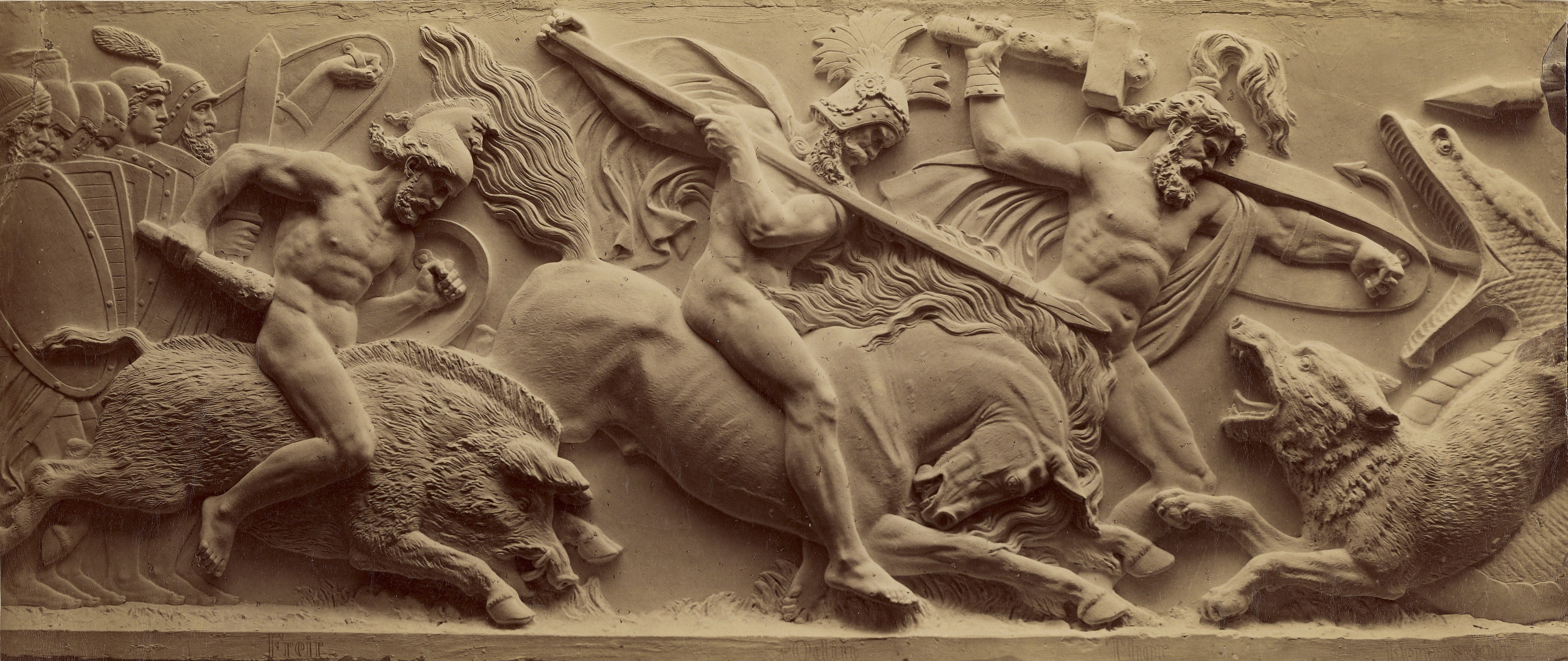
What do you do when you find an enemy inside the gates of your home? If you’re Thor, the answer is simple — kill them. Don’t hesitate. Don’t debate. Don’t gather further data. Just pick up Mjölnir, your magic hammer, and take out the threat.
Maninder Järleberg, PhD laid out the mythological circumstances and Thor’s response last week:
“The gods, seeking to fortify Asgard, enter into an agreement they do not expect to fulfil. A builder offers to complete the wall within a fixed time. The price, should he succeed, is Freyja [goddess of love/beauty/fertility], together with the sun and the moon. The terms are clear. What renders them acceptable is not their fairness, but the assumption that they will not be tested. That assumption fails. The work advances with a speed the gods had not anticipated. The builder’s horse, Svaðilfari, carries the greater part of the labour. What had been treated as a formal possibility becomes an imminent outcome. The agreement, until this point abstract, acquires weight.”
The gods turn to trickery and succeed in delaying the builder past the completion date. Enraged, the builder reveals himself to be a giant, one of their great foes. The gods fall into discord. What should they do? What do they owe the builder? Did they act wrongly or rightly?
Meanwhile, Thor returns to Asgard, sees the giant inside the walls, and kills him without a second thought.
Järleberg says:
Thor does not refuse reflection. Rather, the work of reflection has already become incorporated into character. The principles governing his conduct no longer stand before him as propositions requiring continual reaffirmation. They have become habits of perception, dispositions, and ways of inhabiting the world.
And, in our future, she points out that there could be some real benefits to this sort of solidity, defined as much by what one will never consider as by what one does.
“What may become more valuable, rather than less, is the possession of a character sufficiently formed to navigate uncertainty without continually renegotiating its own foundations. If one possesses a stable moral architecture, much can be rebuilt upon it.”
This is, of course, mythology, with a logic all its own. But most of us would be uncomfortable at the thought of people acting like Thor. Reality is morally complex and ill-suited to white and black gut reactions leading to homicide.
Stoics and the broader world of virtue-ethicists want us to navigate such situations with the aid of virtue — seeing what lines up with wisdom, justice, courage, and moderation.
So I’d like to ask — would the theoretical Stoic sage act differently than Thor?
The closest Stoic approximation of Thor’s reflexive giant slaying is the idea that virtue can be so thoroughly inculcated via practice that it becomes hexis—a permanent habit or disposition. Hexis leads to automatic actions born from absolute, active rational clarity.
So did Thor do the right thing? We lack enough information to know.
A sage’s absolute rational clarity is built atop wisdom (phronesis)— the knowledge of what is good, bad, and indifferent. Hexis, therefore, stems from accurate perceptions of reality. I certainly couldn’t have gathered enough facts to make a good judgment upon glimpsing an enemy in my home, but then I’m no sage, and I’ve always leaned skeptical.
By rushing to judge without the facts, Thor risked an unjust act based on phantasiai (unexamined impressions). A true sage would wait to give or withhold assent to his impression of the situation based on reason and gathered facts.
Having said this, I’d like to steelman the Thor approach, assuming that he indeed acted via hexis based on accurate perception. What would that look like?
Our theoretical sage would weigh giant slaughter around two things:
The virtue of justice (dikaiosyne), or what we owe others and the world,
The Logos, the today much-doubted rational order tying existence together.
The virtue of justice is not only about the letter of the law or a verbal contract, but what’s owed and what’s right. Stoics are very concerned with human (and cosmic) fellowship, and seek to do justice to others.
Our sage would recognize that the gods acted with moral ignorance (amathia), foolishly bargaining away one of their own, the sun, and the moon, endangering the very foundations of their world. The gods also assumed they could cheat the builder with impunity. Of course, the builder also engaged in trickery, hiding that he was one of the gods’ greatest enemies.
But in this steel-manning, perhaps none of this matters to our sage.
I’m not enough of a Norse mythology expert to say whether breaking an agreement with a giant is inherently a violation of virtue. In some stories, giants seem to have a code of sorts and can be reasoned with. But giants were the embodiment of chaos and destruction while the gods embodied order and law. Theirs was a battle between entropy and negentropy. Asgard’s wall is the literal boundary between order and chaos, so a giant inside the walls is a violation and existential threat.
To save a life, surgeons must act swiftly and decisively. The sage would concern himself with saving the Cosmopolis, the universal city, which they see as an interconnected organism bound by order and reason. Asgard is the closest approximation in Norse Mythology.
Perhaps, a giant within the walls is a malignant growth threatening the Cosmopolis. The virtuous choice may be to excise the cancer quickly, even if the cancer is a natural phenomenon and not necessarily “evil.”
A giant, even if a force of chaos, isn’t inherently cut off from reason and virtue. They’re worthy of justice, even if they’re deluded about right and wrong. But just as a Stoic might kill a fellow human in battle when they march against him and endanger what has worth, Thor may see this giant wasn’t just any giant, but one destroying what virtue demanded he defend.
If he did not act, what would have been the cost? The giant may have walked away with a fellow god, the sun, and the moon, endangering all of existence and the basis of life. No matter what bargain was struck and what violations took place, that had to be stopped. The Gods may have been unjust cheats, but letting them take the full force of their comeuppance meant betraying the rest of the Logos and all existence. How can that be just?
Thor doesn’t pause to learn who made what agreement and who deceived whom. He just acts. From a Stoic perspective, if the threat is immediate and existential, lingering in debate and fact-finding is not virtue, but Akrasia (weakness of will), or moral confusion. When your house is on fire, you put it out. You can inquire into who left a candle burning later.
Thor’s character is closely aligned with his duty to protect Asgard, and analysis paralysis isn’t something he’ll get caught up in.
Where Thor really falls short is his penchant for falling into intense rage (Thórsmódr), though I couldn’t find a reference to that in this giant-slaying. The Stoics consider the passions (pathe) incredibly destructive. Acting in anger makes it nearly impossible to use our rational faculties to find the right path and act justly.
A Stoic Thor would kill the giant calmly, out of a rational duty to protect the cosmos, rather than rage at the violation of Asgard. But in terms of the act itself? Forcing a cosmic force of chaos out of the citadel of order is the very definition of restoring the Logos.
I’d argue that Thor more closely embodies Aristotelian “natural virtue” — good instincts lacking the deeply reflexive universal framework of phronesis (practical wisdom) required for navigating complex, non-binary ethical dilemmas.
This was just a thought experiment, and I’m happy to hear different interpretations of virtue ethics in the comments.
As Järleberg notes, few of our evils are as clear-cut as a giant, nor is it usually just to strike down enemies without trial or proper judgment. Stoics would be the first to note that fellow humans/reason-possessing giants, however misguided, are our brothers. It takes a truly existential threat to the cosmopolis to warrant Thor-like reflexive slaying.
Where Thor offers something to admire is in his sage-like groundedness, his hexis, in knowing what is right and what is owed (assuming he really judged correctly). In our lives, this is mostly deployed in deciding what virtue demands of us, and what we must never consider and reflexively reject. But in rare cases, it might justify such a violent external act.
In a complex world, with so many temptations and options, it’s a relief to have clear lines we never cross. To learn more about the benefits of navigating life with virtue, check out this article:
Thanks for reading Socratic State of Mind.
If you liked this article, please like and share it, which helps more readers find my work.
Comments
Nothing yet. Say the first thing.
Sign in to join the conversation.