
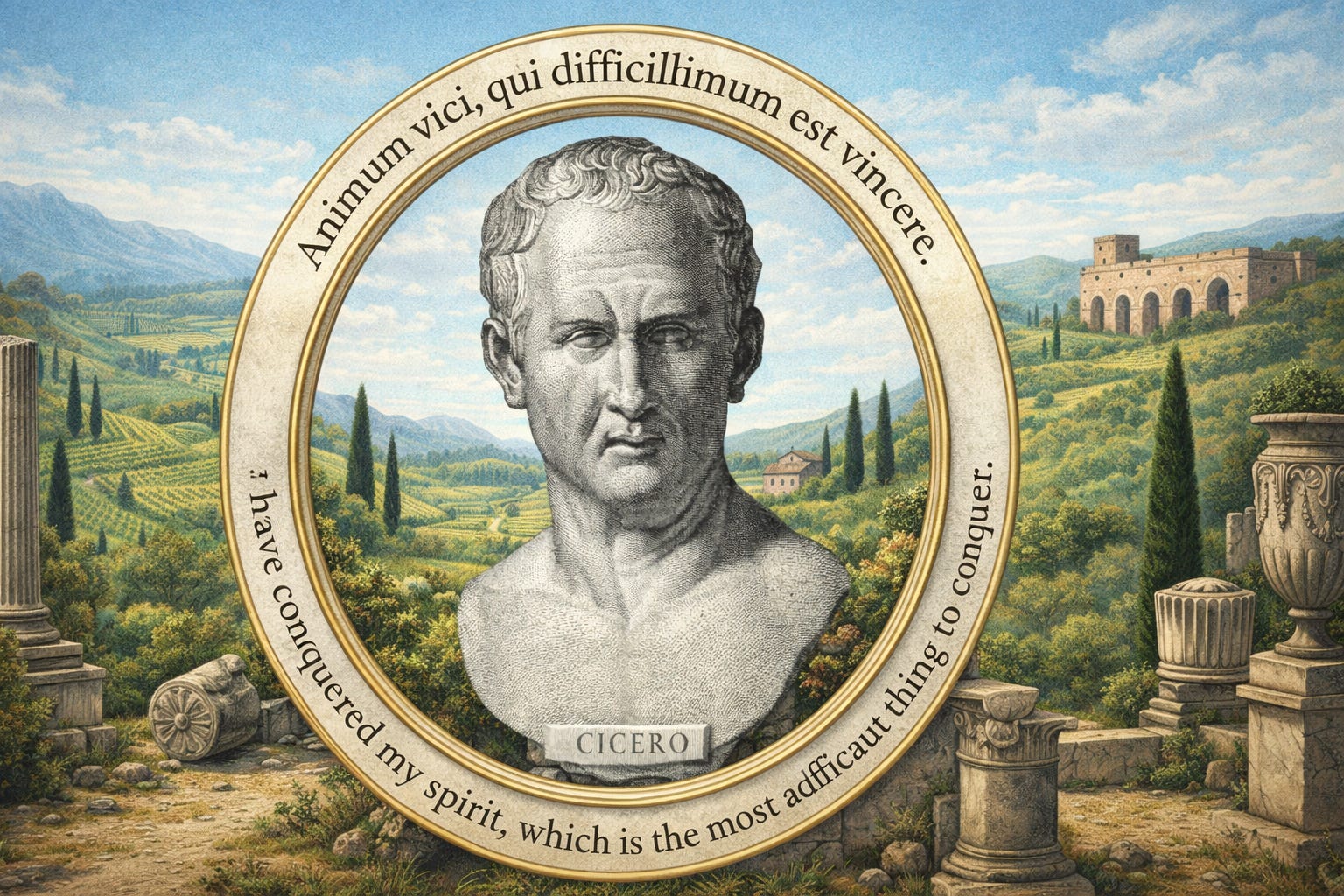
We’re continuing with book two of Cicero’s Tusculan Disputations. Please join our read-along!
Cicero’s Claim: Physical pain isn’t a genuine evil, and virtue is sufficient to lessen its sting. With the right mindset and philosophical practice we can endure any suffering.
Is this view insensitive? Is it “cringe,” as they say? A toxic remnant of a darker age? Regardless, is it true?
If Cicero is right, it’s of monumental importance. Pain is a scourge of the human condition. It can warp us until we’re something we’d hardly recognize. If we’re not prepared, severe pain can crush our spirit and our character. Even with modern painkillers and palliative care, it sometimes destroys lives.
We could discuss the nuances of Cicero’s argument, how he navigates a middle path between Epicurean and Stoic philosophies. But while adherents may quibble and find Cicero’s characterizations unfair, I don’t think it’s important for getting to the heart of the matter.
For those who haven’t read book two, let’s summarize Cicero’s plan for overcoming pain: You recognize that virtue is the only good (we’ll get back to this). By so valuing it, you see these unpleasant bodily sensations we call pain, agony, and torment are nothing compared to virtue’s lofty heights, from which all good flows. Therefore, you willingly endure pain when virtue demands it. You toil, you promote justice, you take wounds, you’re exposed to blistering heat and freezing cold, and so become largely enured to it. As your body becomes accustomed to pain, your mind learns to disregard it as unimportant. Yes, pain is inevitable, but a habit of exposure blunts it and philosophy elevates us above it. It thus loses its power to compel.
We have plausible neuroscientific explanations for why Cicero’s plan works. It comes down to what he says in book two: Opinio shapes dolor — Opinion shapes suffering.
The brain’s prefrontal cortex (The “CEO of the brain”) modulates the anterior cingulate cortex — the region processing the unpleasantness of pain rather than its raw signal. Dr. Tor Wager and other researchers have published on the “cognitive reappraisal” occurring when this modulation takes place. When subjects are trained to cognitively reframe painful stimuli — using a kind of ideology or belief about the nature of pain/its place in the grand scheme of things — and are then exposed to pain, fMRI imaging shows significant reductions in their pain response. The sensation of pain is still there, but their suffering is diminished1.
Conversely, there’s a large body of evidence showing “pain catastrophizing” — belief that pain is unacceptable, unbearable, unfair, etc — amplifies its experienced intensity2.
We can absolutely “believe our way,” into more or less pain depending on our ideology and mindset. The phenomenon of pain won’t disappear, but our interpretation of it can change dramatically. And of course, there are related phenomena like the placebo/nocebo effect, but let’s set that aside.
Let’s jump back to the start of Cicero’s dialogue with “A”, in which A originally asserts that pain is “the greatest of all evils.”
Cicero immediately asks: “Greater even than dishonor [dedecus]?”
Immediately, A retracts his assertion. Oh, of course…yes, dishonor is much worse. What was I thinking?
Because even if A’s gut tells him that pain is the worst, he’s been born into a Roman ideology saying something else his entire life. To say that virtue was a greater evil than dishonor would be akin to saying he’s not a man. In Latin, all this circles vir:
Vir: An adult male possessing social standing and agency and willing to endure suffering for the good of the Republic.
Virtus: Virtue/Courage/Excellence
Vis: Force / Power/ Physical Strength
So as soon as Cicero brings up dishonor, the opposite of what the Roman man stands for, A’s assertion is withdrawn. He must withdraw it if he doesn’t want to give up his entire worldview. Virtue was a philosophical idea, but it had a much older, more bedrock meaning in Roman Society [mos maiorum].
Virility built around virtus was why Hannibal could trap and slaughter 70,000 Roman soldiers at Cannae in 216 B.C. — 20% of the male population of Rome — and have another batch of Romans take the field against him. Romans suffered no less than moderns (usually more), but they had a way of modulating it and rising above it in pursuit of something held to be greater.
The Romans were famous gluttons for punishment because they kept this ideology through centuries of warfare and hardship. Suffering just didn’t land for the Romans as it did for their enemies, so they stayed resolute through more blows, and felt each one less.
It’s why Epicureanism ruffled so many feathers when it was first introduced to Rome. It dared to suggest that pain was the greatest evil and aimed to avoid it as much as possible. How would that not sap the famous Roman spirit, which glorified something greater?
And today? How many rank something above virtue, or above pain, for that matter? Cicero’s very suggestion might arouse fury in some circles.
Let’s imagine modern ideological adherents in place of A.
The Marxist: Cicero, isn’t your philosophy of pain-endurance just an enabling ideology — teaching people to accept suffering that’s politically remediable?
The Buddhist: Cicero, you’ve replaced one story the mind tells itself with another. The path through pain isn’t built by constructing a better narrative about it, but by observing it with non-conceptual awareness until its compulsive quality dissolves. You’re trapped yourself in conceptual elaboration, but the cage you’ve built is very impressive.
The Disenfranchised and Downtrodden: Cicero, isn’t pain endurance exactly what a slave owner and noble like you would preach to maintain their boot on the necks of the enslaved and disadvantaged? If slaves think their suffering is merely a faulty opinion, why fight for freedom? If plebeians believe their poverty and powerlessness is relative, why rise up?
The Safetyism Advocate: Cicero, your claim that pain is neutral or beneficial if met with the right opinion is a refusal to build a more comfortable world. When you tell us to “toughen up,” you avoid fixing the low-grade stresses we’re forced to endure. The goal of good societies is eliminating as much pain as possible through the construction of safe spaces, not cultivating techniques for enduring it.
The Disability Rights Advocate: Cicero, you think pain is a test of character, something virtue can transcend. That’s offensive to those for whom pain isn’t a short-term blip but a permanent condition of existence.
The Postcolonialist: Cicero, your myth of pain-transcendence travels very well wherever colonialists tread. It’s written and embraced by the ruling classes of conquering empires who’ve inflicted vast amounts of pain on subjugated peoples. Is it any surprise that you — once the highest official of the most famous empire in history — promulgates something that serves imperial purposes?
Adherents of these and many more ideologies might look at Cicero’s suggestions and find them insulting, misguided, or evil. There’s no denying that there’s truth in some of them, mixed in with nonsense. But it probably doesn’t matter. Because if we’re looking to reduce suffering, and someone can’t imagine anything more pressing than the crimes of the past, the failures of the present, and, in sum, our corporeal state, reframing our pain through Cicero’s method isn’t going to get them very far. They’re locking themselves into suffering.
Some of these ideologies can achieve pain downregulation through other means. Buddhist monks have sometimes burnt themselves alive without flinching, and Cicero notes the story of Calanus, the Indian “Brahmin sage” who did this in the presence of Alexander the Great.
But it’s hard to imagine safe space advocates and trauma-informed therapy aficionados steeped in TikTok rhetoric devaluing these worldly things for something higher.
As Cicero says, “It is opinion that makes things that are not evils be held as evils,” and their opinions are very strongly held.
We should fight to keep our identity free from labels because of how they degrade our ability to think. But I’ve made an exception —that virtue is the only good. It’s the only one I’ve found that builds resilience and happiness instead of fragility and stupidity over time (so far). The others aren’t so pleasant.
Nihilism, relativism, and a thousand ideologies have shattered Cicero’s virtue-centric world. Virtue is a hard sell for the modern person. Embracing it means downgrading many sacred cows, or sweeping them away entirely.
So should most modern people skip the philosophy and simply go for pain exposure? Should we put down the philosophy book and join the army, run marathons, or hike the Appalachian Trail instead? It might enure us to pain even if it can’t help us rise above it.
Cicero would say this is a false dichotomy and a mistake. It can’t be an either-or. A hardened soldier with no philosophy might be brittle. They may crack spectacularly and catastrophically when the structure of military discipline is removed at the end of their career. The professional athlete may make it through their third shoulder surgery and thousandth grueling practice but be corrupted by their immense wealth, fame, and posse of yes men and be turned into a monster.
The removal of virtue from Stoic therepeia is how we ended up with so many warped versions of Stoicism.
And while it’s true that much suffering in our world is structural and remediable and downstream of corruption and poverty, an individualist philosophy can help us rise above it. Acceptance and Commitment Therapy works in prisons3. Mindfulness dulls pain in underfunded hospitals4. People experiencing structurally-caused suffering have their pain reduced by individualist modalities5. This is how it’s always been, just or not.
Is it “cringe” to perscribe virtue for your pain? For the sake of argument, let’s say yes. But in a world increasingly defined by its fragility, there is something profoundly radical about refusing to be a victim of one's own sensations. Cicero didn’t want us to sign up to be the downtrodden — he was offering us a way to be free. You don't have to believe virtue is the only good to see that treating it as the highest good is the best armor we’ve got. Don't skip the philosophy—you're going to need it.
Thanks for reading Socratic State of Mind.
If you’d like to keep articles like this coming, please consider becoming a paid subscriber and sharing this one with others.
Woo, C. W., Roy, M., Buhle, J. T., & Wager, T. D. (2015). Distinct brain systems mediate the effects of nociceptive input and cognitive manipulations on pain. PLOS Biology, 13(3), e1002036.
Petrini, L., & Arendt-Nielsen, L. (2020). Understanding pain catastrophizing: Putting pieces together. Frontiers in Psychology, 11, 603420.
González-Menéndez, A., Fernández, P., Rodríguez, F., & Villagrá, P. (2014). Long-term outcomes of Acceptance and Commitment Therapy in drug-dependent female inmates: A randomized controlled trial. International Journal of Clinical and Health Psychology, 14(1), 18–27.
Garland, E. L., Baker, A. K., Larsen, P., Riquino, M. R., Priddy, S. E., & Bryan, C. J. (2017). Randomized Controlled Trial of Brief Mindfulness Training and Hypnotic Suggestion for Acute Pain Relief in the Hospital Setting. Journal of General Internal Medicine, 32(10), 1106–1113
Yim, S. H., Lorenz, H., & Salkovskis, P. (2024). The Effectiveness and Feasibility of Psychological Interventions for Populations Under Ongoing Threat: A Systematic Review. Trauma, Violence, & Abuse.
Comments
Nothing yet. Say the first thing.
Sign in to join the conversation.