
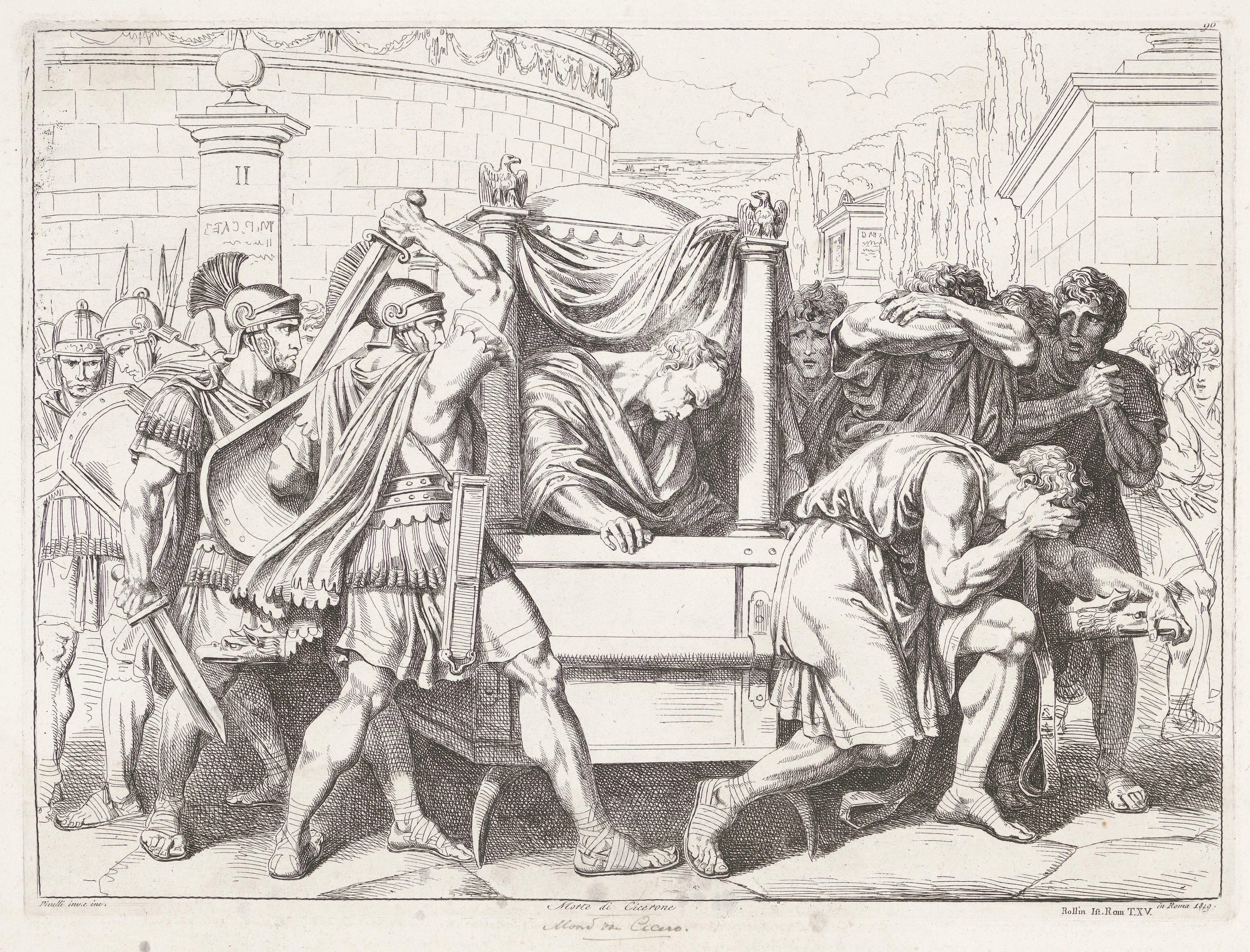
We can’t make up our minds about Cicero. Renaissance thinkers were obsessed with his work, and by the 18th century he was considered among the most important philosophers of antiquity. That didn’t last. By the 19th century his philosophical writing was out of fashion and mostly ignored.
People began to wonder: was he even much of a philosopher? He was known as a Roman statesman, orator, and lawyer — his defeat of the Catiline conspiracy, his fight to save the Republic from Julius Caesar’s power grab, and his death at the hands of Mark Anthony earned him renown as a principled leader and republican martyr.
And sure, he wrote a bunch of philosophy books. But it was a hobby, something he took up on vacation and in retirement. Wasn’t he just a dilettante and a dabbler? Cicero was Roman, and everyone knew that the only worthwhile classical thinkers were Greek. He wrote in Latin, but Greek was known to be the true language of philosophy; its vocabulary and syntax were hardwired for it. And Cicero created no new philosophical theories or a school of his own, but merely compiled, compared, and rethought. He didn’t bring much to the table.
But the last few decades have seen Cicero’s philosophical legacy swing back in the other direction:
Scholars noticed Cicero was more than a rhetorically elegant but intellectually empty mouthpiece for Greek ideas. He’s a sophisticated thinker whose books can be read as a coherent mode of philosophical reflection.
Once seen as an indecisive fence sitter refusing to commit to any view, Cicero’s Academic Skepticism is now viewed as a breath of fresh air and freethinking. His books don’t aim to indoctrinate, but to teach us how to question sacred cows, remain intellectually agile, and think for ourselves.
His philosophical revival is part of a wider trend seeing Rome as more than just an appendix of Greek thought. Cicero’s cultural milieu and patriotism are a feature of his philosophy, not a set of blinders. Roman philosophers like Marcus Aurelius, Seneca, and Lucretius have benefited from the same rising tide.
What appeared to be a dilettante’s hobby was actually an inseparable part of his systematic approach to life. The persuasion, the ethics, and the politics couldn’t stand without the philosophy. They were never separate projects, but formed a continuous argument about how to live well in community with other flawed human beings. They were seperate legs of the same stool.
But his communicative abilities also informed his philosophy. He knew that pure reason divorced from rhetoric wouldn’t convince most people to do better, shield innocents in a courtroom, or help enact necessary laws on the floor of the Senate. As much as he admired Socrates, Cicero argued against Socrates’s pessimistic conclusions about rhetoric in my favorite dialogue, Gorgias.
Rhetoric is also a place where Cicero differed with the Stoics. Stoics believed in stripping language of its flourishes and getting to the point. Cicero thought they went too far and weakened their excellent arguments. Ironically, Curtius’s translation of Tusculan Disputations is pretty stripped down and more in tune with Stoic preferences. He divides up Cicero’s long sentences into shorter ones and makes them punchier. No English translations I’ve read do justice to Cicero’s flowing rhetoric, something I suspect would piss him off.
How Skeptical is Cicero’s Skepticism?
Read Tusculan Disputations and you might wonder if Cicero was really all that skeptical. After all, I just mentioned his strong feelings about rhetoric, and he comes to multiple other conclusions. How skeptical could he be?
But he wasn’t a Pyrrhonian Skeptic suspending judgment about everything to reach tranquility. Rather, he was an Academic Skeptic with a different relationship to belief. The “academy” in question was Plato’s academy, and Cicero saw himself as an heir to Socratic-style skepticism (Socrates was Plato’s teacher).
In Socratic dialogues, Socrates talks interlocutors into states of befuddlement called aporia. They’ve lost their old beliefs but don’t know what to replace them with. If he’d exposed a falsehood, Socrates considered it a job well done and often left confused conversation partners without offering them a better belief.
Later Academic Skeptics used a tool called In Utramque Partem, or “arguing on both sides.” Adept practitioners tried to prove that for every argument, there was an equally persuasive counter-argument they could wheel out. They used this technique to force opponents into epoche, or suspension of judgment, which had a calmer vibe than the bewilderment of Socrates’s aporia.
But Cicero and his teacher Philo weren’t content to leave people stewing in mellow indecision. Cicero was a statesman, and needed provisional conclusions to lead. You can’t be skeptically aloof when an invading army is at the gates, the plebians are threatening to revolt, and the republic is falling apart around you.
He noticed In Utramque Partem often left one side looking more likely, if not certain. It was probabile (probable) or verisimile (truth-like). So he ended up using the tool like a gauntlet to test ideas.
This put him at odds with other major schools of the era, which Cicero said turned students into slaves to their founders’ dogma by hoisting definitive truths on them. The Stoics, for instance, believed in Katalêpsis, a clear mental grasp of reality (the truth). Cicero would have none of that. He thought objective reality existed, but human minds and our senses were unable to fully grasp it. He went with what looked most likely, but never considered it the final truth.
In the last book of Tusculan Disputations, Cicero says “Nos in diem vivimus”— we live from day to day. In other words, he reserved the right to change his mind when an occurance or new stronger argument changed his calculus. In my coming companion essays for Tusculan Disputations, we’ll see what this approach yields when brought to bear on some of the most important human questions.
Personally, I think Cicero has a point. Stoics have exemplars of their philosophy like Cato the Younger, who was devoted to virtue. When the battle against Caesar was lost, he committed suicide rather than return to Rome and be a showpiece for Caesar’s mercy, which would have been a PR coup for the dictator. There are many positive things we could say about Cato. But his refusal to change a clearly dysfunctional economic system and attachment to stasis probably doomed the Republic he loved and fought for.
Cicero walked an interesting tightrope. He was devoted to virtue and public service like Cato and the other Stoics he admired, but was always willing to reconsider what virtue demanded and what logic dictated. In this way he’s incredibly modern. He presaged the scientific idea of fallibilism — that all knowledge is provisional and open to revision — by 1,900 years.
Caught between the Scylla of Julius Caesar’s radical populism and the Charybdis of Cato’s suicidal, purist idealism, Cicero navigated a middle path, fighting and supporting either side in turn based on what would keep the Republic afloat. Cicero was flawed. His ego often worked against his own interests. But he arguably saw more clearly than anyone of his era.
Today, he’s the patron saint of people who want to commit to good causes without becoming blind fanatics. When both sides of every conflict seem to be drowning in dogma, we need him more than ever.
This esay is part of our Tusculan Disputations readalong. Please join us!
If you haven’t already, subscribe below.
And if you know someone who might be interested in joining this read-along, please let them know, or just share it on social media.
Comments
Nothing yet. Say the first thing.
Sign in to join the conversation.