
Earlier this month, the education secretary, Lucy Powell, wrote an article for The Times called “We must end this one-size-fits-all approach to education.” I was going to comment on it, but I haven’t been able to get past the paywall. However, the headline rang a bell with me. Then I remembered why. I had written about politicians who complain about a “one size fits all” system. Appropriately enough, it was originally written for the Labour Teachers blog (you can find an archived version of that post here). I also shared it on my main blog here.
However, given that Powell has resurrected this particular criticism of the education system, I thought I’d re-present it here with only a few edits. Graphics courtesy of @JamesTheo.
George Orwell, in Politics and the English Language, described how a stock phrase, or cliché, could stifle thought. Sentiments that seem disreputable, if expressed clearly, will instead be expressed obscurely and in familiar, overused phrases.
“As soon as certain topics are raised, the concrete melts into the abstract and no one seems able to think of turns of speech that are not hackneyed: prose consists less and less of words chosen for the sake of their meaning, and more and more of phrases tacked together like the sections of a prefabricated henhouse.”
If I had to say which phrases used in education do most to obscure the clear expression of ideas, I would pick the following:
1) “Regurgitating facts”. This cliché has become such a crutch for those who are against testing that I’ve seen it used twice in the same Guardian letters page. But as unpleasant as it sounds, it means little more than “recalling knowledge”. You could argue that the word “facts” suggests a disjointed or atomised form of knowledge, but in practice it would be hard to distinguish between information recalled as facts and that recalled in any other form. Regurgitation might suggest that the recalled knowledge is in some way undigested, but how do we “digest” knowledge other than by recalling it?1
2) “A political football”. Education, properly understood, involves consideration of what is worth learning. This is a philosophical argument, and one where its conclusions will determine the spending of billions of pounds of public money. This is necessarily and obviously political. To put the power to make such ideological judgements outside democratic control seems immediately tyrannical. And that’s where this cliché comes in. Public discourse involving those who have been elected to office, and are subject to public scrutiny, is dismissed as a game by those who would see less democracy in education and more bureaucratic control by unaccountable vested interests.
3) “Exam factories”. This cliché is also used to argue against academic education and testing. Rather than arguing over what forms of assessment work or are needed, we have this dismissal of exams. Exams are the best way to objectively evaluate, on a large scale, what is being learned in schools. This can be characterised as an artificial and mechanical process, and exam systems can be bureaucratic and unhelpful. However, only in education would objectivity and efficiency be feared. The greatest irony here is that, in many respects, the alternatives to exams might seem more like factory work. Anyone involved in the “manufacture” of coursework can see that. Those recommending subjective teacher assessment as an alternative to exams are surely imitating the “performance management” culture of many private companies, including those that run factories.
4) “Educating the whole child”. This is an odd phrase, given that I have never met a teacher who sought only to educate parts of a child. In practice, of course, it is not the child that is to be treated as a whole, but their life. If you want education to go beyond the academic, into therapy, social work, entertainment, preaching and parenting, then this cliché can be used to suggest all aspects of a child’s life fall in the domain of teachers. If you have any faith in parents or a wider community; any belief learning is so important that there should be a profession dedicated to helping children with this above all else, or if you are simply concerned about the intrusion of the state into family life and leisure, then you can, as a teacher, happily develop the whole child’s intellect without feeling you are only doing part of your job.
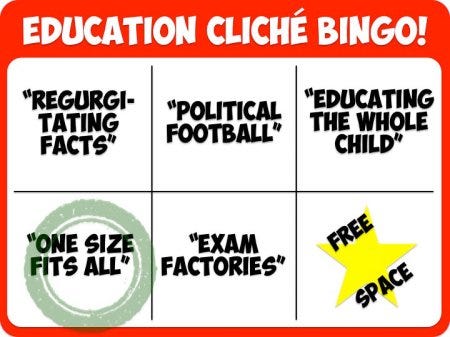
5) “One size fits all”. We tend to assume that, at least as a default, human beings should have equal rights and equal entitlements. Therefore, if children are to be treated differently, we would hope to justify it by demonstrating that the outcomes might still be equal or, if that’s not the case, by showing that inequality is justified in pursuit of another aim. The “one size fits all” cliché, loved by both right-wing advocates of selection and left-wing opponents of academic education, seeks to reverse this principle. Suddenly, those who support equal rights and equal entitlements for all children are expected to explain why they are ignoring differences between children, while those who support inequality are no longer expected to demonstrate that the differences they perceive justify different and/or unequal treatment.
If you feel inclined to use any of these phrases in education discussion, I challenge you to try to express the same idea in your own words. If you find that this makes your argument fall apart, or your opinion seem less plausible, then take this as an indicator that it is time to think again.
Comments
Nothing yet. Say the first thing.
Sign in to join the conversation.