
I spent more than a decade in the classroom, and a good chunk of those years were in English rooms running some of the earliest 1:1 device programs — the kind funded by a grant or some pot of outside money that paid for the infrastructure and the hardware and then handed the rest to us to figure out. Overnight, devices landed in the hands of students who, the week before, had been writing without them, reading without them, going home to a screen that was a television or a video game and not much else. This was the pre-streaming world; it was a different planet. And I want to be honest about something: school had plenty of problems before the devices arrived. The screens didn’t cause them, but they didn’t fix them either — and in one specific way, they made a quiet problem louder. We put the device before the instructional design.
That was the miss, and it still is. We dropped students inside a digital ecosystem before we taught them a single transferable skill for living in it. We handed over the hardware, offered little to no training or support, and then expected kids to test, write, research, and excel in an environment none of us had actually taught them to navigate. If we had stopped there, it might have stayed a contained problem. We didn’t stop there.
The handout-like-candy only accelerated. States began requiring high-stakes testing on devices, so the screen stopped being optional — a child’s measured proficiency now depended on fluency with a tool no one had taught them to use. Then the pandemic put a device in front of every student in every subject, all at once, as a matter of making school work at home. And now the SAT has gone fully digital and the College Board has moved AP exams onto screens too. The on-ramp to college — the highest-stakes academic moment in a teenager’s life — runs through a device. In less than fifteen years we have made digital fluency a prerequisite for nearly everything we ask students to do, while still treating the teaching of that fluency as someone else’s job, or no one’s.
This is exactly why we have to be intentional about screens in K–12. Not casual. Not reactive. Intentional. And intention matters this much because the stakes don’t stop at graduation. These students walk into higher education and a workforce that runs on digital tools every single day. It doesn’t matter whether they become a plumber, a farmer, a firefighter, or a financial analyst — technology will be in the truck, on the job site, in the workflow. Our global economy is run by it. We are preparing kids for that world by handing them devices and hoping the skills arrive on their own, and we would never run any other part of school this way.
So given those stakes, you’d think the response would be to teach harder. Instead, the loudest response of the moment is to retreat — and it’s worth saying plainly what intentional does not mean. It does not mean pulling every screen and calling reduced screen time a strategy. Stripping the devices out of the building is not a pedagogy; it’s clickbait. It makes a great headline, it powers a parent group’s new 501(c)(3), and it sells a lot of copies of The Anxious Generation and The Digital Delusion. What it does not do is build a single transferable skill in a single kid. The opposite of too much tech was never no tech. The opposite of too much tech is intentional tech.
Here’s what Jared Cooney Horvath and Jonathan Haidt would rather you not sit with: the choice was never really “more screens” versus “fewer screens.” That binary is comfortable, it’s marketable, and it lets everyone off the hook for the hard part. The hard part — the actual work — is sequence. There is a way to teach these concepts before you hand a kid the keys to the car, and once you’ve seen it work, the rip-it-all-out argument starts to look like what it is: the easy answer to a hard question.
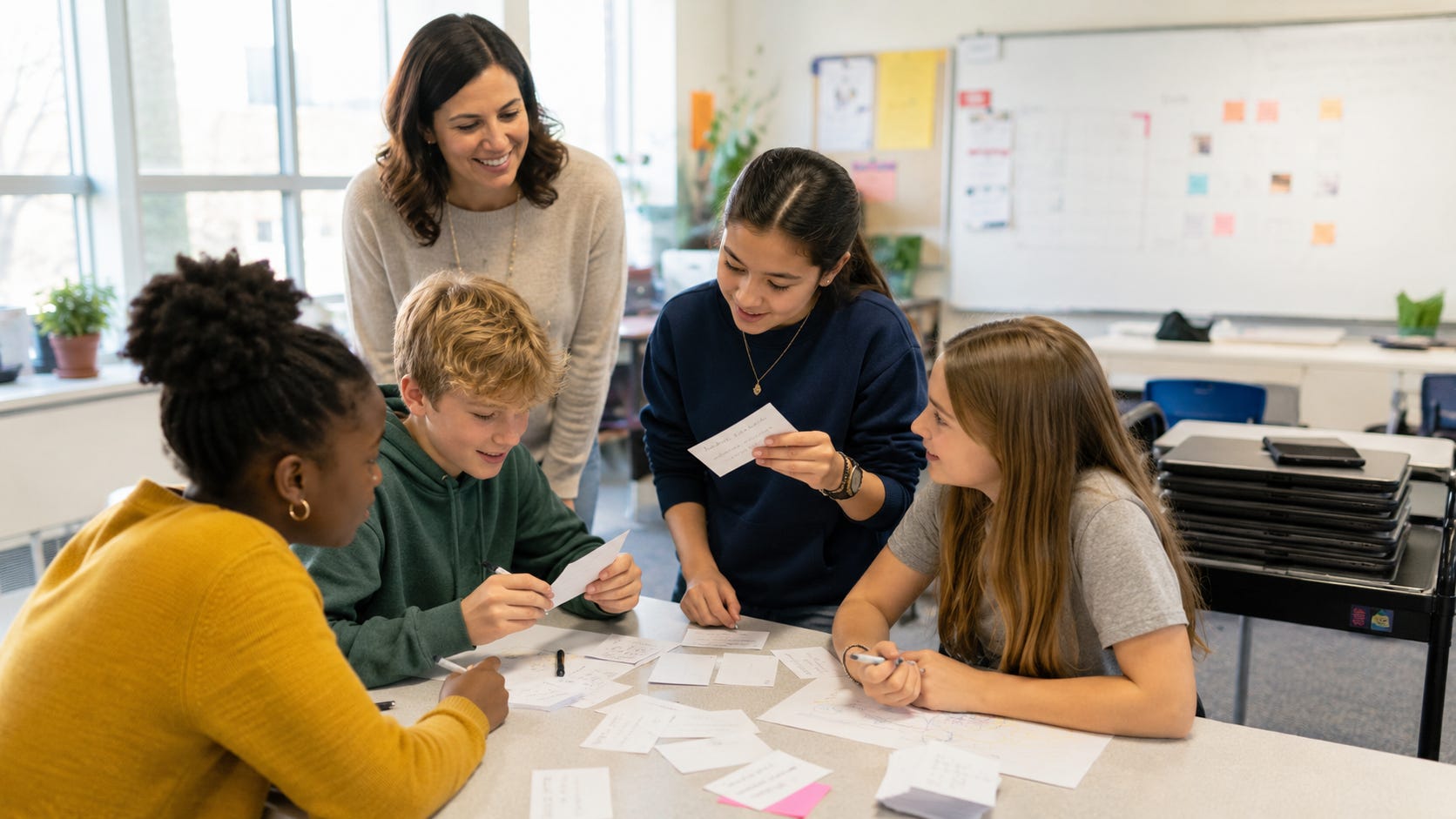
And the better way is almost embarrassingly simple. Build the concept first — with bodies, paper, and conversation — and then hand over the device. When students walk up to a screen already understanding what they’re looking at, the tool deepens their thinking instead of standing in for it. The screen stops being a substitute for the lesson and becomes an amplifier of it. Purpose before platform. Teacher first, tech second. It isn’t complicated; it’s just out of order in most schools.
Take AI, the clearest case we have right now. Our students grew up able to speak into the air and pull an answer out of a connected device, and they’re completely fluent in the gesture — but fluency with the gesture is not the same as understanding the machine. Can they formulate the right question? Can they prompt a model to give them something efficient and genuinely useful instead of something confident and wrong? Do they even have a rough mental model of how the thing was built — that it learned patterns from examples, that it doesn’t actually understand anything, that bad examples in means bad answers out? Mostly, no. Not because they aren’t capable, but because no one taught them. We gave them the tool and assumed the understanding would catch up on its own, and it never does.
We would never accept this with a car. We don’t hand a fifteen-year-old the keys, point at the highway, and say good luck. We make them log hours, we sit white-knuckled in the passenger seat, we teach the rules before the road and the road before the traffic. There’s a permit, then a test, then a graduated license — a whole patient scaffold built on one simple belief: driving is a skill, and skills are taught before they’re trusted. Technology is a skill too. So why do we keep handing students the keys and skipping the road test?
That question is why I built a free resource I want to put directly in your hands, and in your teachers’ hands. Teaching Tech Without the Tech is a classroom toolkit of ten ready-to-run, device-free activities — no logins, no charging carts, nothing to configure — and each one teaches a real, transferable technology concept using nothing but index cards, paper, and room to move. Students become a sorting algorithm and feel for themselves why some programs are instant and others crawl. They “train” a human AI model on examples you’ve quietly mislabeled and watch it grow confidently, fluently wrong — the single most important thing a kid can understand about AI before they ever trust one. They pass a message across the room in numbered packets and discover how the internet actually moves. They sign a shared poster in permanent marker and never again confuse “delete” with “gone.” And every activity ends with what I call The Bridge — the line that connects what their hands just did to the digital skill it sets up next. That bridge is the road test. It’s the moment the learning transfers from the floor of your classroom to the screen, so that when the device arrives, students already know what they’re looking at.
If you lead a building or a district, this is about as low-stakes a place to start as exists. You don’t need a new platform and you don’t need a budget line; you need one teacher to run one activity and watch how differently students walk up to the screen afterward. Share it freely with your whole faculty, and let it be the first road test before the keys. We would never let them drive without one — and in a world this thoroughly wired, our students deserve that same care everywhere technology touches their learning.
Andrew Marcinek is co-founder of Think Forward Solutions and author of Teaching Digital Kindness. Think Forward helps K–12 schools build human-centered technology programs through the Intentional Technology & Screen Framework. Reach him at andrew@thinkforwardsolutions.com.
No posts
Comments
Nothing yet. Say the first thing.
Sign in to join the conversation.