
Walk into a classroom and watch a fourth grader work through her assigned minutes on an adaptive reading program. Watch closely. She isn’t reading. She figured out weeks ago that if she clicks at roughly the right rhythm, the program logs her time, the dashboard turns green, and the whole chain of adults above her — her teacher, the teacher’s principal, the principal’s director — sees the same reassuring color. Her eyes are somewhere else. The minutes accrue. Nothing is learned. Now look at the student two desks over. Same program. Same minutes. She’s building a real argument and revising it twice. A stopwatch cannot tell those two children apart. That is the whole problem with what Los Angeles just did.
Recently, the LAUSD board voted, unanimously, to cap screen time by grade. No devices before second grade. Tight daily limits in the early grades, loosening to roughly ten hours a week by high school. Homework counts against the total. Compliance gets tracked through monitoring software. District laptops stop going home. The whole thing builds on last year’s phone ban, and its sponsor called the moment a chance to “recalibrate.”
I have said this in nearly every post I write and it is how I monitor my own screen time and that of kids in school: all screen time is not equal. It never was. The variable was never the screen — it’s the task and the design. Thirty minutes of a child drilling mindlessly and thirty minutes of a child writing, researching, and defending an idea are the same thirty minutes only to a clock. To a teacher, they are opposite events. A policy that counts minutes has chosen to measure the one number that tells you almost nothing about whether a child learned.
I want to be careful here, because I am not the person who shows up to argue for more screens. I’ve spent years arguing the opposite and proposing balance over bloated edtech environments. Keep devices away from five- and six-year-olds — fine, defensible, probably wise. My kids are 2.5 and 10 months and we are already setting boundaries and limits on screens, mainly TV. And buried in LA’s resolution is its single best idea: an audit of every ed-tech contract the district holds, made public. That’s the right question — what is all of this software for? — and I only wish it had led the policy instead of trailing it.
But a time limit answers a question no one serious was asking. We have spent a decade letting screens crowd out the parts of childhood that don’t run on a clock — the conversation, the conflict and repair, the boredom that turns into imagination, the practice of looking another person in the eye. That loss is real. I wrote an entire book, Teaching Digital Kindness, about one piece of it: the screen is where this generation is learning how to treat other people, and we mostly left them to work it out alone. The cost of getting that wrong was never measured in hours. It’s measured in how kids speak to each other at two in the morning.
A time cap does nothing for any of that. Digital wellness — the subject of the book I have coming this fall — was never about fewer minutes. It’s about a healthier relationship with the tool: knowing what it’s for, knowing when to put it down, and being someone you’d actually want to meet on the other side of it. That’s self-regulation. And you do not hand a child self-regulation by installing a timer. What I also tackle in the book is the idea that we just hand out devices to students with little preparation. External limits without internal judgment don’t build wellness. They build workarounds.
Which brings me to the failure underneath the failure, the one the saturation crowd and the time-cap crowd both keep walking past. It isn’t that kids have too many minutes or too few. It’s that we still refuse to teach them to use this stuff well, appropriately, on purpose. We had the chance to build judgment, and we bought a monitoring vendor instead. Jonathan Haidt and the screens-are-the-enemy movement get the diagnosis half right — kids are oversaturated — and then prescribe pure subtraction, as if removing the tool teaches the skill. It doesn’t. A child who hits her cap has not learned to use the tool well. She has been timed out of using it badly. Those are not the same child.
If schools won’t teach kids to use technology with judgment and care, who will? The platforms engineered to hold their attention? A spreadsheet of weekly minutes? This work belongs to schools, or it belongs to no one — and a policy that spends its whole budget of attention on counting has quietly decided it belongs to no one.
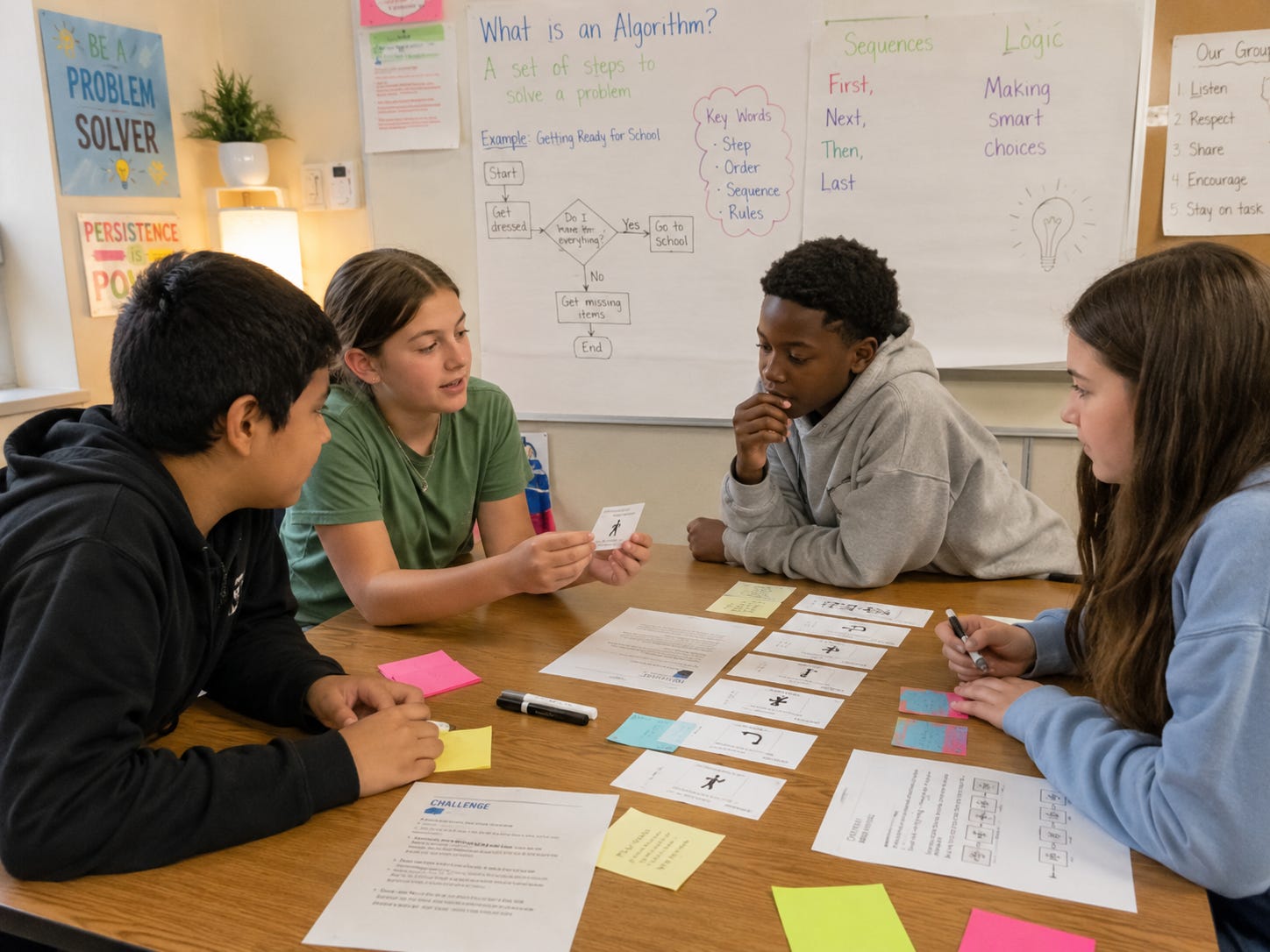
Teaching kids to use technology well does not require a screen in front of every child. That is the false choice that has run this debate from the start — saturate them or starve them. There is a third path, and it’s the one I build for a living: teach the concepts, the fluency, and the wellness largely off the screen, and bring the device in only when it deepens something the student already understands.
What a school needs is not more devices, and it is not a stricter clock. It needs a culture where the default is off, not on — where the screen comes out because a specific piece of learning requires it, and goes back in the moment it doesn’t. Default off is a design choice a school makes on purpose. Fluency is a curriculum a school commits to teaching. A cap is neither. It’s a number, enforced by software, standing in for the work nobody wanted to do.
This week’s deep dive is that work, made concrete: three full lessons — lower elementary, middle school, high school — that build real digital and AI fluency without a single device, backed by the research on why teaching the concept before the tool actually works. Every one of them would register as zero minutes under LA’s new policy. And every one builds more fluency, and more wellness, than a year of compliant clicking.
A timer can tell you a child stopped. It can’t tell you a child learned. It certainly can’t tell you a child is well.
Comments
Nothing yet. Say the first thing.
Sign in to join the conversation.