
I went into Nolan’s Odyssey with a strange mix of apprehension and hope. Much of what I’d seen leading up to the release had not made me overly optimistic, including most of the casting, costume, and set design choices. Everything looked a far cry from the world of the ancient Greeks. Still, I’ve enjoyed many of Nolan’s movies quite a lot in the past, especially Oppenheimer, so I was resolved not to let the photo stills and trailers prejudice me.
I’m glad I went to see it. All my previous concerns about aesthetics and authenticity were valid, and yet I thoroughly enjoyed watching the movie. In our age of polarizing hot takes and rage-baiting headlines, I know there’s increasingly less and less room for nuance. But I don’t have an extreme position. I am not aligned fully with either the scathing roasts of the likes of Emily Wilson, or the unvarnished praise of the die-hard Nolan fans.
As I said, the film’s aesthetics were a major detractor for me. Everything—the costumes, the settings, the casting, and much of the dialogue—feels strikingly modern, artificial, and out of joint with any period of Ancient Greece I know of. In fairness to Nolan, it’s clear that these choices are intentional, and they do cohere to form a particular anachronistic, non-Hellenistic aesthetic. I just find those choices baffling.
There’s been a lot of discussion online before and since the movie came out, complaining about the lack of historical authenticity and insisting that everyone should dress like proper Mycenaeans and be played only by Greek actors.
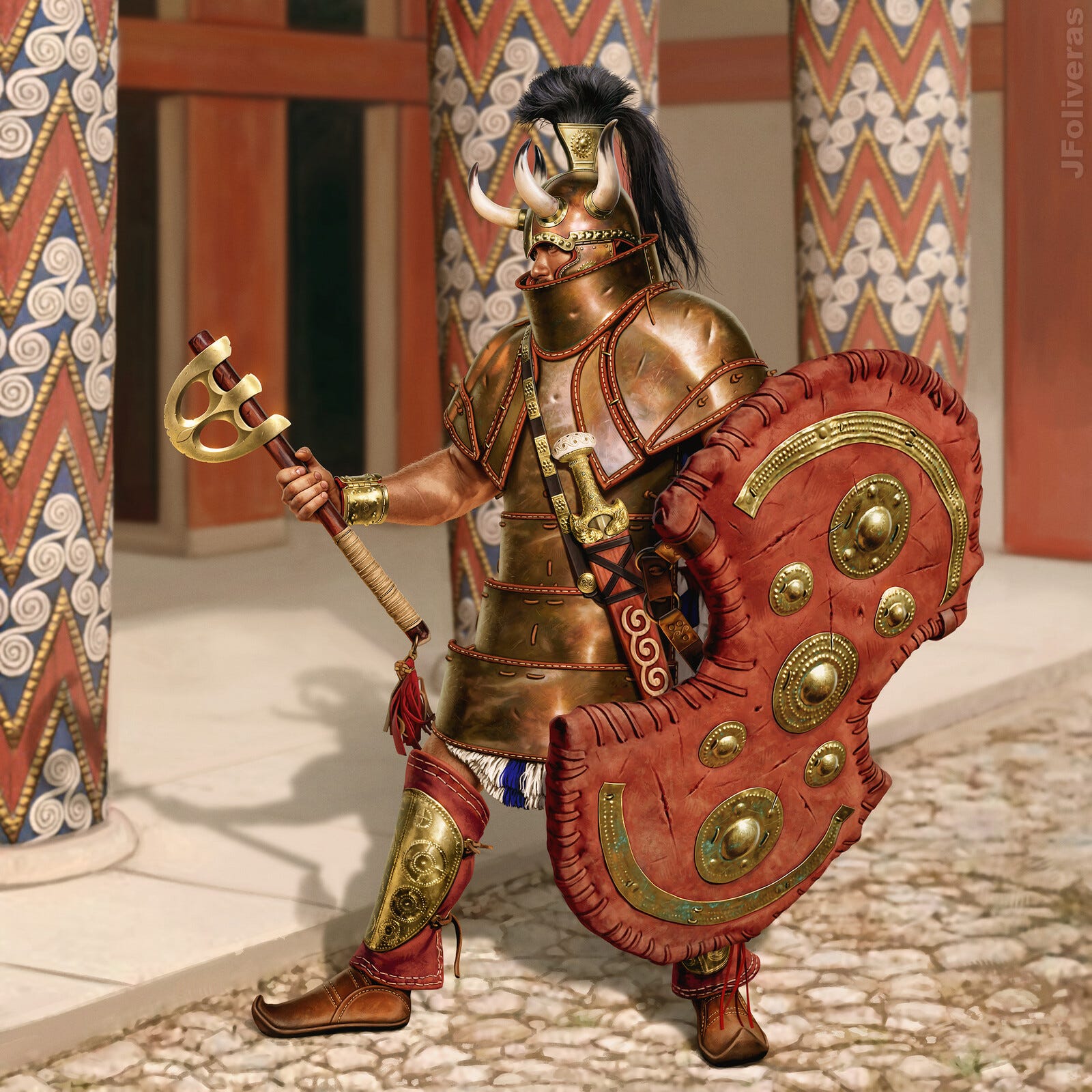
I don’t go that far, partly because Homer himself wasn’t trying to recreate exactly what life was like during the Bronze Age. The epic is a curious mix of historical eras and cultural customs, inherited traditions combined with much later religious beliefs and military equipment.
For these reasons, it doesn’t bother me that the movie is not a historically accurate representation of the Greece of the Mycenaean era or the later Iron Age (when the text is believed to have been finally written down). It does bother me, however, that Nolan’s film fails even the simple vibe check of “looks Greek.” You know, the kind of pan-Hellenic, pseudo-historical aesthetic that most sword and sandal movies manage to pull off.
To communicate the universality and continued relevance of the Odyssey, Nolan casts a diverse range of actors (one of many departures from the text) dressed in clothing that isn’t quite modern, but which also doesn’t belong to any particular historical era. The anachronism also runs well below the surface of skin and clothing. The characters themselves, and the minds they reveal through their action and dialogue, have very little in common with the ancient Greeks. The way they talk about the (mostly absent) gods, for instance, is incongruous with Homer’s presentation of an enchanted world shot through with the divine.
The world of Nolan’s Odyssey feels largely disenchanted. Polyphemus is changed from a thinking, speaking being—the son of the god Poseidon—to a grunting beast. Gods such as Zeus, Apollo, and Poseidon are left off-screen, mentioned only in connection to natural phenomena like thunder or sea-storms or the customs of hospitality. Odysseus’s men believe they are being cursed by Poseidon, but he insists they are superstitious, drawing faulty causal connections to make sense of tragedy. Such a view is alien to the world of Homer’s Odyssey and belongs instead to our own disenchanted, post-secular age. Yet since we never see the gods themselves, we are left with little choice but to agree with Odysseus’s rationalist perspective.
The goddesses we do see—Athena, Circe, and Calypso—are thoroughly disenchanted and disempowered. In Homer’s poem, Odysseus often appears powerless, especially in his interactions with these goddesses. Calypso holds him against his will for seven years until he is rescued through the interference of Athena (and Zeus). Athena herself is the mastermind behind much of the poem’s plot, disguising herself as Mentor to guide Telemachus to Sparta, seeing Odysseus through a host of dangers, aiding him in the slaughter of the suitors, and finally restoring peace between him and the vengeful relatives of the suitors.
In the film, these goddesses are defined by their relationship to Odysseus. Calypso becomes, to quote Emily Wilson, “an unpaid therapist,” existing solely to help Odysseus work through his trauma. And Athena seems to be little more than a figment of Odysseus’s imagination, a manifestation of his war guilt from the sack of Troy. This is a perfect example of what Charles Taylor means by the concept of the “buffered self” of a disenchanted age, in which “the only minds in the cosmos are those of humans.” Athena has no existence or mind of her own, and is “real” only as a projection of Odysseus’s own consciousness.
While all this might make it sound like I hated the movie, I actually did enjoy it on the whole. Once I accepted that Nolan was not interested in providing a faithful adaptation of Homer’s epic, or coming to grips with the belief systems of ancient peoples, I managed to appreciate the film on its own terms.
There are many great moments, including the journey to Hades and the episode with the Sirens. Some of these scenes even adhere pretty closely to Homer’s material. Other, less faithful moments, are also fairly well done, such as Odysseus’s return, the test of the bow, and the slaughter in the hall.
One thing that I think Nolan handles particularly well is the backstory of the fall of Troy. Homer does not provide many details about the Trojan Horse and the fall of the city, since his epics were part of a larger cycle that told the rest of the story. For these moments, Nolan is drawing on a much broader tradition, including the Roman Virgil’s Aeneid.
In typical Nolan fashion, he hinges the film on a decisive moment in the past and revisits it again and again, each time revealing a further layer of truth. In the Odyssey, that moment is the deception of the Trojan Horse and the subsequent sack of Troy, which Nolan shows us three times.
The first is at the outset of the film, where the bard sings of the Trojan War. We see Sinon beside the wooden horse and the Trojan soldiers questioning him. Upon learning that the horse is a gift, they decide to bring it to their own temple of Athena. The bard’s story is soon interrupted by Penelope. What we learn from this is the tale of Troy as depicted in song. This is the heroic, legendary version that spreads the fame of Odysseus.
The second is when Menelaus recounts his version of the fall of Troy, beginning with the grueling experience inside the horse all the way up until the Greeks open the gate for Agamemnon and the rest of the host to rush through. Here we move one layer closer to Odysseus, seeing Troy from the grim, gritty perspective of an actual veteran, suggesting that the bard’s version has sanded away much of the horrifying experience of war.
The third is told by Odysseus himself. Like Menelaus, Odysseus presents the perspective of a veteran, but his story is more tragedy than tense nail-biter. Nolan’s Odysseus is a guilt-ridden soldier, scarred by his experience at Troy.
The film does take a lot of liberties with Odysseus’s character, but I appreciated Nolan’s approach in many ways. Homer’s Odysseus is brutal. He casually makes mention of pillaging towns on his way home from Troy, slaughtering men and enslaving women. He never shows the least bit of regret for tricking the Trojans with the wooden horse or for the atrocities that the Greeks commit as they sack the city. Homer’s Odysseus is also far more ruthless in his homecoming. He kills every suitor in his hall except for one poet whom Telemachus tells him to spare because he was forced to sing for the suitors. And he has all of the female slaves who slept with the suitors executed as well.
Nolan rewrites his hero to be more palatable to a modern audience while still paying homage to the spirit of that character. Homer’s Odysseus may be vengeful and bloody to the last page, but he is also chastened by his twenty-years of suffering. Time and again, Homer describes him as a “broken man.” Odysseus tries to save his men, but they die off one by one, until he is left alone, grieving their loss. When he reunites first with Telemachus, and then Penelope, Odysseus shows a softer side, weeping and venting his frustration over the wasted years that he was gone. Even the Trojan War itself is lamented as vain and senseless by many characters.
Nolan renders that brokenness in a way that resonates for us today. Odysseus is haunted, not only by the loss of his men and fellow heroes, but also for the very things he did at Troy that earned him his heroic fame. The scene where he speaks with Penelope while disguised as a beggar and tries to explain why Odysseus struggles to come home, is especially moving. In destroying Troy, committing atrocities, and watching his comrades do the same, Odysseus worries that he has destroyed the very idea of home itself. Troy becomes the very symbol of civilization. He has torn it down and now struggles with guilt, with the sense that he does not deserve to be at peace.
Overall, I don’t think Nolan’s Odyssey is a great film. But I do think it is well worth watching, if only as a window into our own cultural moment. I’ve been reading Greek Mythology in some form or another since adolescence. Homer’s epics are hugely influential on my own writing, and I’ve taught the Odyssey for years in university classrooms. I’m excited about the animated conversations this movie has already kickstarted, centered on subjects I’ve been passionate about for a long time. That lots of people are becoming interested in this 2,800-year old text, comparing translations, and debating the finer points of an ancient Greek epic, is undeniably a good thing.
No adaptation will ever replace the Odyssey. Even a film of questionable merit such as this one—if it brings more people to the classics, helps keep their memory alive in our post-literate culture, and makes the strange and wonderful world of Classical Mythology accessible to a broader audience—has accomplished something worthwhile.
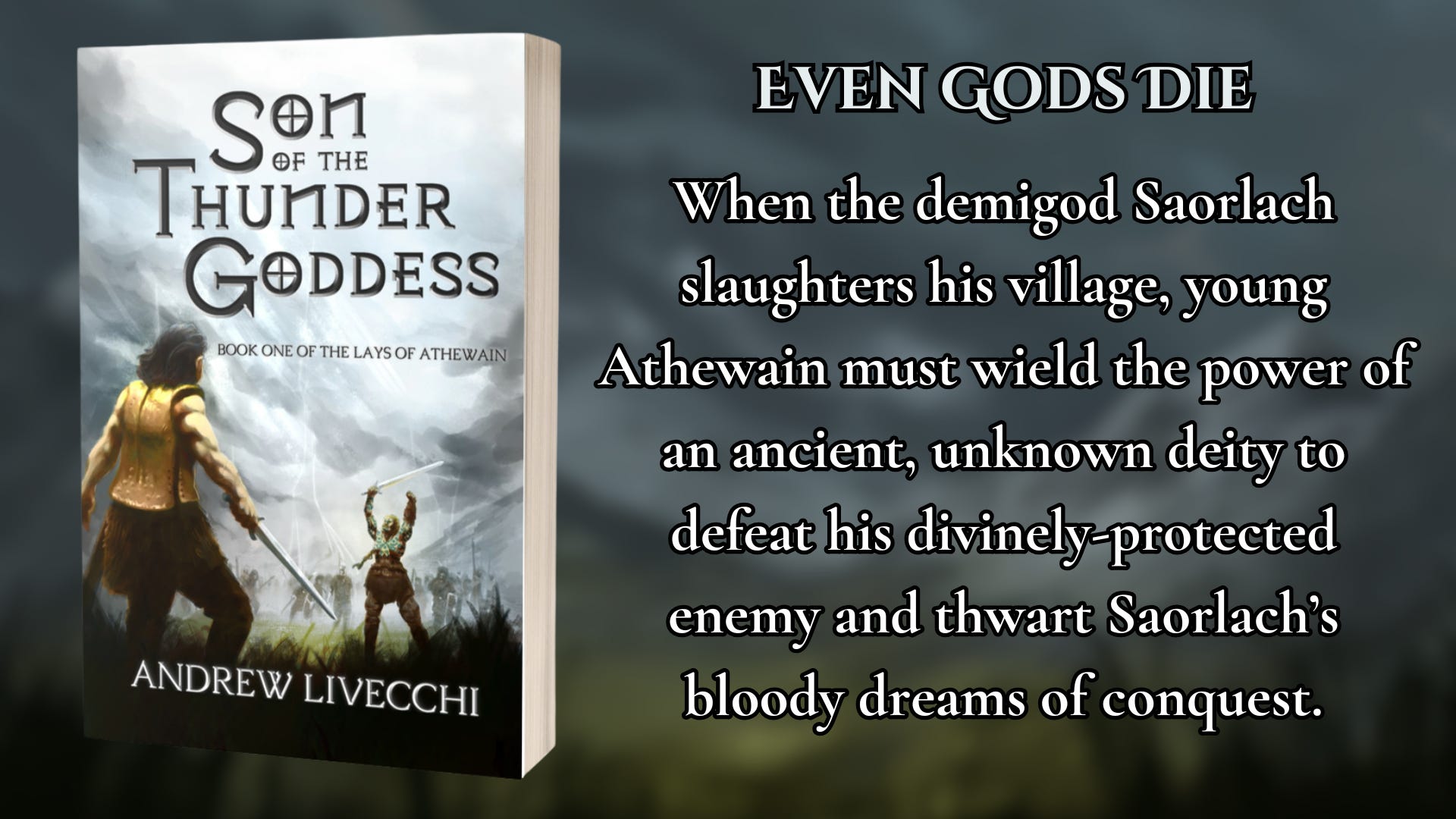
If you enjoyed this post, consider checking out my epic fantasy series, The Lays of Athewain. It builds on a lifelong love of mythology and literature and engages with many of the themes I explore here on Substack.
No posts
Comments
Nothing yet. Say the first thing.
Sign in to join the conversation.