
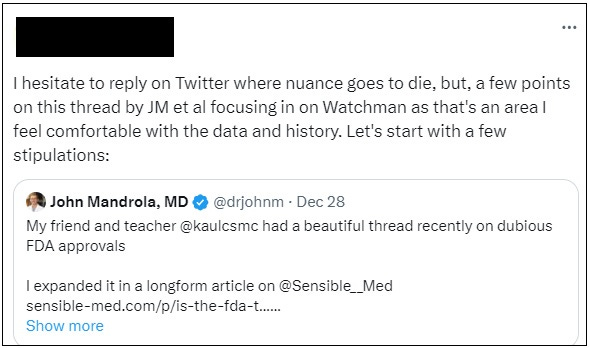
The setup…
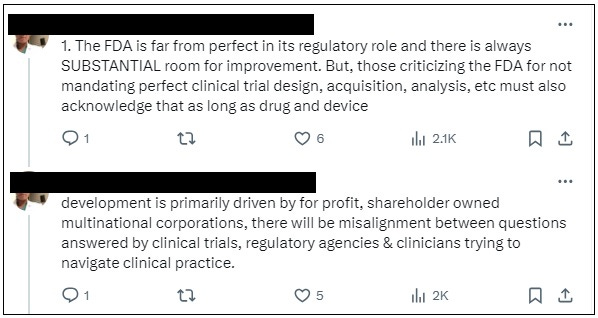
Completely agree with misalignment issue as well as concerns for regulatory capture, which he did not mention. Due to these issues, FDA may be overall net harm as it gives impression to providers that anything “FDA approved” is “tried and tested.”
Thanks for reading Andrew J Foy! Subscribe for free to receive new posts and support my work.
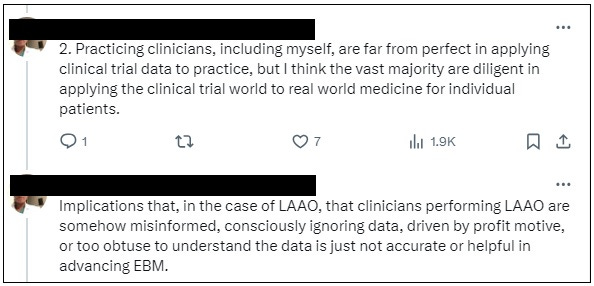
Pandering.
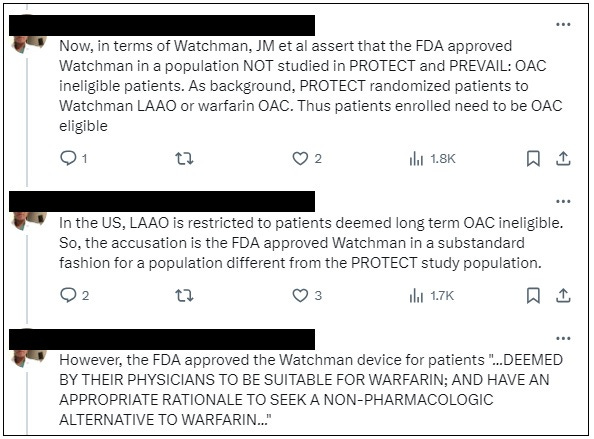
Not wrong but also not really the point.
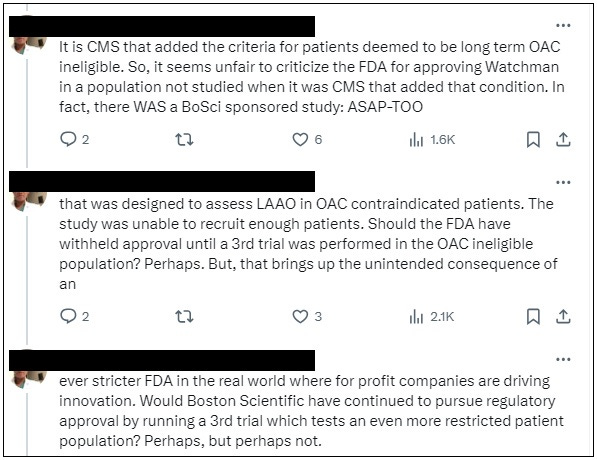
A case can easily be made that they should have withheld approval since these patients would be the prime audience and the first 2 trials were underpowered for making conclusions about individual endpoints and had conflicting results. As a doctor taking care of patients, and not an employee of Boston Scientific, I could care less whether the company would have continued to pursue regulatory approval or not and I care even less about their lost investment should they have abandoned it all at that point.
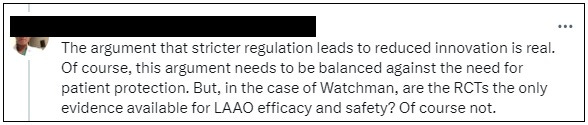
When evaluating new interventions for efficacy and safety, RCTs are the ONLY way to make reliable claims about causation, we’re NOT dealing with a “parachute” intervention here. While a theoretical case can be made for why Watchman would work, a competing case can be made about why it would not. Should the default position not be the null? Skepticism is the basis for scientific thinking.
Whether we resort to lesser evidence and theory in medical decision making, to me, is related to the desperation of the situation. Stroke prevention for AF patients is not a desperate situation in my mind.
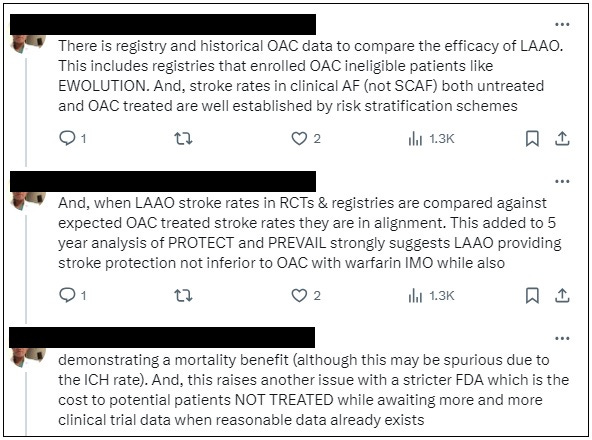
I will say it again, observational data is completely insufficient to make claims about causality. The author is saying, “just compare event rates in Watchman registries to other historical observational data for AF patients on and off oral anticoagulants and if rates are the same or better you’re good to go!” I don’t accept this as it is fraught with confounding, which is why RCTs are generally mandated in the first place.
PROTECT and PREVAIL don’t even agree with each other, which is not unexpected given how wildly underpowered they are to reach any conclusions about individual endpoints. As a rule, when trials are underpowered, events rates tend to vary wildly. So no, I’m not cool with just saying “this observational data is more-or-less similar to these underpowered RCTs so we’re good to go!”
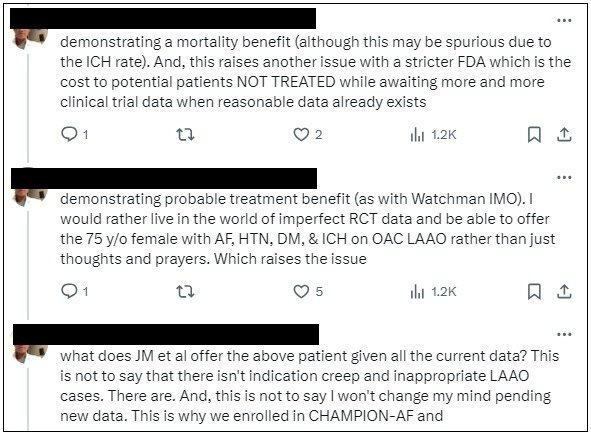
“Thoughts and prayers”. What hyperbole. Give me a break.
I don’t view “waiting” as high cost. Nor is it a situation that calls for thoughts and prayers. If the benefit/risk profile of Watchman is better than nothing, it will be small. NNT on the order of at least 25-30 but more likely 50 to 100. There’s also the chance risk could outweigh benefit or it’s not effective when tested in a properly powered trial. I would like better information on this before making a decision that could ultimately lead to harm in a patient whose stable to begin with and has a low chance of experiencing the endpoint the device is ultimately designed to reduce. That’s my constrained or tragic vision of medicine. The author has an unconstrained vision. And here lies the main conflict.
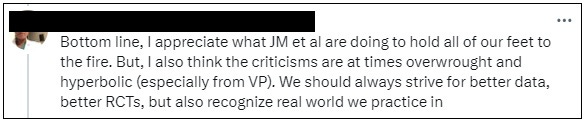
You probably don’t really appreciate it but thanks.
Why would industry strive to provide better data when you seem more than happy to settle for less?
What recognition about the real world? That generating evidence is hard and comes at a cost? We get it. We also get that the rewards are massive.
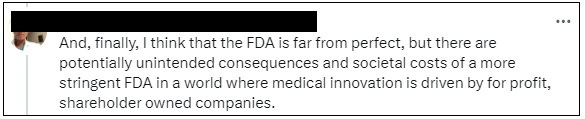
There are also unintended consequences and societal costs of rubber-stamping bad products.
I don’t care about medical innovation for the sake of it. There’s my constrained or conservative vision of medicine again.
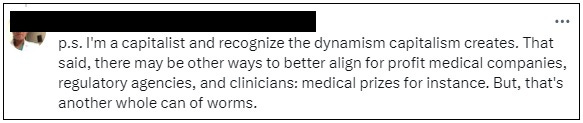
We understand capitalism differently. In my opinion, the healthcare system is not a capitalist system. I love capitalism and believe it’s been a great benefit to mankind, which is why I hate to see it drug through the mud in these sorts of debates. This isn’t about being capitalist or anti-capitalist.
I don’t support corporatism. Maybe you don’t either but to me, it seems that is what you are defending here.
---
To me, most of this physician’s argument is about defending an unconstrained vision of medicine against a constrained or conservative one. That is fine. I don’t believe there is an objectively correct answer as to which is better. There are tradeoffs to both and my own psychology makes me inclined toward the constrained vision as it does for many other physicians and patients and vice versa.
I would think; however, if the author truly loved capitalism he would want to protect individuals and society from having to involuntarily subsidize products that are of questionable benefit and they may not want for themselves (even if perfectly informed) but that is besides the point.
I think it’s also worth pointing out that we, on the constrained side, must fight extra hard to make our voices heard because the unconstrained vision of medicine rules the day. And I don’t believe it’s because that’s what the vast majority of patients want but instead, because it aligns well with the profit motive of industry. Even though “profiting” is not the goal of the unconstrained medical vision, it is for industry, which makes them natural bedfellows.
Thanks for reading Andrew J Foy! Subscribe for free to receive new posts and support my work.
Comments
Nothing yet. Say the first thing.
Sign in to join the conversation.