
Bullshit is an official query of scientific study. Typing “bullshit” into Google Scholar yields 2,040 results since 2026 alone.
Examples include:
Bullfighting in the business arena: Evidence-based strategies for detecting and disposing of organizational bullshit
Bullshit detection and metacognitive awareness: the interplay of cognitive factors, self-esteem, and dark traits
Classroom discussions of social issues in the age of generative AI: Epistemic vigilance against bias and bullshit
Unfortunately, studying bullshit in medicine has not caught on yet; medicine, as a specialty, is probably too puritanical for that. A PubMed search of the term yields only 60 results from 2006 through 2026 and most are not actually in medical journals.
Thus, medical practitioners are probably not aware of this avenue of legitimate study but it is time to change that. Bullshit thrives in environments where profit is prioritized, medicine is no exception.
Let’s dive in.
Scientifically speaking, what is bullshit?
In 2005, Princeton University philosopher Harry Frankfurt published the book On Bullshit. In it, he defined bullshit as communication characterized by a “lack of connection to a concern with truth.” It can be organized into the following categories: 1. Lies, 2. Spin, and 3. Irrelevance.
Lying is a deliberate attempt to mislead from the truth. In my opinion, it is the most malignant form of bullshit. A liar knows the truth, they intentionally choose to ignore it in favor of fostering another narrative. An example would be promoting a product on the basis of data garnered from lower level evidence while overtly ignoring higher level evidence that undermines the claim.
I was at an industry sponsored dinner recently where one of the chief scientists for the company tried to promote renal denervation for blood pressure lowering on the basis of data gathered from the unblinded phase of sham-controlled RCTs. This person did not acknowledge the stark difference in blood pressure reduction in the blinded vs. unblinded phase of the trials. I have written about this previously over at Sensible Medicine. The point is highlighted with the following figure from the original post.
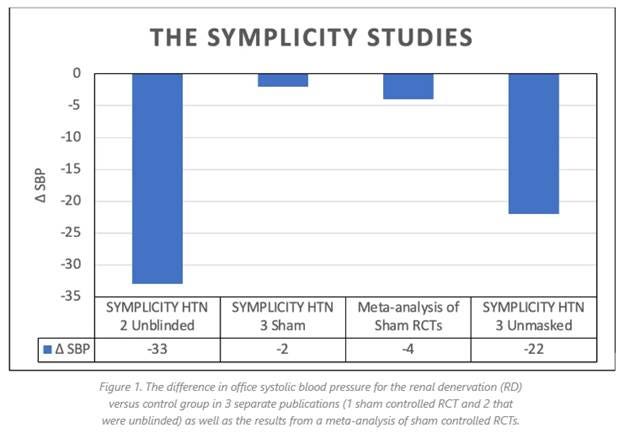
This is a great example of bullshit. It is perfectly fine to promote renal denervation on the basis of the highest level data that comes from sham-controlled RCT’s. These studies generally show a modest but statistically significant reduction in blood pressure and within that average difference lives patients who benefit more and less from the procedure. Of course, a similar blood pressure reduction can be achieved with many drugs.
From my standpoint, the attractiveness of a procedure-based approach to blood pressure lowering hangs on the extent to which it lowers pressure beyond what can be achieved with drugs. The idea of “curing” is substantially more attractive than the idea of lowering by a few points and still needing to take a host of other agents. That might still be worth it depending on the clinical circumstances and that would be the honest and nuanced take - the bullshitter knows that and intentionally chooses to disseminate a false narrative to increase the attractiveness of what they are promoting.
Another great example comes from the advertising of the Watchman device as “one time for a lifetime.” There are several items of bullshit contained within this catchy little slogan. First, the notion that one procedure is all that is needed to reduce stroke risk in patients with Afib, as opposed to a lifetime of taking medication, is pure bullshit. In reality, patients must take multiple blood thinning medicines for several months following Watchman implantation and then must continue taking aspirin for life. In case you didn’t know it, aspirin is a medicine! There is, arguably, not a significant difference in bleeding risk between aspirin and oral blood thinners. Patients will also be subject to future invasive testing, in the form of transesophageal echocardiography, to ensure there are no clots on the device itself. If there are, it would prompt the use of more blooding thinning medicine.
The second bit of bullshit, that is promoted by this add, is that Watchman is equally effective to taking blood thinning medicines to reduce the risk of stroke in patients with Afib – it is not. All Watchman trials have been designed as non-inferior studies to assess whether Watchman is “non-inferior” to blood thinning medicines based on a composite of endpoint events including stroke. All of the Watchman RCTs have been underpowered to test the noninferiority of Watchman for the endpoint of stroke alone. Thus, inferences about stroke risk for Watchman compared to blood thinning medicines are riddled with uncertainty and the studies show a consistent signal that stroke is higher in patients receiving the Watchman device. For a nuanced review of the limitations of the Watchman literature I would encourage readers to take a look at this article, which was recently published in the journal Thrombosis and Haemostasis.
Spin is manipulative language used to distract from another, usually more important, truth. However, as opposed to outright lying, it does not deliberately mislead about the truth itself. Prevalent examples in medicine include promoting a secondary endpoint(s) while ignoring or minimizing the primary endpoint of a research study. Khan et al. studied the prevalence of spin in published cardiovascular randomized clinical trials. They reported that among trials with negative primary endpoints, published in 6 high-impact journals between 2015 though 2017, the majority included spin (57% in the abstract, 67% in the main text, and 11% in the title).
An example of spin would go something like this, “X product did not reduce the primary endpoint [insert whatever you want] but did reduce this secondary endpoint [insert whatever you want].” Purveyors of this type of bullshit would argue about the importance of the secondary endpoint (i.e., nonfatal myocardial infarction). “It is okay that death or a composite endpoint including death was not reduced, heart attacks are important endpoints in and of themselves. You wouldn’t want to have a heart attack would you?”
This is not just problematic because it deflects from the fact that the primary endpoint was not reduced; more importantly, the statistical testing of secondary endpoints is highly prone to false findings. I would refer readers to this famous article by John Ioannidis, “Why most published research findings are false.”
Furthermore, the secondary endpoint being highlighted by the bullshitter, likely has substantial limitations relative to the negative primary endpoint. It is likely far softer and may have subjective components that could be prone to bias depending on the study design.
Irrelevance describes a claim that may or may not be true but ultimately does not matter (or at least should not matter that much) for decision making purposes. This is a tactic that is used commonly in medical product promotion. Take for example, any cancer screening campaign. They all tend to start with an emphasis on the number of people who will die due to the cancer in focus. From that point, it is easy for consumers of the bullshit to infer that screening and early detection could save their life.
Unfortunately, there are many problematic and nuanced assumptions connecting the concepts of early detection, improved quality of life, and years of life saved. The bullshitter is not interested in dealing with that level of nuance and uncertainty and so instead, makes irrelevant claims as a way to scare people into doing something.
Bullshit in medicine is a major problem. We need to start identifying it and calling it out for what it is. I intend to continue exploring this in future posts. Thanks for reading. If you would like to share any examples of medical bullshit, I’d be interested to read about them in the comments.
No posts
Comments
Nothing yet. Say the first thing.
Sign in to join the conversation.