
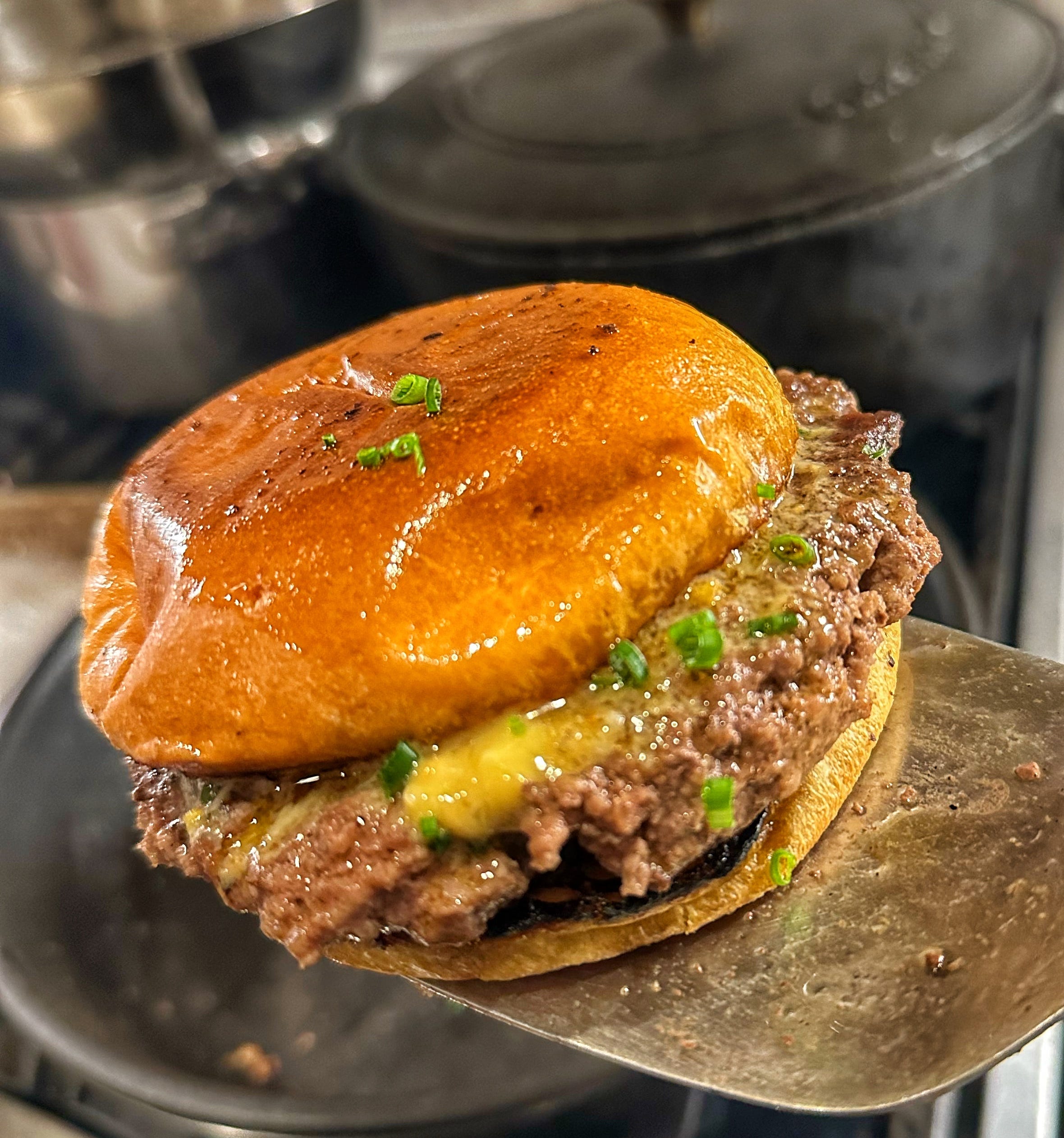
Most people think cooking a frozen burger is a shortcut but it’s not. In many cases, it’s actually the better technique. After reading a few articles from publications like Serious Eats, I recently put it to the test with two identical 8-ounce burger patties. One was kept thawed. The other was flash-frozen before cooking. Both were placed in the same carbon steel pan under the same conditions.
The result surprised me (and my tasting panel of kids).
The frozen burger developed a deeper, darker crust while staying noticeably juicier inside.
Here is the video:

Chef Andrew Gruel@ChefGruel
It's the 4th of July, and you forgot to pull the frozen burger patties. What do you do? Here's some burger info that will blow your biscuit.
3:05 PM · Jul 4, 2026 · 68.3K Views
56 Replies · 134 Reposts · 1.8K Likes
Now onto the science.
When you place a thawed burger into a hot pan, two things happen almost immediately.
The surface begins browning through the Maillard reaction—the series of chemical reactions responsible for that rich, savory crust. At the same time, heat rapidly travels toward the center of the burger. The problem is that the center heats up almost as quickly as the outside.
By the time you’ve developed a beautiful crust, the inside has often gone from medium to medium-well, squeezing out moisture along the way.
A frozen burger changes that equation. The frozen center acts like a heat sink. Before the meat can actually cook, energy has to melt the ice crystals. That takes a surprising amount of heat.
While the center is busy thawing, the outside spends more time exposed to high heat.
That extra time allows the Maillard reaction to continue building flavor and color without overcooking the interior.Think of it as giving the crust a head start.
The Maillard reaction doesn’t begin until the surface reaches roughly 300°F.
This is where hundreds of new flavor compounds are created. It’s the difference between gray meat and a burger that smells like a steakhouse. Because the frozen center slows down the cooking process, the exterior stays in that ideal browning zone longer before the middle reaches your target temperature.
The result is:
A darker crust
More complex beef flavor
Better texture
A juicier center
It’s essentially increasing the amount of “good cooking” while reducing the amount of overcooking.
I cooked both burgers in a carbon steel pan for a reason.
Carbon steel stores an enormous amount of heat. When the cold burger hits the pan, the temperature doesn’t crash the way it might with thinner cookware.
That consistent high heat keeps the surface dry enough to brown quickly instead of steaming.
The frozen burger benefits even more because the pan continues delivering enough energy to build crust while the center slowly catches up.
Cast iron works similarly. A heavy flat-top or griddle does too.
Absolutely. In fact, it can be even more useful on a grill.
The frozen center again slows down the cooking while the outside benefits from direct radiant heat.
You’ll often get:
Better grill marks
More caramelization
Less flare-up from dripping fat
A juicier finished burger
Just remember that thicker burgers benefit the most. Thin smash burgers cook so quickly that freezing doesn’t provide the same advantage.
If you’re going to try this:
Use thicker patties (6-8 ounces works well).
Freeze them solid on a sheet pan so they stay flat.
Season just before cooking or immediately after placing them on the heat if the salt won’t stick beforehand.
Resist pressing on the burger. Every press sends precious juices into the pan instead of your mouth.
Use a thermometer rather than guessing. Pull the burger around 125-130°F if you’re aiming for medium after resting (adjust higher if you prefer more doneness).
Cooking isn’t just about recipes, it’s also understanding how heat moves through food. Sometimes slowing one part of the cooking process actually improves another.
A frozen burger isn’t better because it’s frozen, it’s better because the frozen center buys the exterior more time to develop flavor before the inside overcooks.
That’s physics doing the work for you and once you understand that principle, you’ll start seeing opportunities to use it all over your kitchen—not just with burgers.
I’d love to hear your results if you try it. Cook one thawed and one frozen side by side. I think you’ll be surprised which one disappears first.
Comments
Nothing yet. Say the first thing.
Sign in to join the conversation.