
I have studied the Drama Triangle for years. I have read books on it, taught it to teams, and coded conversations afterward to understand how the roles move between people.
The Drama Triangle was developed by Stephen Karpman in 1968 as part of transactional analysis. It describes three roles that people tend to move between in dysfunctional interpersonal dynamics: Victim, Rescuer, and Persecutor. The model has been widely used in therapy, coaching, and organizational work because it gives language to something most people have experienced but rarely been able to name.
The Victim feels powerless and looks to be saved. The Rescuer steps in to help, often without being asked. The Persecutor attacks, criticizes, or sets unreasonable expectations. The roles are not fixed to people. They are positions in a dynamic, and people shift between them, sometimes within a single conversation.
The triangle is not the cause of the problem. It is a signal that something else has already gone wrong.
This post is not about why the triangle forms. It is about what you can do once you realize you are in it.
There is usually a real issue underneath the conversation. Something that matters, something that needs to get resolved. The trouble is that somewhere along the way, productive communication broke down. People got frustrated. They stopped making progress. They started reacting to each other instead of working the problem.
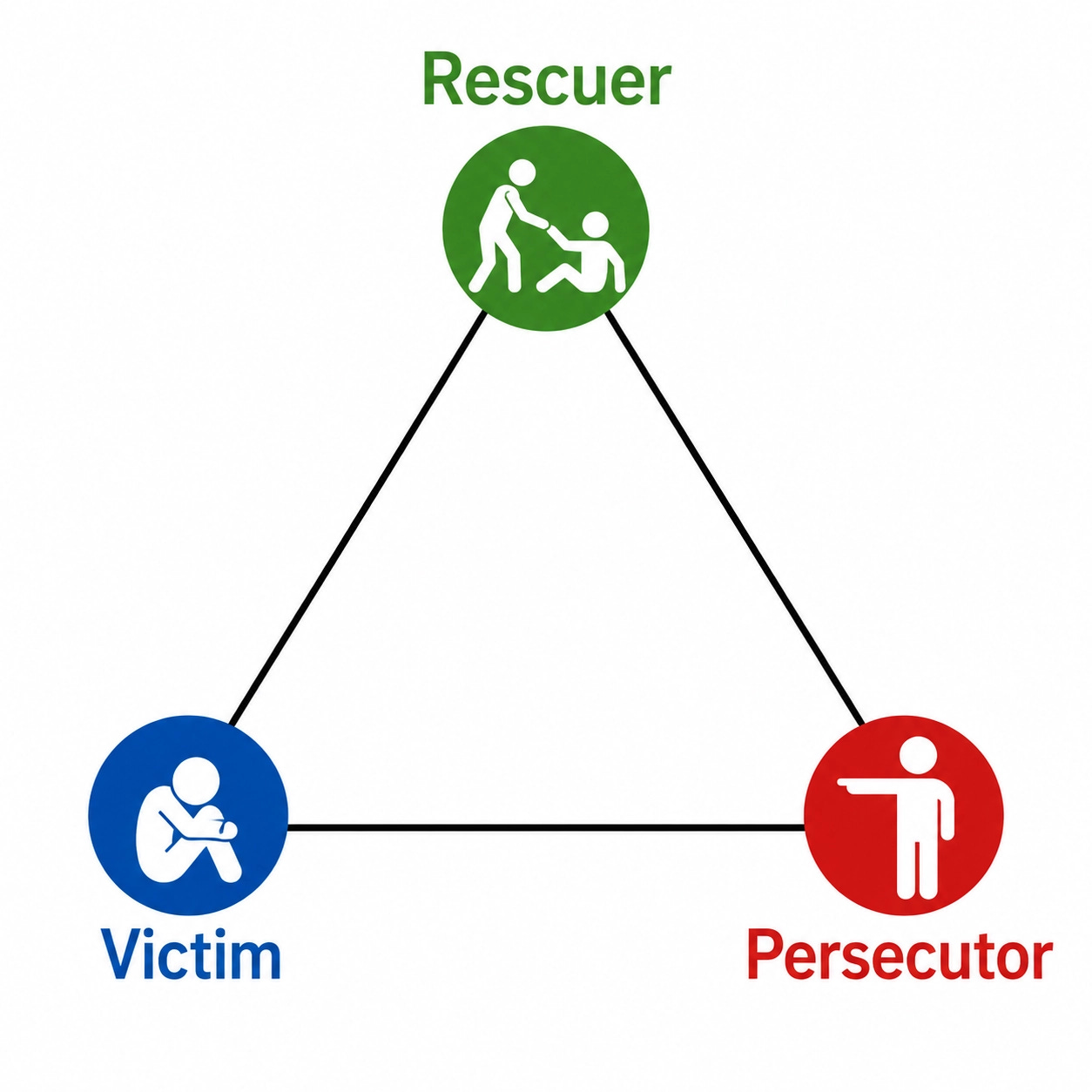
That is when the roles emerge.
The Victim: nothing I do matters because you always...
The Rescuer: fine, I will just take care of it myself...
The Persecutor: the problem is that you keep...
Notice what all three have in common:
—> Attention has shifted from the problem to the people.
That is the real signal. When you see the triangle, it usually means the conversation has lost the shared problem. The most useful question you can ask is not which role am I in. It is what problem are we actually trying to solve.
Sometimes the answer exposes something important: the people in the conversation are not trying to solve the same problem.
The manager thinks the problem is hitting Friday’s deadline.
The employee thinks the problem is an unsustainable workload.
Neither is wrong. They are talking past each other because they are solving different problems without realizing it.
Before you can leave the triangle, you have to notice you are on it.
The signal is friction that keeps cycling. The same argument from different angles. The same frustration appearing in different forms. Conversations that feel like they are going somewhere and then arrive back where they started.
Once you notice it, you have a choice. Not every situation calls for the same response.
A note on perspective. This is a real exchange I was pulled into. I was the boss of the Supervisor and the Supervisor was the boss of the Press Lead. This detail is important because it is written from the vantage point of someone who can intervene: a manager, a coach, or a third party in the room. If you are one of the two people in the conflict, your options are the same but your leverage is different.
Here was the situation, one of my supervisors was having trouble with their lead press operator. They were arguing over how to solve a quality issue on the presses that day and also about break times. I got pulled into their office to help. In this conversation I have coded P for Persecutor, V for Victim, and R for Rescuer next to the job titles so you can see what role they are actually occupying with that response.
The conversation went something like this:
Supervisor (P): Look, we are not going to hit our numbers today unless we get a handle on this quality issue on the presses.
Press Lead (V): It is not my fault. The team is doing all they can here.
Supervisor (P): I am not blaming you or the team. What you are doing is not working and you need to change the bump cycle.
Me (R): Look, you two are on the same team. Let us pull together here.
Press Lead (V): Okay, so now you are saying I do not know how to do my job?
Supervisor (P): No, I am not saying that, but you have to do something different.
Press Lead (V): That is what I am trying to do, but you said I cannot add a minute to the cure time.
Supervisor (P): I do not think that is going to help here. Show me how it will help.
Press Lead (P): Why don’t you show me how changing the bumping cycle will help?
Supervisor (V): So you do not think I know what I am doing either. I am the supervisor here.
Notice that the roles moved. The Press Lead went from Victim to Persecutor and the Supervisor went from Persecutor to Victim. I stepped in as the Rescuer. Nobody was assigned a role; we were moving through them as the conversation deteriorated.
Exiting the triangle does not necessarily mean solving the problem. It means stopping your participation in the dysfunctional dynamic. What happens with the problem afterward is a separate choice.
Sometimes the right answer is to stop before the conversation does any more damage to the relationship.
“Look, we are not getting anywhere right now. Let us step back and come back to this.”
Nobody wins. Nobody needs to lose. You recognize that continuing the conversation is not going to accomplish anything right now and disengage without unnecessarily damaging the relationship. Not every disagreement needs to be resolved in this moment. You can always come back to it when both sides are ready.
This is an example of how this type of exit looks in the story above.
Me: Look, you two are talking past each other. This is important, so I will give you an hour to come back to me with your plan on how to fix this together.
There is also a less graceful way out that often does damage to the relationship.
“Fine. Let us just drop it then.”
The game still ends. Now you may have damaged the relationship, left the original issue unresolved, and created another problem to deal with later. Stopping the game and handling the game well are not the same thing. Coming back to work on this together becomes significantly harder from here.
This is an example of how this type of exit looks in the story above.
Me: Look, stop arguing. You two need to find a way to deal with this.
When there is a real problem underneath the triangle, there is another option.
Restore the shared problem.
Sometimes people appear to have completely different goals. In most cases they are arguing about solutions rather than the underlying need. Getting to a shared problem means getting underneath the positions to find what both people actually require. That is still the productive exit.
“We are going in circles. What is the problem we are actually trying to solve here?”
That question moves the conversation from you versus me to both of us working toward something. If the manager and employee stop arguing about who is at fault and ask what needs to happen before Friday, they have something to work on.
This is an example of how this type of exit looks in the story above.
Me: So, we are going in circles here. Let us focus not on each other but on what the problem is and how we are going to fix it.
Working the problem does not mean accountability disappears.
Maybe the manager did set an unreasonable deadline. Maybe the employee knew two weeks ago that the work was going to be late and said nothing. Maybe both happened. You can figure that out later.
The immediate problem is the quality issue on the presses and it needs to get resolved today. Stabilize the situation. Solve the immediate problem. Then go back and understand why you ended up there.
That is where the Drama Triangle becomes useful again. After the conversation, look at what happened. Where did the triangle begin? What role did I accept? What did my response invite? When did the roles change? Where could I have interrupted the pattern sooner?
Now the model is helping you learn rather than giving you something else to manage while you are trying to have a conversation.
The Drama Triangle is an excellent way to see dysfunctional interpersonal dynamics. It gives language to something most people have experienced but rarely been able to name.
Seeing the game is not the same as knowing what to do next.
When the triangle appears, it usually means the shared problem has been lost. Find the problem. Restore it. Work it together.
The Drama Triangle shows you the game. Restoring the shared problem gives you a way to exit it.
Comments
Nothing yet. Say the first thing.
Sign in to join the conversation.