
Employee engagement has become one of the most measured topics in management. Organizations conduct surveys, compare scores across departments, and build action plans designed to move those numbers in the right direction. None of that is inherently wrong. The problem is what often happens next.
Managers start trying to fix engagement.
That is like trying to fix a fever instead of asking what caused it. A fever tells you something is happening inside the body. It does not tell you what the problem is. The same is true for engagement. A low engagement score is information. It is not a diagnosis.
Over the years, I became less interested in engagement itself and more interested in the system that produces it.
I have been in this situation.
Our employee survey results were better than average but not where we wanted them. We scored well in a lot of areas. Trust of management was the issue that kept coming up.
The written feedback told us what employees wanted: better snacks in the vending machines, less overtime, air conditioning on the floor in summer, more consistency in the work.
So we built an action plan. That is what the company expected. Identify the issues, address the issues, watch the scores improve.
We attacked the symptoms. Better snacks. More consistent scheduling. We added spot air conditioners at some work stations. We worked on what we could control. The company was treating engagement like a checklist. Fix these problems and the number goes up. Nobody was asking why trust of management was low in the first place. Nobody was looking at the system that was producing the results we were seeing. So I started building one.
Think about a fire.
A fire requires three things: a spark, fuel, and oxygen. Remove any one of them and the fire cannot exist. Increase or decrease one of them and the fire changes. You do not manage the fire directly. You manage the conditions that allow it to burn.
Engagement works the same way.
The fire is engagement. The triangle surrounding it is the organizational system. Each side of the triangle has a distinct owner, a distinct responsibility, and a distinct role in producing the engagement you see.
The spark, the fuel, and the oxygen are not interchangeable. Neither side can substitute for another. That is the nature of a system. You need all three operating at the same time or the fire cannot burn.
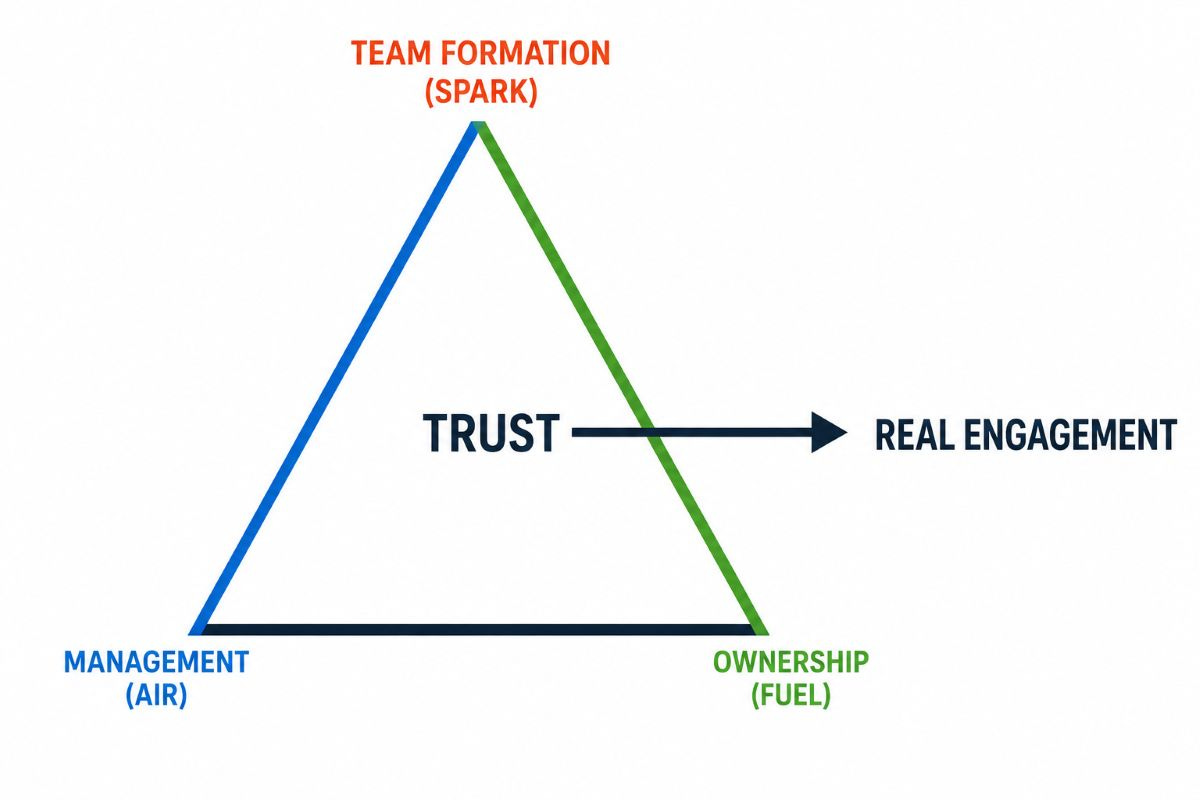
The first side is management. Management provides the oxygen.
This includes everything employees reasonably expect the organization to provide: direction, resources, priorities, accountability, communication, fair policies, functioning equipment, clean restrooms, and working parking lots. It includes the frontline manager, the executive team, HR policies, and the physical environment. Management owns the conditions. If those conditions cannot support people doing good work, engagement will eventually suffer regardless of how motivated the employees are.
Removing barriers creates the possibility for engagement. It does not create engagement itself. A cooler factory floor may reduce frustration. It does not automatically make someone more invested in their work. That is why adding spot air conditioners on the floor did not move our engagement scores.
The second side is ownership. Ownership of the work belongs to the employee. Employees provide the fuel that keeps the fire burning.
Ownership is not something management can assign. It is a choice employees make every day. It shows up in initiative, problem solving, helping teammates, improving processes, and investing more than simple compliance requires.
No matter how good the environment is, you still have to show up each day and do the work. That is the employee’s side of the deal. Management cannot do that for them. If you do not find meaning in the work itself, your engagement will be capped regardless of what the organization provides. There is very little management can do about that. They are independent. Management cannot do the employee’s job for them and employees cannot fix a broken environment by working harder. Each side owns its own responsibilities. Neither can substitute for the other. The system only works when both sides are operating.
The third side is the spark. Every system has a beginning. Teams form, leaders change, projects launch, mergers occur. Those moments often reset expectations and relationships, making them useful places to begin troubleshooting when engagement shifts.
At the center of the triangle sits trust.
Trust does not belong to management. It does not belong to employees. It belongs to the relationship itself.
Trust is also not one thing. A team member may trust their direct manager but not the executive team. They may trust their coworkers but not the company’s direction. Trust exists at multiple levels simultaneously, and it operates as a polarity on both sides. As management fulfills its responsibilities and employees continue to demonstrate ownership, trust grows. When either side consistently fails to meet expectations, trust weakens.
Trust is not a prerequisite for engagement. An employee can show up, do the work, and meet expectations while having very little trust in the organization or the people running it. That is compliance. It produces average engagement scores. Trust is what determines the ceiling. High trust allows the system to operate at full capacity. Low trust limits it regardless of what either side is doing.
When engagement scores decline, most organizations immediately begin discussing engagement initiatives. They improve recognition programs, schedule more town halls, redesign one-on-one meetings, or add new perks.
Those ideas may help. They also may have nothing to do with the actual problem.
This model starts somewhere different.
Has management changed the conditions employees are working in?
Has employee ownership declined?
Has trust been damaged?
Has the system recently experienced a significant change?
Those questions move the conversation away from the presenting problem and toward the underlying system. In operations I learned that solving the presenting problem often creates temporary improvement while leaving the real constraint untouched. If a machine begins producing defective parts, replacing the operator may improve quality for a day. Finding the worn bearing that caused the vibration solves the real problem.
Employee engagement deserves the same discipline.
One important note: this model is a diagnostic tool, not a repair manual. Think of it as a volt meter. It tells you what is happening in the system. It does not tell you how to fix the wiring. That is a separate conversation.
An engagement survey tells you that something changed. It does not tell you why.
That is why I no longer think the right question is how do we improve engagement. The better question is what changed in the system that produced the engagement we are seeing today.
Solve that problem, and engagement often takes care of itself.
Comments
Nothing yet. Say the first thing.
Sign in to join the conversation.