
One pattern I have noticed over the years is that many leadership problems are not caused by a lack of effort or skill. They are caused by people doing the wrong work for their level.
We often tell leaders they need to think more strategically, but that advice is so broad it rarely changes behavior. A more useful question is: what work does your role primarily exist to do?
I had a director who had a habit of pulling my managers aside after meetings and assigning them tasks directly. I would ask one of my managers to work on something and they would tell me the director had already given them something else to do.
There was nothing wrong with what the director was asking for. The problem was how work entered the system. Work was landing on my team without going through the planning process that made sure everything got done.
So I told my managers to go ahead and do what the director asked, but to let me know what it was. That gave me the information I needed to follow up with the director my self. Once I was in that conversation, I could understand what he needed, figure out the timing, and steer my team so both sets of work got done.
The director was not wrong to need things done. He was working in the wrong lane to get them done. Once we put the right layer in between, it worked.
That experience made me realize the problem was not communication. It was that we were asking the wrong organizational layer to perform the work.
A Working Model
I think organizations operate across four primary lanes. The titles vary by company, but the work each lane owns tends to stay consistent.
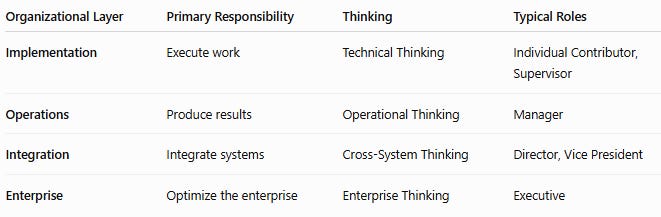
The first lane is Implementation. This is where work gets executed. The primary thinking is technical. Individual contributors and supervisors live here.
The second lane is Operations. This is where results get produced consistently. Managers build the systems, priorities, and routines that allow teams to perform week after week.
The third lane is Integration. Directors and vice presidents work here. Their job is to align departments, resolve competing priorities, and make sure the organization is moving in the same direction.
The fourth lane is Enterprise. Executives live here. Their job is to decide where the organization is going and what it should be optimizing for.
The important point is not the titles. It is the work. Every lane exists because it owns a different problem.
The Mistake
The mistake many organizations make is not that leaders occasionally work outside their lane. The mistake is that they begin to manage down.
If a manager spends all day doing technician work, who is coaching the team? If a director becomes another operations manager, who is aligning competing priorities across departments? If an executive becomes another director, who is thinking about where the organization needs to be three years from now?
The question is not whether you should ever manage down. The question is whether you recognize the cost. Managing down is often necessary. Living there is expensive.
Temporary overlap is part of leadership. Every organization has moments when people step into another lane because the business needs it. The problem is when that becomes the normal way of operating. The more leadership layers blur together, the more execution suffers because the work that only each layer can perform is delayed, delegated, or simply does not happen.
If you ever wonder why your pillar strategy you spent months developing and finalizing is stalling out at the execution layer, maybe you missed a lane.
Why Organizational Size Matters
In a twenty-five-person company, the founder may occupy all four lanes. They set direction, align functions, build operating plans, and occasionally jump in to serve customers. That is not a flaw in the model. It is a staffing reality.
As organizations grow, leaders have to become increasingly intentional about leaving work behind. Promotion is not simply more responsibility. It is a change in the primary work you own.
One of the hardest transitions in leadership is accepting that being capable of doing the work below you does not mean it should remain your primary focus.
A Personal Version
This same pattern shows up at the individual level too. If you have been in a role for several years and the next opportunity has not come, it is worth asking whether you are spending too much time in the lane below. Leadership often promotes what it sees. If what they see is you doing operations work, they may not be able to picture you doing integration work. You may be excellent at the lane below and invisible in the lane you are trying to reach.
The question is not just am I working in my lane. It is also: Can the people above me see me working in the lane above?
The Question Worth Asking
I have found it useful to ask one simple question: Am I working in my lane, or am I managing down?
Sometimes the answer will be that you are managing down because the business needs it today. That is a perfectly reasonable decision. Just make it a conscious tradeoff.
The mistake my director made was not that he needed things done. It was that he went into tasking mode and unloaded on the first person he saw. For urgent topics that can be the right call. The problem is when everything becomes urgent. If everything is always urgent, the urgency is not the issue. Something else is driving it and that is worth looking at separately.
Every hour spent in the lane below is an hour not spent doing the work that only you can do. Managing down is often a habit more than a decision.
Every leadership role has work that only that role can perform. When you move down a lane, someone still has to do the work you left behind.
The question is not whether you are capable of doing work below your role. It is whether anyone is still doing the work only your role exists to do.
Comments
Nothing yet. Say the first thing.
Sign in to join the conversation.