
We have a tendency to judge plans and their execution by what happened afterward.
If the result was good, we assume the plan was good and the execution was sound. If the result was bad, we go looking for who screwed up.
The problem is that plans, execution, and results are separate things.
A plan has to be evaluated on whether it was sound given what was known at the time.
Execution has to be evaluated on whether we did what needed to happen to achieve the objective.
The result has to be evaluated based on what actually happened.
For this discussion, I am using these definitions:
Good plan: Given what we knew at the time, this was a reasonable approach for achieving the objective while managing the risks and alternatives.
Bad plan: Given what we knew at the time, there was a reasonably foreseeable flaw in the problem, objective, solution, alternatives, or risk that should have changed the approach.
Good execution: We did what needed to happen to achieve the objective.
Poor execution: We did not do what needed to happen to achieve the objective.
Good result: The outcome achieved the objective, or moved meaningfully toward it, without unacceptable consequences.
Bad result: The outcome failed to achieve the objective, moved away from it, or produced consequences that outweighed the benefit.
That leaves us with three questions:
Was it a good plan?
Was it well executed?
Did it produce a good result?
Plan and execution give us four very different situations. The labels describe the result relative to the quality of the plan and execution. The result tells us what happened.
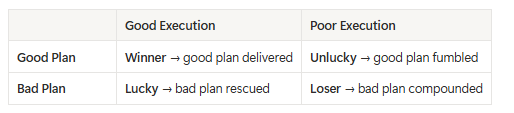
The distinction matters because each one teaches us something different. We are generally good at examining the boxes where the plan and execution worked and where they failed. The Unlucky and Lucky boxes are where we tend to drop the ball. A bad result from a good plan gets treated as a failure. A good result from a bad plan gets celebrated without examination.
This is the result of a good plan that is poorly executed. The approach was sound but something in the execution broke against you.
Early in my career I was the safety manager for a business unit. Our main factory was loud enough that everyone wore ear plugs in the manufacturing area. Fun fact. Every new employee gets their ear openings measured. I found out my right ear is extra small, which explains why to this day I cannot get an ear pod to stay in it. Now you know. Back to the story.
The OSHA requirement was straightforward. Every employee gets a hearing test at hire and each year after to check for any downward shift. One of my jobs was to oversee the program. The first year I scheduled testing on a Tuesday and Wednesday. All the work groups were notified, understood, and ready. We used an outside contractor with mobile equipment. The plan was solid.
I was going to be out of town those two days, so I asked the nursing staff to keep an eye on things.
This was before cell phones. I was traveling. About two hours into the first day, my plan went to hell in a handbasket. My boss had to get involved. The nurses were up in arms.
The plan was not the problem. Nobody was managing the people moving through the process. Everyone understood the plan, but no one was maintaining the flow. That was my failure. I was not there to help execute it.
The next year we kept the same plan with some minor tweaks. I did not leave. I spent two days helping execute it and it worked.
Same plan. Different execution. Different result.
The danger is changing a sound plan because you did not like one result. These can be soul crushers and career defining, but the lesson should be focused on the execution phase not the planning phase. Every plan can fail, but to succeed you have to execute it. When this happens learn from it and do not let it define you.
This is the result of a bad or poor plan that is executed well enough to produce a good outcome anyway. If you ever watched Scooby Doo as a kid, every episode ended here in this box.
Imagine someone decides that buying lottery tickets is their retirement strategy. That is a terrible financial strategy. Now imagine they buy one ticket and win $500,000. Fantastic result. I know it sounds unrealistic, but that actually happened to my ex-wife’s aunt.
Did winning suddenly make buying lottery tickets a sound retirement strategy? Of course not. They landed in the Lucky box.
If they only look at the result they will learn exactly the wrong lesson. Their decision worked, so they conclude their decision was good.
Organizations do this too. Someone takes an unnecessary risk. A project succeeds despite poor planning. A manager ignores warning signs and the problem happens to resolve itself. An executive makes a poorly supported bet and the market moves in their favor. Everyone celebrates. Nobody examines the decision because there is no obvious reason to.
This is often where you see survivor bias raise its ugly head.
The four boxes classify what happened. They do not diagnose what happened inside the plan or execution that produced it. That is where the chain becomes useful.
Every result is the end of a sequence:
Decision → Plan → Execution → Result → Learning
The result is feedback on everything that came before it. When something goes wrong, the temptation is to jump straight to the plan and ask whether it was a good one. That skips a step that matters.
Start at execution. Did we do what was needed to achieve the objective? If the answer is no, you have an execution problem to investigate before you can say anything useful about the plan or the decision.
If execution was sound, move to the plan. Given what actually happened, were the assumptions and approach behind the plan sound?
If the plan performed as expected, move to the decision. Was the original decision reasonable given what we knew when we made it?
A bad result can mean the decision was flawed, the plan was flawed, the execution was flawed, or circumstances broke against you despite doing everything well. The chain helps you find the weak link.
This is also why repetition matters.
Play the lottery once and you might win. Play repeatedly for decades and the quality of the underlying strategy becomes much more apparent. The same thing happens in management.
One project can succeed because circumstances broke your way. One investment can make money despite poor reasoning. One hiring decision can work despite a weak selection process.
Over repeated decisions, luck becomes less useful as a strategy.
The learning loop is not simply: we did something, we got a result, do more or less of it next time. That can teach you exactly the wrong lesson here.
After the result arrives, you need to go back and ask three separate questions.
Was the plan sound given what we knew at the time?
Did we do what needed to happen to achieve the objective?
What did the result teach us that we did not know before?
If the plan was sound, the execution was solid, and the result was bad, do not automatically abandon the approach. If the plan was flawed or the execution was poor and the result was good, do not automatically reinforce it.
The second situation may actually require more discipline because success does not naturally trigger reflection. Failure gets meetings, investigations, and corrective actions. Success gets celebrated.
Sometimes success deserves to be celebrated. Sometimes you just got lucky.
The goal is not to make decisions that always work. Nobody can do that. The goal is to make sound decisions, execute them well, correctly interpret the results, and use what you learned to improve the next decision.
Results are feedback. They are not proof.
No posts
Comments
Nothing yet. Say the first thing.
Sign in to join the conversation.