
Harry had always been a reluctant royal. Ever since the death of Diana, he found public appearances a trial, breaking into a nervous sweat when faced with camera flashes. He would much rather have continued his career in the Army than spend his days shaking hands with well-wishers at royal engagements. The problem was that he was a natural, the public seeing in him shades of his much-loved, much-missed mother. As the BBC’s royal correspondent Jonny Dymond noted: ‘To watch Prince Harry … is to observe a man who comes alive with crowds, with love, with those who need him. But also to see a man entirely unhappy with his lot. A man who desperately wants to get away from cameras, observers, outsiders, looking and filming and exploiting him.’ He had, at his brother’s suggestion, gone for psychological counselling to help him cope. The Queen had kept a weather eye on him, as far as time allowed, and he was always welcome to see her.
Although the arrival of Meghan Markle in his life was looked upon by some rather doubtfully, including Prince William, there were others who hoped she would bring Harry to safe harbour. History was not on their side, however, as evidenced by the abdication of Edward VIII and his relationship with the twice-divorced American Wallis Simpson.
While Harry and Meghan’s royal life together had started brightly, it soon began to unravel and they began crafting a road map for their future that ran parallel to that of the Royal Family rather than being directly part of it. The Windsors and their officials had been aware of the couple’s discussions about living in both North America and Britain, being financially independent and focusing on their own humanitarian mission from around May 2019.
During the summer and autumn of that year, it became even more apparent that Harry and Meghan were unhappy with the unrelenting media criticism and what they considered to be a lack of support from inside the institution. With no change on the horizon, Prince Harry had spoken to the Queen and his father about stepping back as senior royals and raising funds privately so that they would not need the Sovereign Grant nor monies from the Duchy of Cornwall, Prince Charles’s estate, to subsidise their lifestyle. As private citizens, they would not be beholden to the media but would still be able to serve the monarchy, albeit in a limited capacity. The Queen’s initial reaction to this idea was that it was almost impossible to be half in and half out of the Royal Family. It was akin to being ‘slightly’ pregnant.
The couple, who spent Christmas 2019 at a borrowed Canadian mansion on Vancouver Island, watched the smoke signals emerging from Buckingham Palace and realised that the message did not include them. First came the Queen’s Christmas broadcast, when there was clearly no photograph of Harry, Meghan and Archie Harrison Mountbatten-Windsor – her most recent great-grandchild who was born in May 2019 – visible on her desk alongside the other members of her family. Then, in early January, an official royal photograph was released. Taken at Buckingham Palace, it featured the reigning Monarch and her direct heirs in the line of succession: Charles, William and George. It was only the second time the existing and future Sovereigns had been pictured together.
Prince Harry, notoriously thin-skinned at the best of times, interpreted this in the most conspiratorial way possible, that they were no longer part of the Royal Family. It all fed into the couple’s decision-making as they carefully worked out their future. On 8 January 2020, Harry and Meghan announced on Instagram, giving minimal notice to the Queen, Prince Charles and Prince William, that they were indeed ‘stepping back’ from royal duties and dividing their time between Britain and North America. Their official statement, which was issued against the Queen’s express wishes, read in part: ‘After many months of reflection and internal discussions, we have chosen to make a transition this year in starting to carve out a progressive new role within this institution. We intend to step back as “senior” members of the Royal Family and work to become financially independent, while continuing to fully support Her Majesty the Queen.’
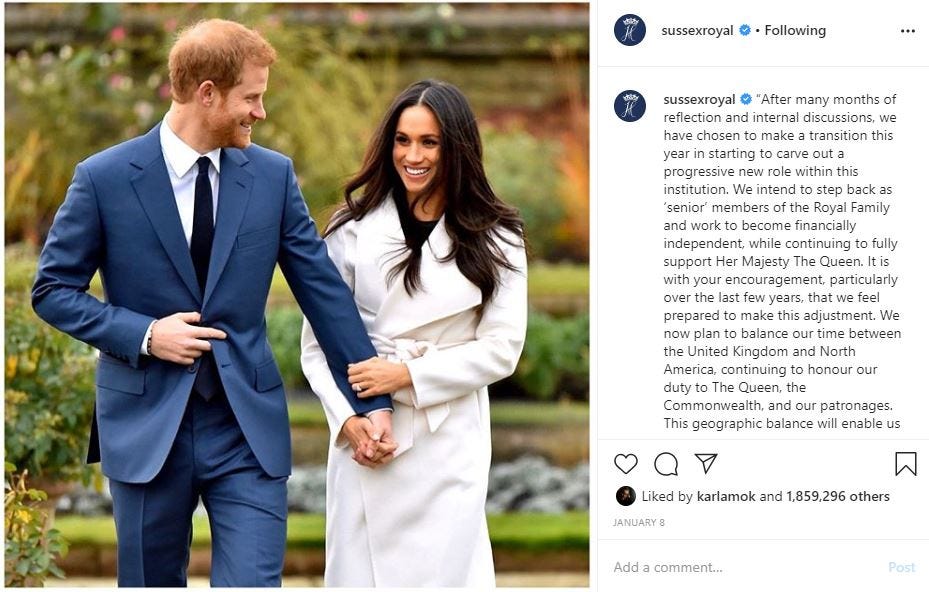
They aimed to ‘collaborate’ with the Queen and the rest of their family to make this happen. This choice of wording clearly demonstrated how weakened the Queen’s position had become. The idea of a junior member of the Royal Family ‘collaborating’ with the Head of State on an equal footing left historians, royal officials and commentators aghast. If it was anything, the Royal Family was a clearly defined hierarchy, not a republic of equals.
Comments
Nothing yet. Say the first thing.
Sign in to join the conversation.