
There is a quiet revolution happening in how we interact with software. And most SaaS founders are not ready for it.
We spent the last 20 years worshiping at the altar of SaaS. Monthly subscriptions, sleek dashboards, and easy onboarding. SaaS helped us escape clunky enterprise software, bringing powerful tools to anyone with a browser and a credit card.
But now, a new kind of interface is emerging.
Not a UI.
Not a mobile app.
Not a browser tab.
An AI agent.
And if you’re still designing your product around users clicking buttons on screens, this next shift might not just disrupt your business—it might erase it.
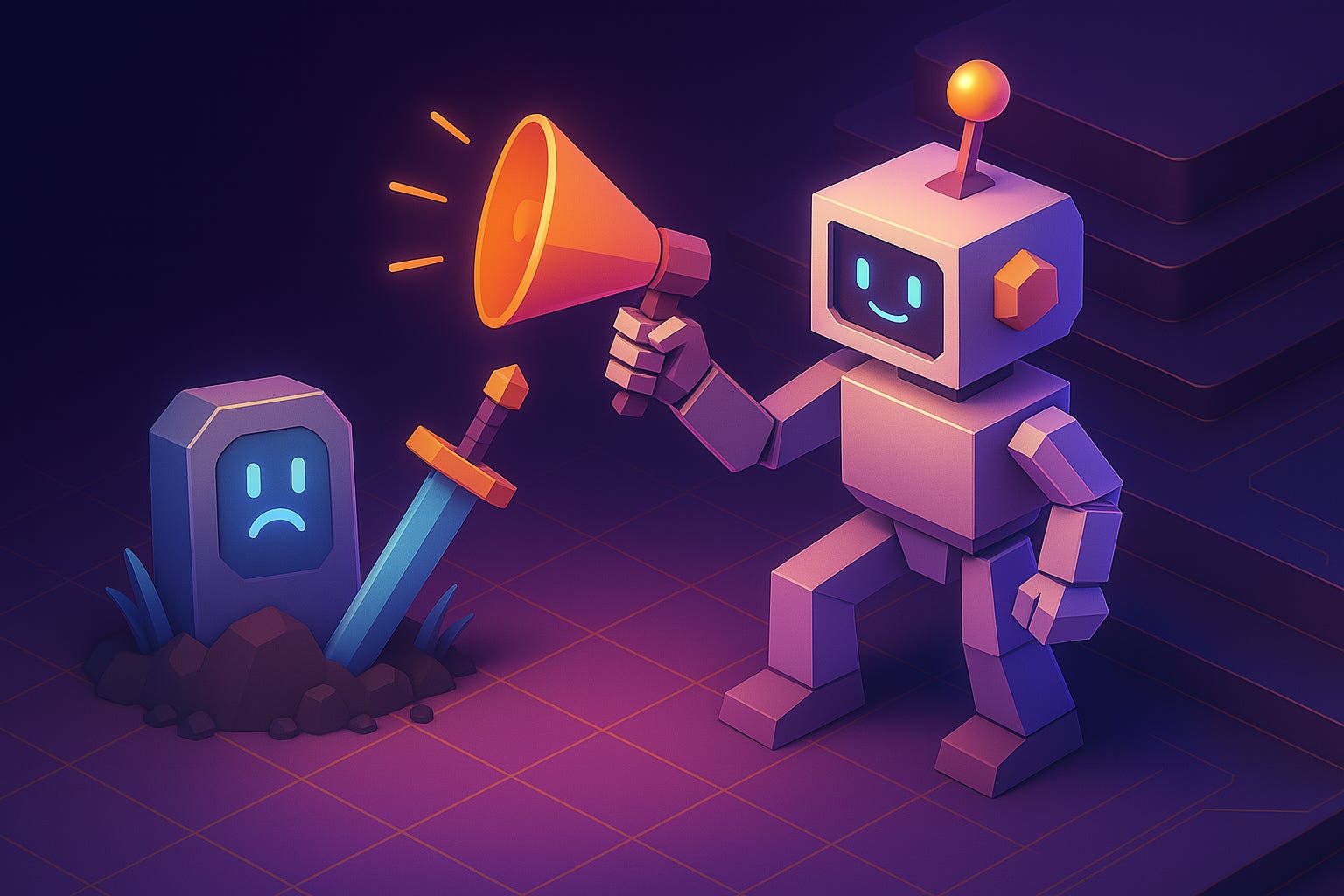
SaaS was born out of necessity. Enterprise software was bloated, expensive, and gated behind long sales cycles. SaaS came in with a promise:
Accessible: anyone could sign up with an email and a credit card.
Affordable: monthly pricing replaced huge license fees.
Usable: slick UIs replaced terminal commands.
It worked. SaaS exploded. And for good reason—it solved a massive problem.
But today, the experience of using many SaaS tools has started to feel heavy again.
Log in.
Remember the password (or complete a two-factor authentication process).
Find the right workspace.
Navigate five menus to find a setting.
Switch between tabs to get something done.
The tools we once called lightweight have become complex systems we manage, rather than systems that work for us.
As someone who’s helped dozens of SaaS founders design these very tools—UI, onboarding flows, dashboards—I’ve seen firsthand how a tool built with love can end up bloated, slow, and full of friction.
Let’s zoom out.
What do users actually want?
They want a result.
They do not care how it gets done—only that it happens quickly and correctly.
This is where AI agents enter the frame.
Imagine this:
“Hey AI, generate a Q2 sales report, email it to Sarah, and update the CRM.”
And it just happens.
No dashboards.
No drag-and-drop.
No feature discovery.
No UX walkthroughs.
Just outcomes, fast.
AI agents do not use software the way humans do. They plug into APIs, scrape what they need, call actions, synthesize data, and deliver the result. Instantly.
They do not navigate SaaS. They skip it.
At my studio, we’re already helping founders rethink their products with this mindset. We’re not just asking, “What can the user click on?” We’re asking, “What can the agent do here?” That shift changes everything.
Hey—I’m a designer. I love interfaces. I’ve spent most of my career obsessing over good UX. But let’s be honest: right now, interfaces feel like a tax.
Every time we have to log in, remember a workflow, or find a button, we are spending cognitive energy.
Conversational interfaces flip that. They replace visual hunting with verbal clarity.
Instead of you bending to the logic of a SaaS UI, the agent bends to yours.
This shift is already visible.
Instead of opening a time tracker, you say, “Log three hours for design work.”
Instead of finding a template, you say, “Generate a contract for a new client, same as last time.”
Instead of opening Google Analytics, you ask, “How many new visitors did we get from LinkedIn this week?”
No SaaS dashboard. No buttons. No flowcharts.
Just language in. Results out.
Some of the most promising experiments I’ve seen lately are zero-interface. One founder I know replaced their entire onboarding flow with a simple Slack message: “What are you trying to get done?” That’s it. No UI, just immediate outcomes.
Here is the uncomfortable truth: most SaaS tools today are optimized for usage, not outcomes.
We have been measuring engagement, feature adoption, and monthly active users, but none of those things mean a user got what they actually needed.
That is why the next wave is not Software as a Service.
It is Outcome as a Service.
I remember building early SaaS dashboards that proudly displayed all the features. But what users really wanted wasn’t to use them—it was to get the job done. They didn’t want to create a report. They wanted to have a report, ready to send.
What do AI agents offer that SaaS does not?
Speed: they act faster than a human ever could.
Context: they remember what you have done and why.
Reach: they can tap into APIs, scrape websites, send emails, and update tools—all in one go.
Focus: they deliver one thing—the outcome you asked for.
Agents are outcome machines.
And that changes everything.
So, does this mean SaaS is dead?
Not exactly.
But the interface layer of SaaS—the part that users click through—might be on its last legs.
In the agent-first world, SaaS becomes invisible infrastructure.
Think of it like this:
SaaS 1.0: “Come use our beautiful dashboard to get something done.”
SaaS 2.0: “Here is our API. Use it however you like.”
SaaS 3.0: “We do not care who calls us—human, bot, or agent—we just deliver results.”
You are no longer designing for users.
You are designing for agents.
The agent becomes the user.
Your product becomes the backend.
The interface disappears.
And that might feel scary at first. But if you’ve ever written internal scripts or built backend automations, you already know the joy of getting something done without a single click. Now imagine that experience is available to everyone.
This is not just theory. It is already happening.
AI agents like Devin, AutoGPT, and open-agent frameworks are already being wired up by early adopters to:
Book meetings
Generate reports
Manage outreach
Update CRMs
Scrape data
Trigger workflows
Even build other agents
And they are skipping the UI entirely.
So, what should founders do?
If your product’s only value is locked behind a UI, you are vulnerable.
Start thinking of your product as an API-first service. That does not mean you need to launch a public API tomorrow. It means your value should be callable from anywhere.
Make sure your product can be used without a screen.
I’ve helped multiple clients re-architect their products around this idea. Once they decouple the business logic from the UI, it opens up everything—automation, agents, integrations, and more.
What do your users really want?
Not another integration.
Not another feature.
They want a result.
Make it easy for agents (and users) to get that outcome in the fewest steps possible. Ideally, one.
We recently prototyped an AI-powered “assistant” inside a B2B platform that replaced five clicks with one voice prompt. Guess what? People used it. Not because it was fancy—because it got to the point.
Think about the prompts someone might use to trigger your product.
What would an AI agent need to know to call your service?
Do you support clear input and output formats? Do you offer enough context? Are you deterministic? Are you predictable?
That is the new UX.
You do not need to be the agent.
You need to power the agent.
Let others build the front-end AI experiences. Be the best backend service they plug into.
Infrastructure wins long term.
Let’s talk casualties.
The SaaS products most at risk are:
Tools with no clear outcome: vanity dashboards, internal admin panels, and niche productivity trackers.
Products built entirely around UI workflows: where the value is clicking buttons.
Tools that cannot be automated: no APIs, no outputs, no modularity.
If your product does not deliver a discrete, clear result—and cannot be triggered automatically—you are building for yesterday’s world.
This is a fair question.
AI agents will rely on trustworthy tools.
In fact, trust becomes even more important in an agent-first world.
Agents will need to:
Know which services are reliable
Understand what outcomes to expect
Respect the constraints they must follow
So, reputation matters. So does interoperability. So does clarity.
The best SaaS products will become modular outcome engines that agents can trust and plug into.
Think of Zapier, but smarter.
Think of Stripe, but invisible.
Think of OpenAI, but vertically specialized.
Here is what a normal workday might look like in 2026.
You speak into your earbuds during a morning walk.
“Hey, review yesterday’s lead generation performance. Message any hot leads. Reschedule the investor call to Thursday. And start a new landing page for the agency site.”
You get home.
The report is in your inbox.
Your CRM is updated.
The investor has confirmed for Thursday.
A draft landing page is waiting in Notion.
You did not touch a single SaaS tool.
But five of them just worked behind the scenes.
That is the shift.
Not all of it.
But the SaaS product as a destination—something you log into, click around, and try to figure out—is disappearing.
In its place: modular backends, invisible APIs, and outcome engines.
The winners will not be the ones with the most features or the prettiest dashboard.
They will be the ones whose products are:
Easy to trigger
Clear in outcome
Fast to execute
Plug-and-play with AI agents
SaaS is not dead.
But the era of building for humans is ending.
The next wave is building for agents.
If AI agents can now:
Log in on your behalf
Scrape your UI
Trigger your features
Parse your outputs
Then why even build a UI at all?
Why build for users?
Why build a SaaS app?
Why not just build the engine—and let the agent handle the rest?
Food for thought.
Let me know what you think in the comments.
Is this the end of SaaS as we know it, or just the beginning of something new?
And if you are building in this space, or trying to pivot toward it, I would love to hear from you.
No posts
Comments
Nothing yet. Say the first thing.
Sign in to join the conversation.