
When I was around 16, my parents bought a new computer. It wasn’t our first—we’d previously owned a 386—but this one was truly powerful for its time. It had a Pentium III CPU running at an impressive 450 MHz and a Voodoo 3 GPU, which allowed me to play state-of-the-art games. The 10-gigabyte hard drive felt more than spacious enough for storing games, movies, and music.
When I first got this computer, I knew little about how it worked. I remember being surprised by just how much empty space there was inside the case. An older neighbor who had owned a computer for a while used to come over to help me reinstall my OS, as I kept irreversibly crashing Windows 98 with pirated software. After a few too many visits, he decided to teach me how to install it myself so he wouldn’t have to keep doing it.
I was reluctant; I was uncomfortable. But I had to learn if I wanted to keep using my computer.
The first few times, I couldn’t get it right and kept calling him for help. The Windows 98 CD wasn’t bootable, so you had to boot from an MS-DOS floppy disk and manually execute the setup.exe file on the CD to start the installation. First, you had to set the boot order in BIOS to allow the system to boot from the floppy. Then, you had to know the drive letter for the CD-ROM, navigate there, and start the setup. These were simple DOS commands, but to me, that black screen felt like pure pain. I was in heaven when the white-on-blue letters of the first installation screen appeared. First step: formatting the drive.
Careful not to lose all your data though. I kept a small partition for the OS installation. I always formatted it with satisfying feeling. It was like taking out the trash: whatever rotten stinking garbage was there, it's gone now.
The installation took about an hour, but that was only the beginning. Installing all the drivers was no easy feat, as Windows 98 had drivers for…nothing. At first, you couldn’t use any peripherals: no sound, no network, no modem, and the graphics were limited to a 640x480 resolution. Back then, most drivers came on floppy disks, and some didn’t even have executables—you had to manually install them through the Device Manager.
Sometimes, Windows wouldn’t even recognize the type of device attached, just displaying a large yellow question mark. You’d be left wondering, What is that? Is it the network card or the audio? And, of course, accessing the internet to find drivers was impossible. First, because you didn’t have a driver for your network card or modem (naturally), and second, because Windows 98 just couldn’t search online for drivers as modern operating systems can. Installing drivers had to be done manually, every single time.
Furthermore, there was a slight risk that installing the wrong driver - or even the good one for that matter - could freeze your system and render it unusable. You’d reset the computer, only to find it would continually boot into the dreaded Blue Screen of Death. Unless, of course, you knew how to remove the driver files in safe mode. Which I didn’t. So, what could you do?
Start the whole thing over.
By the time I finally installed MS Office 97, Winamp, WinRAR, and ACDSee, at least three hours had passed—assuming everything went smoothly. I’d probably spend another two hours installing programs and games. Remember: if you wanted to do anything on your computer, you had to have an app for it. There were no online gaming services, video streaming, or music streaming. If you wanted to play a game, you needed a physical copy on a floppy disk or CD, and you had to install it. If you wanted to listen to music, you needed a music player like Winamp installed, along with MP3 files on your local drive or a CD. And if you wanted to watch a movie, you had to have a video player with the right codec installed. Nothing just worked, you had to work for it.
All of this hung in a delicate balance. I don't want to say Windows 98 was bad, but let's just say it was very sensitive, you had to be careful what you installed on it. Accessing the local network or the internet did not bode well with it as it was very susceptible to worms and viruses. Installing a good antivirus was a must as soon as you set it up. But careful! Too much protection could also mean your computer took a full five minutes to boot up and then crawled like a garden snail rendering it almost useless. On a good day, I could fix myself breakfast between the time I pressed the power button until the hourglass on the screen stopped spinning. I was able to tell when it was ready by the sound of the hard drive, which was churning so loud during boot-up that I could hear it from the kitchen. Once it went quiet, I knew it was good to go.
Where am I going with this?
Back then, all the perceived trouble I went through was still better than what my predecessors had to put up with: having to load 8-bit games from a cassette tape on a Z80 computer, which took 15 minutes every time you wanted to play; or using punched tape to perform simple calculations; or, incredibly, needing a forklift to load a 5 MB (yes, five megabytes) hard drive into the back of a truck to attach it to a computer the size of a building.
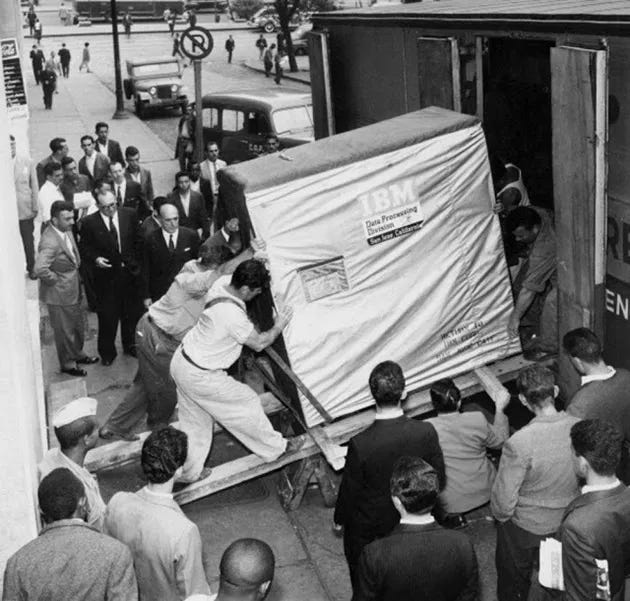
Today, we have it so good. Entertainment is just a push of a button away. Streaming services and endless content are everywhere, instantly accessible. You hardly even need to search for anything, and, perhaps most importantly, the internet is ubiquitous—a luxury that many of us now take for granted.
Imagine how many things we can set in motion today using just our phones. Acquiring goods and services once required a physical trip to a store, but now, to buy a shirt for example, walking to the store is unnecessary because you can order it online. Doing that saves time which you can use for something else—whether it’s learning a new skill, working out, or spending time with the family. This extra time allows you to create more value, instead of spending time walking to a store, which adds no value in itself.
This is what technology does: it continuously removes non-essential steps from our lives, allowing us to focus on what truly matters. With every technological advance, we move forward by leaving behind what’s unnecessary, making room for things that add more value.
When mechanized transportation became the norm, riding a horse gradually turned into a non-essential skill—though some still ride today for enjoyment. Horseback riding isn’t a completely lost skill, just unnecessary in today’s world. Driving a car, however, remains useful for now. Self-driving cars may eventually render this skill obsolete, leaving us to drive only for leisure on weekends. It’s similar to how installing Windows 98 has become a useless skill now when installing a modern OS takes roughly 10 minutes and requires almost no technical expertise.
AI adds another layer aimed at simplifying our interactions with technology. As with previous industrial revolutions, some skills will inevitably be lost or transition into niche areas for enthusiasts. In the next 5-10 years, we’re likely to see a significant shift in skills, with most of our interactions with technology evolving toward AI-based systems. This will be the era of AI assistants, which will serve as the primary interface for all applications. No longer will you need to open separate apps to access services; instead, they’ll be integrated into AI-embedded operating systems, with AI assistants as your sole interface. Calling a ride on Uber or playing music on Spotify, for example, may soon feel outdated. While these apps may still run in the background, you’ll interact with them through your AI assistant, which will manage these tasks on your behalf.
Reflecting back to the years before Windows 98, when I had a simpler computer running only DOS, I used to dream of having a newer, better computer. My friend would jokingly say to me: "Don't worry about having a newer, better computer, you don’t even know what to do with this one!". He meant that there was still more potential in that old machine waiting to be unlocked, but my ignorance and desire for ease prevented me from realizing it. Now, roughly 30 years later, exploring the possibilities with today's technology far exceed the lifespan of humans, making it easy for one to get lost and frustrated. However, knowing what has been before allows us to better appreciate what there is today and realize that the future is not just tomorrow, it's what is happening right now.
Don’t keep it to yourself, I’ll write more ;)
Comments
Nothing yet. Say the first thing.
Sign in to join the conversation.